


ON009081: eeg dataset, 38 subjects#
EEG during Balinese dance movements and balance tasks in expert dancers and non-dancers
Access recordings and metadata through EEGDash.
Citation: I Putu Adiartha Griadhi, Nila Wahyuni, Indira Vidiari Juhanna, Ida Ayu Astiti Suadnyana (20). EEG during Balinese dance movements and balance tasks in expert dancers and non-dancers. 10.82901/nemar.on009081
Modality: eeg Subjects: 38 Recordings: 76 License: CC0 Source: nemar
Metadata: Complete (100%)
38-participant EEG dataset — EEG during Balinese dance movements and balance tasks in expert dancers and non-dancers.
Quickstart#
Install
pip install eegdash
Access the data
from eegdash.dataset import ON009081

dataset = ON009081(cache_dir="./data")
# Get the raw object of the first recording
raw = dataset.datasets[0].raw
print(raw.info)
Filter by subject
dataset = ON009081(cache_dir="./data", subject="01")
Advanced query
dataset = ON009081(
    cache_dir="./data",
    query={"subject": {"$in": ["01", "02"]}},
)
Iterate recordings
for rec in dataset:
    print(rec.subject, rec.raw.info['sfreq'])
If you use this dataset in your research, please cite the original authors.
BibTeX
@dataset{on009081,
  title = {EEG during Balinese dance movements and balance tasks in expert dancers and non-dancers},
  author = {I Putu Adiartha Griadhi and Nila Wahyuni and Indira Vidiari Juhanna and Ida Ayu Astiti Suadnyana},
  doi = {10.82901/nemar.on009081},
  url = {https://doi.org/10.82901/nemar.on009081},
}
About This Dataset#
Raw 16-channel EEG from 38 women (23 expert Balinese dancers, 15 non-dancers; age 15 years and older), recorded
during two paradigms in one session: three Balinese dance movements and a Romberg-type standing task. Standing Stork
(single-leg stance) times are included in participants.tsv.
- task-rest: separate resting recording made before the task session (about 1 min, standing, eyes open; participants closed their eyes only in the final part of the Romberg-type task).
- task-dance: one continuous task recording. It contains three Balinese dance movements (ngeed, agem to the
right, agem to the left; 4 repetitions each, in two blocks separated by a 3-min standing rest), followed by a Romberg-type standing protocol (feet together; 30 s eyes open while fixating a black dot on the wall, 15 s relaxed standing with eyes open, 30 s eyes closed). In several recordings the EEG stopped before the end of the eyes-closed period (see
beyond_recording_end).Recording: KT88-1016 digital EEG system (Contec Medical Systems), 16 dry scalp electrodes (10-20 system without midline sites), each referenced to the ipsilateral earlobe
(A1 for left, A2 for right sites); 100 Hz sampling; effective bandwidth about 0.5-35 Hz (amplifier filtering). The channels Add_lead1 and Add_lead2 carry no signal. The amplifier intermittently produced flat segments (signal resets, about 0 uV); they are left in the data and should be masked before analysis. Occipital alpha power did not increase consistently with eye closure in these recordings; see the data article.
EEG during Balinese dance movements and balance tasks in expert dancers and non-dancers
Events (task-dance): movement phases (descent, hold, ascent) annotated manually from video; Romberg periods from the annotated eye-closure time; and the instruction display timeline. Repetitions in which the movement was not performed are not listed. Two annotated repetitions lack one phase boundary (start of hold or return to upright), so the events files contain 437 descent events for 438 annotated repetitions.
Participants: participants.tsv gives group, age group, sex, categorised dance experience and practice frequency,
and the Standing Stork times (seconds; one trial per leg and eye condition with the hands at the sides, timed with a
Takei balance tester before the EEG session; 240 s = test ceiling). Exact ages, dates, names and video recordings are not shared.
Timing: EEG and video were started manually on a shared count; event times are given on the EEG clock with an EEG-video offset of 0 s. Two estimates of the residual offset disagree by about 1 s (onset of movement artefacts: median about 0 s; cross-correlation of video motion with the EEG muscle-artefact envelope: about +0.9 s, unreliable in part of the sample). Users analysing short phases such as the hold may repeat their analyses with an alternative offset.
Ethics: Research Ethics Committee of the Faculty of Medicine, Universitas Udayana/Sanglah General Hospital (Komisi Etik Penelitian FK Unud/RSUP Sanglah), No. 3259/UN14.2.2.VII.14/LT/2026, 31 August 2026. All participants gave written informed consent, including consent to share de-identified data; for participants younger than 18 years a parent gave written consent and the participant gave assent.
Code for the conversion and analyses: https://doi.org/10.5281/zenodo.24026706 Contact: I Putu Adiartha Griadhi, Department of Physiology, Faculty of Medicine, Universitas Udayana, Denpasar, Bali, Indonesia (adiartha.griadhi@unud.ac.id).
Cohort#
Dataset Statistics#
Sex composition
Channel counts: 18 ch (n=76 recordings)
Sampling frequencies: 100.0 Hz (n=76 recordings)
Total recording duration: 5 h 17 min
Signal · Electrodes & live trace#
Live trace viewer — sub-36 · task-rest
Showing one representative recording out of
38 subjects and 76 recordings in this dataset.
Browse the full set on OpenNeuro;
drop any other _eeg.{set,edf,bdf,vhdr} file onto the
viewer (or pass ?eeg=<url>) to inspect it.
No scalp electrode layout is currently indexed for this dataset. Once the eegdash montage registry ingests it, the interactive viewer will appear here automatically.
NEMAR Processing Statistics#
The plots below are generated by NEMAR’s automated EEG pipeline. The histogram shows pipeline success for data cleaning and ICA decomposition, the percentage of data frames and EEG channels retained after artefact removal, line noise per channel (RMS, dB), and the age/gender distribution of participants.

HED event descriptors word cloud

Manifest#
File Explorer#
Browse the BIDS file structure of this dataset. Records are fetched on demand from the EEGDash catalog the first time you open the explorer.
Full dataset metadata table
Dataset ID |
|
Title |
EEG during Balinese dance movements and balance tasks in expert dancers and non-dancers |
Author (year) |
— |
Canonical |
— |
Importable as |
|
Year |
20 |
Authors |
I Putu Adiartha Griadhi, Nila Wahyuni, Indira Vidiari Juhanna, Ida Ayu Astiti Suadnyana |
License |
CC0 |
Citation / DOI |
|
Source links |
OpenNeuro | NeMAR | Source URL |
Copy-paste BibTeX
@dataset{on009081,
  title = {EEG during Balinese dance movements and balance tasks in expert dancers and non-dancers},
  author = {I Putu Adiartha Griadhi and Nila Wahyuni and Indira Vidiari Juhanna and Ida Ayu Astiti Suadnyana},
  doi = {10.82901/nemar.on009081},
  url = {https://doi.org/10.82901/nemar.on009081},
}
API Reference#
eegdash.datasetEEGDashDataset- class eegdash.dataset.ON009081(cache_dir: str, query: dict | None = None, s3_bucket: str | None = None, **kwargs)[source]#
EEG during Balinese dance movements and balance tasks in expert dancers and non-dancers
- Study:
on009081(NeMAR)- Author (year):
—
- Canonical:
—
Also importable as:
ON009081.Modality:
eeg; Subject type:Unknown. Subjects: 38; recordings: 76; tasks: 2.- Parameters:
cache_dir (str | Path) – Directory where data are cached locally.
query (dict | None) – Additional MongoDB-style filters to AND with the dataset selection. Must not contain the key
dataset.s3_bucket (str | None) – Base S3 bucket used to locate the data.
**kwargs (dict) – Additional keyword arguments forwarded to
EEGDashDataset.
- data_dir#
Local dataset cache directory (
cache_dir / dataset_id).- Type:
Path
Notes
Each item is a recording; recording-level metadata are available via
dataset.description.querysupports MongoDB-style filters on fields inALLOWED_QUERY_FIELDSand is combined with the dataset filter. Dataset-specific caveats are not provided in the summary metadata.References
OpenNeuro dataset: https://openneuro.org/datasets/on009081 NeMAR dataset: https://nemar.org/dataexplorer/detail?dataset_id=on009081 DOI: https://doi.org/10.82901/nemar.on009081
Examples
>>> from eegdash.dataset import ON009081
>>> dataset = ON009081(cache_dir="./data")
>>> recording = dataset[0]
>>> raw = recording.load()
- __init__(cache_dir: str, query: dict | None = None, s3_bucket: str | None = None, **kwargs)[source]#
- save(path: str, overwrite: bool = False, offset: int = 0)[source]#
Save datasets to files by creating one subdirectory for each dataset:
path/
    0/
        0-raw.fif | 0-epo.fif
        description.json
        raw_preproc_kwargs.json (if raws were preprocessed)
        window_kwargs.json (if this is a windowed dataset)
        window_preproc_kwargs.json  (if windows were preprocessed)
        target_name.json (if target_name is not None and dataset is raw)
    1/
        1-raw.fif | 1-epo.fif
        description.json
        raw_preproc_kwargs.json (if raws were preprocessed)
        window_kwargs.json (if this is a windowed dataset)
        window_preproc_kwargs.json  (if windows were preprocessed)
        target_name.json (if target_name is not None and dataset is raw)
- Parameters:
path (str) –
- Directory in which subdirectories are created to store
-raw.fif | -epo.fif and .json files to.
overwrite (bool) – Whether to delete old subdirectories that will be saved to in this call. If a dataset still reads its data lazily from one of them, a
ValueErroris raised before anything is deleted: load the data into memory first (preload=True) or save to another directory.offset (int) – If provided, the integer is added to the id of the dataset in the concat. This is useful in the setting of very large datasets, where one dataset has to be processed and saved at a time to account for its original position.
BaseDataset from braindecode — windowed via create_windows_from_events.braindecodeDataLoader; supports parallel workers and on-the-fly augmentations.pytorch Find datasets with the EEGDash APIQuery the catalogue, filter by task or modality, list candidates.
 Load one EEG recordingResolve a single record to an MNE Raw with channels and events.
 EEG recording to PyTorch DataLoaderWrap braindecode windows in a DataLoader for model training.
 Preprocess EEG and create windowsFilter, resample, epoch — and persist the windowed dataset.
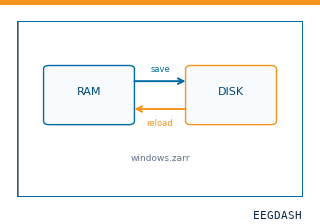 Save and reload prepared dataCache a windowed dataset to disk and reattach it without recompute.
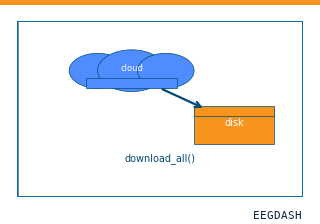 Download a dataset locallyPrefetch BIDS files to a local cache and validate the layout.
Swap any load_dataset(...) call for on009081 to reproduce the tutorial on this dataset.
Citation
I Putu Adiartha Griadhi, Nila Wahyuni, Indira Vidiari Juhanna, Ida Ayu Astiti Suadnyana (20). EEG during Balinese dance movements and balance tasks in expert dancers and non-dancers. 10.82901/nemar.on009081
Provenance
¹Contributed to nemar in BIDS format.
²Curated & ingested by the EEGDash catalog; see CITATION.cff for canonical reference.
³Persistent identifier: 10.82901/nemar.on009081.
See Also#
eegdash.dataset.EEGDashDataseteegdash.dataset