


NM000437: ieeg dataset, 5 subjects#
NeuroListen (Listening to the Brain): sEEG auditory-reconstruction features from 5 participants, authors’ per-trial HGA/LFS/BBS arrays
Access recordings and metadata through EEGDash.
Citation: Xueyi Zhang, Ruicong Wang, Jialu Sun, Siqi Cai, Haizhou Li (20). NeuroListen (Listening to the Brain): sEEG auditory-reconstruction features from 5 participants, authors’ per-trial HGA/LFS/BBS arrays. 10.82901/nemar.nm000437
Modality: ieeg Subjects: 5 Recordings: 15 License: CC-BY-4.0 Source: nemar
Metadata: Complete (100%)
5-participant iEEG dataset — NeuroListen (Listening to the Brain): sEEG auditory-reconstruction features from 5 participants, authors' per-trial HGA/LFS/BBS arrays.
Quickstart#
Install
pip install eegdash
Access the data
from eegdash.dataset import NM000437

dataset = NM000437(cache_dir="./data")
# Get the raw object of the first recording
raw = dataset.datasets[0].raw
print(raw.info)
Filter by subject
dataset = NM000437(cache_dir="./data", subject="01")
Advanced query
dataset = NM000437(
    cache_dir="./data",
    query={"subject": {"$in": ["01", "02"]}},
)
Iterate recordings
for rec in dataset:
    print(rec.subject, rec.raw.info['sfreq'])
If you use this dataset in your research, please cite the original authors.
BibTeX
@dataset{nm000437,
  title = {NeuroListen (Listening to the Brain): sEEG auditory-reconstruction features from 5 participants, authors' per-trial HGA/LFS/BBS arrays},
  author = {Xueyi Zhang and Ruicong Wang and Jialu Sun and Siqi Cai and Haizhou Li},
  doi = {10.82901/nemar.nm000437},
  url = {https://doi.org/10.82901/nemar.nm000437},
}
About This Dataset#
Stereo-EEG from five patients with epilepsy (native Mandarin Chinese speakers with basic English; 25-40 years,
mean 31) listening to spoken Mandarin Chinese words (44 categories), Mandarin digits (0-9) and English words (20 categories), 2 s per word. The paper reports more than 10 hours of neural-speech paired recordings. Re-packaged from the authors’ public release (Zenodo record 17426506, CC-BY-4.0).
Reference article: Zhang X, Wang R, Sun J, Cai S, Li H. *Listening to the Brain: Multi-Band sEEG Auditory
Reconstruction via Dynamic Spatio-Temporal Hypergraphs.* NeurIPS 2025 Datasets and Benchmarks Track. https://doi.org/10.52202/085713-4302. Code: NeuroListen/NeuroListen Recording (paper): SEEG shafts (Sinovation SDE-10/12/16, 0.8 mm, 3.5 mm spacing, 8-13 shafts and 118-186 contacts per participant), Nihon Kohden EEG-1200 at 1000 Hz. A marker sent to the DC channel aligned stimuli and sEEG.
NeuroListen (“Listening to the Brain”): sEEG auditory-reconstruction features (derivative)
This is a derivative dataset
The release provides the authors’ per-trial feature arrays, not the continuous recordings. The authors removed contacts with epileptiform activity (61, 27, 46, 22 and 37 in participants 1-5) and applied bipolar re-referencing.
They then computed three feature sets at 200 Hz:
View full README
NeuroListen (“Listening to the Brain”): sEEG auditory-reconstruction features (derivative)
This is a derivative dataset
The release provides the authors’ per-trial feature arrays, not the continuous recordings. The authors removed contacts with epileptiform activity (61, 27, 46, 22 and 37 in participants 1-5) and applied bipolar re-referencing.
They then computed three feature sets at 200 Hz:
- desc-hga: high-gamma activity (70-150 Hz band-pass, analytic amplitude).
- desc-lfs: low-frequency signal (low-pass 100 Hz).
- desc-bbs: broadband, which combines LFS and HGA. Its channel count equals HGA plus LFS, and the provenance JSON
records whether its values equal the stacked HGA and LFS arrays.
All three are normalised within each 2 s window. Each trial is one 2 s array (400 samples × channels).
Layout
sub-<NN>/ieeg/sub-<NN>_task-listen_desc-<band>_ieeg.vhdr: one epoched BrainVision file per participant and feature set, with the trials back to back in release order (RecordingType: epoched,EpochLength: 2). Values are the stored float64 values rounded to float32. The round-trip check compares every epoch with its release array...._events.tsv: one row per trial (epoch onset, word, language CN / EN / DIGIT, release index and file name).Channel names are
hga001,lfs001, … (column order of the release arrays). The release does not give the bipolar contact pairs, soelectrodes.tsvlists names only, withn/acoordinates. Units aren/a(normalised features).stimuli/audio/: the stimulus recordings (<word>_<CN|EN>.wav,<digit>_DIGIT.wav, 24 kHz mono) per participant, verbatim.stimuli/mel/: the authors’ 80-bin mel-spectrograms of the stimuli (100 frames per word), verbatim.Age and sex are not given per participant (
n/a). Trial counts per language are inparticipants.tsv.
Not included: the five “Original EEG” files
The release also contains Original_EEG_Files.zip: five Nihon Kohden .EEG excerpts (SubN_Sample_Original.EEG,
0.2-0.44 GB each). They are not packaged here, for three reasons:
1. They come without the Nihon Kohden channel table (.21E), patient (.PNT) and log (.LOG) files, so channels
cannot be named or typed.
MNE’s Nihon Kohden reader does not parse their EEG-1200A extended layout (it returns one 1-second channel).
Their headers carry full recording date-times (year, month, day and time) in several places, including binary fields that cannot be masked reliably without the format specification.
They remain available from the Zenodo record.
Additional details from the paper
Compiled by the campaign enrichment lane (batch3/enrich/c-listening, 2026-10-08) from the reference article and the deposit; section numbers refer to the article. No electrode coordinates or anatomical labels are available in the deposit or the article.
Paper: Zhang X, Wang R, Sun J, Cai S, Li H. “Listening to the Brain: Multi-Band sEEG Auditory Reconstruction via Dynamic Spatio-Temporal Hypergraphs”, NeurIPS 2025 Datasets & Benchmarks Track (https://openreview.net/forum?id=koxXKW4FbR; proceedings PDF https://proceedings.neurips.cc/paper_files/paper/2025/file/bbc6396ae4b4dbf78ce328aa8beafd27-Paper-Datasets_and_Benchmarks_Track.pdf). Section numbers below refer to it.
Task/paradigm. Passive listening: per round 44 Mandarin Chinese words, 10 Mandarin digits (0-9) and 20 English words, 2 s per word, presented from a speaker; 5-s ready interval with the prompt “Please listen to the speech attentively” then a “ding”; 5-10 min breaks between rounds; > 10 h of neural-speech pairs in total (Sec 3.4). Stimulus markers were sent to a DC channel of the amplifier while the speech was played (Sec 3.5).
Participants. Five patients with epilepsy, native Mandarin speakers with basic English, aged 25-40 (mean 31) (Sec 3.1). Per-subject age/sex: n/a.
Recording system. Nihon Kohden EEG 1200, 1000 Hz (Sec 3.3). Raw deposit files Original_EEG_Files/SubN_Sample_Original.EEG have the header “EEG-1200A V01.00” (Nihon Kohden), recording dates June 2023 in the header; the .21E/.PNT/.LOG companion files are not deposited, so electrode names are not recoverable from the deposit (Voyager Job probe).
Reference scheme. Bipolar re-referencing of the remaining contacts after excluding contacts with epileptiform activity (61, 27, 46, 22, 37 per subject) (Sec 4.2). Derivatives: high-gamma (70-150 Hz analytic amplitude), low-frequency (< 100 Hz) and broadband, downsampled to 200 Hz, normalised per 2-s window (Sec 4.2); deposit zips subN_bipolar_listen_seeg_2000_{hga,lfs,bbs}.zip hold one 400 x C .npy per trial (C = 101, 145, 148, 109, 73 bipolar channels).
Electrode types. Platinum-iridium sEEG shafts, Sinovation (Beijing) Medical Technology SDE-10/12/16, diameter 0.8 mm, inter-contact distance 3.5 mm, 10-16 contacts per shaft; 8-13 shafts and 118-186 contacts per subject (Sec 3.2-3.3).
Localisation. Contact positions were determined with LeGUI (SPM12-based) after co-registering pre-implantation MRI with post-implantation CT (Sec 3.2, Fig. 3 caption). Figure 3 shows shaft trajectories for subjects 1-3 (shaft letter: contact count) without region names. No coordinates/labels deposited.
License
CC-BY-4.0
NEMAR Metadata#
[](https://doi.org/10.82901/nemar.nm000437) # NeuroListen (“Listening to the Brain”): sEEG auditory-reconstruction features (derivative) Stereo-EEG from five patients with epilepsy (native Mandarin Chinese speakers with basic English; 25-40 years, mean 31) listening to spoken Mandarin Chinese words (44 categories), Mandarin digits (0-9) and English words (20 categories), 2 s per word. The paper reports more than 10 hours of neural-speech paired recordings. Re-packaged from the authors’ public release (Zenodo record [17426506](https://doi.org/10.5281/zenodo.17426506), CC-BY-4.0). Reference article: Zhang X, Wang R, Sun J, Cai S, Li H. Listening to the Brain: Multi-Band sEEG Auditory Reconstruction via Dynamic Spatio-Temporal Hypergraphs. NeurIPS 2025 Datasets and Benchmarks Track. https://doi.org/10.52202/085713-4302. Code: NeuroListen/NeuroListen Recording (paper): SEEG shafts (Sinovation SDE-10/12/16, 0.8 mm, 3.5 mm spacing, 8-13 shafts and 118-186 contacts per participant), Nihon Kohden EEG-1200 at 1000 Hz. A marker sent to the DC channel aligned stimuli and sEEG. ## This is a derivative dataset The release provides the authors’ per-trial feature arrays, not the continuous recordings. The authors removed contacts with epileptiform activity (61, 27, 46, 22 and 37 in participants 1-5) and applied bipolar re-referencing. They then computed three feature sets at 200 Hz: - desc-hga: high-gamma activity (70-150 Hz band-pass, analytic amplitude). - desc-lfs: low-frequency signal (low-pass 100 Hz). - desc-bbs: broadband, which combines LFS and HGA. Its channel count equals HGA plus LFS, and the provenance JSON
records whether its values equal the stacked HGA and LFS arrays.
All three are normalised within each 2 s window. Each trial is one 2 s array (400 samples × channels). ## Layout - sub-<NN>/ieeg/sub-<NN>_task-listen_desc-<band>_ieeg.vhdr: one epoched BrainVision file per participant and feature
set, with the trials back to back in release order (RecordingType: epoched, EpochLength: 2). Values are the stored float64 values rounded to float32. The round-trip check compares every epoch with its release array.
…_events.tsv: one row per trial (epoch onset, word, language CN / EN / DIGIT, release index and file name).
Channel names are hga001, lfs001, … (column order of the release arrays). The release does not give the bipolar contact pairs, so electrodes.tsv lists names only, with n/a coordinates. Units are n/a (normalised features).
stimuli/audio/: the stimulus recordings (<word>_<CN|EN>.wav, <digit>_DIGIT.wav, 24 kHz mono) per participant, verbatim. stimuli/mel/: the authors’ 80-bin mel-spectrograms of the stimuli (100 frames per word), verbatim.
Age and sex are not given per participant (n/a). Trial counts per language are in participants.tsv.
## Not included: the five “Original EEG” files The release also contains Original_EEG_Files.zip: five Nihon Kohden .EEG excerpts (SubN_Sample_Original.EEG, 0.2-0.44 GB each). They are not packaged here, for three reasons: 1. They come without the Nihon Kohden channel table (.21E), patient (.PNT) and log (.LOG) files, so channels
cannot be named or typed.
MNE’s Nihon Kohden reader does not parse their EEG-1200A extended layout (it returns one 1-second channel).
Their headers carry full recording date-times (year, month, day and time) in several places, including binary fields that cannot be masked reliably without the format specification.
They remain available from the Zenodo record. ## Additional details from the paper Compiled by the campaign enrichment lane (batch3/enrich/c-listening, 2026-10-08) from the reference article and the deposit; section numbers refer to the article. No electrode coordinates or anatomical labels are available in the deposit or the article. Paper: Zhang X, Wang R, Sun J, Cai S, Li H. “Listening to the Brain: Multi-Band sEEG Auditory Reconstruction via Dynamic Spatio-Temporal Hypergraphs”, NeurIPS 2025 Datasets & Benchmarks Track (https://openreview.net/forum?id=koxXKW4FbR; proceedings PDF https://proceedings.neurips.cc/paper_files/paper/2025/file/bbc6396ae4b4dbf78ce328aa8beafd27-Paper-Datasets_and_Benchmarks_Track.pdf). Section numbers below refer to it. Task/paradigm. Passive listening: per round 44 Mandarin Chinese words, 10 Mandarin digits (0-9) and 20 English words, 2 s per word, presented from a speaker; 5-s ready interval with the prompt “Please listen to the speech attentively” then a “ding”; 5-10 min breaks between rounds; > 10 h of neural-speech pairs in total (Sec 3.4). Stimulus markers were sent to a DC channel of the amplifier while the speech was played (Sec 3.5). Participants. Five patients with epilepsy, native Mandarin speakers with basic English, aged 25-40 (mean 31) (Sec 3.1). Per-subject age/sex: n/a. Recording system. Nihon Kohden EEG 1200, 1000 Hz (Sec 3.3). Raw deposit files Original_EEG_Files/SubN_Sample_Original.EEG have the header “EEG-1200A V01.00” (Nihon Kohden), recording dates June 2023 in the header; the .21E/.PNT/.LOG companion files are not deposited, so electrode names are not recoverable from the deposit (Voyager Job probe). Reference scheme. Bipolar re-referencing of the remaining contacts after excluding contacts with epileptiform activity (61, 27, 46, 22, 37 per subject) (Sec 4.2). Derivatives: high-gamma (70-150 Hz analytic amplitude), low-frequency (< 100 Hz) and broadband, downsampled to 200 Hz, normalised per 2-s window (Sec 4.2); deposit zips subN_bipolar_listen_seeg_2000_{hga,lfs,bbs}.zip hold one 400 x C .npy per trial (C = 101, 145, 148, 109, 73 bipolar channels). Electrode types. Platinum-iridium sEEG shafts, Sinovation (Beijing) Medical Technology SDE-10/12/16, diameter 0.8 mm, inter-contact distance 3.5 mm, 10-16 contacts per shaft; 8-13 shafts and 118-186 contacts per subject (Sec 3.2-3.3). Localisation. Contact positions were determined with LeGUI (SPM12-based) after co-registering pre-implantation MRI with post-implantation CT (Sec 3.2, Fig. 3 caption). Figure 3 shows shaft trajectories for subjects 1-3 (shaft letter: contact count) without region names. No coordinates/labels deposited. ## License CC-BY-4.0
License: CC-BY-4.0
Authors:
Xueyi Zhang
Ruicong Wang
Jialu Sun
Siqi Cai
Haizhou Li
Versions:
Version |
DOI |
Released |
|---|---|---|
|
Cohort#
Dataset Statistics#
Channel counts (ch)
Sampling frequencies: 200.0 Hz (n=15 recordings)
Total recording duration: 17 h 3 min
Signal · Electrodes & live trace#
Live trace viewer — sub-01 · task-listen
Showing one representative recording out of
5 subjects and 15 recordings in this dataset.
Browse the full set on OpenNeuro;
drop any other _ieeg.{set,edf,bdf,vhdr} file onto the
viewer (or pass ?ieeg=<url>) to inspect it.
No scalp electrode layout is currently indexed for this dataset. Once the eegdash montage registry ingests it, the interactive viewer will appear here automatically.
NEMAR Processing Statistics#
The plots below are generated by NEMAR’s automated EEG pipeline. The histogram shows pipeline success for data cleaning and ICA decomposition, the percentage of data frames and EEG channels retained after artefact removal, line noise per channel (RMS, dB), and the age/gender distribution of participants.

HED event descriptors word cloud

Manifest#
File Explorer#
Browse the BIDS file structure of this dataset. Records are fetched on demand from the EEGDash catalog the first time you open the explorer.
Full dataset metadata table
Dataset ID |
|
Title |
NeuroListen (Listening to the Brain): sEEG auditory-reconstruction features from 5 participants, authors’ per-trial HGA/LFS/BBS arrays |
Author (year) |
— |
Canonical |
— |
Importable as |
|
Year |
20 |
Authors |
Xueyi Zhang, Ruicong Wang, Jialu Sun, Siqi Cai, Haizhou Li |
License |
CC-BY-4.0 |
Citation / DOI |
|
Source links |
OpenNeuro | NeMAR | Source URL |
Copy-paste BibTeX
@dataset{nm000437,
  title = {NeuroListen (Listening to the Brain): sEEG auditory-reconstruction features from 5 participants, authors' per-trial HGA/LFS/BBS arrays},
  author = {Xueyi Zhang and Ruicong Wang and Jialu Sun and Siqi Cai and Haizhou Li},
  doi = {10.82901/nemar.nm000437},
  url = {https://doi.org/10.82901/nemar.nm000437},
}
API Reference#
eegdash.datasetEEGDashDataset- class eegdash.dataset.NM000437(cache_dir: str, query: dict | None = None, s3_bucket: str | None = None, **kwargs)[source]#
NeuroListen (Listening to the Brain): sEEG auditory-reconstruction features from 5 participants, authors’ per-trial HGA/LFS/BBS arrays
- Study:
nm000437(NeMAR)- Author (year):
—
- Canonical:
—
Also importable as:
NM000437.Modality:
ieeg; Subject type:Unknown. Subjects: 5; recordings: 15; tasks: 1.- Parameters:
cache_dir (str | Path) – Directory where data are cached locally.
query (dict | None) – Additional MongoDB-style filters to AND with the dataset selection. Must not contain the key
dataset.s3_bucket (str | None) – Base S3 bucket used to locate the data.
**kwargs (dict) – Additional keyword arguments forwarded to
EEGDashDataset.
- data_dir#
Local dataset cache directory (
cache_dir / dataset_id).- Type:
Path
Notes
Each item is a recording; recording-level metadata are available via
dataset.description.querysupports MongoDB-style filters on fields inALLOWED_QUERY_FIELDSand is combined with the dataset filter. Dataset-specific caveats are not provided in the summary metadata.References
OpenNeuro dataset: https://openneuro.org/datasets/nm000437 NeMAR dataset: https://nemar.org/dataexplorer/detail?dataset_id=nm000437 DOI: https://doi.org/10.82901/nemar.nm000437
Examples
>>> from eegdash.dataset import NM000437
>>> dataset = NM000437(cache_dir="./data")
>>> recording = dataset[0]
>>> raw = recording.load()
- __init__(cache_dir: str, query: dict | None = None, s3_bucket: str | None = None, **kwargs)[source]#
- save(path: str, overwrite: bool = False, offset: int = 0)[source]#
Save datasets to files by creating one subdirectory for each dataset:
path/
    0/
        0-raw.fif | 0-epo.fif
        description.json
        raw_preproc_kwargs.json (if raws were preprocessed)
        window_kwargs.json (if this is a windowed dataset)
        window_preproc_kwargs.json  (if windows were preprocessed)
        target_name.json (if target_name is not None and dataset is raw)
    1/
        1-raw.fif | 1-epo.fif
        description.json
        raw_preproc_kwargs.json (if raws were preprocessed)
        window_kwargs.json (if this is a windowed dataset)
        window_preproc_kwargs.json  (if windows were preprocessed)
        target_name.json (if target_name is not None and dataset is raw)
- Parameters:
path (str) –
- Directory in which subdirectories are created to store
-raw.fif | -epo.fif and .json files to.
overwrite (bool) – Whether to delete old subdirectories that will be saved to in this call.
offset (int) – If provided, the integer is added to the id of the dataset in the concat. This is useful in the setting of very large datasets, where one dataset has to be processed and saved at a time to account for its original position.
BaseDataset from braindecode — windowed via create_windows_from_events.braindecodeDataLoader; supports parallel workers and on-the-fly augmentations.pytorch Find datasets with the EEGDash APIQuery the catalogue, filter by task or modality, list candidates.
 Load one EEG recordingResolve a single record to an MNE Raw with channels and events.
 EEG recording to PyTorch DataLoaderWrap braindecode windows in a DataLoader for model training.
 Preprocess EEG and create windowsFilter, resample, epoch — and persist the windowed dataset.
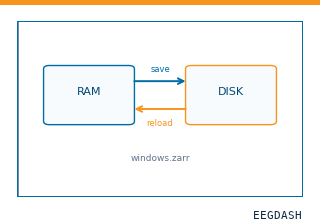 Save and reload prepared dataCache a windowed dataset to disk and reattach it without recompute.
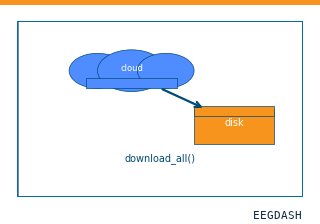 Download a dataset locallyPrefetch BIDS files to a local cache and validate the layout.
Swap any load_dataset(...) call for nm000437 to reproduce the tutorial on this dataset.
Citation
Xueyi Zhang, Ruicong Wang, Jialu Sun, Siqi Cai, Haizhou Li (20). NeuroListen (Listening to the Brain): sEEG auditory-reconstruction features from 5 participants, authors' per-trial HGA/LFS/BBS arrays. 10.82901/nemar.nm000437
Provenance
¹Contributed to nemar in BIDS format.
²Curated & ingested by the EEGDash catalog; see CITATION.cff for canonical reference.
³Persistent identifier: 10.82901/nemar.nm000437.
See Also#
eegdash.dataset.EEGDashDataseteegdash.dataset