


ON003800: eeg dataset, 13 subjects#
Auditory Gamma Entrainment
Access recordings and metadata through EEGDash.
Citation: Mojtaba Lahijanian, Mohammad Javad Sedghizadeh, Hamid Aghajan, Zahra Vahabi (20). Auditory Gamma Entrainment. 10.82901/nemar.on003800
Modality: eeg Subjects: 13 Recordings: 24 License: CC0 Source: nemar
Metadata: Complete (100%)
13-participant EEG dataset — Auditory Gamma Entrainment.
Quickstart#
Install
pip install eegdash
Access the data
from eegdash.dataset import ON003800

dataset = ON003800(cache_dir="./data")
# Get the raw object of the first recording
raw = dataset.datasets[0].raw
print(raw.info)
Filter by subject
dataset = ON003800(cache_dir="./data", subject="01")
Advanced query
dataset = ON003800(
    cache_dir="./data",
    query={"subject": {"$in": ["01", "02"]}},
)
Iterate recordings
for rec in dataset:
    print(rec.subject, rec.raw.info['sfreq'])
If you use this dataset in your research, please cite the original authors.
BibTeX
@dataset{on003800,
  title = {Auditory Gamma Entrainment},
  author = {Mojtaba Lahijanian and Mohammad Javad Sedghizadeh and Hamid Aghajan and Zahra Vahabi},
  doi = {10.82901/nemar.on003800},
  url = {https://doi.org/10.82901/nemar.on003800},
}
About This Dataset#
Introduction
This experiment was designed to entrain the brain oscillations through synthetic auditory stimulation conducted on a group of elderly suffering from dementia. Recently, gamma entrainment has been proposed and shown effective in improving several symptoms of Alzheimer’s Diseases (AD). The aim of this study is to investigate the effect of entrainment on brain oscillations using EEG signal recording during the auditory brain stimulation.
This study was approved by the Review Board of Tehran University of Medical Sciences (Approval ID: IR.TUMS.MEDICINE.REC.1398.524) and all participants provided informed consent before participating and were free to withdraw at any time.
Rest data
Before the main task, a one-minute data was recorded with open eyes for measuring raw resting-state potentials. The rest data for participants number 6 and 13 are missing.
Auditory stimulation
View full README
This study was approved by the Review Board of Tehran University of Medical Sciences (Approval ID: IR.TUMS.MEDICINE.REC.1398.524) and all participants provided informed consent before participating and were free to withdraw at any time.
Rest data
Before the main task, a one-minute data was recorded with open eyes for measuring raw resting-state potentials. The rest data for participants number 6 and 13 are missing.
Auditory stimulation
Two speakers were placed in front of the participant 50cm apart from each other and directly pointed at the participant’s ears at a distance of 50cm. The sound intensity was around -40dB within a fixed range for all participants. Before starting the task, the participant was asked if the volume was loud enough and the sound volume was set at a comfortable level for each participant. The auditory stimulus was a 5kHz carrier tone amplitude modulated with a 40Hz rectangular wave (40Hz On and Off cycles). Since a 40Hz audio signal cannot be easily heard, the 5KHz carrier frequency was used to render the 40Hz pulse train audible. In order to minimize the effect of the carrier sound, the duty cycle of the modulating 40Hz waveform was set to 4% (1ms of the 25ms cycle was On). The auditory stimulant was generated in MATLAB and played as a .wav file. This file consisted of six trials of 40sec stimulus interleaved by five trials of 20sec rest (silence). The entire session resulted in 340sec (6*40+5*20) of recorded EEG signal.
EEG recording and preprocessing
All EEG data were recorded using 19 monopolar channels in the standard 10/20 system referenced to the earlobes, sampled at 250Hz, and the impedance of the electrodes was kept under 20kOhm.
Data from all the participants were preprocessed identically following Makoto’s preprocessing pipeline: Highpass filtering above 1Hz; removal of the line noise; rejecting potential bad channels; interpolating rejected channels; re-referencing data to the average; Artifact Subspace Reconstruction (ASR); re-referencing data to the average again; estimating the brain source activity using independent component analysis (ICA); dipole fitting; rejecting bad dipoles (sources) for further cleaning the data. These preprocessing steps were performed using EEGLab MATLAB toolbox.
Instructions
During the experiment, participants were seated comfortably with open eyes in a quiet room. They were instructed to relax their body to avoid muscle artifacts and move their head as little as possible.
Curation history
2026-05-11 — BIDS compliance curation pass on the NEMAR import. Commits 9546de8..``a431c25``. Initial state: 1 error + 557 warnings; final state: 0 errors + 417 warnings (the remaining warnings are recommended-but-missing metadata fields that require information not present in the dataset — equipment details, fiducial coordinates, etc.). Specific changes:
- Zero-padded participant_id in participants.tsv from sub-NN to sub-NNN to match the subject directory names. Fixes the PARTICIPANT_ID_MISMATCH error.
- Corrected Units in all *_events.json from "second" to the BIDS-required "s" for the onset, duration, and response_time columns.
- Dropped the task-AuditoryGammaEntrainment entity from *_electrodes.tsv and *_coordsystem.json filenames via git mv. Electrode positions and coordinate systems do not vary by task within a session, per BIDS-EEG; the files now inherit to the Rest scans as well.
- Set type=EEG for all 19 rows in every subject’s channels.tsv. The type column was previously n/a, which caused the validator to count 0 EEG channels and mismatch with the JSON’s correct EEGChannelCount: 19. The units column is left as n/a pending clarification of the recording’s amplitude units.
- In every *_eeg.json sidecar: renamed MiscChannelCount to the BIDS-canonical MISCChannelCount, and added TriggerChannelCount: 0 (verified by inspecting channels.tsv, the .set file’s EEG.chanlocs, and the README’s description of MATLAB-script-generated events stored in events.tsv rather than a hardware trigger).
- Updated dataset_description.json: bumped BIDSVersion from 1.0.0 (which predates BIDS-EEG) to 1.9.0; added DatasetType: "raw" and a GeneratedBy entry pointing back to this section and to the git log; cleaned ReferencesAndLinks from a single empty-string entry to an empty array.
Cohort#
Dataset Statistics#
Age distribution (n=13, range 57–89 yr, mean 72.6 yr · sex per subject not reported)
Sex composition
Channel counts: 19 ch (n=24 recordings)
Sampling frequencies: 250.0 Hz (n=24 recordings)
Total recording duration: 1 h 24 min
Signal · Electrodes & live trace#
Live trace viewer — sub-010 · task-Rest
Showing one representative recording out of
13 subjects and 24 recordings in this dataset.
Browse the full set on OpenNeuro;
drop any other _eeg.{set,edf,bdf,vhdr} file onto the
viewer (or pass ?eeg=<url>) to inspect it.
Electrode layout — EEG · 19 sensors — 19 channels
NEMAR Processing Statistics#
The plots below are generated by NEMAR’s automated EEG pipeline. The histogram shows pipeline success for data cleaning and ICA decomposition, the percentage of data frames and EEG channels retained after artefact removal, line noise per channel (RMS, dB), and the age/gender distribution of participants.

HED event descriptors word cloud

Manifest#
File Explorer#
Browse the BIDS file structure of this dataset. Records are fetched on demand from the EEGDash catalog the first time you open the explorer.
Full dataset metadata table
Dataset ID |
|
Title |
Auditory Gamma Entrainment |
Author (year) |
— |
Canonical |
— |
Importable as |
|
Year |
20 |
Authors |
Mojtaba Lahijanian, Mohammad Javad Sedghizadeh, Hamid Aghajan, Zahra Vahabi |
License |
CC0 |
Citation / DOI |
|
Source links |
Copy-paste BibTeX
@dataset{on003800,
  title = {Auditory Gamma Entrainment},
  author = {Mojtaba Lahijanian and Mohammad Javad Sedghizadeh and Hamid Aghajan and Zahra Vahabi},
  doi = {10.82901/nemar.on003800},
  url = {https://doi.org/10.82901/nemar.on003800},
}
API Reference#
eegdash.datasetEEGDashDataset- class eegdash.dataset.ON003800(cache_dir: str, query: dict | None = None, s3_bucket: str | None = None, **kwargs)[source]#
Auditory Gamma Entrainment
- Study:
on003800(NeMAR)- Author (year):
—
- Canonical:
—
Also importable as:
ON003800.Modality:
eeg; Experiment type:Intervention, Clinical; Subject type:Dementia. Subjects: 13; recordings: 0; tasks: 2.- Parameters:
cache_dir (str | Path) – Directory where data are cached locally.
query (dict | None) – Additional MongoDB-style filters to AND with the dataset selection. Must not contain the key
dataset.s3_bucket (str | None) – Base S3 bucket used to locate the data.
**kwargs (dict) – Additional keyword arguments forwarded to
EEGDashDataset.
- data_dir#
Local dataset cache directory (
cache_dir / dataset_id).- Type:
Path
Notes
Each item is a recording; recording-level metadata are available via
dataset.description.querysupports MongoDB-style filters on fields inALLOWED_QUERY_FIELDSand is combined with the dataset filter. Dataset-specific caveats are not provided in the summary metadata.References
OpenNeuro dataset: https://openneuro.org/datasets/on003800 NeMAR dataset: https://nemar.org/dataexplorer/detail?dataset_id=on003800 DOI: https://doi.org/10.82901/nemar.on003800
Examples
>>> from eegdash.dataset import ON003800
>>> dataset = ON003800(cache_dir="./data")
>>> recording = dataset[0]
>>> raw = recording.load()
- __init__(cache_dir: str, query: dict | None = None, s3_bucket: str | None = None, **kwargs)[source]#
- save(path: str, overwrite: bool = False, offset: int = 0)[source]#
Save datasets to files by creating one subdirectory for each dataset:
path/
    0/
        0-raw.fif | 0-epo.fif
        description.json
        raw_preproc_kwargs.json (if raws were preprocessed)
        window_kwargs.json (if this is a windowed dataset)
        window_preproc_kwargs.json  (if windows were preprocessed)
        target_name.json (if target_name is not None and dataset is raw)
    1/
        1-raw.fif | 1-epo.fif
        description.json
        raw_preproc_kwargs.json (if raws were preprocessed)
        window_kwargs.json (if this is a windowed dataset)
        window_preproc_kwargs.json  (if windows were preprocessed)
        target_name.json (if target_name is not None and dataset is raw)
- Parameters:
path (str) –
- Directory in which subdirectories are created to store
-raw.fif | -epo.fif and .json files to.
overwrite (bool) – Whether to delete old subdirectories that will be saved to in this call.
offset (int) – If provided, the integer is added to the id of the dataset in the concat. This is useful in the setting of very large datasets, where one dataset has to be processed and saved at a time to account for its original position.
BaseDataset from braindecode — windowed via create_windows_from_events.braindecodeDataLoader; supports parallel workers and on-the-fly augmentations.pytorch Find datasets with the EEGDash APIQuery the catalogue, filter by task or modality, list candidates.
 Load one EEG recordingResolve a single record to an MNE Raw with channels and events.
 EEG recording to PyTorch DataLoaderWrap braindecode windows in a DataLoader for model training.
 Preprocess EEG and create windowsFilter, resample, epoch — and persist the windowed dataset.
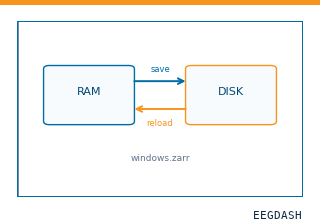 Save and reload prepared dataCache a windowed dataset to disk and reattach it without recompute.
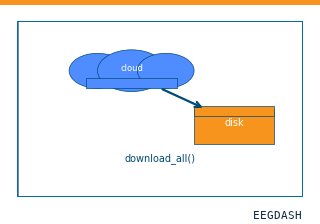 Download a dataset locallyPrefetch BIDS files to a local cache and validate the layout.
Swap any load_dataset(...) call for on003800 to reproduce the tutorial on this dataset.
Citation
Mojtaba Lahijanian, Mohammad Javad Sedghizadeh, Hamid Aghajan, Zahra Vahabi (20). Auditory Gamma Entrainment. 10.82901/nemar.on003800
Provenance
¹Contributed to nemar in BIDS format.
²Curated & ingested by the EEGDash catalog; see CITATION.cff for canonical reference.
³Persistent identifier: 10.82901/nemar.on003800.
See Also#
eegdash.dataset.EEGDashDataseteegdash.dataset