


NM000376: ieeg dataset, 9 subjects#
Intracranial EEG from 9 adults during a memory-guided actions experiment (preprocessed epochs, Moraresku et al.)
Access recordings and metadata through EEGDash.
Citation: Sofiia Moraresku, Jiri Hammer, Vasileios Dimakopoulos, Michaela Kajsova, Radek Janca, Petr Jezdik, Adam Kalina, Petr Marusic, Kamil Vlcek (2025). Intracranial EEG from 9 adults during a memory-guided actions experiment (preprocessed epochs, Moraresku et al.). 10.82901/nemar.nm000376
Modality: ieeg Subjects: 9 Recordings: 9 License: CC-BY-4.0 Source: nemar
Metadata: Complete (100%)
9-participant iEEG dataset — Intracranial EEG from 9 adults during a memory-guided actions experiment (preprocessed epochs, Moraresku et al.).
Quickstart#
Install
pip install eegdash
Access the data
from eegdash.dataset import NM000376

dataset = NM000376(cache_dir="./data")
# Get the raw object of the first recording
raw = dataset.datasets[0].raw
print(raw.info)
Filter by subject
dataset = NM000376(cache_dir="./data", subject="01")
Advanced query
dataset = NM000376(
    cache_dir="./data",
    query={"subject": {"$in": ["01", "02"]}},
)
Iterate recordings
for rec in dataset:
    print(rec.subject, rec.raw.info['sfreq'])
If you use this dataset in your research, please cite the original authors.
BibTeX
@dataset{nm000376,
  title = {Intracranial EEG from 9 adults during a memory-guided actions experiment (preprocessed epochs, Moraresku et al.)},
  author = {Sofiia Moraresku and Jiri Hammer and Vasileios Dimakopoulos and Michaela Kajsova and Radek Janca and Petr Jezdik and Adam Kalina and Petr Marusic and Kamil Vlcek},
  doi = {10.82901/nemar.nm000376},
  url = {https://doi.org/10.82901/nemar.nm000376},
}
About This Dataset#
Stereo-EEG of 9 patients with drug-resistant epilepsy (Motol Epilepsy Center, Prague) performing a delayed
memory-guided action task. This is a derivative dataset: it re-packages, without further processing, the authors’ preprocessed epochs released on Zenodo (record 13712628, concept DOI 10.5281/zenodo.13712627, “Dataset: Intracranial EEG recordings from 9 human adults during a memory-guided actions experiment”, CC BY 4.0). The original continuous recordings are not public.
Reference article: Moraresku S, Hammer J, Dimakopoulos V, Kajsova M, Janca R, Jezdik P, Kalina A, Marusic P, Vlcek K (2025).
Neural Dynamics of Visual Stream Interactions During Memory-Guided Actions Investigated by Intracranial EEG. Neuroscience Bulletin 41(8):1347–1363. https://doi.org/10.1007/s12264-025-01371-x (PMC12314303; correction: 10.1007/s12264-025-01453-w; preprint: 10.1101/2024.08.20.608807).
Intracranial EEG from 9 adults during a memory-guided actions experiment — preprocessed epochs (BIDS derivative)
Overview
Analysis code: kamilvlcek/iEEG_scripts.
Participants / cohort
View full README
Intracranial EEG from 9 adults during a memory-guided actions experiment — preprocessed epochs (BIDS derivative)
Overview
Analysis code: kamilvlcek/iEEG_scripts.
Participants / cohort
Nine patients (4 women; mean ± SEM age 37 ± 3 years) with drug-resistant epilepsy, enrolled at the Motol Epilepsy Center in
Prague, who underwent iEEG monitoring for localisation of the seizure onset zone before surgery. Per-patient age, gender,
handedness, education, epilepsy duration, suspected seizure zone and pathology are taken from Supplementary Table S1 of
the article (participants.tsv); the patient labels P1–P9 are identical in the release file names
(memact_trials_P<N>.mat) and in Table S1. All had normal or corrected-to-normal vision. participants.tsv also gives,
derived from the release, the number of bipolar channels, the number of electrode labels, and the number of channels with
negative/positive MNI x. The paper notes that more electrodes were implanted in the right hemisphere. For the analyses,
the paper used 369 channels in three regions (IPL: 137 channels in 8 patients; VTC: 169 in 9; hippocampus: 63 in 8; Table 1).
Recording years are not stated in the paper or the release.
Task (task-memact)
Each trial: jittered fixation (1.9–2.1 s, white cross on dark grey), encoding (2 s; a central red cross and two objects:
two identical circles in the “same” condition, or a square and a triangle in the “different” condition; one object always
closer to the cross, distance ratio 1.5), jittered delay (3.9–4.1 s), action/recall (2 s, green cross; joystick reach from
the screen centre to the remembered position of the object closer to the cross). Condition 2 = “same” (remember the
position), 3 = “different” (remember position and identity, followed by a 2-s two-alternative question: green ‘A’ button =
triangle, red ‘B’ button = square). A response was correct if the reach trajectory came within a square of ± half the minimum
inter-object distance (10.5 % of the screen width) around the correct object; reaction time ran from the start of the action phase to reaching the correct area.
160 delayed trials in blocks of 10 (one condition per block, subject-controlled breaks, counterbalanced order), preceded by
a task presentation and training trials (Training = 1; shortened blocks of five trials per condition, with feedback);
160 immediate trials were also run but are not in the release.
Stimulus presentation: PsychoPy3 v2020.1.3, 15.6-inch TFT notebook monitor at 60 Hz, Xbox wireless controller; task and iEEG synchronised by TTL pulses at each trial start.
Acquisition
Eleven to fifteen semi-rigid depth electrodes per patient (diameter 0.8 mm, 8–18 contacts of 2 mm, 1.5 mm apart; DIXI Medical Instruments), placed solely for clinical pre-surgical evaluation. Medical amplifiers Quantum, NeuroWorks, sampled at 2048 Hz; recording reference: a white-matter contact per patient. Contact positions from post-implantation CT co-registered to pre-implantation MRI, labelled by a neurologist and normalised to MNI space with SPM12 (paper, Methods).
What the authors’ data contain (from data_description.docx)
fsample512 Hz; 170 epochs per patient, channels × 5069 samples, time −2.0 to 7.898 s, 0 = onset of the encoding phase.Bipolar channels between adjacent contacts (e.g.
A1-A2); faulty contacts and contacts in the seizure onset zone or heterotopic cortex removed; notch filter at 50 Hz and harmonics; downsampled from 2048 Hz.channelInfo(name, amplifier number, signal type, MNI coordinates),RjEpochChannel(channels × epochs rejection labels) andTrialInformationTable.
Preprocessing already applied by the source
Downsampling 2048 → 512 Hz; notch filter (4th-order Butterworth band-stop, 1 Hz wide, at 50 Hz and harmonics, zero phase); removal of bad contacts (visual inspection) and of contacts in the seizure onset zone or heterotopic cortex; bipolar derivations between adjacent contacts (positions at the centre between the two contacts); epoching. Processing in MATLAB R2018a (paper, Methods).
BIDS packaging
One BrainVision file per patient, the 170 epochs back to back (
RecordingType= epoched,EpochLength= 9.900390625 s);New Segmentmarkers at epoch starts andencoding_onsetmarkers at time 0. Values = the stored float64 values rounded to float32 (relative error ≤ 6e-8). Units labelled µV (the release does not state a unit; amplitudes are microvolt-scale).events.tsv: one row per epoch at the encoding onset, with everyTrialInformationTablecolumn verbatim, the epoch number and the number of channels flagged for that epoch.ResponseTimecontains negative values in the source; they are kept as is.channels.tsv: original label, amplifier number, signal type, and the authors’ rejected epochs per channel (rejected_epochs); the flags are labels only — no data were removed.electrodes.tsv(space-IXI549Space): one MNI point per bipolar channel, as given by the authors (SPM12 normalization).sourcedata/zenodo-13712628/: the original.matfiles,data_description.docxand the Zenodo record JSON, byte-identical.
Known caveats
Units are labelled µV but the release does not state a unit (amplitudes are microvolt-scale).
ResponseTimecontains negative values in the source; they are kept as is.Rejection flags (
rejected_epochs,Trials2Reject) are the authors’ labels only; no data were removed.Earlier versions of this README and the
*_ieeg.jsonTaskDescription described the encoding display as one object (triangle or square) at one position; the paper’s Methods describe two objects (two circles, or a square and a triangle) with the one closer to the cross to be remembered. The description was corrected on 2026-10-07.sub-P9: Supplementary Table S1 lists the suspected seizure zone as “R temporal, parietal, and occipital lobes”, but all 168 released channels have negative MNI x (left hemisphere). The source does not explain this; neither value was changed.
The number of electrode labels in the channel names exceeds the paper’s “eleven to fifteen” electrodes per patient for sub-P1, sub-P2, sub-P3 and sub-P9 (16–18 labels); not explained by the source.
How to load
from mne_bids import BIDSPath, read_raw_bids
bp = BIDSPath(root=".", subject="P1", task="memact", datatype="ieeg")
raw = read_raw_bids(bp)   # 170 epochs back to back; use events.tsv (encoding onsets) to re-epoch
Citation
Moraresku S, et al. (2025) Neural Dynamics of Visual Stream Interactions During Memory-Guided Actions Investigated by Intracranial EEG. Neurosci Bull 41(8):1347–1363. doi:10.1007/s12264-025-01371-x; data: doi:10.5281/zenodo.13712628.
Provenance / sources
Zenodo record 13712628 (record JSON and data_description.docx under sourcedata/); Moraresku et al. 2025 full text
(Europe PMC PMC12314303: Methods, Table 1, Funding, Acknowledgements, Data Availability) and Supplementary Table S1.
Metadata enrichment 2026-10-07 (see CHANGES).
Licence
CC BY 4.0 (Zenodo metadata license id cc-by-4.0).
NEMAR Metadata#
[](https://doi.org/10.82901/nemar.nm000376) # Intracranial EEG from 9 adults during a memory-guided actions experiment — preprocessed epochs (BIDS derivative) ## Overview Stereo-EEG of 9 patients with drug-resistant epilepsy (Motol Epilepsy Center, Prague) performing a delayed memory-guided action task. This is a derivative dataset: it re-packages, without further processing, the authors’ preprocessed epochs released on Zenodo (record [13712628](https://doi.org/10.5281/zenodo.13712628), concept DOI 10.5281/zenodo.13712627, “Dataset: Intracranial EEG recordings from 9 human adults during a memory-guided actions experiment”, CC BY 4.0). The original continuous recordings are not public. Reference article: Moraresku S, Hammer J, Dimakopoulos V, Kajsova M, Janca R, Jezdik P, Kalina A, Marusic P, Vlcek K (2025). Neural Dynamics of Visual Stream Interactions During Memory-Guided Actions Investigated by Intracranial EEG. Neuroscience Bulletin 41(8):1347–1363. https://doi.org/10.1007/s12264-025-01371-x (PMC12314303; correction: 10.1007/s12264-025-01453-w; preprint: 10.1101/2024.08.20.608807). Analysis code: kamilvlcek/iEEG_scripts. ## Participants / cohort Nine patients (4 women; mean ± SEM age 37 ± 3 years) with drug-resistant epilepsy, enrolled at the Motol Epilepsy Center in Prague, who underwent iEEG monitoring for localisation of the seizure onset zone before surgery. Per-patient age, gender, handedness, education, epilepsy duration, suspected seizure zone and pathology are taken from Supplementary Table S1 of the article (participants.tsv); the patient labels P1–P9 are identical in the release file names (memact_trials_P<N>.mat) and in Table S1. All had normal or corrected-to-normal vision. participants.tsv also gives, derived from the release, the number of bipolar channels, the number of electrode labels, and the number of channels with negative/positive MNI x. The paper notes that more electrodes were implanted in the right hemisphere. For the analyses, the paper used 369 channels in three regions (IPL: 137 channels in 8 patients; VTC: 169 in 9; hippocampus: 63 in 8; Table 1). Recording years are not stated in the paper or the release. ## Task (task-memact) Each trial: jittered fixation (1.9–2.1 s, white cross on dark grey), encoding (2 s; a central red cross and two objects: two identical circles in the “same” condition, or a square and a triangle in the “different” condition; one object always closer to the cross, distance ratio 1.5), jittered delay (3.9–4.1 s), action/recall (2 s, green cross; joystick reach from the screen centre to the remembered position of the object closer to the cross). Condition 2 = “same” (remember the position), 3 = “different” (remember position and identity, followed by a 2-s two-alternative question: green ‘A’ button = triangle, red ‘B’ button = square). A response was correct if the reach trajectory came within a square of ± half the minimum inter-object distance (10.5 % of the screen width) around the correct object; reaction time ran from the start of the action phase to reaching the correct area. 160 delayed trials in blocks of 10 (one condition per block, subject-controlled breaks, counterbalanced order), preceded by a task presentation and training trials (Training = 1; shortened blocks of five trials per condition, with feedback); 160 immediate trials were also run but are not in the release. Stimulus presentation: PsychoPy3 v2020.1.3, 15.6-inch TFT notebook monitor at 60 Hz, Xbox wireless controller; task and iEEG synchronised by TTL pulses at each trial start. ## Acquisition Eleven to fifteen semi-rigid depth electrodes per patient (diameter 0.8 mm, 8–18 contacts of 2 mm, 1.5 mm apart; DIXI Medical Instruments), placed solely for clinical pre-surgical evaluation. Medical amplifiers Quantum, NeuroWorks, sampled at 2048 Hz; recording reference: a white-matter contact per patient. Contact positions from post-implantation CT co-registered to pre-implantation MRI, labelled by a neurologist and normalised to MNI space with SPM12 (paper, Methods). ## What the authors’ data contain (from data_description.docx) - fsample 512 Hz; 170 epochs per patient, channels × 5069 samples, time −2.0 to 7.898 s, 0 = onset of the encoding phase. - Bipolar channels between adjacent contacts (e.g. A1-A2); faulty contacts and contacts in the seizure onset zone or
heterotopic cortex removed; notch filter at 50 Hz and harmonics; downsampled from 2048 Hz.
channelInfo (name, amplifier number, signal type, MNI coordinates), RjEpochChannel (channels × epochs rejection labels) and TrialInformationTable.
## Preprocessing already applied by the source Downsampling 2048 → 512 Hz; notch filter (4th-order Butterworth band-stop, 1 Hz wide, at 50 Hz and harmonics, zero phase); removal of bad contacts (visual inspection) and of contacts in the seizure onset zone or heterotopic cortex; bipolar derivations between adjacent contacts (positions at the centre between the two contacts); epoching. Processing in MATLAB R2018a (paper, Methods). ## BIDS packaging - One BrainVision file per patient, the 170 epochs back to back (RecordingType = epoched, EpochLength = 9.900390625 s);
New Segment markers at epoch starts and encoding_onset markers at time 0. Values = the stored float64 values rounded to float32 (relative error ≤ 6e-8). Units labelled µV (the release does not state a unit; amplitudes are microvolt-scale).
events.tsv: one row per epoch at the encoding onset, with every TrialInformationTable column verbatim, the epoch number and the number of channels flagged for that epoch. ResponseTime contains negative values in the source; they are kept as is.
channels.tsv: original label, amplifier number, signal type, and the authors’ rejected epochs per channel (rejected_epochs); the flags are labels only — no data were removed.
electrodes.tsv (space-IXI549Space): one MNI point per bipolar channel, as given by the authors (SPM12 normalization).
sourcedata/zenodo-13712628/: the original .mat files, data_description.docx and the Zenodo record JSON, byte-identical.
## Known caveats - Units are labelled µV but the release does not state a unit (amplitudes are microvolt-scale). - ResponseTime contains negative values in the source; they are kept as is. - Rejection flags (rejected_epochs, Trials2Reject) are the authors’ labels only; no data were removed. - Earlier versions of this README and the *_ieeg.json TaskDescription described the encoding display as one object
(triangle or square) at one position; the paper’s Methods describe two objects (two circles, or a square and a triangle) with the one closer to the cross to be remembered. The description was corrected on 2026-10-07.
sub-P9: Supplementary Table S1 lists the suspected seizure zone as “R temporal, parietal, and occipital lobes”, but all 168 released channels have negative MNI x (left hemisphere). The source does not explain this; neither value was changed.
The number of electrode labels in the channel names exceeds the paper’s “eleven to fifteen” electrodes per patient for sub-P1, sub-P2, sub-P3 and sub-P9 (16–18 labels); not explained by the source.
## How to load
`python
from mne_bids import BIDSPath, read_raw_bids
bp = BIDSPath(root=".", subject="P1", task="memact", datatype="ieeg")
raw = read_raw_bids(bp)   # 170 epochs back to back; use events.tsv (encoding onsets) to re-epoch
`
## Citation
Moraresku S, et al. (2025) Neural Dynamics of Visual Stream Interactions During Memory-Guided Actions Investigated by
Intracranial EEG. Neurosci Bull 41(8):1347–1363. doi:10.1007/s12264-025-01371-x; data: doi:10.5281/zenodo.13712628.
## Provenance / sources
Zenodo record 13712628 (record JSON and data_description.docx under sourcedata/); Moraresku et al. 2025 full text
(Europe PMC PMC12314303: Methods, Table 1, Funding, Acknowledgements, Data Availability) and Supplementary Table S1.
Metadata enrichment 2026-10-07 (see CHANGES).
## Licence
CC BY 4.0 (Zenodo metadata license id cc-by-4.0).
License: CC-BY-4.0
Authors:
Sofiia Moraresku
Jiri Hammer
Vasileios Dimakopoulos
Michaela Kajsova
Radek Janca
… and 4 more
Versions:
Version |
DOI |
Released |
|---|---|---|
|
Cohort#
Dataset Statistics#
Age distribution by gender (n=9, range 24–49 yr, mean 36.8 yr)
Sex composition
Channel counts (ch)
Sampling frequencies: 512.0 Hz (n=9 recordings)
Total recording duration: 4 h 12 min
Signal · Electrodes & live trace#
Live trace viewer — sub-P3 · task-memact
Showing one representative recording out of
9 subjects and 9 recordings in this dataset.
Browse the full set on OpenNeuro;
drop any other _ieeg.{set,edf,bdf,vhdr} file onto the
viewer (or pass ?ieeg=<url>) to inspect it.
Electrode layout — iEEG · 109 sensors — 109 channels
NEMAR Processing Statistics#
The plots below are generated by NEMAR’s automated EEG pipeline. The histogram shows pipeline success for data cleaning and ICA decomposition, the percentage of data frames and EEG channels retained after artefact removal, line noise per channel (RMS, dB), and the age/gender distribution of participants.

HED event descriptors word cloud

Manifest#
File Explorer#
Browse the BIDS file structure of this dataset. Records are fetched on demand from the EEGDash catalog the first time you open the explorer.
Full dataset metadata table
Dataset ID |
|
Title |
Intracranial EEG from 9 adults during a memory-guided actions experiment (preprocessed epochs, Moraresku et al.) |
Author (year) |
— |
Canonical |
— |
Importable as |
|
Year |
2025 |
Authors |
Sofiia Moraresku, Jiri Hammer, Vasileios Dimakopoulos, Michaela Kajsova, Radek Janca, Petr Jezdik, Adam Kalina, Petr Marusic, Kamil Vlcek |
License |
CC-BY-4.0 |
Citation / DOI |
|
Source links |
OpenNeuro | NeMAR | Source URL |
Copy-paste BibTeX
@dataset{nm000376,
  title = {Intracranial EEG from 9 adults during a memory-guided actions experiment (preprocessed epochs, Moraresku et al.)},
  author = {Sofiia Moraresku and Jiri Hammer and Vasileios Dimakopoulos and Michaela Kajsova and Radek Janca and Petr Jezdik and Adam Kalina and Petr Marusic and Kamil Vlcek},
  doi = {10.82901/nemar.nm000376},
  url = {https://doi.org/10.82901/nemar.nm000376},
}
API Reference#
eegdash.datasetEEGDashDataset- class eegdash.dataset.NM000376(cache_dir: str, query: dict | None = None, s3_bucket: str | None = None, **kwargs)[source]#
Intracranial EEG from 9 adults during a memory-guided actions experiment (preprocessed epochs, Moraresku et al.)
- Study:
nm000376(NeMAR)- Author (year):
—
- Canonical:
—
Also importable as:
NM000376.Modality:
ieeg; Subject type:Unknown. Subjects: 9; recordings: 9; tasks: 1.- Parameters:
cache_dir (str | Path) – Directory where data are cached locally.
query (dict | None) – Additional MongoDB-style filters to AND with the dataset selection. Must not contain the key
dataset.s3_bucket (str | None) – Base S3 bucket used to locate the data.
**kwargs (dict) – Additional keyword arguments forwarded to
EEGDashDataset.
- data_dir#
Local dataset cache directory (
cache_dir / dataset_id).- Type:
Path
Notes
Each item is a recording; recording-level metadata are available via
dataset.description.querysupports MongoDB-style filters on fields inALLOWED_QUERY_FIELDSand is combined with the dataset filter. Dataset-specific caveats are not provided in the summary metadata.References
OpenNeuro dataset: https://openneuro.org/datasets/nm000376 NeMAR dataset: https://nemar.org/dataexplorer/detail?dataset_id=nm000376 DOI: https://doi.org/10.82901/nemar.nm000376
Examples
>>> from eegdash.dataset import NM000376
>>> dataset = NM000376(cache_dir="./data")
>>> recording = dataset[0]
>>> raw = recording.load()
- __init__(cache_dir: str, query: dict | None = None, s3_bucket: str | None = None, **kwargs)[source]#
- save(path: str, overwrite: bool = False, offset: int = 0)[source]#
Save datasets to files by creating one subdirectory for each dataset:
path/
    0/
        0-raw.fif | 0-epo.fif
        description.json
        raw_preproc_kwargs.json (if raws were preprocessed)
        window_kwargs.json (if this is a windowed dataset)
        window_preproc_kwargs.json  (if windows were preprocessed)
        target_name.json (if target_name is not None and dataset is raw)
    1/
        1-raw.fif | 1-epo.fif
        description.json
        raw_preproc_kwargs.json (if raws were preprocessed)
        window_kwargs.json (if this is a windowed dataset)
        window_preproc_kwargs.json  (if windows were preprocessed)
        target_name.json (if target_name is not None and dataset is raw)
- Parameters:
path (str) –
- Directory in which subdirectories are created to store
-raw.fif | -epo.fif and .json files to.
overwrite (bool) – Whether to delete old subdirectories that will be saved to in this call.
offset (int) – If provided, the integer is added to the id of the dataset in the concat. This is useful in the setting of very large datasets, where one dataset has to be processed and saved at a time to account for its original position.
BaseDataset from braindecode — windowed via create_windows_from_events.braindecodeDataLoader; supports parallel workers and on-the-fly augmentations.pytorch Find datasets with the EEGDash APIQuery the catalogue, filter by task or modality, list candidates.
 Load one EEG recordingResolve a single record to an MNE Raw with channels and events.
 EEG recording to PyTorch DataLoaderWrap braindecode windows in a DataLoader for model training.
 Preprocess EEG and create windowsFilter, resample, epoch — and persist the windowed dataset.
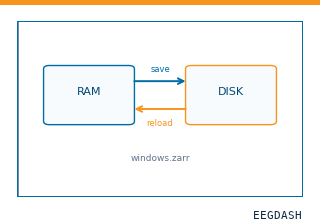 Save and reload prepared dataCache a windowed dataset to disk and reattach it without recompute.
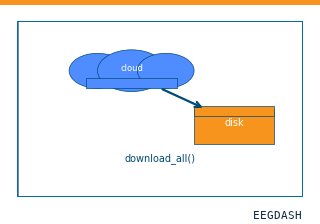 Download a dataset locallyPrefetch BIDS files to a local cache and validate the layout.
Swap any load_dataset(...) call for nm000376 to reproduce the tutorial on this dataset.
Citation
Sofiia Moraresku, Jiri Hammer, Vasileios Dimakopoulos, Michaela Kajsova, Radek Janca, … (2025). Intracranial EEG from 9 adults during a memory-guided actions experiment (preprocessed epochs, Moraresku et al.). 10.82901/nemar.nm000376
Provenance
¹Contributed to nemar in BIDS format.
²Curated & ingested by the EEGDash catalog; see CITATION.cff for canonical reference.
³Persistent identifier: 10.82901/nemar.nm000376.
See Also#
eegdash.dataset.EEGDashDataseteegdash.dataset