


NM000482: ieeg dataset, 7 subjects#
StarkweatherOFC-CCEP: orbitofrontal cortico-cortical evoked potential recordings, 7 patients (Starkweather et al.) (derivative)
Access recordings and metadata through EEGDash.
Citation: Clara Starkweather (—). StarkweatherOFC-CCEP: orbitofrontal cortico-cortical evoked potential recordings, 7 patients (Starkweather et al.) (derivative). 10.82901/nemar.nm000482
Modality: ieeg Subjects: 7 Recordings: 14 License: CC-BY-4.0 Source: nemar
Metadata: Complete (100%)
7-participant iEEG dataset — StarkweatherOFC-CCEP: orbitofrontal cortico-cortical evoked potential recordings, 7 patients (Starkweather et al.) (derivative).
Quickstart#
Install
pip install eegdash
Access the data
from eegdash.dataset import NM000482

dataset = NM000482(cache_dir="./data")
# Get the raw object of the first recording
raw = dataset.datasets[0].raw
print(raw.info)
Filter by subject
dataset = NM000482(cache_dir="./data", subject="01")
Advanced query
dataset = NM000482(
    cache_dir="./data",
    query={"subject": {"$in": ["01", "02"]}},
)
Iterate recordings
for rec in dataset:
    print(rec.subject, rec.raw.info['sfreq'])
If you use this dataset in your research, please cite the original authors.
BibTeX
@dataset{nm000482,
  title = {StarkweatherOFC-CCEP: orbitofrontal cortico-cortical evoked potential recordings, 7 patients (Starkweather et al.) (derivative)},
  author = {Clara Starkweather},
  doi = {10.82901/nemar.nm000482},
  url = {https://doi.org/10.82901/nemar.nm000482},
}
About This Dataset#
Release: figshare 31083118 “Rapid Homotopic Communication Between Human Orbitofrontal Subregions - dataset and MATLAB codes” (Clara Starkweather; doi:10.6084/m9.figshare.31083118.v2, CC BY 4.0). Release description:
“Data and codes pertaining to the manuscript “Rapid Homotopic Communication Between Human Orbitofrontal Subregions” by Starkweather et al. This is a cortico-cortical evoked potential mapping study. This uploaded data contains preprocessed data timeseries (condensed_ecog_OFC_only.mat) with each item within the structure referring to an individual electrode. condensed_ecog(eRec).bipolar refers to the bipolar referenced data from electrode eRec, and condensed_eocg(eRec).lat_coor corresponds to the medial/lateral distance from the lateral orbital sulcus. The critical data analysis summary (Figure 3a) contained in the manuscript was obtained by first running automate_stim_metadata_collection_zscores.m, followed by CCEP_multiplearrays_multiplesubjects_zscores”
For each participant the release holds
condensed_ecog_OFC_only.mat, a struct array with one element per orbitofrontal
electrode contact carrying the authors’ preprocessed timeseries at 1000 Hz: unreferenced_ecog (written here as
acq-unreferenced) and bipolar (adjacent-contact re-referenced, acq-bipolar; the first contact of a chain has no
bipolar signal and is marked bad). Values are written in microvolts (files whose release values are in volts are
multiplied by 1e6; stated per channel in channels.tsv). This is a DERIVATIVE dataset: the raw recordings are not in the
release. Channel names are <brain_region><contact> from the release fields. Single-pulse stimulation times and
amplitudes (stimset.mat) are in events.tsv (onset = release sample / 1000).
sub-01: 18 OFC contacts (OL), 23.8 min, reference n/a
sub-02: 23 OFC contacts (LOFC, LSFG, ROFC, RSFG), 25.2 min, reference n/a
sub-03: 20 OFC contacts (LOD, ROD), 14.1 min, reference n/a
sub-04: 42 OFC contacts (LOFC, ROFC, RSGC), 90.0 min, reference ROFC1Ref
sub-05: 27 OFC contacts (LOFC, ROFC), 43.0 min, reference ROFC1Ref
sub-06: 30 OFC contacts (LOFC, ROFC), 45.0 min, reference ROFC1Ref
sub-07: 31 OFC contacts (LOFC, ROFC), 23.6 min, reference RACC1Ref
Orbitofrontal cortico-cortical evoked potential (CCEP) recordings, 7 patients (Starkweather et al.) - derivative
Localisation
No x/y/z coordinates are released. electrodes.tsv carries the release’s sulcus-relative distances per contact
(lat_coor = medial/lateral distance from the lateral orbital sulcus per the release description; med_coor,
mid_coor, olf_coor, trans_coor copied with their release names) and the release electrode label (brain_region).
sourcedata/figshare-31083118/
All release files per subject folder, byte for byte: condensed_ecog_OFC_only.mat, condensed_ecog_info_only.mat (the
files of subjects 04 and 07 are truncated in the release, 2.9 kB / 2.2 kB, and cannot be opened), metadata.mat (CCEP
onset latency / peak amplitude / peak latency / significance per stimulated -> recorded pair), stimset.mat, and the
authors’ MATLAB scripts under code/.
Provenance
Converted by the ieeg-nemar-20261005 campaign (lane o5c-B) with code/o5c_B_conv_lit138.py; round-trip checks (MNE
read-back) in code/conversion_report.json. A different dataset of the same first author (approach-avoidance SEEG HFA) is
NEMAR nm000383; participant overlap is unknown.
NEMAR Metadata#
[](https://doi.org/10.82901/nemar.nm000482) # Orbitofrontal cortico-cortical evoked potential (CCEP) recordings, 7 patients (Starkweather et al.) - derivative Release: figshare 31083118 “Rapid Homotopic Communication Between Human Orbitofrontal Subregions - dataset and MATLAB codes” (Clara Starkweather; doi:10.6084/m9.figshare.31083118.v2, CC BY 4.0). Release description: “Data and codes pertaining to the manuscript “Rapid Homotopic Communication Between Human Orbitofrontal Subregions” by Starkweather et al. This is a cortico-cortical evoked potential mapping study. This uploaded data contains preprocessed data timeseries (condensed_ecog_OFC_only.mat) with each item within the structure referring to an individual electrode. condensed_ecog(eRec).bipolar refers to the bipolar referenced data from electrode eRec, and condensed_eocg(eRec).lat_coor corresponds to the medial/lateral distance from the lateral orbital sulcus. The critical data analysis summary (Figure 3a) contained in the manuscript was obtained by first running automate_stim_metadata_collection_zscores.m, followed by CCEP_multiplearrays_multiplesubjects_zscores” ## Content (7 participants, 4.41 h per acquisition) For each participant the release holds condensed_ecog_OFC_only.mat, a struct array with one element per orbitofrontal electrode contact carrying the authors’ preprocessed timeseries at 1000 Hz: unreferenced_ecog (written here as acq-unreferenced) and bipolar (adjacent-contact re-referenced, acq-bipolar; the first contact of a chain has no bipolar signal and is marked bad). Values are written in microvolts (files whose release values are in volts are multiplied by 1e6; stated per channel in channels.tsv). This is a DERIVATIVE dataset: the raw recordings are not in the release. Channel names are <brain_region><contact> from the release fields. Single-pulse stimulation times and amplitudes (stimset.mat) are in events.tsv (onset = release sample / 1000).
sub-01: 18 OFC contacts (OL), 23.8 min, reference n/a
sub-02: 23 OFC contacts (LOFC, LSFG, ROFC, RSFG), 25.2 min, reference n/a
sub-03: 20 OFC contacts (LOD, ROD), 14.1 min, reference n/a
sub-04: 42 OFC contacts (LOFC, ROFC, RSGC), 90.0 min, reference ROFC1Ref
sub-05: 27 OFC contacts (LOFC, ROFC), 43.0 min, reference ROFC1Ref
sub-06: 30 OFC contacts (LOFC, ROFC), 45.0 min, reference ROFC1Ref
sub-07: 31 OFC contacts (LOFC, ROFC), 23.6 min, reference RACC1Ref
## Localisation No x/y/z coordinates are released. electrodes.tsv carries the release’s sulcus-relative distances per contact (lat_coor = medial/lateral distance from the lateral orbital sulcus per the release description; med_coor, mid_coor, olf_coor, trans_coor copied with their release names) and the release electrode label (brain_region). ## sourcedata/figshare-31083118/ All release files per subject folder, byte for byte: condensed_ecog_OFC_only.mat, condensed_ecog_info_only.mat (the files of subjects 04 and 07 are truncated in the release, 2.9 kB / 2.2 kB, and cannot be opened), metadata.mat (CCEP onset latency / peak amplitude / peak latency / significance per stimulated -> recorded pair), stimset.mat, and the authors’ MATLAB scripts under code/. ## Provenance Converted by the ieeg-nemar-20261005 campaign (lane o5c-B) with code/o5c_B_conv_lit138.py; round-trip checks (MNE read-back) in code/conversion_report.json. A different dataset of the same first author (approach-avoidance SEEG HFA) is NEMAR nm000383; participant overlap is unknown.
License: CC-BY-4.0
Authors:
Clara Starkweather
Versions:
Version |
DOI |
Released |
|---|---|---|
|
Cohort#
Dataset Statistics#
Channel counts (ch)
Sampling frequencies: 1000.0 Hz (n=14 recordings)
Total recording duration: 8 h 49 min
Signal · Electrodes & live trace#
Live trace viewer — sub-04 · task-ccep
Showing one representative recording out of
7 subjects and 14 recordings in this dataset.
Browse the full set on OpenNeuro;
drop any other _ieeg.{set,edf,bdf,vhdr} file onto the
viewer (or pass ?ieeg=<url>) to inspect it.
No scalp electrode layout is currently indexed for this dataset. Once the eegdash montage registry ingests it, the interactive viewer will appear here automatically.
NEMAR Processing Statistics#
The plots below are generated by NEMAR’s automated EEG pipeline. The histogram shows pipeline success for data cleaning and ICA decomposition, the percentage of data frames and EEG channels retained after artefact removal, line noise per channel (RMS, dB), and the age/gender distribution of participants.

HED event descriptors word cloud

Manifest#
File Explorer#
Browse the BIDS file structure of this dataset. Records are fetched on demand from the EEGDash catalog the first time you open the explorer.
Full dataset metadata table
Dataset ID |
|
Title |
StarkweatherOFC-CCEP: orbitofrontal cortico-cortical evoked potential recordings, 7 patients (Starkweather et al.) (derivative) |
Author (year) |
— |
Canonical |
— |
Importable as |
|
Year |
— |
Authors |
Clara Starkweather |
License |
CC-BY-4.0 |
Citation / DOI |
|
Source links |
OpenNeuro | NeMAR | Source URL |
Copy-paste BibTeX
@dataset{nm000482,
  title = {StarkweatherOFC-CCEP: orbitofrontal cortico-cortical evoked potential recordings, 7 patients (Starkweather et al.) (derivative)},
  author = {Clara Starkweather},
  doi = {10.82901/nemar.nm000482},
  url = {https://doi.org/10.82901/nemar.nm000482},
}
API Reference#
eegdash.datasetEEGDashDataset- class eegdash.dataset.NM000482(cache_dir: str, query: dict | None = None, s3_bucket: str | None = None, **kwargs)[source]#
StarkweatherOFC-CCEP: orbitofrontal cortico-cortical evoked potential recordings, 7 patients (Starkweather et al.) (derivative)
- Study:
nm000482(NeMAR)- Author (year):
—
- Canonical:
—
Also importable as:
NM000482.Modality:
ieeg; Subject type:Unknown. Subjects: 7; recordings: 14; tasks: 1.- Parameters:
cache_dir (str | Path) – Directory where data are cached locally.
query (dict | None) – Additional MongoDB-style filters to AND with the dataset selection. Must not contain the key
dataset.s3_bucket (str | None) – Base S3 bucket used to locate the data.
**kwargs (dict) – Additional keyword arguments forwarded to
EEGDashDataset.
- data_dir#
Local dataset cache directory (
cache_dir / dataset_id).- Type:
Path
Notes
Each item is a recording; recording-level metadata are available via
dataset.description.querysupports MongoDB-style filters on fields inALLOWED_QUERY_FIELDSand is combined with the dataset filter. Dataset-specific caveats are not provided in the summary metadata.References
OpenNeuro dataset: https://openneuro.org/datasets/nm000482 NeMAR dataset: https://nemar.org/dataexplorer/detail?dataset_id=nm000482 DOI: https://doi.org/10.82901/nemar.nm000482
Examples
>>> from eegdash.dataset import NM000482
>>> dataset = NM000482(cache_dir="./data")
>>> recording = dataset[0]
>>> raw = recording.load()
- __init__(cache_dir: str, query: dict | None = None, s3_bucket: str | None = None, **kwargs)[source]#
- save(path: str, overwrite: bool = False, offset: int = 0)[source]#
Save datasets to files by creating one subdirectory for each dataset:
path/
    0/
        0-raw.fif | 0-epo.fif
        description.json
        raw_preproc_kwargs.json (if raws were preprocessed)
        window_kwargs.json (if this is a windowed dataset)
        window_preproc_kwargs.json  (if windows were preprocessed)
        target_name.json (if target_name is not None and dataset is raw)
    1/
        1-raw.fif | 1-epo.fif
        description.json
        raw_preproc_kwargs.json (if raws were preprocessed)
        window_kwargs.json (if this is a windowed dataset)
        window_preproc_kwargs.json  (if windows were preprocessed)
        target_name.json (if target_name is not None and dataset is raw)
- Parameters:
path (str) –
- Directory in which subdirectories are created to store
-raw.fif | -epo.fif and .json files to.
overwrite (bool) – Whether to delete old subdirectories that will be saved to in this call.
offset (int) – If provided, the integer is added to the id of the dataset in the concat. This is useful in the setting of very large datasets, where one dataset has to be processed and saved at a time to account for its original position.
BaseDataset from braindecode — windowed via create_windows_from_events.braindecodeDataLoader; supports parallel workers and on-the-fly augmentations.pytorch Find datasets with the EEGDash APIQuery the catalogue, filter by task or modality, list candidates.
 Load one EEG recordingResolve a single record to an MNE Raw with channels and events.
 EEG recording to PyTorch DataLoaderWrap braindecode windows in a DataLoader for model training.
 Preprocess EEG and create windowsFilter, resample, epoch — and persist the windowed dataset.
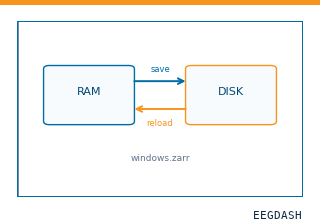 Save and reload prepared dataCache a windowed dataset to disk and reattach it without recompute.
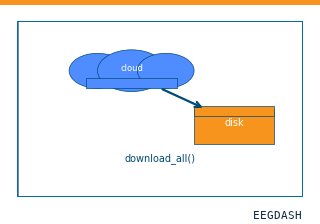 Download a dataset locallyPrefetch BIDS files to a local cache and validate the layout.
Swap any load_dataset(...) call for nm000482 to reproduce the tutorial on this dataset.
Citation
Clara Starkweather (n.d.). StarkweatherOFC-CCEP: orbitofrontal cortico-cortical evoked potential recordings, 7 patients (Starkweather et al.) (derivative). 10.82901/nemar.nm000482
Provenance
¹Contributed to nemar in BIDS format.
²Curated & ingested by the EEGDash catalog; see CITATION.cff for canonical reference.
³Persistent identifier: 10.82901/nemar.nm000482.
See Also#
eegdash.dataset.EEGDashDataseteegdash.dataset