


NM000370: ieeg dataset, 3 subjects#
Human intraoperative Neuropixels recordings, LF band (Paulk et al. 2022, DANDI 000397)
Access recordings and metadata through EEGDash.
Citation: Angelique C. Paulk, Yoav Kfir, Arjun R. Khanna, Martina L. Mustroph, Eric M. Trautmann, Dan J. Soper, Sergey D. Stavisky, Marleen Welkenhuysen, Barundeb Dutta, Krishna V. Shenoy, Leigh R. Hochberg, R. Mark Richardson, Ziv M. Williams, Sydney S. Cash (2022). Human intraoperative Neuropixels recordings, LF band (Paulk et al. 2022, DANDI 000397). 10.82901/nemar.nm000370
Modality: ieeg Subjects: 3 Recordings: 3 License: CC0 Source: nemar
Metadata: Complete (100%)
3-participant iEEG dataset — Human intraoperative Neuropixels recordings, LF band (Paulk et al. 2022, DANDI 000397).
Quickstart#
Install
pip install eegdash
Access the data
from eegdash.dataset import NM000370

dataset = NM000370(cache_dir="./data")
# Get the raw object of the first recording
raw = dataset.datasets[0].raw
print(raw.info)
Filter by subject
dataset = NM000370(cache_dir="./data", subject="01")
Advanced query
dataset = NM000370(
    cache_dir="./data",
    query={"subject": {"$in": ["01", "02"]}},
)
Iterate recordings
for rec in dataset:
    print(rec.subject, rec.raw.info['sfreq'])
If you use this dataset in your research, please cite the original authors.
BibTeX
@dataset{nm000370,
  title = {Human intraoperative Neuropixels recordings, LF band (Paulk et al. 2022, DANDI 000397)},
  author = {Angelique C. Paulk and Yoav Kfir and Arjun R. Khanna and Martina L. Mustroph and Eric M. Trautmann and Dan J. Soper and Sergey D. Stavisky and Marleen Welkenhuysen and Barundeb Dutta and Krishna V. Shenoy and Leigh R. Hochberg and R. Mark Richardson and Ziv M. Williams and Sydney S. Cash},
  doi = {10.82901/nemar.nm000370},
  url = {https://doi.org/10.82901/nemar.nm000370},
}
About This Dataset#
Human intraoperative Neuropixels recordings, LF band (Paulk et al. 2022, DANDI 000397)
Recordings from a single Neuropixels 1.0 silicon probe (thick-shank variant, 384 recorded sites) inserted
into human cortex during neurosurgery at Massachusetts General Hospital. Three participants, one recording each, without a task:
Pt01 right dorsolateral prefrontal cortex, DBS lead implantation (movement disorder), general anesthesia Pt02 left dorsolateral prefrontal cortex, DBS lead implantation (movement disorder), awake with monitored
anesthesia care
Pt03 left anterior temporal lobe cortex, anterior temporal lobectomy (epilepsy), general anesthesia
These are the three successful recordings of the article; six further attempts (probe fracture or excessive noise) are described in the article but not released.
Scope note: Neuropixels are penetrating high-density silicon probes, not clinical iEEG electrodes. This dataset contains only the local-field-potential (LF) band (0.5-500 Hz, 2.5 kHz), which is iEEG-like and is represented here in iEEG-BIDS (“iEEG-adjacent”). The 30 kHz action-potential (AP) band is not converted; it
View full README
Pt03 left anterior temporal lobe cortex, anterior temporal lobectomy (epilepsy), general anesthesia
These are the three successful recordings of the article; six further attempts (probe fracture or excessive noise) are described in the article but not released.
Scope note: Neuropixels are penetrating high-density silicon probes, not clinical iEEG electrodes. This dataset contains only the local-field-potential (LF) band (0.5-500 Hz, 2.5 kHz), which is iEEG-like and is represented here in iEEG-BIDS (“iEEG-adjacent”). The 30 kHz action-potential (AP) band is not converted; it remains, unchanged, in the original NWB files under sourcedata/dandi-000397/.
- Sources:
Paulk AC et al. Large-scale neural recordings with single neuron resolution using Neuropixels probes in human cortex. Nature Neuroscience 25, 252-263 (2022). https://doi.org/10.1038/s41593-021-00997-0 Dryad: doi:10.5061/dryad.d2547d840 (CC0; original SpikeGLX .bin/.meta files of the AP and LF bands, motion-corrected AP data and more, about 137 GB). DANDI 000397 (CC0): NWB conversion of the raw AP and LF bands (NeuroConv). At conversion time (2026-10-06) the Dandiset had no published version; the 3 NWB assets were downloaded from the draft and verified against the DANDI SHA-256 digests (sourcedata/sourcedata_provenance.json).
Please cite the article and the data records.
Ethics
From the Dryad release methods: “All patients voluntarily participated after informed consent according to guidelines as monitored by the Massachusetts General Brigham (previously Partners) Institutional Review Board (IRB) Massachusetts General Hospital (MGH). Participants were informed that participation in the experiment would not alter their clinical treatment in any way, and that they could withdraw at any time without jeopardizing their clinical care. Participants were not compensated monetarily for participating.” The data are released under CC0.
Contents
3 participants, 3 recordings (one each), 384 LF-band channels per recording at 2500 Hz: Pt01 833.8 s, Pt02 873.3 s, Pt03 586.3 s (38.2 min in total). About 4.4 GB of BrainVision data plus 24.1 GB of original NWB (LF + AP bands) in sourcedata/.
sub-Pt0X/ieeg/*_ieeg.vhdr/.vmrk/.eeg BrainVision, INT_16, resolution 4.6875 µV per bit (the NWB conversion). sub-Pt0X/ieeg/*_channels.tsv 384 probe sites in source order (LF0 … LF383). sub-Pt0X/ieeg/*_electrodes.tsv probe-relative site positions (no anatomical coordinates). sub-Pt0X/sub-Pt0X_scans.tsv source file, SHA-256 and series. sourcedata/dandi-000397/ byte-identical copies of the three DANDI NWB files (LF and AP bands).
Signal: what was converted and how
Source: acquisition/ElectricalSeriesLFP of each NWB file (“LFP traces for the processed (lf) SpikeGLX data”): int16, conversion 4.6875e-06 V per bit, offset 0, 2500 Hz from 0 s, 384 channels. The BrainVision .eeg files contain exactly these int16 samples (multiplexed, little-endian) with resolution 4.6875 µV, so the conversion is lossless; nothing was filtered, resampled, re-referenced, cropped, or removed.
Acquisition (Dryad methods): SpikeGLX Release v20201103-phase30; LF band band-pass filtered 0.5-500 Hz and sampled at 2.5 kHz; AP band 0.3-10 kHz at 30 kHz; 10-bit ADC with a 10 mVpp linear range; default electrode map (the 384 most distal sites, lower third of the shank). Reference and ground: sterile needle electrodes (Medtronic) in nearby muscle, often scalp. Channel inter-sample shifts of the Neuropixels ADC multiplexing are listed in channels.tsv (inter_sample_shift) and are not corrected in the data. The recordings contain movement artefacts (the authors provide motion-corrected AP-band data on Dryad).
Channel names: the NWB electrodes table names its rows after the AP band (AP0 … AP383); the same rows carry the LF band, so the LF channels are named LF0 … LF383 here (source name in channels.tsv).
Channel type: BIDS has no channel type for silicon-probe sites; SEEG (intracortical depth recording) is used.
Electrodes and coordinates
No anatomical coordinates are released. electrodes.tsv has x, y, z = n/a and gives the site position on the probe (probe_x_um across the shank, probe_y_um along the shank), contact shape and site number from the NWB electrodes table, and the recorded area from the Dryad methods. The NWB device description reads {“probe_type”: “0”, “probe_type_description”: “NP1.0”, “flex_part_number”: “NP2_FLEX_0”, “connected_base_station_part_number”: “NP2_QBSC_00”}.
Participants
Age and sex are not released per participant (NWB age is the cohort range P34Y/P75Y and sex “U”; the full cohort of 9 had a mean age of 59 years, range 34-75, 7 female). participants.tsv gives age and sex as n/a, the cohort age range verbatim, anesthesia state, procedure and recorded area.
Cohort (Dryad methods; Paulk et al. 2022 Supplementary Table 1): 9 participants at Massachusetts General Hospital already scheduled for a craniotomy: 1 left anterior frontal tumour removal (thin probe, fractured, no recording), 6 deep brain stimulation lead implantations (1 thin probe fractured; 3 thick-probe recordings with considerable noise; Pt. 01 and Pt. 02 released) and 2 left anterior temporal lobectomies for epilepsy (1 with considerable noise; Pt. 03 released). Supplementary Table 1 labels the released recordings “Pt. 01” to “Pt. 03” with procedure, anesthesia state and location identical to the Dryad methods, which proves the mapping to sub-Pt01 … sub-Pt03. participants.tsv adds from that table the probe variant (thick for all three) and the spike-sorting yield (total clusters, single units, MUA clusters: Pt01 262/202/60, Pt02 312/178/134, Pt03 29/19/10); the spike-sorted units themselves are not part of this release.
Not available from any source checked (n/a): per-participant age and sex, handedness, diagnosis details beyond the procedure, and the recording year (NWB session_start_time is the placeholder 1900-01-01; the Dryad methods and the article supplement give no dates; the original SpikeGLX .meta files on Dryad could not be downloaded anonymously).
Events
None: the recordings have no task and the NWB files contain no event or trial tables.
Conversion checks
For every recording the int16 samples in the .eeg file were compared with the NWB dataset for all samples: identical; file size equals samples x channels x 2 bytes.
MNE-Python reads every file with the right sampling rate, 384 channels and sample count; start, middle and end windows equal the NWB int16 values times the NWB conversion (in volts).
The NWB copies in sourcedata/ match the DANDI SHA-256 digests.
bids-validator 3.0.2: 0 errors; warnings for recommended fields the source does not document and for the absence of events files (there are no events).
Conversion code: b2dandi_npx_bids.py (iEEG-NEMAR campaign, batch 2), using h5py; checked with MNE-Python.
Known caveats
LF band only; the 30 kHz AP band stays in the NWB files under sourcedata/ (see Scope note).
No anatomical coordinates; channel inter-sample shifts are not corrected; recordings contain movement artefacts (see Signal and Electrodes and coordinates).
Per-participant age, sex and recording year are not released.
How to load
from mne_bids import BIDSPath, read_raw_bids bp = BIDSPath(root=”nm000370”, subject=”Pt01”, task=”intraop”, datatype=”ieeg”) raw = read_raw_bids(bp) # 384 LF-band channels at 2500 Hz
Citation
Paulk AC, Kfir Y, Khanna AR, Mustroph ML, Trautmann EM, Soper DJ, Stavisky SD, Welkenhuysen M, Dutta B, Shenoy KV, Hochberg LR, Richardson RM, Williams ZM, Cash SS. Large-scale neural recordings with single neuron resolution using Neuropixels probes in human cortex. Nature Neuroscience 25, 252-263 (2022). doi:10.1038/s41593-021-00997-0 ; data: Dryad doi:10.5061/dryad.d2547d840 and DANDI:000397.
Provenance of the 2026-10-07 metadata enrichment
Paulk et al. 2022 Supplementary Information (Supplementary Table 1, freely downloadable; the article body is subscription-only and was not read); Dryad record doi:10.5061/dryad.d2547d840 (methods, API metadata).
NEMAR Metadata#
[](https://doi.org/10.82901/nemar.nm000370) Human intraoperative Neuropixels recordings, LF band (Paulk et al. 2022, DANDI 000397) ====================================================================================== Overview ——– Recordings from a single Neuropixels 1.0 silicon probe (thick-shank variant, 384 recorded sites) inserted into human cortex during neurosurgery at Massachusetts General Hospital. Three participants, one recording each, without a task:
Pt01 right dorsolateral prefrontal cortex, DBS lead implantation (movement disorder), general anesthesia Pt02 left dorsolateral prefrontal cortex, DBS lead implantation (movement disorder), awake with monitored
anesthesia care
Pt03 left anterior temporal lobe cortex, anterior temporal lobectomy (epilepsy), general anesthesia
These are the three successful recordings of the article; six further attempts (probe fracture or excessive noise) are described in the article but not released. Scope note: Neuropixels are penetrating high-density silicon probes, not clinical iEEG electrodes. This dataset contains only the local-field-potential (LF) band (0.5-500 Hz, 2.5 kHz), which is iEEG-like and is represented here in iEEG-BIDS (“iEEG-adjacent”). The 30 kHz action-potential (AP) band is not converted; it remains, unchanged, in the original NWB files under sourcedata/dandi-000397/. Sources:
Paulk AC et al. Large-scale neural recordings with single neuron resolution using Neuropixels probes in human cortex. Nature Neuroscience 25, 252-263 (2022). https://doi.org/10.1038/s41593-021-00997-0 Dryad: doi:10.5061/dryad.d2547d840 (CC0; original SpikeGLX .bin/.meta files of the AP and LF bands, motion-corrected AP data and more, about 137 GB). DANDI 000397 (CC0): NWB conversion of the raw AP and LF bands (NeuroConv). At conversion time (2026-10-06) the Dandiset had no published version; the 3 NWB assets were downloaded from the draft and verified against the DANDI SHA-256 digests (sourcedata/sourcedata_provenance.json).
Please cite the article and the data records. Ethics —— From the Dryad release methods: “All patients voluntarily participated after informed consent according to guidelines as monitored by the Massachusetts General Brigham (previously Partners) Institutional Review Board (IRB) Massachusetts General Hospital (MGH). Participants were informed that participation in the experiment would not alter their clinical treatment in any way, and that they could withdraw at any time without jeopardizing their clinical care. Participants were not compensated monetarily for participating.” The data are released under CC0. Contents ——– 3 participants, 3 recordings (one each), 384 LF-band channels per recording at 2500 Hz: Pt01 833.8 s, Pt02 873.3 s, Pt03 586.3 s (38.2 min in total). About 4.4 GB of BrainVision data plus 24.1 GB of original NWB (LF + AP bands) in sourcedata/.
sub-Pt0X/ieeg/*_ieeg.vhdr/.vmrk/.eeg BrainVision, INT_16, resolution 4.6875 µV per bit (the NWB conversion). sub-Pt0X/ieeg/*_channels.tsv 384 probe sites in source order (LF0 … LF383). sub-Pt0X/ieeg/*_electrodes.tsv probe-relative site positions (no anatomical coordinates). sub-Pt0X/sub-Pt0X_scans.tsv source file, SHA-256 and series. sourcedata/dandi-000397/ byte-identical copies of the three DANDI NWB files (LF and AP bands).
Signal: what was converted and how#
Source: acquisition/ElectricalSeriesLFP of each NWB file (“LFP traces for the processed (lf) SpikeGLX data”): int16, conversion 4.6875e-06 V per bit, offset 0, 2500 Hz from 0 s, 384 channels. The BrainVision .eeg files contain exactly these int16 samples (multiplexed, little-endian) with resolution 4.6875 µV, so the conversion is lossless; nothing was filtered, resampled, re-referenced, cropped, or removed. Acquisition (Dryad methods): SpikeGLX Release v20201103-phase30; LF band band-pass filtered 0.5-500 Hz and sampled at 2.5 kHz; AP band 0.3-10 kHz at 30 kHz; 10-bit ADC with a 10 mVpp linear range; default electrode map (the 384 most distal sites, lower third of the shank). Reference and ground: sterile needle electrodes (Medtronic) in nearby muscle, often scalp. Channel inter-sample shifts of the Neuropixels ADC multiplexing are listed in channels.tsv (inter_sample_shift) and are not corrected in the data. The recordings contain movement artefacts (the authors provide motion-corrected AP-band data on Dryad). Channel names: the NWB electrodes table names its rows after the AP band (AP0 … AP383); the same rows carry the LF band, so the LF channels are named LF0 … LF383 here (source name in channels.tsv). Channel type: BIDS has no channel type for silicon-probe sites; SEEG (intracortical depth recording) is used. Electrodes and coordinates ————————– No anatomical coordinates are released. electrodes.tsv has x, y, z = n/a and gives the site position on the probe (probe_x_um across the shank, probe_y_um along the shank), contact shape and site number from the NWB electrodes table, and the recorded area from the Dryad methods. The NWB device description reads {“probe_type”: “0”, “probe_type_description”: “NP1.0”, “flex_part_number”: “NP2_FLEX_0”, “connected_base_station_part_number”: “NP2_QBSC_00”}. Participants ———— Age and sex are not released per participant (NWB age is the cohort range P34Y/P75Y and sex “U”; the full cohort of 9 had a mean age of 59 years, range 34-75, 7 female). participants.tsv gives age and sex as n/a, the cohort age range verbatim, anesthesia state, procedure and recorded area. Cohort (Dryad methods; Paulk et al. 2022 Supplementary Table 1): 9 participants at Massachusetts General Hospital already scheduled for a craniotomy: 1 left anterior frontal tumour removal (thin probe, fractured, no recording), 6 deep brain stimulation lead implantations (1 thin probe fractured; 3 thick-probe recordings with considerable noise; Pt. 01 and Pt. 02 released) and 2 left anterior temporal lobectomies for epilepsy (1 with considerable noise; Pt. 03 released). Supplementary Table 1 labels the released recordings “Pt. 01” to “Pt. 03” with procedure, anesthesia state and location identical to the Dryad methods, which proves the mapping to sub-Pt01 … sub-Pt03. participants.tsv adds from that table the probe variant (thick for all three) and the spike-sorting yield (total clusters, single units, MUA clusters: Pt01 262/202/60, Pt02 312/178/134, Pt03 29/19/10); the spike-sorted units themselves are not part of this release. Not available from any source checked (n/a): per-participant age and sex, handedness, diagnosis details beyond the procedure, and the recording year (NWB session_start_time is the placeholder 1900-01-01; the Dryad methods and the article supplement give no dates; the original SpikeGLX .meta files on Dryad could not be downloaded anonymously). Events —— None: the recordings have no task and the NWB files contain no event or trial tables. Conversion checks —————– - For every recording the int16 samples in the .eeg file were compared with the NWB dataset for all samples:
identical; file size equals samples x channels x 2 bytes.
MNE-Python reads every file with the right sampling rate, 384 channels and sample count; start, middle and end windows equal the NWB int16 values times the NWB conversion (in volts).
The NWB copies in sourcedata/ match the DANDI SHA-256 digests.
bids-validator 3.0.2: 0 errors; warnings for recommended fields the source does not document and for the absence of events files (there are no events).
Conversion code: b2dandi_npx_bids.py (iEEG-NEMAR campaign, batch 2), using h5py; checked with MNE-Python. Known caveats ————- - LF band only; the 30 kHz AP band stays in the NWB files under sourcedata/ (see Scope note). - No anatomical coordinates; channel inter-sample shifts are not corrected; recordings contain movement
artefacts (see Signal and Electrodes and coordinates).
Per-participant age, sex and recording year are not released.
How to load#
from mne_bids import BIDSPath, read_raw_bids bp = BIDSPath(root=”nm000370”, subject=”Pt01”, task=”intraop”, datatype=”ieeg”) raw = read_raw_bids(bp) # 384 LF-band channels at 2500 Hz
Citation#
Paulk AC, Kfir Y, Khanna AR, Mustroph ML, Trautmann EM, Soper DJ, Stavisky SD, Welkenhuysen M, Dutta B, Shenoy KV, Hochberg LR, Richardson RM, Williams ZM, Cash SS. Large-scale neural recordings with single neuron resolution using Neuropixels probes in human cortex. Nature Neuroscience 25, 252-263 (2022). doi:10.1038/s41593-021-00997-0 ; data: Dryad doi:10.5061/dryad.d2547d840 and DANDI:000397. Provenance of the 2026-10-07 metadata enrichment ———————————————— Paulk et al. 2022 Supplementary Information (Supplementary Table 1, freely downloadable; the article body is subscription-only and was not read); Dryad record doi:10.5061/dryad.d2547d840 (methods, API metadata).
License: CC0
Authors:
Angelique C. Paulk
Yoav Kfir
Arjun R. Khanna
Martina L. Mustroph
Eric M. Trautmann
… and 9 more
Versions:
Version |
DOI |
Released |
|---|---|---|
|
Cohort#
Dataset Statistics#
Channel counts: 384 ch (n=3 recordings)
Sampling frequencies: 2500.0 Hz (n=3 recordings)
Total recording duration: 38 min
Signal · Electrodes & live trace#
Live trace viewer — sub-Pt01 · task-intraop
Showing one representative recording out of
3 subjects and 3 recordings in this dataset.
Browse the full set on OpenNeuro;
drop any other _ieeg.{set,edf,bdf,vhdr} file onto the
viewer (or pass ?ieeg=<url>) to inspect it.
No scalp electrode layout is currently indexed for this dataset. Once the eegdash montage registry ingests it, the interactive viewer will appear here automatically.
NEMAR Processing Statistics#
The plots below are generated by NEMAR’s automated EEG pipeline. The histogram shows pipeline success for data cleaning and ICA decomposition, the percentage of data frames and EEG channels retained after artefact removal, line noise per channel (RMS, dB), and the age/gender distribution of participants.

HED event descriptors word cloud

Manifest#
File Explorer#
Browse the BIDS file structure of this dataset. Records are fetched on demand from the EEGDash catalog the first time you open the explorer.
Full dataset metadata table
Dataset ID |
|
Title |
Human intraoperative Neuropixels recordings, LF band (Paulk et al. 2022, DANDI 000397) |
Author (year) |
— |
Canonical |
— |
Importable as |
|
Year |
2022 |
Authors |
Angelique C. Paulk, Yoav Kfir, Arjun R. Khanna, Martina L. Mustroph, Eric M. Trautmann, Dan J. Soper, Sergey D. Stavisky, Marleen Welkenhuysen, Barundeb Dutta, Krishna V. Shenoy, Leigh R. Hochberg, R. Mark Richardson, Ziv M. Williams, Sydney S. Cash |
License |
CC0 |
Citation / DOI |
|
Source links |
OpenNeuro | NeMAR | Source URL |
Copy-paste BibTeX
@dataset{nm000370,
  title = {Human intraoperative Neuropixels recordings, LF band (Paulk et al. 2022, DANDI 000397)},
  author = {Angelique C. Paulk and Yoav Kfir and Arjun R. Khanna and Martina L. Mustroph and Eric M. Trautmann and Dan J. Soper and Sergey D. Stavisky and Marleen Welkenhuysen and Barundeb Dutta and Krishna V. Shenoy and Leigh R. Hochberg and R. Mark Richardson and Ziv M. Williams and Sydney S. Cash},
  doi = {10.82901/nemar.nm000370},
  url = {https://doi.org/10.82901/nemar.nm000370},
}
API Reference#
eegdash.datasetEEGDashDataset- class eegdash.dataset.NM000370(cache_dir: str, query: dict | None = None, s3_bucket: str | None = None, **kwargs)[source]#
Human intraoperative Neuropixels recordings, LF band (Paulk et al. 2022, DANDI 000397)
- Study:
nm000370(NeMAR)- Author (year):
—
- Canonical:
—
Also importable as:
NM000370.Modality:
ieeg; Subject type:Unknown. Subjects: 3; recordings: 3; tasks: 1.- Parameters:
cache_dir (str | Path) – Directory where data are cached locally.
query (dict | None) – Additional MongoDB-style filters to AND with the dataset selection. Must not contain the key
dataset.s3_bucket (str | None) – Base S3 bucket used to locate the data.
**kwargs (dict) – Additional keyword arguments forwarded to
EEGDashDataset.
- data_dir#
Local dataset cache directory (
cache_dir / dataset_id).- Type:
Path
Notes
Each item is a recording; recording-level metadata are available via
dataset.description.querysupports MongoDB-style filters on fields inALLOWED_QUERY_FIELDSand is combined with the dataset filter. Dataset-specific caveats are not provided in the summary metadata.References
OpenNeuro dataset: https://openneuro.org/datasets/nm000370 NeMAR dataset: https://nemar.org/dataexplorer/detail?dataset_id=nm000370 DOI: https://doi.org/10.82901/nemar.nm000370
Examples
>>> from eegdash.dataset import NM000370
>>> dataset = NM000370(cache_dir="./data")
>>> recording = dataset[0]
>>> raw = recording.load()
- __init__(cache_dir: str, query: dict | None = None, s3_bucket: str | None = None, **kwargs)[source]#
- save(path: str, overwrite: bool = False, offset: int = 0)[source]#
Save datasets to files by creating one subdirectory for each dataset:
path/
    0/
        0-raw.fif | 0-epo.fif
        description.json
        raw_preproc_kwargs.json (if raws were preprocessed)
        window_kwargs.json (if this is a windowed dataset)
        window_preproc_kwargs.json  (if windows were preprocessed)
        target_name.json (if target_name is not None and dataset is raw)
    1/
        1-raw.fif | 1-epo.fif
        description.json
        raw_preproc_kwargs.json (if raws were preprocessed)
        window_kwargs.json (if this is a windowed dataset)
        window_preproc_kwargs.json  (if windows were preprocessed)
        target_name.json (if target_name is not None and dataset is raw)
- Parameters:
path (str) –
- Directory in which subdirectories are created to store
-raw.fif | -epo.fif and .json files to.
overwrite (bool) – Whether to delete old subdirectories that will be saved to in this call.
offset (int) – If provided, the integer is added to the id of the dataset in the concat. This is useful in the setting of very large datasets, where one dataset has to be processed and saved at a time to account for its original position.
BaseDataset from braindecode — windowed via create_windows_from_events.braindecodeDataLoader; supports parallel workers and on-the-fly augmentations.pytorch Find datasets with the EEGDash APIQuery the catalogue, filter by task or modality, list candidates.
 Load one EEG recordingResolve a single record to an MNE Raw with channels and events.
 EEG recording to PyTorch DataLoaderWrap braindecode windows in a DataLoader for model training.
 Preprocess EEG and create windowsFilter, resample, epoch — and persist the windowed dataset.
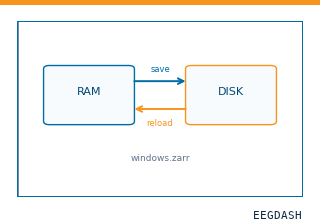 Save and reload prepared dataCache a windowed dataset to disk and reattach it without recompute.
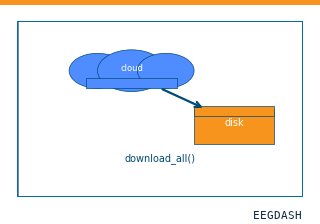 Download a dataset locallyPrefetch BIDS files to a local cache and validate the layout.
Swap any load_dataset(...) call for nm000370 to reproduce the tutorial on this dataset.
Citation
Angelique C. Paulk, Yoav Kfir, Arjun R. Khanna, Martina L. Mustroph, Eric M. Trautmann, … (2022). Human intraoperative Neuropixels recordings, LF band (Paulk et al. 2022, DANDI 000397). 10.82901/nemar.nm000370
Provenance
¹Contributed to nemar in BIDS format.
²Curated & ingested by the EEGDash catalog; see CITATION.cff for canonical reference.
³Persistent identifier: 10.82901/nemar.nm000370.
See Also#
eegdash.dataset.EEGDashDataseteegdash.dataset