


NM000357: ieeg dataset, 16 subjects#
Movie watching and recognition memory: depth-electrode macro iEEG from Keles et al. 2024 (DANDI 000623)
Access recordings and metadata through EEGDash.
Citation: Umit Keles, Julien Dubois, Kevin J. M. Le, J. Michael Tyszka, David A. Kahn, Chrystal M. Reed, Jeffrey M. Chung, Adam N. Mamelak, Ralph Adolphs, Ueli Rutishauser (2024). Movie watching and recognition memory: depth-electrode macro iEEG from Keles et al. 2024 (DANDI 000623). 10.82901/nemar.nm000357
Modality: ieeg Subjects: 16 Recordings: 29 License: CC-BY-4.0 Source: nemar
Metadata: Complete (100%)
16-participant iEEG dataset — Movie watching and recognition memory: depth-electrode macro iEEG from Keles et al. 2024 (DANDI 000623).
Quickstart#
Install
pip install eegdash
Access the data
from eegdash.dataset import NM000357

dataset = NM000357(cache_dir="./data")
# Get the raw object of the first recording
raw = dataset.datasets[0].raw
print(raw.info)
Filter by subject
dataset = NM000357(cache_dir="./data", subject="01")
Advanced query
dataset = NM000357(
    cache_dir="./data",
    query={"subject": {"$in": ["01", "02"]}},
)
Iterate recordings
for rec in dataset:
    print(rec.subject, rec.raw.info['sfreq'])
If you use this dataset in your research, please cite the original authors.
BibTeX
@dataset{nm000357,
  title = {Movie watching and recognition memory: depth-electrode macro iEEG from Keles et al. 2024 (DANDI 000623)},
  author = {Umit Keles and Julien Dubois and Kevin J. M. Le and J. Michael Tyszka and David A. Kahn and Chrystal M. Reed and Jeffrey M. Chung and Adam N. Mamelak and Ralph Adolphs and Ueli Rutishauser},
  doi = {10.82901/nemar.nm000357},
  url = {https://doi.org/10.82901/nemar.nm000357},
}
About This Dataset#
Movie watching and recognition memory: depth-electrode macro iEEG (Keles et al. 2024, DANDI 000623)
Intracranial EEG from the clinical macroelectrode contacts of hybrid Behnke-Fried depth electrodes in
patients with drug-resistant epilepsy undergoing invasive monitoring at Cedars-Sinai Medical Center.
In each run participants passively watched an 8-min edited excerpt of Alfred Hitchcock’s “Bang! You’re Dead” (encoding) and then performed a new/old recognition memory test on 40 movie frames (20 seen, 20 unseen) with a 1-6 confidence rating. Electrodes targeted amygdala, hippocampus and medial frontal cortex (ACC, pre-SMA, vmPFC); implanted orthogonally, the macro contacts also sample lateral cortex.
This dataset is an iEEG-BIDS representation of the macroelectrode field potentials released by the authors in NWB format on the DANDI Archive:
Keles U, Dubois J, Le KJM, Tyszka JM, Kahn DA, Reed CM, Chung JM, Mamelak AN, Adolphs R, Rutishauser U
View full README
In each run participants passively watched an 8-min edited excerpt of Alfred Hitchcock’s “Bang! You’re Dead” (encoding) and then performed a new/old recognition memory test on 40 movie frames (20 seen, 20 unseen) with a 1-6 confidence rating. Electrodes targeted amygdala, hippocampus and medial frontal cortex (ACC, pre-SMA, vmPFC); implanted orthogonally, the macro contacts also sample lateral cortex.
This dataset is an iEEG-BIDS representation of the macroelectrode field potentials released by the authors in NWB format on the DANDI Archive:
Keles U, Dubois J, Le KJM, Tyszka JM, Kahn DA, Reed CM, Chung JM, Mamelak AN, Adolphs R, Rutishauser U (2024). Data for: Multimodal single-neuron, intracranial EEG, and fMRI brain responses during movie watching in human patients (Version 0.240227.2023). DANDI archive. https://dandiarchive.org/dandiset/000623/0.240227.2023 (license CC-BY-4.0) Data descriptor: Keles U et al. Multimodal single-neuron, intracranial EEG, and fMRI brain responses during movie watching in human patients. Sci Data 11, 214 (2024). https://doi.org/10.1038/s41597-024-03029-1
Please cite both. The fMRI part of the study is separately available in BIDS on OpenNeuro (ds004798); it is not duplicated here. Single-neuron spike times, microwire LFP, eye tracking, pupil, fixations, saccades and blinks are not converted to BIDS; they remain available, unchanged, in the original NWB files copied under sourcedata/dandi-000623/ and on DANDI.
Task and paradigm (Keles et al. 2024, Methods “Task” and “Movie stimulus”)
Each run had two phases. Movie watching: an 8-min edited excerpt (edited from the original 30 min) of the black-and-white television episode “Bang! You’re Dead” (Alfred Hitchcock Presents, 1961), the same edit used in several prior neuroimaging studies; the movie has a frame rate of 25 Hz (11971 frames with OpenCV, per the Usage Notes). Participants were told beforehand that a memory test would follow. Recognition: 20 novel frames (from parts of the full episode removed in the edit) and 20 familiar frames (from the edited version shown) were presented one at a time; participants answered on an external response box with a confidence scale from 1 (novel, sure) through 3 (novel, most unsure) and 4 (familiar, most unsure) to 6 (familiar, sure). The same set of 80 frames (40 novel, 40 familiar) was used across participants; the frame order was randomized per run and the 40 frames shown differed between the two runs of a participant, while the movie was identical in both runs.
The authors note that familiarity from the first viewing may affect test-retest reliability of run 2. All electrophysiology was recorded in the epilepsy monitoring unit (EMU); electrode implantation and placement followed clinical protocols independent of the study.
Ethics
From the data descriptor: participation was voluntary and participants (or their legal guardian if under 18) provided informed consent. All protocols were approved by the Institutional Review Boards of the California Institute of Technology (IRB 16-0692F) and Cedars-Sinai Medical Center (IRB 13369).
This deposit is a redistribution of the publicly released data under its CC-BY-4.0 license; the original release carries the ethics permissions.
Contents
16 participants (sub-CS41 … sub-CS62; 10 female, 6 male; age 17-67 years), 29 recordings (13 participants with two runs, 3 with one run), 2754 macro channels in total (40-128 per recording, 1000 Hz), about 6.5 h of data (656-1036 s per recording). The data descriptor reports 20 participants for the whole study; 4 of them only took part in the fMRI part, so DANDI 000623 (and this dataset) contains the 16 participants with intracranial recordings.
sub-<label> DANDI subject label (e.g. CS62 = study patient code P62CS). ses-<label> DANDI session label, e.g. P62CSR1 / P62CSR2 = run 1 / run 2 of the
experiment in the epilepsy monitoring unit (see Table 1 of the paper for participants with a single run).
ieeg/*_ieeg.vhdr/.vmrk/.eeg BrainVision, IEEE float32, microvolts, resolution 1.0. ieeg/*_channels.tsv one row per macro contact, in the column order of the source series. ieeg/*_electrodes.tsv source contact coordinates (see Coordinates). ieeg/*_events.tsv trials, TTL markers and movie-frame times (see Events). sourcedata/dandi-000623/ byte-identical copies of the DANDI NWB files (+ dandiset.yaml);
sourcedata/sourcedata_provenance.json lists size, SHA-256 and DANDI asset id.
Signal: what was converted and how
Source: processing/ecephys/LFP_macro/ElectricalSeries of each NWB file (unit volts, conversion 1.0, offset 0, no channel_conversion, regular 1000 Hz clock given by starting_time and rate). The values were written unchanged to BrainVision as float32 microvolts. For every file the conversion checked that float32(volts x 1e6) x 1e-6 reproduces the stored float64 volts exactly (see Conversion checks); no filtering, resampling, re-referencing, cropping or channel removal was done by this conversion.
Processing already applied by the authors (Keles et al. 2024, Methods/Data Records): macro channels were acquired with a Neuralynx ATLAS system at 2000 Hz with a 0.1 Hz hardware high-pass, then low-pass filtered at 500 Hz (anti-aliasing) and decimated to 1000 Hz. The recordings were cropped by the authors to 10 s before movie onset through 10 s after the end of the task. The notch filter, 0.1 Hz high-pass and common-average reference described in the paper’s “LFP and iEEG data processing” section are analysis steps for the quality validation; the authors’ released code (code/ephys_qc/ieeg/prep_filterLFP.py) applies them after reading the NWB files, consistent with the released series not containing them. The reference of the macro recordings is not documented by the source; iEEGReference is therefore stated as unknown.
For participant CS62 (P62CS) the authors’ NWB writer keeps only the first 40 macro channels. All 29 NWB files contain an LFP_macro series with a regular 1000 Hz clock; all were converted.
Recording CS53/P53CSR2 has 35 trial rows (1 encoding + 34 recognition) instead of 41, as in the source trials table.
Channel names are the authors’ original lab labels (origchannel_name, e.g. RAMY1 = right amygdala contact 1); channels.tsv also gives the source electrode-table row and origchannel (“macro-N”).
Channel type SEEG: all contacts are on depth electrodes. The source provides no bad-channel marking, so no status column is given.
Timing and events
The NWB behavioural clock has movie onset (TTL 4) at 0 s. The LFP series was stored with its own clock that starts 10 s earlier (the series description states “the session starts at 10.0 seconds”; the first stored sample is at starting_time, e.g. 0.000834 s for P62CSR2). Event onsets in BIDS are relative to the first sample: onset = source_time + 10 s - starting_time. The original source times are kept in source_start_time / source_stop_time / source_response_time. trial_type levels: encoding (movie interval), recognition (one row per frame trial), ttl (all TTL codes, with the experiment id recorded at the same time), movie_frame (stimulus/presentation/movieframe_time).
For recognition trials response_time is the latency (source response time - trial start); the source “response_time” column is an absolute time in the session clock and is kept as source_response_time. The movie and the frame images are copyrighted and are not distributed.
Coordinates
electrodes.tsv x/y/z are copied from the NWB electrodes table, which the authors’ writer fills from per-patient MNI coordinate files (macro_MNI.xyz). The paper states that locations are provided in MNI152 coordinates and shows them on the MNI152NLin2009cAsym template; because the template variant used to compute the values is not stated, coordsystem.json uses iEEGCoordinateSystem “Other” with this description, units mm. The NWB column descriptions (“+x is posterior” etc.) are PyNWB defaults and do not describe these values. The authors note that some template-space locations fall in white matter due to misregistration. Native-space coordinates and images are not released.
Participants and privacy
participants.tsv gives age (years), sex, species, the epilepsy diagnosis text and the DANDI subject id, all copied from the NWB subject metadata. No acquisition dates are given in BIDS. The NWB files carry a session_start_time; per the data descriptor (“For anonymity, the session dates (NWBFile.session_start_time) are not the actual dates of the sessions”) these are not real dates.
Conversion checks
Source: 29/29 DANDI assets (27,744,749,325 bytes) verified by SHA-256 against the DANDI digests; sourcedata copies re-verified after copying.
Signal: for every recording, MNE (1.13) reading of the BrainVision file reproduces every stored NWB sample exactly (float64 volts, bit-identical; no non-finite samples in the source), with the same channel order as the source electrode region and the same sampling rate and sample count.
Events: every trial, TTL and movie-frame onset recomputed from the NWB with the 10 s pre-roll correction agrees with events.tsv within 1 microsecond (onsets are written with 6 decimals); no event falls outside the recording. Movie onset (TTL 4) is at source time 0 in every file.
BIDS validator (bids-validator 3.0.2): 0 errors; remaining warnings are recommended fields that the source does not document (e.g. iEEGGround, DeviceSerialNumber, CogAtlasID, HEDVersion).
Known limitations
The released field potentials are already downsampled/low-passed by the authors (see above); “raw” here means “earliest released form”, not the 2000 Hz acquisition.
Reference and electrode contact size are not documented in the source and are given as unknown/n/a.
Movie-frame, TTL and trial times come from the stimulus computer clock synchronised by the authors to the recording via TTLs; this conversion does not re-estimate that synchronisation.
How to load
- Python (MNE-BIDS):
from mne_bids import BIDSPath, read_raw_bids bp = BIDSPath(root=”<path to this dataset>”, subject=”CS51”, session=”P51CSR1”,
task=”movie”, datatype=”ieeg”, suffix=”ieeg”, extension=”.vhdr”)
raw = read_raw_bids(bp) # 1000 Hz, SEEG channels; events.tsv -> raw.annotations import pandas as pd ev = pd.read_csv(bp.copy().update(suffix=”events”, extension=”.tsv”).fpath, sep=”t”)
Column meanings and code levels (TTL codes, experiment ids, response codes) are in *_events.json.
The original NWB files (spikes, microwire LFP, eye tracking) can be read with pynwb; the authors’ code is at rutishauserlab/bmovie-release-NWB-BIDS.
Citations
Keles U, Dubois J, Le KJM, Tyszka JM, Kahn DA, Reed CM, Chung JM, Mamelak AN, Adolphs R, Rutishauser U. Multimodal single-neuron, intracranial EEG, and fMRI brain responses during movie watching in human patients. Sci Data 11, 214 (2024). https://doi.org/10.1038/s41597-024-03029-1
Keles U et al. (2024). Data for: Multimodal single-neuron, intracranial EEG, and fMRI brain responses during movie watching in human patients (Version 0.240227.2023). DANDI archive. https://doi.org/10.48324/dandi.000623/0.240227.2023
Related fMRI part of the study (same task, subset of participants): OpenNeuro ds004798.
Provenance
Source: DANDI:000623 version 0.240227.2023, all 29 assets downloaded with the dandi CLI (0.81.0) on 2026-10-06 and verified against the DANDI SHA-256 digests. Conversion script: laneB_ieeg005_bids.py (h5py 3.16, numpy 2.5, pybv 0.8.1). Prior automated BIDS layouts of this Dandiset exists on GitHub (github.com/bids-dandisets/000623): an automatically generated nwb2bids layout following the draft BEP032 microephys schema, whose .nwb entries are 88-byte URL pointers to the DANDI files, with generic channel tables (type n/a, sampling frequency -1) not mapped to the macro series, no DOI and no version of record. It is a metadata mirror of the same NWB release, not an archived iEEG-BIDS copy; it is acknowledged here as related prior work. As of 2026-10-06 no iEEG-BIDS version of these recordings was found on DANDI, OpenNeuro (ds004798 is the fMRI part only) or NEMAR.
NEMAR Metadata#
[](https://doi.org/10.82901/nemar.nm000357) Movie watching and recognition memory: depth-electrode macro iEEG (Keles et al. 2024, DANDI 000623) ===================================================================================================== Overview ——– Intracranial EEG from the clinical macroelectrode contacts of hybrid Behnke-Fried depth electrodes in patients with drug-resistant epilepsy undergoing invasive monitoring at Cedars-Sinai Medical Center. In each run participants passively watched an 8-min edited excerpt of Alfred Hitchcock’s “Bang! You’re Dead” (encoding) and then performed a new/old recognition memory test on 40 movie frames (20 seen, 20 unseen) with a 1-6 confidence rating. Electrodes targeted amygdala, hippocampus and medial frontal cortex (ACC, pre-SMA, vmPFC); implanted orthogonally, the macro contacts also sample lateral cortex. This dataset is an iEEG-BIDS representation of the macroelectrode field potentials released by the authors in NWB format on the DANDI Archive:
Keles U, Dubois J, Le KJM, Tyszka JM, Kahn DA, Reed CM, Chung JM, Mamelak AN, Adolphs R, Rutishauser U (2024). Data for: Multimodal single-neuron, intracranial EEG, and fMRI brain responses during movie watching in human patients (Version 0.240227.2023). DANDI archive. https://dandiarchive.org/dandiset/000623/0.240227.2023 (license CC-BY-4.0) Data descriptor: Keles U et al. Multimodal single-neuron, intracranial EEG, and fMRI brain responses during movie watching in human patients. Sci Data 11, 214 (2024). https://doi.org/10.1038/s41597-024-03029-1
Please cite both. The fMRI part of the study is separately available in BIDS on OpenNeuro (ds004798); it is not duplicated here. Single-neuron spike times, microwire LFP, eye tracking, pupil, fixations, saccades and blinks are not converted to BIDS; they remain available, unchanged, in the original NWB files copied under sourcedata/dandi-000623/ and on DANDI. Task and paradigm (Keles et al. 2024, Methods “Task” and “Movie stimulus”) ————————————————————————- Each run had two phases. Movie watching: an 8-min edited excerpt (edited from the original 30 min) of the black-and-white television episode “Bang! You’re Dead” (Alfred Hitchcock Presents, 1961), the same edit used in several prior neuroimaging studies; the movie has a frame rate of 25 Hz (11971 frames with OpenCV, per the Usage Notes). Participants were told beforehand that a memory test would follow. Recognition: 20 novel frames (from parts of the full episode removed in the edit) and 20 familiar frames (from the edited version shown) were presented one at a time; participants answered on an external response box with a confidence scale from 1 (novel, sure) through 3 (novel, most unsure) and 4 (familiar, most unsure) to 6 (familiar, sure). The same set of 80 frames (40 novel, 40 familiar) was used across participants; the frame order was randomized per run and the 40 frames shown differed between the two runs of a participant, while the movie was identical in both runs. The authors note that familiarity from the first viewing may affect test-retest reliability of run 2. All electrophysiology was recorded in the epilepsy monitoring unit (EMU); electrode implantation and placement followed clinical protocols independent of the study. Ethics —— From the data descriptor: participation was voluntary and participants (or their legal guardian if under 18) provided informed consent. All protocols were approved by the Institutional Review Boards of the California Institute of Technology (IRB 16-0692F) and Cedars-Sinai Medical Center (IRB 13369). This deposit is a redistribution of the publicly released data under its CC-BY-4.0 license; the original release carries the ethics permissions. Contents ——– 16 participants (sub-CS41 … sub-CS62; 10 female, 6 male; age 17-67 years), 29 recordings (13 participants with two runs, 3 with one run), 2754 macro channels in total (40-128 per recording, 1000 Hz), about 6.5 h of data (656-1036 s per recording). The data descriptor reports 20 participants for the whole study; 4 of them only took part in the fMRI part, so DANDI 000623 (and this dataset) contains the 16 participants with intracranial recordings.
sub-<label> DANDI subject label (e.g. CS62 = study patient code P62CS). ses-<label> DANDI session label, e.g. P62CSR1 / P62CSR2 = run 1 / run 2 of the
experiment in the epilepsy monitoring unit (see Table 1 of the paper for participants with a single run).
ieeg/*_ieeg.vhdr/.vmrk/.eeg BrainVision, IEEE float32, microvolts, resolution 1.0. ieeg/*_channels.tsv one row per macro contact, in the column order of the source series. ieeg/*_electrodes.tsv source contact coordinates (see Coordinates). ieeg/*_events.tsv trials, TTL markers and movie-frame times (see Events). sourcedata/dandi-000623/ byte-identical copies of the DANDI NWB files (+ dandiset.yaml);
sourcedata/sourcedata_provenance.json lists size, SHA-256 and DANDI asset id.
Signal: what was converted and how#
Source: processing/ecephys/LFP_macro/ElectricalSeries of each NWB file (unit volts, conversion 1.0, offset 0, no channel_conversion, regular 1000 Hz clock given by starting_time and rate). The values were written unchanged to BrainVision as float32 microvolts. For every file the conversion checked that float32(volts x 1e6) x 1e-6 reproduces the stored float64 volts exactly (see Conversion checks); no filtering, resampling, re-referencing, cropping or channel removal was done by this conversion. Processing already applied by the authors (Keles et al. 2024, Methods/Data Records): macro channels were acquired with a Neuralynx ATLAS system at 2000 Hz with a 0.1 Hz hardware high-pass, then low-pass filtered at 500 Hz (anti-aliasing) and decimated to 1000 Hz. The recordings were cropped by the authors to 10 s before movie onset through 10 s after the end of the task. The notch filter, 0.1 Hz high-pass and common-average reference described in the paper’s “LFP and iEEG data processing” section are analysis steps for the quality validation; the authors’ released code (code/ephys_qc/ieeg/prep_filterLFP.py) applies them after reading the NWB files, consistent with the released series not containing them. The reference of the macro recordings is not documented by the source; iEEGReference is therefore stated as unknown. For participant CS62 (P62CS) the authors’ NWB writer keeps only the first 40 macro channels. All 29 NWB files contain an LFP_macro series with a regular 1000 Hz clock; all were converted. Recording CS53/P53CSR2 has 35 trial rows (1 encoding + 34 recognition) instead of 41, as in the source trials table. Channel names are the authors’ original lab labels (origchannel_name, e.g. RAMY1 = right amygdala contact 1); channels.tsv also gives the source electrode-table row and origchannel (“macro-N”). Channel type SEEG: all contacts are on depth electrodes. The source provides no bad-channel marking, so no status column is given. Timing and events —————– The NWB behavioural clock has movie onset (TTL 4) at 0 s. The LFP series was stored with its own clock that starts 10 s earlier (the series description states “the session starts at 10.0 seconds”; the first stored sample is at starting_time, e.g. 0.000834 s for P62CSR2). Event onsets in BIDS are relative to the first sample: onset = source_time + 10 s - starting_time. The original source times are kept in source_start_time / source_stop_time / source_response_time. trial_type levels: encoding (movie interval), recognition (one row per frame trial), ttl (all TTL codes, with the experiment id recorded at the same time), movie_frame (stimulus/presentation/movieframe_time). For recognition trials response_time is the latency (source response time - trial start); the source “response_time” column is an absolute time in the session clock and is kept as source_response_time. The movie and the frame images are copyrighted and are not distributed. Coordinates ———– electrodes.tsv x/y/z are copied from the NWB electrodes table, which the authors’ writer fills from per-patient MNI coordinate files (macro_MNI.xyz). The paper states that locations are provided in MNI152 coordinates and shows them on the MNI152NLin2009cAsym template; because the template variant used to compute the values is not stated, coordsystem.json uses iEEGCoordinateSystem “Other” with this description, units mm. The NWB column descriptions (“+x is posterior” etc.) are PyNWB defaults and do not describe these values. The authors note that some template-space locations fall in white matter due to misregistration. Native-space coordinates and images are not released. Participants and privacy ———————— participants.tsv gives age (years), sex, species, the epilepsy diagnosis text and the DANDI subject id, all copied from the NWB subject metadata. No acquisition dates are given in BIDS. The NWB files carry a session_start_time; per the data descriptor (“For anonymity, the session dates (NWBFile.session_start_time) are not the actual dates of the sessions”) these are not real dates. Conversion checks —————– - Source: 29/29 DANDI assets (27,744,749,325 bytes) verified by SHA-256 against the DANDI digests;
sourcedata copies re-verified after copying.
Signal: for every recording, MNE (1.13) reading of the BrainVision file reproduces every stored NWB sample exactly (float64 volts, bit-identical; no non-finite samples in the source), with the same channel order as the source electrode region and the same sampling rate and sample count.
Events: every trial, TTL and movie-frame onset recomputed from the NWB with the 10 s pre-roll correction agrees with events.tsv within 1 microsecond (onsets are written with 6 decimals); no event falls outside the recording. Movie onset (TTL 4) is at source time 0 in every file.
BIDS validator (bids-validator 3.0.2): 0 errors; remaining warnings are recommended fields that the source does not document (e.g. iEEGGround, DeviceSerialNumber, CogAtlasID, HEDVersion).
Known limitations#
The released field potentials are already downsampled/low-passed by the authors (see above); “raw” here means “earliest released form”, not the 2000 Hz acquisition.
Reference and electrode contact size are not documented in the source and are given as unknown/n/a.
Movie-frame, TTL and trial times come from the stimulus computer clock synchronised by the authors to the recording via TTLs; this conversion does not re-estimate that synchronisation.
How to load#
- Python (MNE-BIDS):
from mne_bids import BIDSPath, read_raw_bids bp = BIDSPath(root=”<path to this dataset>”, subject=”CS51”, session=”P51CSR1”,
task=”movie”, datatype=”ieeg”, suffix=”ieeg”, extension=”.vhdr”)
raw = read_raw_bids(bp) # 1000 Hz, SEEG channels; events.tsv -> raw.annotations import pandas as pd ev = pd.read_csv(bp.copy().update(suffix=”events”, extension=”.tsv”).fpath, sep=”t”)
Column meanings and code levels (TTL codes, experiment ids, response codes) are in *_events.json. The original NWB files (spikes, microwire LFP, eye tracking) can be read with pynwb; the authors’ code is at rutishauserlab/bmovie-release-NWB-BIDS. Citations ——— - Keles U, Dubois J, Le KJM, Tyszka JM, Kahn DA, Reed CM, Chung JM, Mamelak AN, Adolphs R,
Rutishauser U. Multimodal single-neuron, intracranial EEG, and fMRI brain responses during movie watching in human patients. Sci Data 11, 214 (2024). https://doi.org/10.1038/s41597-024-03029-1
Keles U et al. (2024). Data for: Multimodal single-neuron, intracranial EEG, and fMRI brain responses during movie watching in human patients (Version 0.240227.2023). DANDI archive. https://doi.org/10.48324/dandi.000623/0.240227.2023
Related fMRI part of the study (same task, subset of participants): OpenNeuro ds004798.
Provenance#
Source: DANDI:000623 version 0.240227.2023, all 29 assets downloaded with the dandi CLI (0.81.0) on 2026-10-06 and verified against the DANDI SHA-256 digests. Conversion script: laneB_ieeg005_bids.py (h5py 3.16, numpy 2.5, pybv 0.8.1). Prior automated BIDS layouts of this Dandiset exists on GitHub (github.com/bids-dandisets/000623): an automatically generated nwb2bids layout following the draft BEP032 microephys schema, whose .nwb entries are 88-byte URL pointers to the DANDI files, with generic channel tables (type n/a, sampling frequency -1) not mapped to the macro series, no DOI and no version of record. It is a metadata mirror of the same NWB release, not an archived iEEG-BIDS copy; it is acknowledged here as related prior work. As of 2026-10-06 no iEEG-BIDS version of these recordings was found on DANDI, OpenNeuro (ds004798 is the fMRI part only) or NEMAR.
License: CC-BY-4.0
Authors:
Umit Keles
Julien Dubois
Kevin J. M. Le
Michael Tyszka
David A. Kahn
… and 5 more
Versions:
Version |
DOI |
Released |
|---|---|---|
|
Cohort#
Dataset Statistics#
Age distribution by gender (n=16, range 17–67 yr, mean 39.1 yr)
Sex composition
Channel counts (ch)
Sampling frequencies: 1000.0 Hz (n=29 recordings)
Total recording duration: 6 h 29 min
Signal · Electrodes & live trace#
Live trace viewer — sub-CS55 · ses-P55CSR2 · task-movie
Showing one representative recording out of
16 subjects and 29 recordings in this dataset.
Browse the full set on OpenNeuro;
drop any other _ieeg.{set,edf,bdf,vhdr} file onto the
viewer (or pass ?ieeg=<url>) to inspect it.
Electrode layout — iEEG · 77 sensors — 77 channels
NEMAR Processing Statistics#
The plots below are generated by NEMAR’s automated EEG pipeline. The histogram shows pipeline success for data cleaning and ICA decomposition, the percentage of data frames and EEG channels retained after artefact removal, line noise per channel (RMS, dB), and the age/gender distribution of participants.

HED event descriptors word cloud

Manifest#
File Explorer#
Browse the BIDS file structure of this dataset. Records are fetched on demand from the EEGDash catalog the first time you open the explorer.
Full dataset metadata table
Dataset ID |
|
Title |
Movie watching and recognition memory: depth-electrode macro iEEG from Keles et al. 2024 (DANDI 000623) |
Author (year) |
— |
Canonical |
— |
Importable as |
|
Year |
2024 |
Authors |
Umit Keles, Julien Dubois, Kevin J. M. Le, J. Michael Tyszka, David A. Kahn, Chrystal M. Reed, Jeffrey M. Chung, Adam N. Mamelak, Ralph Adolphs, Ueli Rutishauser |
License |
CC-BY-4.0 |
Citation / DOI |
|
Source links |
OpenNeuro | NeMAR | Source URL |
Copy-paste BibTeX
@dataset{nm000357,
  title = {Movie watching and recognition memory: depth-electrode macro iEEG from Keles et al. 2024 (DANDI 000623)},
  author = {Umit Keles and Julien Dubois and Kevin J. M. Le and J. Michael Tyszka and David A. Kahn and Chrystal M. Reed and Jeffrey M. Chung and Adam N. Mamelak and Ralph Adolphs and Ueli Rutishauser},
  doi = {10.82901/nemar.nm000357},
  url = {https://doi.org/10.82901/nemar.nm000357},
}
API Reference#
eegdash.datasetEEGDashDataset- class eegdash.dataset.NM000357(cache_dir: str, query: dict | None = None, s3_bucket: str | None = None, **kwargs)[source]#
Movie watching and recognition memory: depth-electrode macro iEEG from Keles et al. 2024 (DANDI 000623)
- Study:
nm000357(NeMAR)- Author (year):
—
- Canonical:
—
Also importable as:
NM000357.Modality:
ieeg; Subject type:Unknown. Subjects: 16; recordings: 29; tasks: 1.- Parameters:
cache_dir (str | Path) – Directory where data are cached locally.
query (dict | None) – Additional MongoDB-style filters to AND with the dataset selection. Must not contain the key
dataset.s3_bucket (str | None) – Base S3 bucket used to locate the data.
**kwargs (dict) – Additional keyword arguments forwarded to
EEGDashDataset.
- data_dir#
Local dataset cache directory (
cache_dir / dataset_id).- Type:
Path
Notes
Each item is a recording; recording-level metadata are available via
dataset.description.querysupports MongoDB-style filters on fields inALLOWED_QUERY_FIELDSand is combined with the dataset filter. Dataset-specific caveats are not provided in the summary metadata.References
OpenNeuro dataset: https://openneuro.org/datasets/nm000357 NeMAR dataset: https://nemar.org/dataexplorer/detail?dataset_id=nm000357 DOI: https://doi.org/10.82901/nemar.nm000357
Examples
>>> from eegdash.dataset import NM000357
>>> dataset = NM000357(cache_dir="./data")
>>> recording = dataset[0]
>>> raw = recording.load()
- __init__(cache_dir: str, query: dict | None = None, s3_bucket: str | None = None, **kwargs)[source]#
- save(path: str, overwrite: bool = False, offset: int = 0)[source]#
Save datasets to files by creating one subdirectory for each dataset:
path/
    0/
        0-raw.fif | 0-epo.fif
        description.json
        raw_preproc_kwargs.json (if raws were preprocessed)
        window_kwargs.json (if this is a windowed dataset)
        window_preproc_kwargs.json  (if windows were preprocessed)
        target_name.json (if target_name is not None and dataset is raw)
    1/
        1-raw.fif | 1-epo.fif
        description.json
        raw_preproc_kwargs.json (if raws were preprocessed)
        window_kwargs.json (if this is a windowed dataset)
        window_preproc_kwargs.json  (if windows were preprocessed)
        target_name.json (if target_name is not None and dataset is raw)
- Parameters:
path (str) –
- Directory in which subdirectories are created to store
-raw.fif | -epo.fif and .json files to.
overwrite (bool) – Whether to delete old subdirectories that will be saved to in this call.
offset (int) – If provided, the integer is added to the id of the dataset in the concat. This is useful in the setting of very large datasets, where one dataset has to be processed and saved at a time to account for its original position.
BaseDataset from braindecode — windowed via create_windows_from_events.braindecodeDataLoader; supports parallel workers and on-the-fly augmentations.pytorch Find datasets with the EEGDash APIQuery the catalogue, filter by task or modality, list candidates.
 Load one EEG recordingResolve a single record to an MNE Raw with channels and events.
 EEG recording to PyTorch DataLoaderWrap braindecode windows in a DataLoader for model training.
 Preprocess EEG and create windowsFilter, resample, epoch — and persist the windowed dataset.
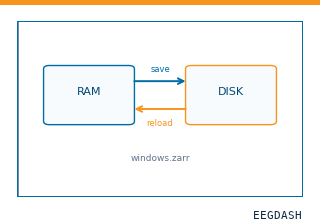 Save and reload prepared dataCache a windowed dataset to disk and reattach it without recompute.
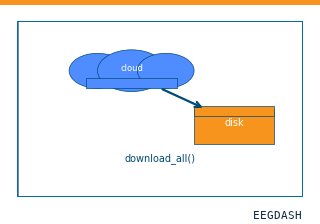 Download a dataset locallyPrefetch BIDS files to a local cache and validate the layout.
Swap any load_dataset(...) call for nm000357 to reproduce the tutorial on this dataset.
Citation
Umit Keles, Julien Dubois, Kevin J. M. Le, J. Michael Tyszka, David A. Kahn, … (2024). Movie watching and recognition memory: depth-electrode macro iEEG from Keles et al. 2024 (DANDI 000623). 10.82901/nemar.nm000357
Provenance
¹Contributed to nemar in BIDS format.
²Curated & ingested by the EEGDash catalog; see CITATION.cff for canonical reference.
³Persistent identifier: 10.82901/nemar.nm000357.
See Also#
eegdash.dataset.EEGDashDataseteegdash.dataset