


NM000436: ieeg dataset, 9 subjects#
Intraoperative VIM thalamus microelectrode recordings during transcutaneous afferent patterned stimulation (TAPS) for essential tremor (Luu et al.; derivative: authors’ processed 48 kHz signals)
Access recordings and metadata through EEGDash.
Citation: Cuong P. Luu, Jordan Ranum, Youngwon Youn, Jennifer L. Perrault, Bryan M. Krause, Matthew I. Banks, Laura Buyan-Dent, Kip A. Ludwig, Wendell B. Lake, Aaron J. Suminski (2025). Intraoperative VIM thalamus microelectrode recordings during transcutaneous afferent patterned stimulation (TAPS) for essential tremor (Luu et al.; derivative: authors’ processed 48 kHz signals). 10.82901/nemar.nm000436
Modality: ieeg Subjects: 9 Recordings: 84 License: CC0-1.0 Source: nemar
Metadata: Complete (100%)
9-participant iEEG dataset — Intraoperative VIM thalamus microelectrode recordings during transcutaneous afferent patterned stimulation (TAPS) for essential tremor (Luu et al.; derivative: authors' processed 48 kHz signals).
Quickstart#
Install
pip install eegdash
Access the data
from eegdash.dataset import NM000436

dataset = NM000436(cache_dir="./data")
# Get the raw object of the first recording
raw = dataset.datasets[0].raw
print(raw.info)
Filter by subject
dataset = NM000436(cache_dir="./data", subject="01")
Advanced query
dataset = NM000436(
    cache_dir="./data",
    query={"subject": {"$in": ["01", "02"]}},
)
Iterate recordings
for rec in dataset:
    print(rec.subject, rec.raw.info['sfreq'])
If you use this dataset in your research, please cite the original authors.
BibTeX
@dataset{nm000436,
  title = {Intraoperative VIM thalamus microelectrode recordings during transcutaneous afferent patterned stimulation (TAPS) for essential tremor (Luu et al.; derivative: authors' processed 48 kHz signals)},
  author = {Cuong P. Luu and Jordan Ranum and Youngwon Youn and Jennifer L. Perrault and Bryan M. Krause and Matthew I. Banks and Laura Buyan-Dent and Kip A. Ludwig and Wendell B. Lake and Aaron J. Suminski},
  doi = {10.82901/nemar.nm000436},
  url = {https://doi.org/10.82901/nemar.nm000436},
}
About This Dataset#
Intraoperative microelectrode recordings (MER) from the ventral intermediate nucleus of the thalamus (VIM) region of
9 adults with medication-refractory essential tremor undergoing DBS surgery (University of Wisconsin-Madison, IRB 2018-1052).
At each recording depth, 60 s were recorded without and with transcutaneous afferent patterned stimulation (TAPS) of the
treated hand, a wearable peripheral nerve stimulation therapy. Remifentanil was stopped 15 min before mapping (article).
VIM thalamus microelectrode recordings during TAPS for essential tremor (Luu et al. 2025) - DERIVATIVE
THIS IS A DERIVATIVE DATASET: the original recordings were never released
The original FHC recordings (.apm files) and the authors’ intermediate ‘R files’ (output of MER_loadData.m) are NOT part of the Dryad release. The release contains only the authors’ processed MATLAB files (‘P-’ = “Processed neural data after signal processing and artifact removal”, Dryad README) and derived files.
View full README
VIM thalamus microelectrode recordings during TAPS for essential tremor (Luu et al. 2025) - DERIVATIVE
THIS IS A DERIVATIVE DATASET: the original recordings were never released
The original FHC recordings (.apm files) and the authors’ intermediate ‘R files’ (output of MER_loadData.m) are NOT part of the Dryad release. The release contains only the authors’ processed MATLAB files (‘P-’ = “Processed neural data after signal processing and artifact removal”, Dryad README) and derived files.
The signals here are the P-File field
rawexactly as released (cast to float32): the authors’ software-filtered, offset-removed (zero-mean), 60 s-trimmed signals. Evidence (measured on all files in Voyager Jobs ieeg-b3w10-vim-insp-1008005934 and ieeg-b3w10-vim-quant-1008010513): - every trace is exactly 2,880,000 samples = 60.0 s at 48 kHz per trial, while the acquisition timestamps (trialTimes)span 2,880,013-2,880,061 ticks: trimmed to exactly 60 s;
the mean of each 60 s trace is ~1e-5..6e-4 µV against a standard deviation of 1e3..7e3 µV (relative 1e-8): offset removed in software;
the power spectrum falls by 13-20 orders of magnitude between 6-8 kHz and 20-24 kHz, i.e. a steep double-precision digital low-pass near 8-10 kHz, whereas the article states a 20 kHz hardware band limit;
the values are not on any ADC quantisation grid (FHC .apm files store integer samples times voltageCalib), so they are not a scaled copy of the acquired samples.
Further derived fields of the P-Files (lfp, spk, rawLPCheby, rawBPCheby, raw_blanked, spk_blanked, spike waveforms, PSDs) are not converted; they remain available in sourcedata/P-Files.
Contents
9 participants (
sub-<NN>= study subject number 02, 03, 06-12 of IRB study CH1052), 84 runs, 1.40 h at 48 kHz.task-taps_acq-off= P-Filebase(TAPS off);task-taps_acq-on= P-Filestim(TAPS on). Runs are numbered in chronological order of acquisition within each subject (P-File trialTimes). A few P-File cells hold two consecutive 60 s trials; each trial is a run, placed right after the cell’s first trial (trialTimes gives only the first trial’s times, so later trials have n/a trial ticks in scans.tsv).sub-<NN>_scans.tsv: TAPS state, depth label and depth (mm above target), source P-File cell, acquisition-clock trial times, TAPS frequency/amplitude, fraction of samples in the authors’ artefact mask.Channels
Ant,Cen,Pos: the anterior, center and posterior Ben-gun microelectrodes (2 mm apart), each recorded bipolar against the macro contact 1 cm dorsal to its tip (article); type DBS, µV (unit from the authors’ figure labels).events.tsv: the whole trial (taps_off_trial/taps_on_trial) and the segments of the authors’ motion-artefact blanking mask (artifact_blanked_by_authors). The data samples themselves are not blanked.Data format: BrainVision IEEE float32. BrainVision has no float64; the float64 P-File values are stored as float32 (relative rounding <= 6e-8, at most 0.002 µV, far below the ~0.022 µV ADC step). Every file was read back and is bit-identical to float32 of the P-File values. The float64 originals are in sourcedata/.
Electrodes:
space-Otherper subject, with the P-File coordinates in mm (chanCoord for each track and depth, implantCoord and therapyCoord for the final DBS lead and therapeutic contact). CAVEAT: the authors do not state the frame. The values (x 0, y +2/0/-2 for the anterior/center/posterior tracks, z = depth in mm above the planned target) look like offsets from the planned VIM target along the trajectory. They are NOT MNI/Talairach coordinates; do not use them for atlas lookups.participants.tsv: age and sex are n/a (the article reports only group values: 65 +/- 7 years, 2 of 9 female); implant side (P-File), TAPS-treated hand (TETRAS log), TAPS settings (P-File).
Empty P-File cells (no recording) are skipped; they are listed in code/conversion_report.json.
sourcedata/: P-Files (MAT header creation date set to day 01, HDF5 content unchanged), the Dryad README, and the root folder zip (analysis scripts, TETRAS scores, stimVbaseSPK.mat; member and MAT header dates set to day 01).
Source
Dryad: Cuong P. Luu, Jordan Ranum, Youngwon Youn, Jennifer L. Perrault, Bryan M. Krause, Matthew I. Banks, Laura Buyan-Dent, Kip A. Ludwig, Wendell B. Lake, Aaron J. Suminski. “Real-time VIM thalamus recordings during peripheral nerve stimulation treatment for essential tremor: DBS intraoperative dataset”. doi:10.5061/dryad.cjsxksngp (CC0-1.0).
Article: Luu et al. (2025) “Wearable peripheral nerve stimulator reduces essential tremor symptoms through targeted brain modulation”, Brain Stimulation, doi:10.1016/j.brs.2025.06.004. Preprint doi:10.1101/2024.12.02.24317799.
Funding: University of Wisconsin-Madison School of Medicine and Public Health; AJS and WBL were partly funded by Cala Health, Inc. (preprint).
Privacy
The release contains study codes only (CH1052-NN). Strings in the P-Files are depth labels and implant side. MAT header file-creation dates (June 2024, processing dates) were set to day 01. No names or recording dates were found.
NEMAR Metadata#
[](https://doi.org/10.82901/nemar.nm000436) # VIM thalamus microelectrode recordings during TAPS for essential tremor (Luu et al. 2025) - DERIVATIVE Intraoperative microelectrode recordings (MER) from the ventral intermediate nucleus of the thalamus (VIM) region of 9 adults with medication-refractory essential tremor undergoing DBS surgery (University of Wisconsin-Madison, IRB 2018-1052). At each recording depth, 60 s were recorded without and with transcutaneous afferent patterned stimulation (TAPS) of the treated hand, a wearable peripheral nerve stimulation therapy. Remifentanil was stopped 15 min before mapping (article). ## THIS IS A DERIVATIVE DATASET: the original recordings were never released - The original FHC recordings (.apm files) and the authors’ intermediate ‘R files’ (output of MER_loadData.m) are NOT part
of the Dryad release. The release contains only the authors’ processed MATLAB files (‘P-’ = “Processed neural data after signal processing and artifact removal”, Dryad README) and derived files.
The signals here are the P-File field raw exactly as released (cast to float32): the authors’ software-filtered, offset-removed (zero-mean), 60 s-trimmed signals. Evidence (measured on all files in Voyager Jobs ieeg-b3w10-vim-insp-1008005934 and ieeg-b3w10-vim-quant-1008010513): - every trace is exactly 2,880,000 samples = 60.0 s at 48 kHz per trial, while the acquisition timestamps (trialTimes)
span 2,880,013-2,880,061 ticks: trimmed to exactly 60 s;
the mean of each 60 s trace is ~1e-5..6e-4 µV against a standard deviation of 1e3..7e3 µV (relative 1e-8): offset removed in software;
the power spectrum falls by 13-20 orders of magnitude between 6-8 kHz and 20-24 kHz, i.e. a steep double-precision digital low-pass near 8-10 kHz, whereas the article states a 20 kHz hardware band limit;
the values are not on any ADC quantisation grid (FHC .apm files store integer samples times voltageCalib), so they are not a scaled copy of the acquired samples.
Further derived fields of the P-Files (lfp, spk, rawLPCheby, rawBPCheby, raw_blanked, spk_blanked, spike waveforms, PSDs) are not converted; they remain available in sourcedata/P-Files.
## Contents - 9 participants (sub-<NN> = study subject number 02, 03, 06-12 of IRB study CH1052), 84 runs, 1.40 h at 48 kHz. - task-taps_acq-off = P-File base (TAPS off); task-taps_acq-on = P-File stim (TAPS on). Runs are numbered in
chronological order of acquisition within each subject (P-File trialTimes). A few P-File cells hold two consecutive 60 s trials; each trial is a run, placed right after the cell’s first trial (trialTimes gives only the first trial’s times, so later trials have n/a trial ticks in scans.tsv).
sub-<NN>_scans.tsv: TAPS state, depth label and depth (mm above target), source P-File cell, acquisition-clock trial times, TAPS frequency/amplitude, fraction of samples in the authors’ artefact mask.
Channels Ant, Cen, Pos: the anterior, center and posterior Ben-gun microelectrodes (2 mm apart), each recorded bipolar against the macro contact 1 cm dorsal to its tip (article); type DBS, µV (unit from the authors’ figure labels).
events.tsv: the whole trial (taps_off_trial / taps_on_trial) and the segments of the authors’ motion-artefact blanking mask (artifact_blanked_by_authors). The data samples themselves are not blanked.
Data format: BrainVision IEEE float32. BrainVision has no float64; the float64 P-File values are stored as float32 (relative rounding <= 6e-8, at most 0.002 µV, far below the ~0.022 µV ADC step). Every file was read back and is bit-identical to float32 of the P-File values. The float64 originals are in sourcedata/.
Electrodes: space-Other per subject, with the P-File coordinates in mm (chanCoord for each track and depth, implantCoord and therapyCoord for the final DBS lead and therapeutic contact). CAVEAT: the authors do not state the frame. The values (x 0, y +2/0/-2 for the anterior/center/posterior tracks, z = depth in mm above the planned target) look like offsets from the planned VIM target along the trajectory. They are NOT MNI/Talairach coordinates; do not use them for atlas lookups.
participants.tsv: age and sex are n/a (the article reports only group values: 65 +/- 7 years, 2 of 9 female); implant side (P-File), TAPS-treated hand (TETRAS log), TAPS settings (P-File).
Empty P-File cells (no recording) are skipped; they are listed in code/conversion_report.json.
sourcedata/: P-Files (MAT header creation date set to day 01, HDF5 content unchanged), the Dryad README, and the root folder zip (analysis scripts, TETRAS scores, stimVbaseSPK.mat; member and MAT header dates set to day 01).
## Source - Dryad: Cuong P. Luu, Jordan Ranum, Youngwon Youn, Jennifer L. Perrault, Bryan M. Krause, Matthew I. Banks, Laura Buyan-Dent, Kip A. Ludwig, Wendell B. Lake, Aaron J. Suminski. “Real-time VIM thalamus recordings during peripheral nerve stimulation treatment for essential
tremor: DBS intraoperative dataset”. doi:10.5061/dryad.cjsxksngp (CC0-1.0).
Article: Luu et al. (2025) “Wearable peripheral nerve stimulator reduces essential tremor symptoms through targeted brain modulation”, Brain Stimulation, doi:10.1016/j.brs.2025.06.004. Preprint doi:10.1101/2024.12.02.24317799.
Funding: University of Wisconsin-Madison School of Medicine and Public Health; AJS and WBL were partly funded by Cala Health, Inc. (preprint).
## Privacy The release contains study codes only (CH1052-NN). Strings in the P-Files are depth labels and implant side. MAT header file-creation dates (June 2024, processing dates) were set to day 01. No names or recording dates were found.
License: CC0-1.0
Authors:
Cuong P. Luu
Jordan Ranum
Youngwon Youn
Jennifer L. Perrault
Bryan M. Krause
… and 5 more
Versions:
Version |
DOI |
Released |
|---|---|---|
|
Cohort#
Dataset Statistics#
Channel counts: 3 ch (n=84 recordings)
Sampling frequencies: 48000.0 Hz (n=84 recordings)
Total recording duration: 1 h 24 min
Signal · Electrodes & live trace#
Live trace viewer — sub-02 · task-taps · run-09
Showing one representative recording out of
9 subjects and 84 recordings in this dataset.
Browse the full set on OpenNeuro;
drop any other _ieeg.{set,edf,bdf,vhdr} file onto the
viewer (or pass ?ieeg=<url>) to inspect it.
Electrode layout — iEEG · 20 sensors — 20 channels
NEMAR Processing Statistics#
The plots below are generated by NEMAR’s automated EEG pipeline. The histogram shows pipeline success for data cleaning and ICA decomposition, the percentage of data frames and EEG channels retained after artefact removal, line noise per channel (RMS, dB), and the age/gender distribution of participants.

HED event descriptors word cloud

Manifest#
File Explorer#
Browse the BIDS file structure of this dataset. Records are fetched on demand from the EEGDash catalog the first time you open the explorer.
Full dataset metadata table
Dataset ID |
|
Title |
Intraoperative VIM thalamus microelectrode recordings during transcutaneous afferent patterned stimulation (TAPS) for essential tremor (Luu et al.; derivative: authors’ processed 48 kHz signals) |
Author (year) |
— |
Canonical |
— |
Importable as |
|
Year |
2025 |
Authors |
Cuong P. Luu, Jordan Ranum, Youngwon Youn, Jennifer L. Perrault, Bryan M. Krause, Matthew I. Banks, Laura Buyan-Dent, Kip A. Ludwig, Wendell B. Lake, Aaron J. Suminski |
License |
CC0-1.0 |
Citation / DOI |
|
Source links |
OpenNeuro | NeMAR | Source URL |
Copy-paste BibTeX
@dataset{nm000436,
  title = {Intraoperative VIM thalamus microelectrode recordings during transcutaneous afferent patterned stimulation (TAPS) for essential tremor (Luu et al.; derivative: authors' processed 48 kHz signals)},
  author = {Cuong P. Luu and Jordan Ranum and Youngwon Youn and Jennifer L. Perrault and Bryan M. Krause and Matthew I. Banks and Laura Buyan-Dent and Kip A. Ludwig and Wendell B. Lake and Aaron J. Suminski},
  doi = {10.82901/nemar.nm000436},
  url = {https://doi.org/10.82901/nemar.nm000436},
}
API Reference#
eegdash.datasetEEGDashDataset- class eegdash.dataset.NM000436(cache_dir: str, query: dict | None = None, s3_bucket: str | None = None, **kwargs)[source]#
Intraoperative VIM thalamus microelectrode recordings during transcutaneous afferent patterned stimulation (TAPS) for essential tremor (Luu et al.; derivative: authors’ processed 48 kHz signals)
- Study:
nm000436(NeMAR)- Author (year):
—
- Canonical:
—
Also importable as:
NM000436.Modality:
ieeg; Subject type:Unknown. Subjects: 9; recordings: 84; tasks: 1.- Parameters:
cache_dir (str | Path) – Directory where data are cached locally.
query (dict | None) – Additional MongoDB-style filters to AND with the dataset selection. Must not contain the key
dataset.s3_bucket (str | None) – Base S3 bucket used to locate the data.
**kwargs (dict) – Additional keyword arguments forwarded to
EEGDashDataset.
- data_dir#
Local dataset cache directory (
cache_dir / dataset_id).- Type:
Path
Notes
Each item is a recording; recording-level metadata are available via
dataset.description.querysupports MongoDB-style filters on fields inALLOWED_QUERY_FIELDSand is combined with the dataset filter. Dataset-specific caveats are not provided in the summary metadata.References
OpenNeuro dataset: https://openneuro.org/datasets/nm000436 NeMAR dataset: https://nemar.org/dataexplorer/detail?dataset_id=nm000436 DOI: https://doi.org/10.82901/nemar.nm000436
Examples
>>> from eegdash.dataset import NM000436
>>> dataset = NM000436(cache_dir="./data")
>>> recording = dataset[0]
>>> raw = recording.load()
- __init__(cache_dir: str, query: dict | None = None, s3_bucket: str | None = None, **kwargs)[source]#
- save(path: str, overwrite: bool = False, offset: int = 0)[source]#
Save datasets to files by creating one subdirectory for each dataset:
path/
    0/
        0-raw.fif | 0-epo.fif
        description.json
        raw_preproc_kwargs.json (if raws were preprocessed)
        window_kwargs.json (if this is a windowed dataset)
        window_preproc_kwargs.json  (if windows were preprocessed)
        target_name.json (if target_name is not None and dataset is raw)
    1/
        1-raw.fif | 1-epo.fif
        description.json
        raw_preproc_kwargs.json (if raws were preprocessed)
        window_kwargs.json (if this is a windowed dataset)
        window_preproc_kwargs.json  (if windows were preprocessed)
        target_name.json (if target_name is not None and dataset is raw)
- Parameters:
path (str) –
- Directory in which subdirectories are created to store
-raw.fif | -epo.fif and .json files to.
overwrite (bool) – Whether to delete old subdirectories that will be saved to in this call.
offset (int) – If provided, the integer is added to the id of the dataset in the concat. This is useful in the setting of very large datasets, where one dataset has to be processed and saved at a time to account for its original position.
BaseDataset from braindecode — windowed via create_windows_from_events.braindecodeDataLoader; supports parallel workers and on-the-fly augmentations.pytorch Find datasets with the EEGDash APIQuery the catalogue, filter by task or modality, list candidates.
 Load one EEG recordingResolve a single record to an MNE Raw with channels and events.
 EEG recording to PyTorch DataLoaderWrap braindecode windows in a DataLoader for model training.
 Preprocess EEG and create windowsFilter, resample, epoch — and persist the windowed dataset.
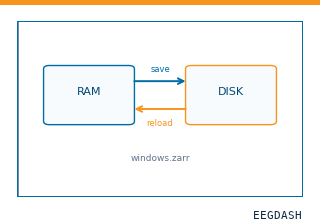 Save and reload prepared dataCache a windowed dataset to disk and reattach it without recompute.
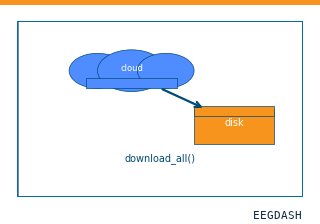 Download a dataset locallyPrefetch BIDS files to a local cache and validate the layout.
Swap any load_dataset(...) call for nm000436 to reproduce the tutorial on this dataset.
Citation
Cuong P. Luu, Jordan Ranum, Youngwon Youn, Jennifer L. Perrault, Bryan M. Krause, … (2025). Intraoperative VIM thalamus microelectrode recordings during transcutaneous afferent patterned stimulation (TAPS) for essential tremor (Luu et al.; derivative: authors' processed 48 kHz signals). 10.82901/nemar.nm000436
Provenance
¹Contributed to nemar in BIDS format.
²Curated & ingested by the EEGDash catalog; see CITATION.cff for canonical reference.
³Persistent identifier: 10.82901/nemar.nm000436.
See Also#
eegdash.dataset.EEGDashDataseteegdash.dataset