


NM000365: ieeg dataset, 12 subjects#
Du-IN Chinese word-reading sEEG (Zheng et al., NeurIPS 2024): authors’ preprocessed 3-s epochs, 12 subjects, 61 words
Access recordings and metadata through EEGDash.
Citation: Hui Zheng, Hai-Teng Wang, Wei-Bang Jiang, Zhong-Tao Chen, Li He, Pei-Yang Lin, Peng-Hu Wei, Guo-Guang Zhao, Yun-Zhe Liu (2021). Du-IN Chinese word-reading sEEG (Zheng et al., NeurIPS 2024): authors’ preprocessed 3-s epochs, 12 subjects, 61 words. 10.82901/nemar.nm000365
Modality: ieeg Subjects: 12 Recordings: 67 License: CC-BY-4.0 Source: nemar
Metadata: Complete (100%)
12-participant iEEG dataset — Du-IN Chinese word-reading sEEG (Zheng et al., NeurIPS 2024): authors' preprocessed 3-s epochs, 12 subjects, 61 words.
Quickstart#
Install
pip install eegdash
Access the data
from eegdash.dataset import NM000365

dataset = NM000365(cache_dir="./data")
# Get the raw object of the first recording
raw = dataset.datasets[0].raw
print(raw.info)
Filter by subject
dataset = NM000365(cache_dir="./data", subject="01")
Advanced query
dataset = NM000365(
    cache_dir="./data",
    query={"subject": {"$in": ["01", "02"]}},
)
Iterate recordings
for rec in dataset:
    print(rec.subject, rec.raw.info['sfreq'])
If you use this dataset in your research, please cite the original authors.
BibTeX
@dataset{nm000365,
  title = {Du-IN Chinese word-reading sEEG (Zheng et al., NeurIPS 2024): authors' preprocessed 3-s epochs, 12 subjects, 61 words},
  author = {Hui Zheng and Hai-Teng Wang and Wei-Bang Jiang and Zhong-Tao Chen and Li He and Pei-Yang Lin and Peng-Hu Wei and Guo-Guang Zhao and Yun-Zhe Liu},
  doi = {10.82901/nemar.nm000365},
  url = {https://doi.org/10.82901/nemar.nm000365},
}
About This Dataset#
These are not raw recordings. This dataset is a BIDS packaging of the word-reading sEEG data released with
Du-IN: Discrete units-guided mask modeling for decoding speech from Intracranial Neural signals (Zheng, Wang, Jiang,
Chen, He, Lin, Wei, Zhao, Liu; NeurIPS 2024; doi:10.52202/079017-2542; arXiv:2405.11459). The authors published only
a preprocessed version of the 61-word reading data on Hugging Face (liulab-repository/Du-IN, revision
2c85b670230dced33f2f1cbd0903648680ecc7d0, last modified 2025-04-30, licence CC-BY-4.0). Their GitHub README says:
“we can only share the preprocessed version of the 61-word reading sEEG dataset (~3 hours)”. The ~12 h of
non-task recordings used for pre-training are not shared. dataset_description.json therefore declares
DatasetType: derivative.
does not link age or sex to individual subjects, so
participants.tsvholds only the subject IDs. 7 to 13 sEEGelectrodes per subject, placed for clinical reasons only. Recorded at 2000 Hz.
Du-IN Chinese word-reading sEEG (Zheng et al., NeurIPS 2024): the authors’ preprocessed epochs
Task: reading Chinese words aloud. The 61-word set and the authors’ English translations are in the paper (Table 4) and in the
word_encolumn of the events files. Each trial starts with the word in white text (0.5 s). The text then turns green, which is the go cue, and stays on screen for 2 s while the subject reads the word aloud. A fixation cross follows for 0.5 s. Each ~10-minute block presents every word twice in random order (122 trials). The paper reports 25 blocks in total.
View full README
Du-IN Chinese word-reading sEEG (Zheng et al., NeurIPS 2024): the authors’ preprocessed epochs
Task: reading Chinese words aloud. The 61-word set and the authors’ English translations are in the paper (Table 4) and in the
word_encolumn of the events files. Each trial starts with the word in white text (0.5 s). The text then turns green, which is the go cue, and stays on screen for 2 s while the subject reads the word aloud. A fixation cross follows for 0.5 s. Each ~10-minute block presents every word twice in random order (122 trials). The paper reports 25 blocks in total.Ethics, as stated by the authors: “Experiments that contribute to this work were approved by IRB. All subjects consent to participate.” The consent form includes a privacy statement and data retention “after deleting all personal identification information (PII)”. The release contains no names, dates or imaging.
Additional study details (from the paper, arXiv:2405.11459v3: section 4.1, Appendix A, Ethics Statement, Appendix O)
Implant: 7 to 13 sEEG depth electrodes per subject; the paper gives 72 to 158 channels per subject at acquisition (the released bipolar channel counts are 62 to 147, see the table below). Electrodes carry 8-16 channels each (section 4.3). “All electrode locations are exclusively dictated by clinical considerations.” Most subjects had electrodes on one hemisphere only; the paper shows per-subject electrode locations as figures (Appendix O, Figures 9-11) but no coordinates were released.
Recordings: about 15 h of 2000 Hz sEEG per subject, of which about 3 h are task recordings (the part released here) and about 12 h are non-task recordings during wakefulness (not released). The subject’s voice was recorded simultaneously during the task; the audio is not part of the release.
Word set: 61 words chosen for (1) versatility in generating sentences, (2) expressing basic caregiving needs and (3) covering as many Chinese pronunciation combinations as possible. The design follows Moses et al. (2021).
Recording site: not stated explicitly by the paper or the release. Two authors (P.-H. Wei, G.-G. Zhao) are affiliated with Capital Medical University, Xuanwu Hospital, Beijing, and the release directory is named
seeg.he2023xuanwu. NoInstitutionNameis set in the sidecars for this reason.Amplifier/recording system, electrode manufacturer and acquisition reference are not stated in the paper or the release (left out of the sidecars).
Consent (Ethics Statement): adults with full civil capacity signed written informed consent; for minors or participants without full civil capacity, the legal guardian signed. The consent form covers research purpose, risks, data use, a privacy statement (PII not disclosed), data retention after deleting all PII, voluntariness and the right to withdraw at any time.
Preprocessing done by the authors (before release)
Paper section 4.2: band-pass 0.5-200 Hz, 50 Hz notch, resampling to 1000 Hz, bipolar re-reference. The signals were
then cut into 3-s samples (3000 points), each labelled with its word. The released variant is named
dataset.bipolar.default.unaligned. The paper also lists per-channel z-scoring, but the stored values are not
z-scored: per-channel standard deviations are of order 1e-5. That step is presumably applied at training time.
The release does not state:
- the unit (the magnitudes are only plausible as volts, so V is used and the numbers are left unchanged);
- the contact pairing of each bipolar channel (channel names are as released);
- where each 3-s epoch sits relative to word onset, go cue or speech onset;
- whether the stored epoch order is the presentation order;
- electrode coordinates or anatomical labels. BIDS iEEG requires an electrodes file, so each subject’s electrodes.tsv
lists the released channel names with x, y, z and size set to
n/a, andcoordsystem.jsonsaysOtherwith no unit. No coordinates were estimated.
Files
sub-<id>/ieeg/sub-<id>_task-wordreading_run-<n>_ieeg.vhdr/.vmrk/.eeg: one file per source run (word-recitation/run<n>). BrainVision, IEEE float32, 1000 Hz, unit V, resolution 1. Each value is the authors’ stored float64 value rounded to float32 (maximum absolute rounding error 1.5e-08 V). The epochs are stored back to back: the sidecar saysRecordingType: epochedwithEpochLength: 3, and the marker file has aNew Segmentat each epoch start. The time axis of the file is not the time axis of the original recording. Do not filter across epoch boundaries. To get epochs, split every 3000 samples.mne_bids.read_raw_bidsrefuses epoched recordings, so read the file withmne.io.read_raw_brainvisionand reshape it...._events.tsv: one row per epoch.valueholds the word exactly as stored (UTF-8 Chinese) andword_enholds the authors’ translation.source_epoch_indexis the epoch’s position in the source pickle...._channels.tsv: all channels areSEEGwith the authors’ filter settings.groupis the electrode shaft (the name prefix). All channels aregood, since the release flags none.sub-<id>_scans.tsv: the source file behind each recording.sourcedata/huggingface-liulab-repository-Du-IN/: the originaldataandinfofiles of every run, byte-identical (sha256 insourcedata/sourcedata_provenance.json). They are Python pickles. Never callpickle.loadon files you do not trust.code/laneJ_pkl.pyis a restricted unpickler that admits only the globals these files use. Eachdatafile is a list of records{name: <word>, data_s: float64 array (n_channels, 3000)}. Eachinfofile holds{ch_names: [...]}. Model checkpoints (pretrains/) from the same release are not copied, because they are not recordings.code/: the download, conversion and round-trip scripts used to build this package.
Recordings
| Subject | Runs | Channels | Epochs | Minutes of epochs | NaN values |
|---|---|---|---|---|---|
| sub-001 | 1, 2, 3, 4, 5, 6 | 104 | 3065 | 153.2 | 0 |
| sub-002 | 1, 2, 3, 4, 5, 6 | 115 | 3625 | 181.2 | 0 |
| sub-003 | 1, 2, 3, 4, 5, 6 | 67 | 3442 | 172.1 | 0 |
| sub-004 | 1, 3, 4, 5, 6 | 100 | 3043 | 152.2 | 0 |
| sub-005 | 1, 2, 3, 4, 5 | 123 | 3048 | 152.4 | 0 |
| sub-006 | 1, 2, 3, 4, 5, 6 | 101 | 3365 | 168.2 | 0 |
| sub-007 | 1, 2, 3, 4, 5, 6 | 94 | 3546 | 177.3 | 0 |
| sub-008 | 1, 2, 3, 4, 5, 6 | 98 | 3628 | 181.4 | 0 |
| sub-009 | 1, 2, 3, 4, 5, 6 | 147 | 3473 | 173.7 | 0 |
| sub-010 | 1, 2, 3, 4, 5, 6 | 88 | 3501 | 175.1 | 0 |
| sub-011 | 1, 2, 3, 4, 5, 6 | 90 | 3161 | 158.1 | 0 |
| sub-012 | 1, 2, 3 | 62 | 1830 | 91.5 | 0 |
Total: 67 runs, 38727 epochs (32.27 h).
Subject 004 has no run 2, subject 005 has no run 6, and subject 012 has only runs 1-3. This matches the release.
A full run would hold 610 epochs (5 blocks x 122 trials), but many runs hold fewer. The authors’ loader explains why:
“The labels may not be the same, due to bad trials” (utils/data/seeg/he2023xuanwu/word_recitation.py). The removed
trials and the rejection criterion are not documented, and sub-009 run 5 has 60 of the 61 words. A few runs contain
large transients: the maximum |value| is 0.48 V in sub-003 run 3 and 0.24 V in sub-008 run 4, while median channel SDs
are about 2e-5 to 6e-5 V. These are kept as released, and no channel is marked bad.
Conversion and checks
Packaging only: no filtering, resampling, re-referencing, channel dropping or epoch dropping. A round trip read every file back with MNE and compared it with the source pickles. All samples were equal to float32(source), and channel order, epoch count, words, onsets and durations matched in all 67 runs. The BIDS validator reported no errors. Packaged for NEMAR by Bruno Aristimunha (2026-10-06).
How to load
import mne, numpy as np, pandas as pd
vhdr = "sub-001/ieeg/sub-001_task-wordreading_run-1_ieeg.vhdr"
raw = mne.io.read_raw_brainvision(vhdr, preload=True)          # 1000 Hz, SEEG, volts
data = raw.get_data()                                           # (n_channels, n_epochs * 3000)
epochs = data.reshape(data.shape[0], -1, 3000).transpose(1, 0, 2)  # (n_epochs, n_channels, 3000)
ev = pd.read_csv(vhdr.replace("_ieeg.vhdr", "_events.tsv"), sep="\t")
labels = ev["value"].to_numpy()                                 # one Chinese word per epoch (word_en: English)
task-wordreading_events.json lists the 61 words with the authors’ English translations (value Levels).
Funding and acknowledgements
National Science and Technology Innovation 2030 Major Program (2022ZD0205500), National Natural Science Foundation of
China (32271093), Beijing Natural Science Foundation (Z230010, L222033), and the Fundamental Research Funds for the
Central Universities (paper, Acknowledgements; also in dataset_description.json).
Licence and citation
Licence: CC-BY-4.0 (Hugging Face dataset card of liulab-repository/Du-IN). The Du-IN code on GitHub is MIT licensed.
If you use these data, cite:
Zheng H, Wang H-T, Jiang W-B, Chen Z-T, He L, Lin P-Y, Wei P-H, Zhao G-G, Liu Y-Z. Du-IN: Discrete units-guided mask modeling for decoding speech from Intracranial Neural signals. NeurIPS 2024. doi:10.52202/079017-2542, arXiv:2405.11459.
NEMAR Metadata#
[](https://doi.org/10.82901/nemar.nm000365) # Du-IN Chinese word-reading sEEG (Zheng et al., NeurIPS 2024): the authors’ preprocessed epochs These are not raw recordings. This dataset is a BIDS packaging of the word-reading sEEG data released with Du-IN: Discrete units-guided mask modeling for decoding speech from Intracranial Neural signals (Zheng, Wang, Jiang, Chen, He, Lin, Wei, Zhao, Liu; NeurIPS 2024; doi:10.52202/079017-2542; arXiv:2405.11459). The authors published only a preprocessed version of the 61-word reading data on Hugging Face (liulab-repository/Du-IN, revision 2c85b670230dced33f2f1cbd0903648680ecc7d0, last modified 2025-04-30, licence CC-BY-4.0). Their GitHub README says: “we can only share the preprocessed version of the 61-word reading sEEG dataset (~3 hours)”. The ~12 h of non-task recordings used for pre-training are not shared. dataset_description.json therefore declares DatasetType: derivative. ## Participants and task (from the paper, Appendix A) - 12 patients with pharmacologically intractable epilepsy (9 male, 3 female; aged 15-53, mean 27.8, SD 10.4). The release
does not link age or sex to individual subjects, so participants.tsv holds only the subject IDs. 7 to 13 sEEG electrodes per subject, placed for clinical reasons only. Recorded at 2000 Hz.
Task: reading Chinese words aloud. The 61-word set and the authors’ English translations are in the paper (Table 4) and in the word_en column of the events files. Each trial starts with the word in white text (0.5 s). The text then turns green, which is the go cue, and stays on screen for 2 s while the subject reads the word aloud. A fixation cross follows for 0.5 s. Each ~10-minute block presents every word twice in random order (122 trials). The paper reports 25 blocks in total.
Ethics, as stated by the authors: “Experiments that contribute to this work were approved by IRB. All subjects consent to participate.” The consent form includes a privacy statement and data retention “after deleting all personal identification information (PII)”. The release contains no names, dates or imaging.
## Additional study details (from the paper, arXiv:2405.11459v3: section 4.1, Appendix A, Ethics Statement, Appendix O) - Implant: 7 to 13 sEEG depth electrodes per subject; the paper gives 72 to 158 channels per subject at acquisition
(the released bipolar channel counts are 62 to 147, see the table below). Electrodes carry 8-16 channels each (section 4.3). “All electrode locations are exclusively dictated by clinical considerations.” Most subjects had electrodes on one hemisphere only; the paper shows per-subject electrode locations as figures (Appendix O, Figures 9-11) but no coordinates were released.
Recordings: about 15 h of 2000 Hz sEEG per subject, of which about 3 h are task recordings (the part released here) and about 12 h are non-task recordings during wakefulness (not released). The subject’s voice was recorded simultaneously during the task; the audio is not part of the release.
Word set: 61 words chosen for (1) versatility in generating sentences, (2) expressing basic caregiving needs and (3) covering as many Chinese pronunciation combinations as possible. The design follows Moses et al. (2021).
Recording site: not stated explicitly by the paper or the release. Two authors (P.-H. Wei, G.-G. Zhao) are affiliated with Capital Medical University, Xuanwu Hospital, Beijing, and the release directory is named seeg.he2023xuanwu. No InstitutionName is set in the sidecars for this reason.
Amplifier/recording system, electrode manufacturer and acquisition reference are not stated in the paper or the release (left out of the sidecars).
Consent (Ethics Statement): adults with full civil capacity signed written informed consent; for minors or participants without full civil capacity, the legal guardian signed. The consent form covers research purpose, risks, data use, a privacy statement (PII not disclosed), data retention after deleting all PII, voluntariness and the right to withdraw at any time.
## Preprocessing done by the authors (before release) Paper section 4.2: band-pass 0.5-200 Hz, 50 Hz notch, resampling to 1000 Hz, bipolar re-reference. The signals were then cut into 3-s samples (3000 points), each labelled with its word. The released variant is named dataset.bipolar.default.unaligned. The paper also lists per-channel z-scoring, but the stored values are not z-scored: per-channel standard deviations are of order 1e-5. That step is presumably applied at training time. The release does not state: - the unit (the magnitudes are only plausible as volts, so V is used and the numbers are left unchanged); - the contact pairing of each bipolar channel (channel names are as released); - where each 3-s epoch sits relative to word onset, go cue or speech onset; - whether the stored epoch order is the presentation order; - electrode coordinates or anatomical labels. BIDS iEEG requires an electrodes file, so each subject’s electrodes.tsv
lists the released channel names with x, y, z and size set to n/a, and coordsystem.json says Other with no unit. No coordinates were estimated.
## Files - sub-<id>/ieeg/sub-<id>_task-wordreading_run-<n>_ieeg.vhdr/.vmrk/.eeg: one file per source run
(word-recitation/run<n>). BrainVision, IEEE float32, 1000 Hz, unit V, resolution 1. Each value is the authors’ stored float64 value rounded to float32 (maximum absolute rounding error 1.5e-08 V). The epochs are stored back to back: the sidecar says RecordingType: epoched with EpochLength: 3, and the marker file has a New Segment at each epoch start. The time axis of the file is not the time axis of the original recording. Do not filter across epoch boundaries. To get epochs, split every 3000 samples. mne_bids.read_raw_bids refuses epoched recordings, so read the file with mne.io.read_raw_brainvision and reshape it.
…_events.tsv: one row per epoch. value holds the word exactly as stored (UTF-8 Chinese) and word_en holds the authors’ translation. source_epoch_index is the epoch’s position in the source pickle.
…_channels.tsv: all channels are SEEG with the authors’ filter settings. group is the electrode shaft (the name prefix). All channels are good, since the release flags none.
sub-<id>_scans.tsv: the source file behind each recording.
sourcedata/huggingface-liulab-repository-Du-IN/: the original data and info files of every run, byte-identical (sha256 in sourcedata/sourcedata_provenance.json). They are Python pickles. Never call pickle.load on files you do not trust. code/laneJ_pkl.py is a restricted unpickler that admits only the globals these files use. Each data file is a list of records {name: <word>, data_s: float64 array (n_channels, 3000)}. Each info file holds {ch_names: […]}. Model checkpoints (pretrains/) from the same release are not copied, because they are not recordings.
code/: the download, conversion and round-trip scripts used to build this package.
## Recordings
| Subject | Runs | Channels | Epochs | Minutes of epochs | NaN values |
|---|—|---|—|---|—|
| sub-001 | 1, 2, 3, 4, 5, 6 | 104 | 3065 | 153.2 | 0 |
| sub-002 | 1, 2, 3, 4, 5, 6 | 115 | 3625 | 181.2 | 0 |
| sub-003 | 1, 2, 3, 4, 5, 6 | 67 | 3442 | 172.1 | 0 |
| sub-004 | 1, 3, 4, 5, 6 | 100 | 3043 | 152.2 | 0 |
| sub-005 | 1, 2, 3, 4, 5 | 123 | 3048 | 152.4 | 0 |
| sub-006 | 1, 2, 3, 4, 5, 6 | 101 | 3365 | 168.2 | 0 |
| sub-007 | 1, 2, 3, 4, 5, 6 | 94 | 3546 | 177.3 | 0 |
| sub-008 | 1, 2, 3, 4, 5, 6 | 98 | 3628 | 181.4 | 0 |
| sub-009 | 1, 2, 3, 4, 5, 6 | 147 | 3473 | 173.7 | 0 |
| sub-010 | 1, 2, 3, 4, 5, 6 | 88 | 3501 | 175.1 | 0 |
| sub-011 | 1, 2, 3, 4, 5, 6 | 90 | 3161 | 158.1 | 0 |
| sub-012 | 1, 2, 3 | 62 | 1830 | 91.5 | 0 |
Total: 67 runs, 38727 epochs (32.27 h).
Subject 004 has no run 2, subject 005 has no run 6, and subject 012 has only runs 1-3. This matches the release.
A full run would hold 610 epochs (5 blocks x 122 trials), but many runs hold fewer. The authors’ loader explains why:
“The labels may not be the same, due to bad trials” (utils/data/seeg/he2023xuanwu/word_recitation.py). The removed
trials and the rejection criterion are not documented, and sub-009 run 5 has 60 of the 61 words. A few runs contain
large transients: the maximum |value| is 0.48 V in sub-003 run 3 and 0.24 V in sub-008 run 4, while median channel SDs
are about 2e-5 to 6e-5 V. These are kept as released, and no channel is marked bad.
## Conversion and checks
Packaging only: no filtering, resampling, re-referencing, channel dropping or epoch dropping. A round trip
read every file back with MNE and compared it with the source pickles. All samples were equal to float32(source),
and channel order, epoch count, words, onsets and durations matched in all 67 runs. The BIDS validator reported
no errors. Packaged for NEMAR by Bruno Aristimunha (2026-10-06).
## How to load
`python
import mne, numpy as np, pandas as pd
vhdr = "sub-001/ieeg/sub-001_task-wordreading_run-1_ieeg.vhdr"
raw = mne.io.read_raw_brainvision(vhdr, preload=True)          # 1000 Hz, SEEG, volts
data = raw.get_data()                                           # (n_channels, n_epochs * 3000)
epochs = data.reshape(data.shape[0], -1, 3000).transpose(1, 0, 2)  # (n_epochs, n_channels, 3000)
ev = pd.read_csv(vhdr.replace("_ieeg.vhdr", "_events.tsv"), sep="\t")
labels = ev["value"].to_numpy()                                 # one Chinese word per epoch (word_en: English)
`
task-wordreading_events.json lists the 61 words with the authors’ English translations (value Levels).
## Funding and acknowledgements
National Science and Technology Innovation 2030 Major Program (2022ZD0205500), National Natural Science Foundation of
China (32271093), Beijing Natural Science Foundation (Z230010, L222033), and the Fundamental Research Funds for the
Central Universities (paper, Acknowledgements; also in dataset_description.json).
## Licence and citation
Licence: CC-BY-4.0 (Hugging Face dataset card of liulab-repository/Du-IN). The Du-IN code on GitHub is MIT licensed.
If you use these data, cite:
Zheng H, Wang H-T, Jiang W-B, Chen Z-T, He L, Lin P-Y, Wei P-H, Zhao G-G, Liu Y-Z. Du-IN: Discrete units-guided mask
modeling for decoding speech from Intracranial Neural signals. NeurIPS 2024. doi:10.52202/079017-2542, arXiv:2405.11459.
License: CC-BY-4.0
Authors:
Hui Zheng
Hai-Teng Wang
Wei-Bang Jiang
Zhong-Tao Chen
Li He
… and 4 more
Versions:
Version |
DOI |
Released |
|---|---|---|
|
Cohort#
Dataset Statistics#
Channel counts (ch)
Sampling frequencies: 1000.0 Hz (n=67 recordings)
Total recording duration: 32 h
Signal · Electrodes & live trace#
Live trace viewer — sub-012 · task-wordreading · run-3
Showing one representative recording out of
12 subjects and 67 recordings in this dataset.
Browse the full set on OpenNeuro;
drop any other _ieeg.{set,edf,bdf,vhdr} file onto the
viewer (or pass ?ieeg=<url>) to inspect it.
No scalp electrode layout is currently indexed for this dataset. Once the eegdash montage registry ingests it, the interactive viewer will appear here automatically.
NEMAR Processing Statistics#
The plots below are generated by NEMAR’s automated EEG pipeline. The histogram shows pipeline success for data cleaning and ICA decomposition, the percentage of data frames and EEG channels retained after artefact removal, line noise per channel (RMS, dB), and the age/gender distribution of participants.

HED event descriptors word cloud

Manifest#
File Explorer#
Browse the BIDS file structure of this dataset. Records are fetched on demand from the EEGDash catalog the first time you open the explorer.
Full dataset metadata table
Dataset ID |
|
Title |
Du-IN Chinese word-reading sEEG (Zheng et al., NeurIPS 2024): authors’ preprocessed 3-s epochs, 12 subjects, 61 words |
Author (year) |
— |
Canonical |
— |
Importable as |
|
Year |
2021 |
Authors |
Hui Zheng, Hai-Teng Wang, Wei-Bang Jiang, Zhong-Tao Chen, Li He, Pei-Yang Lin, Peng-Hu Wei, Guo-Guang Zhao, Yun-Zhe Liu |
License |
CC-BY-4.0 |
Citation / DOI |
|
Source links |
OpenNeuro | NeMAR | Source URL |
Copy-paste BibTeX
@dataset{nm000365,
  title = {Du-IN Chinese word-reading sEEG (Zheng et al., NeurIPS 2024): authors' preprocessed 3-s epochs, 12 subjects, 61 words},
  author = {Hui Zheng and Hai-Teng Wang and Wei-Bang Jiang and Zhong-Tao Chen and Li He and Pei-Yang Lin and Peng-Hu Wei and Guo-Guang Zhao and Yun-Zhe Liu},
  doi = {10.82901/nemar.nm000365},
  url = {https://doi.org/10.82901/nemar.nm000365},
}
API Reference#
eegdash.datasetEEGDashDataset- class eegdash.dataset.NM000365(cache_dir: str, query: dict | None = None, s3_bucket: str | None = None, **kwargs)[source]#
Du-IN Chinese word-reading sEEG (Zheng et al., NeurIPS 2024): authors’ preprocessed 3-s epochs, 12 subjects, 61 words
- Study:
nm000365(NeMAR)- Author (year):
—
- Canonical:
—
Also importable as:
NM000365.Modality:
ieeg; Subject type:Unknown. Subjects: 12; recordings: 67; tasks: 1.- Parameters:
cache_dir (str | Path) – Directory where data are cached locally.
query (dict | None) – Additional MongoDB-style filters to AND with the dataset selection. Must not contain the key
dataset.s3_bucket (str | None) – Base S3 bucket used to locate the data.
**kwargs (dict) – Additional keyword arguments forwarded to
EEGDashDataset.
- data_dir#
Local dataset cache directory (
cache_dir / dataset_id).- Type:
Path
Notes
Each item is a recording; recording-level metadata are available via
dataset.description.querysupports MongoDB-style filters on fields inALLOWED_QUERY_FIELDSand is combined with the dataset filter. Dataset-specific caveats are not provided in the summary metadata.References
OpenNeuro dataset: https://openneuro.org/datasets/nm000365 NeMAR dataset: https://nemar.org/dataexplorer/detail?dataset_id=nm000365 DOI: https://doi.org/10.82901/nemar.nm000365
Examples
>>> from eegdash.dataset import NM000365
>>> dataset = NM000365(cache_dir="./data")
>>> recording = dataset[0]
>>> raw = recording.load()
- __init__(cache_dir: str, query: dict | None = None, s3_bucket: str | None = None, **kwargs)[source]#
- save(path: str, overwrite: bool = False, offset: int = 0)[source]#
Save datasets to files by creating one subdirectory for each dataset:
path/
    0/
        0-raw.fif | 0-epo.fif
        description.json
        raw_preproc_kwargs.json (if raws were preprocessed)
        window_kwargs.json (if this is a windowed dataset)
        window_preproc_kwargs.json  (if windows were preprocessed)
        target_name.json (if target_name is not None and dataset is raw)
    1/
        1-raw.fif | 1-epo.fif
        description.json
        raw_preproc_kwargs.json (if raws were preprocessed)
        window_kwargs.json (if this is a windowed dataset)
        window_preproc_kwargs.json  (if windows were preprocessed)
        target_name.json (if target_name is not None and dataset is raw)
- Parameters:
path (str) –
- Directory in which subdirectories are created to store
-raw.fif | -epo.fif and .json files to.
overwrite (bool) – Whether to delete old subdirectories that will be saved to in this call.
offset (int) – If provided, the integer is added to the id of the dataset in the concat. This is useful in the setting of very large datasets, where one dataset has to be processed and saved at a time to account for its original position.
BaseDataset from braindecode — windowed via create_windows_from_events.braindecodeDataLoader; supports parallel workers and on-the-fly augmentations.pytorch Find datasets with the EEGDash APIQuery the catalogue, filter by task or modality, list candidates.
 Load one EEG recordingResolve a single record to an MNE Raw with channels and events.
 EEG recording to PyTorch DataLoaderWrap braindecode windows in a DataLoader for model training.
 Preprocess EEG and create windowsFilter, resample, epoch — and persist the windowed dataset.
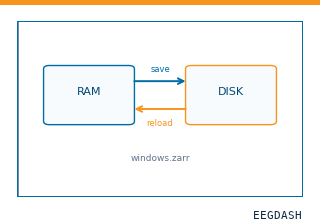 Save and reload prepared dataCache a windowed dataset to disk and reattach it without recompute.
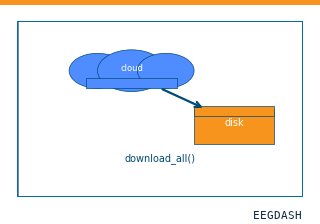 Download a dataset locallyPrefetch BIDS files to a local cache and validate the layout.
Swap any load_dataset(...) call for nm000365 to reproduce the tutorial on this dataset.
Citation
Hui Zheng, Hai-Teng Wang, Wei-Bang Jiang, Zhong-Tao Chen, Li He, … (2021). Du-IN Chinese word-reading sEEG (Zheng et al., NeurIPS 2024): authors' preprocessed 3-s epochs, 12 subjects, 61 words. 10.82901/nemar.nm000365
Provenance
¹Contributed to nemar in BIDS format.
²Curated & ingested by the EEGDash catalog; see CITATION.cff for canonical reference.
³Persistent identifier: 10.82901/nemar.nm000365.
See Also#
eegdash.dataset.EEGDashDataseteegdash.dataset