


NM000400: ieeg dataset, 7 subjects#
Brain-wide human sEEG during aversive eyepuffs and ketamine infusion (Kauvar, Richman, Liu et al. 2025; DANDI 001347)
Access recordings and metadata through EEGDash.
Citation: Kauvar I, Richman EB, Liu TX, Li C, Vesuna S, Chibukhchyan A, Yamada L, Fogarty A, Solomon E, Choi EY, Mortazavi L, Chau Loo Kung G, Mukunda P, Raja C, Gil-Hernández D, Patron K, Zhang X, Brawer J, Wrobel S, Lusk Z, Lyu D, Mitra A, Hack L, Luo L, Grosenick L, van Roessel P, Williams LM, Heifets BD, Henderson JM, McNab JA, Rodríguez CI, Buch V, Nuyujukian P, Deisseroth K (2025). Brain-wide human sEEG during aversive eyepuffs and ketamine infusion (Kauvar, Richman, Liu et al. 2025; DANDI 001347). 10.82901/nemar.nm000400
Modality: ieeg Subjects: 7 Recordings: 30 License: CC-BY-4.0 Source: nemar
Metadata: Complete (100%)
7-participant iEEG dataset — Brain-wide human sEEG during aversive eyepuffs and ketamine infusion (Kauvar, Richman, Liu et al. 2025; DANDI 001347).
Quickstart#
Install
pip install eegdash
Access the data
from eegdash.dataset import NM000400

dataset = NM000400(cache_dir="./data")
# Get the raw object of the first recording
raw = dataset.datasets[0].raw
print(raw.info)
Filter by subject
dataset = NM000400(cache_dir="./data", subject="01")
Advanced query
dataset = NM000400(
    cache_dir="./data",
    query={"subject": {"$in": ["01", "02"]}},
)
Iterate recordings
for rec in dataset:
    print(rec.subject, rec.raw.info['sfreq'])
If you use this dataset in your research, please cite the original authors.
BibTeX
@dataset{nm000400,
  title = {Brain-wide human sEEG during aversive eyepuffs and ketamine infusion (Kauvar, Richman, Liu et al. 2025; DANDI 001347)},
  author = {Kauvar I and Richman EB and Liu TX and Li C and Vesuna S and Chibukhchyan A and Yamada L and Fogarty A and Solomon E and Choi EY and Mortazavi L and Chau Loo Kung G and Mukunda P and Raja C and Gil-Hernández D and Patron K and Zhang X and Brawer J and Wrobel S and Lusk Z and Lyu D and Mitra A and Hack L and Luo L and Grosenick L and van Roessel P and Williams LM and Heifets BD and Henderson JM and McNab JA and Rodríguez CI and Buch V and Nuyujukian P and Deisseroth K},
  doi = {10.82901/nemar.nm000400},
  url = {https://doi.org/10.82901/nemar.nm000400},
}
About This Dataset#
Brain-wide human sEEG during aversive eyepuffs and ketamine infusion (Kauvar, Richman, Liu et al. 2025; DANDI 001347)
Stereo-EEG (sEEG) from adult epilepsy patients undergoing Phase 2 extended-stay monitoring at Stanford Hospital who
took part in a study of the brain-wide response to brief aversive air puffs to the eye (“eyepuffs”) and of its modulation by the dissociative drug ketamine (40-min continuous infusion, 0.5 mg/kg). Electrode trajectories were chosen for clinical reasons only.
- This dataset is a BIDS-iEEG representation of the human sEEG series that the authors released in NWB format:
Liu TX, Kauvar I, Richman E (2025). Brain-wide human electrophysiology during aversive stimuli and ketamine (Version 0.250528.0702) [Data set]. DANDI Archive. https://doi.org/10.48324/dandi.001347/0.250528.0702 License: CC-BY-4.0. Article: Kauvar I*, Richman EB*, Liu TX*, et al., Deisseroth K (2025). Conserved brain-wide emergence of emotional response from sensory experience in humans and mice. Science. https://doi.org/10.1126/science.adt3971 (open access: https://pmc.ncbi.nlm.nih.gov/articles/PMC12286656/)
View full README
- This dataset is a BIDS-iEEG representation of the human sEEG series that the authors released in NWB format:
Liu TX, Kauvar I, Richman E (2025). Brain-wide human electrophysiology during aversive stimuli and ketamine (Version 0.250528.0702) [Data set]. DANDI Archive. https://doi.org/10.48324/dandi.001347/0.250528.0702 License: CC-BY-4.0. Article: Kauvar I*, Richman EB*, Liu TX*, et al., Deisseroth K (2025). Conserved brain-wide emergence of emotional response from sensory experience in humans and mice. Science. https://doi.org/10.1126/science.adt3971 (open access: https://pmc.ncbi.nlm.nih.gov/articles/PMC12286656/)
Please cite both.
Ethics (from the article): “The Stanford Institutional Review Board approved the study protocol, and participants documented their written informed consent prior to entry into the study” (clinicaltrials.gov NCT04861051).
This deposit redistributes the publicly released data under their CC-BY-4.0 license.
Why this is a derivative dataset
The released series are not the raw recordings. The article (Methods) states: “iEEG voltage traces were lowpass filtered for anti-aliasing (finite impulse response filter), then downsampled to 200 Hz”. The authors also cut each session to a 20-min window (NWB session_description: “Voltage traces of multichannel SEEG around eyepuffs, 10min pre and post puff start”). The dataset is therefore labelled DatasetType “derivative”. The article’s further steps (60 Hz notch, bipolar re-referencing, bad-channel removal) are NOT reflected in the released series as far as we can tell: the contacts are monopolar, and a 60 Hz line peak is present in the recordings of SD181-SD245 (no 60 Hz peak in SD168/SD172).
Contents
7 participants (sub-SD168, SD172, SD181, SD185, SD186, SD211, SD245), 30 recordings (3-6 sessions each), 88-206 sEEG contacts per participant, 200 Hz, 1200 s per recording (10.0 h in total).
- sub-<label>/ses-<session>/ieeg/ BrainVision (.vhdr/.vmrk/.eeg), IEEE float32, microvolts; channels.tsv; ieeg.json;
electrodes.tsv + coordsystem.json (labels only, no coordinates)
sub-<label>/sub-<label>_scans.tsv source NWB file, its SHA-256 and the float32 rounding error per recording sourcedata/dandi-001347/ byte-identical copies of all 44 sub-SD* NWB files of the DANDI release
(30 sEEG + 14 behaviour); sourcedata/sourcedata_provenance.json lists size, SHA-256 and DANDI asset id of each.
Session labels are the DANDI session labels: puffBaseline / puffPreinfusion (before ketamine), puffInfusion (during the infusion), puffPostinfusion (after; SD211 also has puffPostinfusionfast), puffControl (control series; the article describes an unexpected-auditory control in which the device sounded but was directed away from the participant). Which control and which infusion schedule applied to each participant is described in the article and its supplement, not in the release.
Signal: what was converted and how
Source: processing/ecephys/LFP/v_trace (ElectricalSeries) of each sub-SD*_ecephys.nwb: float64, 240,000 samples x contacts, regular 200 Hz clock starting at 0 s.
Units. The NWB attribute says unit “volts”, conversion 1.0, but the series ‘comments’ (and the device description) carry the authors’ factor “scale_to_microvolts=0.09765625” (SD168, SD172) or “=0.390625” (all others); these are the Nihon Kohden JE-120 amplitude resolutions. We wrote stored value x scale_to_microvolts, in microvolts. Check: the median per-contact standard deviation is 460-580 stored units for SD168/SD172 and 97-185 for the others; after scaling both groups are in the same physiological range (about 40-70 microvolts). This is the only change besides float32 rounding (reported in scans.tsv). No filtering, resampling, re-referencing, cropping or channel removal was done by the conversion.
Channels. All contacts of the source series are kept, in the source order, with the source contact labels. channels.tsv adds:
group the depth electrode (NWB ElectrodeGroup) location_label the authors’ anatomical label (NWB electrodes.location, e.g. AMY, HIPP, INS, THAL ANT, WM) status “bad” where the authors’ location label is EXCLUDE, else “good”.
The release has no electrode coordinates (x/y/z are NaN in every NWB file): electrodes.tsv lists the contacts with x/y/z = n/a and the authors’ labels, and coordsystem.json says so. channels.tsv low_cutoff/high_cutoff are n/a: the authors’ anti-aliasing low-pass cut-off is not documented, and the hardware filter settings are not released.
The article localised contacts with iELVis from pre-implant MRI and post-implant CT; those coordinates are not part of the release.
- Not converted (kept in sourcedata only):
acquisition/dc_trace of each sEEG file: 20 channels at 200 Hz (DC01-DC16, SpO2, Pulse, EtCO2, CO2Wave) with unit “na”; no physical unit is given, so they are not written to the BIDS signal files.
the behaviour NWB files (sub-SD*_ses-puff_behavior.nwb): eye-closure traces from 200 fps video, puff on/off frame indices and per-trial reflexive/affective eye-closure scores for each series. Their clock is the video clock; the release does not give the offset to the sEEG series, so no events.tsv was derived from them.
7 participants (SD163, SD170, SD178, SD184, SD207, SD215, SD242) have behaviour files only (no sEEG in the release); they are in sourcedata only and not in participants.tsv.
Events: the release has no event markers on the sEEG clock. Per the source session description, the eyepuff series starts 10 min (600 s) into each 20-min recording; individual puff times on the sEEG clock are not released.
The DC channels in sourcedata may carry the puff trigger, but the release does not say which one, so we did not derive events from them.
Participants
Age and sex are not released per participant (NWB subject.age “P18Y/” = adult; sex “O”); participants.tsv uses n/a and keeps the source values in source_age/source_sex. The article reports 14 implanted participants with the full protocol, 7 of whom met the behavioural inclusion criteria for neural analysis; the 7 with sEEG here appear to be those 7.
Privacy review (2026-10-08)
All string attributes and string datasets of all 44 NWB files were listed: study codes (SDnnn), contact labels, anatomical labels, institution/lab, experimenter names (authors), placeholder session_start_time 2000-01-01T12:00 (sEEG files) and NWB export timestamps 2025-02-28 (behaviour files’ session_start_time equals their file_create_date, i.e. export time, not recording time). No names of patients, recording dates, hospital IDs or free-text clinical notes were found.
Additional metadata and localisation (added 2026-10-08)
Compiled after the upload from the article, its supplement and the source deposit (each statement names its source). Text and sidecar metadata only; no data file was changed.
Recording system. “Electrodes used were from AdTech Inc, had 12-16 platinum contacts, and were 0.86 mm in diameter, 2.29 mm in height, with 3-5 mm center-to-center inter-electrode distance. Data was recorded with the Nihon Kohden recording system, using the JE-120 amplifier for digitization” (paper Methods). The NWB device is nihon_kohden (description scale_to_microvolts=0.09765625 or 0.390625).
Reference. For analysis, “Channels were rereferenced with a bipolar montage” (paper). It is not stated whether the deposited v_trace is monopolar or bipolar. The electrodes table lists single contacts (e.g. LPC1, LPC2), so it is probably the monopolar recording reference, but this is not confirmed.
Localisation method. The paper describes it as follows: “We registered intracranial electrodes to specific anatomical regions using each subjects’ preimplantation T1-weighted MRI and postimplantation CT scans … iELVis toolbox … FreeSurfer v6.0.0 recon-all … bbregister … or flirt … we marked these locations by hand using BioImage Suite … dykstraElecPjct”. Yeo7/Yeo17 labels were assigned for grey-matter surface contacts, and an HCP-MMP mapping was made for cortical contacts (table S1). Per-contact region labels (abbreviations such as HIPP, AMY, INS, PMC, THAL ANT, WM, EXCLUDE, OUT OF BRAIN) are stored in the NWB electrodes.location column. Coordinates are not deposited: x, y and z are NaN for all contacts.
NEMAR Metadata#
[](https://doi.org/10.82901/nemar.nm000400) Brain-wide human sEEG during aversive eyepuffs and ketamine infusion (Kauvar, Richman, Liu et al. 2025; DANDI 001347) ===================================================================================================================== Overview ——– Stereo-EEG (sEEG) from adult epilepsy patients undergoing Phase 2 extended-stay monitoring at Stanford Hospital who took part in a study of the brain-wide response to brief aversive air puffs to the eye (“eyepuffs”) and of its modulation by the dissociative drug ketamine (40-min continuous infusion, 0.5 mg/kg). Electrode trajectories were chosen for clinical reasons only. This dataset is a BIDS-iEEG representation of the human sEEG series that the authors released in NWB format:
Liu TX, Kauvar I, Richman E (2025). Brain-wide human electrophysiology during aversive stimuli and ketamine (Version 0.250528.0702) [Data set]. DANDI Archive. https://doi.org/10.48324/dandi.001347/0.250528.0702 License: CC-BY-4.0. Article: Kauvar I*, Richman EB*, Liu TX*, et al., Deisseroth K (2025). Conserved brain-wide emergence of emotional response from sensory experience in humans and mice. Science. https://doi.org/10.1126/science.adt3971 (open access: https://pmc.ncbi.nlm.nih.gov/articles/PMC12286656/)
Please cite both. Ethics (from the article): “The Stanford Institutional Review Board approved the study protocol, and participants documented their written informed consent prior to entry into the study” (clinicaltrials.gov NCT04861051). This deposit redistributes the publicly released data under their CC-BY-4.0 license. Why this is a derivative dataset ——————————– The released series are not the raw recordings. The article (Methods) states: “iEEG voltage traces were lowpass filtered for anti-aliasing (finite impulse response filter), then downsampled to 200 Hz”. The authors also cut each session to a 20-min window (NWB session_description: “Voltage traces of multichannel SEEG around eyepuffs, 10min pre and post puff start”). The dataset is therefore labelled DatasetType “derivative”. The article’s further steps (60 Hz notch, bipolar re-referencing, bad-channel removal) are NOT reflected in the released series as far as we can tell: the contacts are monopolar, and a 60 Hz line peak is present in the recordings of SD181-SD245 (no 60 Hz peak in SD168/SD172). Contents ——– 7 participants (sub-SD168, SD172, SD181, SD185, SD186, SD211, SD245), 30 recordings (3-6 sessions each), 88-206 sEEG contacts per participant, 200 Hz, 1200 s per recording (10.0 h in total).
- sub-<label>/ses-<session>/ieeg/ BrainVision (.vhdr/.vmrk/.eeg), IEEE float32, microvolts; channels.tsv; ieeg.json;
electrodes.tsv + coordsystem.json (labels only, no coordinates)
sub-<label>/sub-<label>_scans.tsv source NWB file, its SHA-256 and the float32 rounding error per recording sourcedata/dandi-001347/ byte-identical copies of all 44 sub-SD* NWB files of the DANDI release
(30 sEEG + 14 behaviour); sourcedata/sourcedata_provenance.json lists size, SHA-256 and DANDI asset id of each.
Session labels are the DANDI session labels: puffBaseline / puffPreinfusion (before ketamine), puffInfusion (during the infusion), puffPostinfusion (after; SD211 also has puffPostinfusionfast), puffControl (control series; the article describes an unexpected-auditory control in which the device sounded but was directed away from the participant). Which control and which infusion schedule applied to each participant is described in the article and its supplement, not in the release. Signal: what was converted and how ———————————- Source: processing/ecephys/LFP/v_trace (ElectricalSeries) of each sub-SD*_ecephys.nwb: float64, 240,000 samples x contacts, regular 200 Hz clock starting at 0 s. Units. The NWB attribute says unit “volts”, conversion 1.0, but the series ‘comments’ (and the device description) carry the authors’ factor “scale_to_microvolts=0.09765625” (SD168, SD172) or “=0.390625” (all others); these are the Nihon Kohden JE-120 amplitude resolutions. We wrote stored value x scale_to_microvolts, in microvolts. Check: the median per-contact standard deviation is 460-580 stored units for SD168/SD172 and 97-185 for the others; after scaling both groups are in the same physiological range (about 40-70 microvolts). This is the only change besides float32 rounding (reported in scans.tsv). No filtering, resampling, re-referencing, cropping or channel removal was done by the conversion. Channels. All contacts of the source series are kept, in the source order, with the source contact labels. channels.tsv adds:
group the depth electrode (NWB ElectrodeGroup) location_label the authors’ anatomical label (NWB electrodes.location, e.g. AMY, HIPP, INS, THAL ANT, WM) status “bad” where the authors’ location label is EXCLUDE, else “good”.
The release has no electrode coordinates (x/y/z are NaN in every NWB file): electrodes.tsv lists the contacts with x/y/z = n/a and the authors’ labels, and coordsystem.json says so. channels.tsv low_cutoff/high_cutoff are n/a: the authors’ anti-aliasing low-pass cut-off is not documented, and the hardware filter settings are not released. The article localised contacts with iELVis from pre-implant MRI and post-implant CT; those coordinates are not part of the release. Not converted (kept in sourcedata only):
acquisition/dc_trace of each sEEG file: 20 channels at 200 Hz (DC01-DC16, SpO2, Pulse, EtCO2, CO2Wave) with unit “na”; no physical unit is given, so they are not written to the BIDS signal files.
the behaviour NWB files (sub-SD*_ses-puff_behavior.nwb): eye-closure traces from 200 fps video, puff on/off frame indices and per-trial reflexive/affective eye-closure scores for each series. Their clock is the video clock; the release does not give the offset to the sEEG series, so no events.tsv was derived from them.
7 participants (SD163, SD170, SD178, SD184, SD207, SD215, SD242) have behaviour files only (no sEEG in the release); they are in sourcedata only and not in participants.tsv.
Events: the release has no event markers on the sEEG clock. Per the source session description, the eyepuff series starts 10 min (600 s) into each 20-min recording; individual puff times on the sEEG clock are not released. The DC channels in sourcedata may carry the puff trigger, but the release does not say which one, so we did not derive events from them. Participants ———— Age and sex are not released per participant (NWB subject.age “P18Y/” = adult; sex “O”); participants.tsv uses n/a and keeps the source values in source_age/source_sex. The article reports 14 implanted participants with the full protocol, 7 of whom met the behavioural inclusion criteria for neural analysis; the 7 with sEEG here appear to be those 7. Privacy review (2026-10-08) ————————— All string attributes and string datasets of all 44 NWB files were listed: study codes (SDnnn), contact labels, anatomical labels, institution/lab, experimenter names (authors), placeholder session_start_time 2000-01-01T12:00 (sEEG files) and NWB export timestamps 2025-02-28 (behaviour files’ session_start_time equals their file_create_date, i.e. export time, not recording time). No names of patients, recording dates, hospital IDs or free-text clinical notes were found. ## Additional metadata and localisation (added 2026-10-08) Compiled after the upload from the article, its supplement and the source deposit (each statement names its source). Text and sidecar metadata only; no data file was changed. Recording system. “Electrodes used were from AdTech Inc, had 12-16 platinum contacts, and were 0.86 mm in diameter, 2.29 mm in height, with 3-5 mm center-to-center inter-electrode distance. Data was recorded with the Nihon Kohden recording system, using the JE-120 amplifier for digitization” (paper Methods). The NWB device is nihon_kohden (description scale_to_microvolts=0.09765625 or 0.390625). Reference. For analysis, “Channels were rereferenced with a bipolar montage” (paper). It is not stated whether the deposited v_trace is monopolar or bipolar. The electrodes table lists single contacts (e.g. LPC1, LPC2), so it is probably the monopolar recording reference, but this is not confirmed. Localisation method. The paper describes it as follows: “We registered intracranial electrodes to specific anatomical regions using each subjects’ preimplantation T1-weighted MRI and postimplantation CT scans … iELVis toolbox … FreeSurfer v6.0.0 recon-all … bbregister … or flirt … we marked these locations by hand using BioImage Suite … dykstraElecPjct”. Yeo7/Yeo17 labels were assigned for grey-matter surface contacts, and an HCP-MMP mapping was made for cortical contacts (table S1). Per-contact region labels (abbreviations such as HIPP, AMY, INS, PMC, THAL ANT, WM, EXCLUDE, OUT OF BRAIN) are stored in the NWB electrodes.location column. Coordinates are not deposited: x, y and z are NaN for all contacts.
License: CC-BY-4.0
Authors:
Kauvar I
Richman EB
Liu TX
Li C
Vesuna S
… and 29 more
Versions:
Version |
DOI |
Released |
|---|---|---|
|
Cohort#
Dataset Statistics#
Channel counts (ch)
Sampling frequencies: 200.0 Hz (n=30 recordings)
Total recording duration: 10 h 0 min
Signal · Electrodes & live trace#
Live trace viewer — sub-SD168 · ses-puffInfusion · task-eyepuff
Showing one representative recording out of
7 subjects and 30 recordings in this dataset.
Browse the full set on OpenNeuro;
drop any other _ieeg.{set,edf,bdf,vhdr} file onto the
viewer (or pass ?ieeg=<url>) to inspect it.
No scalp electrode layout is currently indexed for this dataset. Once the eegdash montage registry ingests it, the interactive viewer will appear here automatically.
NEMAR Processing Statistics#
The plots below are generated by NEMAR’s automated EEG pipeline. The histogram shows pipeline success for data cleaning and ICA decomposition, the percentage of data frames and EEG channels retained after artefact removal, line noise per channel (RMS, dB), and the age/gender distribution of participants.

HED event descriptors word cloud

Manifest#
File Explorer#
Browse the BIDS file structure of this dataset. Records are fetched on demand from the EEGDash catalog the first time you open the explorer.
Full dataset metadata table
Dataset ID |
|
Title |
Brain-wide human sEEG during aversive eyepuffs and ketamine infusion (Kauvar, Richman, Liu et al. 2025; DANDI 001347) |
Author (year) |
— |
Canonical |
— |
Importable as |
|
Year |
2025 |
Authors |
Kauvar I, Richman EB, Liu TX, Li C, Vesuna S, Chibukhchyan A, Yamada L, Fogarty A, Solomon E, Choi EY, Mortazavi L, Chau Loo Kung G, Mukunda P, Raja C, Gil-Hernández D, Patron K, Zhang X, Brawer J, Wrobel S, Lusk Z, Lyu D, Mitra A, Hack L, Luo L, Grosenick L, van Roessel P, Williams LM, Heifets BD, Henderson JM, McNab JA, Rodríguez CI, Buch V, Nuyujukian P, Deisseroth K |
License |
CC-BY-4.0 |
Citation / DOI |
|
Source links |
OpenNeuro | NeMAR | Source URL |
Copy-paste BibTeX
@dataset{nm000400,
  title = {Brain-wide human sEEG during aversive eyepuffs and ketamine infusion (Kauvar, Richman, Liu et al. 2025; DANDI 001347)},
  author = {Kauvar I and Richman EB and Liu TX and Li C and Vesuna S and Chibukhchyan A and Yamada L and Fogarty A and Solomon E and Choi EY and Mortazavi L and Chau Loo Kung G and Mukunda P and Raja C and Gil-Hernández D and Patron K and Zhang X and Brawer J and Wrobel S and Lusk Z and Lyu D and Mitra A and Hack L and Luo L and Grosenick L and van Roessel P and Williams LM and Heifets BD and Henderson JM and McNab JA and Rodríguez CI and Buch V and Nuyujukian P and Deisseroth K},
  doi = {10.82901/nemar.nm000400},
  url = {https://doi.org/10.82901/nemar.nm000400},
}
API Reference#
eegdash.datasetEEGDashDataset- class eegdash.dataset.NM000400(cache_dir: str, query: dict | None = None, s3_bucket: str | None = None, **kwargs)[source]#
Brain-wide human sEEG during aversive eyepuffs and ketamine infusion (Kauvar, Richman, Liu et al. 2025; DANDI 001347)
- Study:
nm000400(NeMAR)- Author (year):
—
- Canonical:
—
Also importable as:
NM000400.Modality:
ieeg; Subject type:Unknown. Subjects: 7; recordings: 30; tasks: 1.- Parameters:
cache_dir (str | Path) – Directory where data are cached locally.
query (dict | None) – Additional MongoDB-style filters to AND with the dataset selection. Must not contain the key
dataset.s3_bucket (str | None) – Base S3 bucket used to locate the data.
**kwargs (dict) – Additional keyword arguments forwarded to
EEGDashDataset.
- data_dir#
Local dataset cache directory (
cache_dir / dataset_id).- Type:
Path
Notes
Each item is a recording; recording-level metadata are available via
dataset.description.querysupports MongoDB-style filters on fields inALLOWED_QUERY_FIELDSand is combined with the dataset filter. Dataset-specific caveats are not provided in the summary metadata.References
OpenNeuro dataset: https://openneuro.org/datasets/nm000400 NeMAR dataset: https://nemar.org/dataexplorer/detail?dataset_id=nm000400 DOI: https://doi.org/10.82901/nemar.nm000400
Examples
>>> from eegdash.dataset import NM000400
>>> dataset = NM000400(cache_dir="./data")
>>> recording = dataset[0]
>>> raw = recording.load()
- __init__(cache_dir: str, query: dict | None = None, s3_bucket: str | None = None, **kwargs)[source]#
- save(path: str, overwrite: bool = False, offset: int = 0)[source]#
Save datasets to files by creating one subdirectory for each dataset:
path/
    0/
        0-raw.fif | 0-epo.fif
        description.json
        raw_preproc_kwargs.json (if raws were preprocessed)
        window_kwargs.json (if this is a windowed dataset)
        window_preproc_kwargs.json  (if windows were preprocessed)
        target_name.json (if target_name is not None and dataset is raw)
    1/
        1-raw.fif | 1-epo.fif
        description.json
        raw_preproc_kwargs.json (if raws were preprocessed)
        window_kwargs.json (if this is a windowed dataset)
        window_preproc_kwargs.json  (if windows were preprocessed)
        target_name.json (if target_name is not None and dataset is raw)
- Parameters:
path (str) –
- Directory in which subdirectories are created to store
-raw.fif | -epo.fif and .json files to.
overwrite (bool) – Whether to delete old subdirectories that will be saved to in this call.
offset (int) – If provided, the integer is added to the id of the dataset in the concat. This is useful in the setting of very large datasets, where one dataset has to be processed and saved at a time to account for its original position.
BaseDataset from braindecode — windowed via create_windows_from_events.braindecodeDataLoader; supports parallel workers and on-the-fly augmentations.pytorch Find datasets with the EEGDash APIQuery the catalogue, filter by task or modality, list candidates.
 Load one EEG recordingResolve a single record to an MNE Raw with channels and events.
 EEG recording to PyTorch DataLoaderWrap braindecode windows in a DataLoader for model training.
 Preprocess EEG and create windowsFilter, resample, epoch — and persist the windowed dataset.
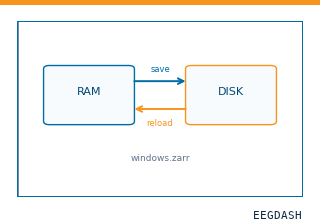 Save and reload prepared dataCache a windowed dataset to disk and reattach it without recompute.
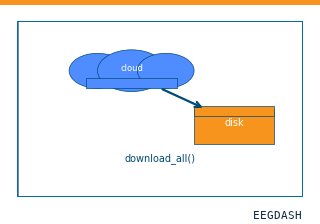 Download a dataset locallyPrefetch BIDS files to a local cache and validate the layout.
Swap any load_dataset(...) call for nm000400 to reproduce the tutorial on this dataset.
Citation
Kauvar I, Richman EB, Liu TX, Li C, Vesuna S, … (2025). Brain-wide human sEEG during aversive eyepuffs and ketamine infusion (Kauvar, Richman, Liu et al. 2025; DANDI 001347). 10.82901/nemar.nm000400
Provenance
¹Contributed to nemar in BIDS format.
²Curated & ingested by the EEGDash catalog; see CITATION.cff for canonical reference.
³Persistent identifier: 10.82901/nemar.nm000400.
See Also#
eegdash.dataset.EEGDashDataseteegdash.dataset