


NM000446: ieeg dataset, 16 subjects#
STN local field potentials from awake Parkinson’s disease patients ON and OFF medication, with and without DBS (Wiest et al. 2023)
Access recordings and metadata through EEGDash.
Citation: Christoph Wiest, Flavie Torrecillos, Alek Pogosyan, Fahd Baig, Erlick A. Pereira, Francesca Morgante, Keyoumars Ashkan, Huiling Tan (2023). STN local field potentials from awake Parkinson’s disease patients ON and OFF medication, with and without DBS (Wiest et al. 2023). 10.82901/nemar.nm000446
Modality: ieeg Subjects: 16 Recordings: 44 License: CC-BY-SA-4.0 Source: nemar
Metadata: Complete (100%)
16-participant iEEG dataset — STN local field potentials from awake Parkinson's disease patients ON and OFF medication, with and without DBS (Wiest et al. 2023).
Quickstart#
Install
pip install eegdash
Access the data
from eegdash.dataset import NM000446

dataset = NM000446(cache_dir="./data")
# Get the raw object of the first recording
raw = dataset.datasets[0].raw
print(raw.info)
Filter by subject
dataset = NM000446(cache_dir="./data", subject="01")
Advanced query
dataset = NM000446(
    cache_dir="./data",
    query={"subject": {"$in": ["01", "02"]}},
)
Iterate recordings
for rec in dataset:
    print(rec.subject, rec.raw.info['sfreq'])
If you use this dataset in your research, please cite the original authors.
BibTeX
@dataset{nm000446,
  title = {STN local field potentials from awake Parkinson's disease patients ON and OFF medication, with and without DBS (Wiest et al. 2023)},
  author = {Christoph Wiest and Flavie Torrecillos and Alek Pogosyan and Fahd Baig and Erlick A. Pereira and Francesca Morgante and Keyoumars Ashkan and Huiling Tan},
  doi = {10.82901/nemar.nm000446},
  url = {https://doi.org/10.82901/nemar.nm000446},
}
About This Dataset#
Local field potentials from the subthalamic nucleus (STN), recorded together with scalp EEG and accelerometers, from patients
with Parkinson’s disease 3-6 days after DBS surgery while the leads were externalised. Recordings were made OFF and ON dopaminergic medication, at rest and during stimulation sessions. The data were analysed in Wiest et al. (2023), who showed that the aperiodic exponent of STN LFPs rises with levodopa and with 130 Hz STN DBS.
recordings from awake patients with Parkinson’s, ON and OFF meds, and during 130 Hz DBS. Oxford University Research
Archive / MRC BNDU data sharing platform. doi:10.5287/bodleian:mzJ7YwXvo (https://data.mrc.ox.ac.uk/stn-lfp-on-off-and-dbs)
STN LFPs from awake Parkinson’s patients ON and OFF levodopa, with and without DBS (Wiest et al. 2023)
Wiest C, Torrecillos F, Pogosyan A, Bange M, Muthuraman M, Groppa S, Hulse N, Hasegawa H, Ashkan K, Baig F, Morgante F, Pereira EA, Mallet N, Magill PJ, Brown P, Sharott A, Tan H (2023). The aperiodic exponent of subthalamic field potentials reflects excitation/inhibition balance in Parkinsonism. eLife 12:e82467. doi:10.7554/eLife.82467
Analysis code: doi:10.5287/bodleian:rJ7jyjX97
Funding (paper): Medical Research Council (MC_UU_00003/2, MC_UU_00003/5, MC_UU_00003/6, MR/V00655X/1, MR/P012272/1); National Institute for Health Research (NIHR) Oxford Biomedical Research Centre; Rosetrees Trust; Parkinson’s UK (G-0806).
View full README
STN LFPs from awake Parkinson’s patients ON and OFF levodopa, with and without DBS (Wiest et al. 2023)
Wiest C, Torrecillos F, Pogosyan A, Bange M, Muthuraman M, Groppa S, Hulse N, Hasegawa H, Ashkan K, Baig F, Morgante F, Pereira EA, Mallet N, Magill PJ, Brown P, Sharott A, Tan H (2023). The aperiodic exponent of subthalamic field potentials reflects excitation/inhibition balance in Parkinsonism. eLife 12:e82467. doi:10.7554/eLife.82467
Analysis code: doi:10.5287/bodleian:rJ7jyjX97
Funding (paper): Medical Research Council (MC_UU_00003/2, MC_UU_00003/5, MC_UU_00003/6, MR/V00655X/1, MR/P012272/1); National Institute for Health Research (NIHR) Oxford Biomedical Research Centre; Rosetrees Trust; Parkinson’s UK (G-0806).
Licence
CC BY-SA 4.0, as stated on the record page and on the download form. The release zips contain only .mat files (no licence or README file), so nothing more restrictive applies.
Ethics (Wiest et al. 2023)
Approved by the Health Research Authority UK and the National Research Ethics Service local Research Ethics Committee (IRAS: 46576) and by the local ethics committee at the University of Mainz (837.208.17 (11042)). Written informed consent, and consent to publish, was obtained before surgery.
Recordings (methods from Wiest et al. 2023)
Leads: Medtronic 3389 or SenSight, Boston Scientific Vercise DB-2202 or DB-2201, or Abbott Infinity 6172ANS (the paper does not say which lead each patient had). Directional contacts were fused to ring contacts. Ground on the non-dominant forearm.
Amplifiers: TMSi Porti at 2048 Hz or TMSi SAGA32 at 4096 Hz. Exported from Spike2 to MATLAB by the authors. Each file’s sampling rate is in the sidecar; the model name is inferred from that rate as the paper describes.
Stimulation: custom in-house neurostimulator, symmetric biphasic constant-current pulses (60 us, negative phase first), 130 Hz at the middle contacts; a self-adhesive electrode on the back was the stimulation reference.
The paper analysed 60 s rest segments per medication state (30 hemispheres, 17 patients) and 60 s segments without and with DBS (26 hemispheres, 17 patients).
Contents
16 patients (
sub-<release code>, e.g. sub-G10, sub-K6, sub-XG37), sessionsses-medoffandses-medon. 44 continuous recordings, 18.21 h in total, at 2048 or 4096 Hz. Durations range from 120 s to 96 min. -task-rest(17 recordings): rest recordings. -task-stim(26 recordings): sessions in which stimulation was delivered for parts of the recording. The originalSpike2 file names refer to ERNA (evoked resonant neural activity) and to continuous DBS. Periods without stimulation are included. The stimulation amplitude trace (Amp*/Am*) is included where the release has it.
task-unspecified(1 recording(s): sub-G27 ses-medoff acq-left): single-channel exports without the original file name. The release does not say what the patient was doing.acq-left/acq-rightfollow the hemisphere in the release file name (<code>_leSTN_*/<code>_riSTN_*).acq-bilateral: the release has the same file (byte-identical) under both hemisphere names. These are the rest files that hold both leads, and they are converted once. Seesource_filesin scans.tsv.
Every channel of each file is kept with its release label (channels.tsv): - DBS: STN lead channels (L../R../Le../Lv../Rv..). The digits are contact numbers. The release does not document
monopolar vs bipolar montage.
EEG: scalp electrodes. ECG and EMG where the release labels them so.
MISC: the online-derived copies of channels (prefix F_/F-, S_/S-), the accelerometers (Ac*/Acc*), the stimulation amplitude (Amp*/Am*), and channels the release does not document (Ch1/Ch2, Rs*, Ax*,*Fex/*Ffl, Code, Ph/Pho, Snd, Virtual, …). Labels that occur more than once in a file (e.g. ‘Virtual’) get a suffix _2, _3, …
Channels that are constant in the release are marked
bad.
Units are not stated in the release, so channels.tsv lists them as n/a. The values are the release’s float64 numbers. Every sample is exactly representable in float32, so the BrainVision IEEE_FLOAT_32 files hold the values unchanged. This was checked per channel by the converter (code/conversion_report.json).
events.tsv: Spike2 marker times (EvData/EvTits, e.g. ‘Mark’) where the release has them. They are undocumented keyboard or marker events, kept as
spike2_marker.electrodes.tsv: the DBS channels, with x, y, z = n/a. The paper localised the leads with Lead-DBS, but no coordinates are released.
Recordings whose release file name gives one hemisphere while the internal Spike2 file name refers to the other: sub-G10 ses-medon task-stim acq-right. We keep the release naming; see
spike2_name_hemisphere_tagin code/conversion_report.json.participants.tsv: release code, diagnosis and recruiting hospital (from the original site folder name). Age and sex are not published per patient, so they are n/a.
Not converted: 60 s DBS analysis epochs
sourcedata/bndu/Human-DBS/MATRIX_DBS.mat (from the ‘Human DBS’ zip) holds 26 single-channel excerpts per
condition: signal_base (no stimulation) and signal_dbs (130 Hz DBS), 58-60 s each, at 2048/4096 Hz,
plus a MATLAB table. They are the 60 s segments the authors cut for the DBS analysis, not complete recordings, so they are
kept unchanged in sourcedata and not converted to BIDS recordings.
Not converted: single-channel files with author-processed values
These release files hold one channel each, with no file name or path. Their values are not plain amplifier samples: they are float64 numbers on a one-third grid, consistent with averages of fused directional contacts, and they are not representable in float32. They are kept unchanged in sourcedata (only the header date day set to 01) and are not presented as raw recordings: - G25_leSTN_OFF.mat: channel(s) L24, 448 s at 2048 Hz (author-processed values (not float32-representable; e.g. averages of fused directional contacts)) - G25_leSTN_ON.mat: channel(s) L24, 402 s at 2048 Hz (author-processed values (not float32-representable; e.g. averages of fused directional contacts)) - G25_riSTN_OFF.mat: channel(s) R24, 184 s at 2048 Hz (author-processed values (not float32-representable; e.g. averages of fused directional contacts)) - G25_riSTN_ON.mat: channel(s) R24, 201 s at 2048 Hz (author-processed values (not float32-representable; e.g. averages of fused directional contacts)) - G27_riSTN_OFF.mat: channel(s) R24, 896 s at 4096 Hz (author-processed values (not float32-representable; e.g. averages of fused directional contacts))
sourcedata/bndu
All 61 .mat files of the release, in folders named after their zips. Changes, made for privacy only:
- The MAT header ‘Created on’ date has its day set to 01.
- SmrData.FileName (the original Spike2 file name, which held dates and hospital study codes) is replaced by the release
file name.
SmrData.FilePath(the original folder, which held dates, site folder names and researchers’ user names) is blanked.
In MATLAB v7.3 files the edits are made in place, and the rest of the file is byte-identical. MATLAB v5 files were re-saved (compressed v5) and every variable was checked to be equal after reloading. Each file was checked for the removed strings. SHA-256 of the original and the edited files: code/conversion_report.json.
Privacy
The release has no names in the signals. The identifying metadata in the exports (file names and paths with recording dates, hospital study numbers, site folders and staff user names) were removed as described above. MAT-file creation dates keep only the year and month.
NEMAR Metadata#
[](https://doi.org/10.82901/nemar.nm000446) # STN LFPs from awake Parkinson’s patients ON and OFF levodopa, with and without DBS (Wiest et al. 2023) Local field potentials from the subthalamic nucleus (STN), recorded together with scalp EEG and accelerometers, from patients with Parkinson’s disease 3-6 days after DBS surgery while the leads were externalised. Recordings were made OFF and ON dopaminergic medication, at rest and during stimulation sessions. The data were analysed in Wiest et al. (2023), who showed that the aperiodic exponent of STN LFPs rises with levodopa and with 130 Hz STN DBS. ## Source - Wiest C, Torrecillos F, Pogosyan A, Baig F, Pereira E, Morgante F, Ashkan K, Tan H (2022). STN local field potential
recordings from awake patients with Parkinson’s, ON and OFF meds, and during 130 Hz DBS. Oxford University Research Archive / MRC BNDU data sharing platform. doi:10.5287/bodleian:mzJ7YwXvo (https://data.mrc.ox.ac.uk/stn-lfp-on-off-and-dbs)
Wiest C, Torrecillos F, Pogosyan A, Bange M, Muthuraman M, Groppa S, Hulse N, Hasegawa H, Ashkan K, Baig F, Morgante F, Pereira EA, Mallet N, Magill PJ, Brown P, Sharott A, Tan H (2023). The aperiodic exponent of subthalamic field potentials reflects excitation/inhibition balance in Parkinsonism. eLife 12:e82467. doi:10.7554/eLife.82467
Analysis code: doi:10.5287/bodleian:rJ7jyjX97
Funding (paper): Medical Research Council (MC_UU_00003/2, MC_UU_00003/5, MC_UU_00003/6, MR/V00655X/1, MR/P012272/1); National Institute for Health Research (NIHR) Oxford Biomedical Research Centre; Rosetrees Trust; Parkinson’s UK (G-0806).
## Licence CC BY-SA 4.0, as stated on the record page and on the download form. The release zips contain only .mat files (no licence or README file), so nothing more restrictive applies. ## Ethics (Wiest et al. 2023) Approved by the Health Research Authority UK and the National Research Ethics Service local Research Ethics Committee (IRAS: 46576) and by the local ethics committee at the University of Mainz (837.208.17 (11042)). Written informed consent, and consent to publish, was obtained before surgery. ## Recordings (methods from Wiest et al. 2023) - Leads: Medtronic 3389 or SenSight, Boston Scientific Vercise DB-2202 or DB-2201, or Abbott Infinity 6172ANS (the paper
does not say which lead each patient had). Directional contacts were fused to ring contacts. Ground on the non-dominant forearm.
Amplifiers: TMSi Porti at 2048 Hz or TMSi SAGA32 at 4096 Hz. Exported from Spike2 to MATLAB by the authors. Each file’s sampling rate is in the sidecar; the model name is inferred from that rate as the paper describes.
Stimulation: custom in-house neurostimulator, symmetric biphasic constant-current pulses (60 us, negative phase first), 130 Hz at the middle contacts; a self-adhesive electrode on the back was the stimulation reference.
The paper analysed 60 s rest segments per medication state (30 hemispheres, 17 patients) and 60 s segments without and with DBS (26 hemispheres, 17 patients).
## Contents - 16 patients (sub-<release code>, e.g. sub-G10, sub-K6, sub-XG37), sessions ses-medoff and ses-medon.
44 continuous recordings, 18.21 h in total, at 2048 or 4096 Hz. Durations range from 120 s to 96 min. - task-rest (17 recordings): rest recordings. - task-stim (26 recordings): sessions in which stimulation was delivered for parts of the recording. The original
Spike2 file names refer to ERNA (evoked resonant neural activity) and to continuous DBS. Periods without stimulation are included. The stimulation amplitude trace (Amp*/Am*) is included where the release has it.
task-unspecified (1 recording(s): sub-G27 ses-medoff acq-left): single-channel exports without the original file name. The release does not say what the patient was doing.
acq-left / acq-right follow the hemisphere in the release file name (<code>_leSTN_* / <code>_riSTN_*). acq-bilateral: the release has the same file (byte-identical) under both hemisphere names. These are the rest files that hold both leads, and they are converted once. See source_files in scans.tsv.
Every channel of each file is kept with its release label (channels.tsv): - DBS: STN lead channels (L../R../Le../Lv../Rv..). The digits are contact numbers. The release does not document
monopolar vs bipolar montage.
EEG: scalp electrodes. ECG and EMG where the release labels them so.
MISC: the online-derived copies of channels (prefix F_/F-, S_/S-), the accelerometers (Ac*/Acc*), the stimulation amplitude (Amp*/Am*), and channels the release does not document (Ch1/Ch2, Rs*, Ax*, *Fex/*Ffl, Code, Ph/Pho, Snd, Virtual, …). Labels that occur more than once in a file (e.g. ‘Virtual’) get a suffix _2, _3, …
Channels that are constant in the release are marked bad.
Units are not stated in the release, so channels.tsv lists them as n/a. The values are the release’s float64 numbers. Every sample is exactly representable in float32, so the BrainVision IEEE_FLOAT_32 files hold the values unchanged. This was checked per channel by the converter (code/conversion_report.json).
events.tsv: Spike2 marker times (EvData/EvTits, e.g. ‘Mark’) where the release has them. They are undocumented keyboard or marker events, kept as spike2_marker.
electrodes.tsv: the DBS channels, with x, y, z = n/a. The paper localised the leads with Lead-DBS, but no coordinates are released.
Recordings whose release file name gives one hemisphere while the internal Spike2 file name refers to the other: sub-G10 ses-medon task-stim acq-right. We keep the release naming; see spike2_name_hemisphere_tag in code/conversion_report.json.
participants.tsv: release code, diagnosis and recruiting hospital (from the original site folder name). Age and sex are not published per patient, so they are n/a.
## Not converted: 60 s DBS analysis epochs sourcedata/bndu/Human-DBS/MATRIX_DBS.mat (from the ‘Human DBS’ zip) holds 26 single-channel excerpts per condition: signal_base (no stimulation) and signal_dbs (130 Hz DBS), 58-60 s each, at 2048/4096 Hz, plus a MATLAB table. They are the 60 s segments the authors cut for the DBS analysis, not complete recordings, so they are kept unchanged in sourcedata and not converted to BIDS recordings. ## Not converted: single-channel files with author-processed values These release files hold one channel each, with no file name or path. Their values are not plain amplifier samples: they are float64 numbers on a one-third grid, consistent with averages of fused directional contacts, and they are not representable in float32. They are kept unchanged in sourcedata (only the header date day set to 01) and are not presented as raw recordings: - G25_leSTN_OFF.mat: channel(s) L24, 448 s at 2048 Hz (author-processed values (not float32-representable; e.g. averages of fused directional contacts)) - G25_leSTN_ON.mat: channel(s) L24, 402 s at 2048 Hz (author-processed values (not float32-representable; e.g. averages of fused directional contacts)) - G25_riSTN_OFF.mat: channel(s) R24, 184 s at 2048 Hz (author-processed values (not float32-representable; e.g. averages of fused directional contacts)) - G25_riSTN_ON.mat: channel(s) R24, 201 s at 2048 Hz (author-processed values (not float32-representable; e.g. averages of fused directional contacts)) - G27_riSTN_OFF.mat: channel(s) R24, 896 s at 4096 Hz (author-processed values (not float32-representable; e.g. averages of fused directional contacts)) ## sourcedata/bndu All 61 .mat files of the release, in folders named after their zips. Changes, made for privacy only: - The MAT header ‘Created on’ date has its day set to 01. - SmrData.FileName (the original Spike2 file name, which held dates and hospital study codes) is replaced by the release
file name.
SmrData.FilePath (the original folder, which held dates, site folder names and researchers’ user names) is blanked.
In MATLAB v7.3 files the edits are made in place, and the rest of the file is byte-identical. MATLAB v5 files were re-saved (compressed v5) and every variable was checked to be equal after reloading. Each file was checked for the removed strings. SHA-256 of the original and the edited files: code/conversion_report.json. ## Privacy The release has no names in the signals. The identifying metadata in the exports (file names and paths with recording dates, hospital study numbers, site folders and staff user names) were removed as described above. MAT-file creation dates keep only the year and month.
License: CC-BY-SA-4.0
Authors:
Christoph Wiest
Flavie Torrecillos
Alek Pogosyan
Fahd Baig
Erlick A. Pereira
… and 3 more
Versions:
Version |
DOI |
Released |
|---|---|---|
|
Cohort#
Dataset Statistics#
Channel counts (ch)
Sampling frequencies (Hz)
Total recording duration: 18 h 12 min
Signal · Electrodes & live trace#
Live trace viewer — sub-G10 · ses-medoff · task-stim
Showing one representative recording out of
16 subjects and 44 recordings in this dataset.
Browse the full set on OpenNeuro;
drop any other _ieeg.{set,edf,bdf,vhdr} file onto the
viewer (or pass ?ieeg=<url>) to inspect it.
No scalp electrode layout is currently indexed for this dataset. Once the eegdash montage registry ingests it, the interactive viewer will appear here automatically.
NEMAR Processing Statistics#
The plots below are generated by NEMAR’s automated EEG pipeline. The histogram shows pipeline success for data cleaning and ICA decomposition, the percentage of data frames and EEG channels retained after artefact removal, line noise per channel (RMS, dB), and the age/gender distribution of participants.

HED event descriptors word cloud

Manifest#
File Explorer#
Browse the BIDS file structure of this dataset. Records are fetched on demand from the EEGDash catalog the first time you open the explorer.
Full dataset metadata table
Dataset ID |
|
Title |
STN local field potentials from awake Parkinson’s disease patients ON and OFF medication, with and without DBS (Wiest et al. 2023) |
Author (year) |
— |
Canonical |
— |
Importable as |
|
Year |
2023 |
Authors |
Christoph Wiest, Flavie Torrecillos, Alek Pogosyan, Fahd Baig, Erlick A. Pereira, Francesca Morgante, Keyoumars Ashkan, Huiling Tan |
License |
CC-BY-SA-4.0 |
Citation / DOI |
|
Source links |
OpenNeuro | NeMAR | Source URL |
Copy-paste BibTeX
@dataset{nm000446,
  title = {STN local field potentials from awake Parkinson's disease patients ON and OFF medication, with and without DBS (Wiest et al. 2023)},
  author = {Christoph Wiest and Flavie Torrecillos and Alek Pogosyan and Fahd Baig and Erlick A. Pereira and Francesca Morgante and Keyoumars Ashkan and Huiling Tan},
  doi = {10.82901/nemar.nm000446},
  url = {https://doi.org/10.82901/nemar.nm000446},
}
API Reference#
eegdash.datasetEEGDashDataset- class eegdash.dataset.NM000446(cache_dir: str, query: dict | None = None, s3_bucket: str | None = None, **kwargs)[source]#
STN local field potentials from awake Parkinson’s disease patients ON and OFF medication, with and without DBS (Wiest et al. 2023)
- Study:
nm000446(NeMAR)- Author (year):
—
- Canonical:
—
Also importable as:
NM000446.Modality:
ieeg; Subject type:Unknown. Subjects: 16; recordings: 44; tasks: 3.- Parameters:
cache_dir (str | Path) – Directory where data are cached locally.
query (dict | None) – Additional MongoDB-style filters to AND with the dataset selection. Must not contain the key
dataset.s3_bucket (str | None) – Base S3 bucket used to locate the data.
**kwargs (dict) – Additional keyword arguments forwarded to
EEGDashDataset.
- data_dir#
Local dataset cache directory (
cache_dir / dataset_id).- Type:
Path
Notes
Each item is a recording; recording-level metadata are available via
dataset.description.querysupports MongoDB-style filters on fields inALLOWED_QUERY_FIELDSand is combined with the dataset filter. Dataset-specific caveats are not provided in the summary metadata.References
OpenNeuro dataset: https://openneuro.org/datasets/nm000446 NeMAR dataset: https://nemar.org/dataexplorer/detail?dataset_id=nm000446 DOI: https://doi.org/10.82901/nemar.nm000446
Examples
>>> from eegdash.dataset import NM000446
>>> dataset = NM000446(cache_dir="./data")
>>> recording = dataset[0]
>>> raw = recording.load()
- __init__(cache_dir: str, query: dict | None = None, s3_bucket: str | None = None, **kwargs)[source]#
- save(path: str, overwrite: bool = False, offset: int = 0)[source]#
Save datasets to files by creating one subdirectory for each dataset:
path/
    0/
        0-raw.fif | 0-epo.fif
        description.json
        raw_preproc_kwargs.json (if raws were preprocessed)
        window_kwargs.json (if this is a windowed dataset)
        window_preproc_kwargs.json  (if windows were preprocessed)
        target_name.json (if target_name is not None and dataset is raw)
    1/
        1-raw.fif | 1-epo.fif
        description.json
        raw_preproc_kwargs.json (if raws were preprocessed)
        window_kwargs.json (if this is a windowed dataset)
        window_preproc_kwargs.json  (if windows were preprocessed)
        target_name.json (if target_name is not None and dataset is raw)
- Parameters:
path (str) –
- Directory in which subdirectories are created to store
-raw.fif | -epo.fif and .json files to.
overwrite (bool) – Whether to delete old subdirectories that will be saved to in this call.
offset (int) – If provided, the integer is added to the id of the dataset in the concat. This is useful in the setting of very large datasets, where one dataset has to be processed and saved at a time to account for its original position.
BaseDataset from braindecode — windowed via create_windows_from_events.braindecodeDataLoader; supports parallel workers and on-the-fly augmentations.pytorch Find datasets with the EEGDash APIQuery the catalogue, filter by task or modality, list candidates.
 Load one EEG recordingResolve a single record to an MNE Raw with channels and events.
 EEG recording to PyTorch DataLoaderWrap braindecode windows in a DataLoader for model training.
 Preprocess EEG and create windowsFilter, resample, epoch — and persist the windowed dataset.
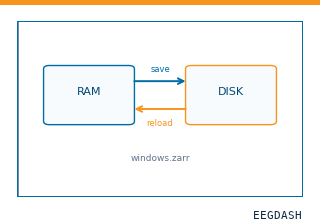 Save and reload prepared dataCache a windowed dataset to disk and reattach it without recompute.
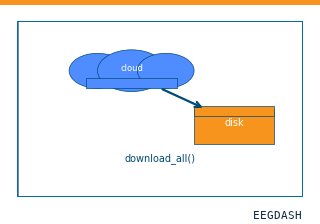 Download a dataset locallyPrefetch BIDS files to a local cache and validate the layout.
Swap any load_dataset(...) call for nm000446 to reproduce the tutorial on this dataset.
Citation
Christoph Wiest, Flavie Torrecillos, Alek Pogosyan, Fahd Baig, Erlick A. Pereira, … (2023). STN local field potentials from awake Parkinson's disease patients ON and OFF medication, with and without DBS (Wiest et al. 2023). 10.82901/nemar.nm000446
Provenance
¹Contributed to nemar in BIDS format.
²Curated & ingested by the EEGDash catalog; see CITATION.cff for canonical reference.
³Persistent identifier: 10.82901/nemar.nm000446.
See Also#
eegdash.dataset.EEGDashDataseteegdash.dataset