


NM000375: ieeg dataset, 16 subjects#
Neural interactions in the human frontal cortex dissociate reward and punishment learning (Combrisson et al., 2024): preprocessed SEEG high-gamma power, 16 patients (derivative)
Access recordings and metadata through EEGDash.
Citation: Etienne Combrisson, Ruggero Basanisi, Sylvain Rheims, Philippe Kahane, Julien Bastin, Andrea Brovelli (2021). Neural interactions in the human frontal cortex dissociate reward and punishment learning (Combrisson et al., 2024): preprocessed SEEG high-gamma power, 16 patients (derivative). 10.82901/nemar.nm000375
Modality: ieeg Subjects: 16 Recordings: 16 License: CC0-1.0 Source: nemar
Metadata: Complete (100%)
16-participant iEEG dataset — Neural interactions in the human frontal cortex dissociate reward and punishment learning (Combrisson et al., 2024): preprocessed SEEG high-gamma power, 16 patients (derivative).
Quickstart#
Install
pip install eegdash
Access the data
from eegdash.dataset import NM000375

dataset = NM000375(cache_dir="./data")
# Get the raw object of the first recording
raw = dataset.datasets[0].raw
print(raw.info)
Filter by subject
dataset = NM000375(cache_dir="./data", subject="01")
Advanced query
dataset = NM000375(
    cache_dir="./data",
    query={"subject": {"$in": ["01", "02"]}},
)
Iterate recordings
for rec in dataset:
    print(rec.subject, rec.raw.info['sfreq'])
If you use this dataset in your research, please cite the original authors.
BibTeX
@dataset{nm000375,
  title = {Neural interactions in the human frontal cortex dissociate reward and punishment learning (Combrisson et al., 2024): preprocessed SEEG high-gamma power, 16 patients (derivative)},
  author = {Etienne Combrisson and Ruggero Basanisi and Sylvain Rheims and Philippe Kahane and Julien Bastin and Andrea Brovelli},
  doi = {10.82901/nemar.nm000375},
  url = {https://doi.org/10.82901/nemar.nm000375},
}
About This Dataset#
Preprocessed intracranial (SEEG) high-gamma power from patients performing a probabilistic instrumental learning task
with a reward condition and a punishment condition. This is a DERIVATIVE dataset: the Dryad release contains only the authors’ high-gamma power, not raw iEEG.
The article (Combrisson et al., 2024, eLife) used information theory (mutual information, interaction information,
transfer entropy) on gamma power from four regions (anterior insula aINS, dorsolateral prefrontal cortex dlPFC, lateral orbitofrontal cortex lOFC, ventromedial prefrontal cortex vmPFC) to show a reward subsystem (lOFC-vmPFC, driven by vmPFC) and a punishment subsystem (aINS-dlPFC, driven by aINS), interacting synergistically (dlPFC-vmPFC) when encoding prediction errors. The patients and task are those of Gueguen et al. (2021, Nat Commun, doi:10.1038/s41467-021-23704-w).
Reward and punishment learning: SEEG high-gamma power (derivative)
Overview
Participants / cohort
16 patients with pharmaco-resistant focal epilepsy undergoing presurgical evaluation with stereotactic intracerebral
View full README
Reward and punishment learning: SEEG high-gamma power (derivative)
Overview
Participants / cohort
16 patients with pharmaco-resistant focal epilepsy undergoing presurgical evaluation with stereotactic intracerebral EEG, recorded at the clinical neurophysiology epilepsy departments of Grenoble and Lyon Hospitals (France) (eLife, Methods). The per-patient recording site and recording years are not given.
Cohort demographics reported by the eLife article: 33.5 ± 12.4 years old, 10 females. These numbers are identical to those of the 20-patient cohort of Gueguen et al. (2021) from which the patients come (Gueguen et al. Supplementary Table 1: 20 patients, 10 F / 10 M, ages 13-57, 18 right- and 2 left-handed). That table cannot be matched patient by patient to this release, so age, sex and handedness are n/a per participant.
participants.tsv:paper_subjectgives the subject number used in eLife Figure 1-figure supplement 1 (subjects 1-16); the mapping was proven by matching the per-ROI derivation counts of every subject (release subject-6 does not exist, so release subjects 7-17 are paper subjects 6-16). The release contains 248 bipolar derivations (aINS 75, dlPFC 70, lOFC 59, vmPFC 44), the numbers reported in the article.
Task
Probabilistic instrumental learning task (eLife Methods): after training, 3 to 6 sessions of 96 trials; each session has four new pairs of abstract cues (Agathodaimon alphabet), each presented 24 times; two pairs are rewarding (+1€ vs 0€) and two punishing (-1€ vs 0€), intermingled, with reciprocal outcome probabilities 0.75/0.25 within a pair. The chosen cue turned red for 250 ms and the outcome appeared 1000 ms later. Patients were instructed to maximize their payoff, treating reward-seeking and punishment avoidance as equally important. Responses: left/right index on a joystick; stimuli on a 19-inch 60 Hz monitor with Presentation 16.5. Trial counts per patient (288-576) correspond to these 3-6 sessions.
Acquisition (original recordings)
Micromed audio-video-EEG monitoring system; depth iEEG sampled at 512 Hz or 1024 Hz, 0.1-200 Hz bandwidth; reference: one contact located in the white matter. Dixi depth electrodes (0.8 mm diameter, 8-18 contacts 2 mm wide, 1.5 mm apart), 5-17 electrodes per patient, implanted on clinical grounds only. Contacts localized on post-implant CT or MRI co-registered with the pre-implant MRI (IntrAnat; MarsAtlas and Destrieux parcellations) (eLife Methods). Per-patient sampling rates are not given.
Preprocessing applied by the authors (eLife Methods)
Bipolar derivations between adjacent contacts; only grey-matter derivations in the four ROIs; recording sites with artifacts or pathological activity (e.g. epileptic spikes) removed by visual inspection. Gamma power (50-100 Hz) by a multitaper transform (9 Slepian tapers, 15 cycles, 200 ms, 10 Hz time-bandwidth, centred at 75 Hz), down-sampled to 256 Hz and smoothed with a 10-point Savitzky-Golay filter (MNE-Python). Trial-wise prediction errors from a Q-learning model with learning rate, choice temperature and choice-repetition parameters.
Source
Dryad: Etienne Combrisson, Ruggero Basanisi, Sylvain Rheims, Philippe Kahane, Julien Bastin, Andrea Brovelli. Data from: Neural interactions in the human frontal cortex dissociate reward and punishment learning. doi:10.5061/dryad.jdfn2z3k4 (version 4, 2024-06-12). License: CC0 1.0 (Dryad record
https://spdx.org/licenses/CC0-1.0.html; Zenodo replica 11612904 cc-zero).Article: Combrisson et al. (2024) eLife, doi:10.7554/eLife.92938. Code: github.com/brainets/papercode (combrisson_pblt_2024).
Original files unchanged in
sourcedata/dryad-jdfn2z3k4/(zip with netCDF power, behaviour and anatomy xlsx).
What each file holds
sub-XX/ieeg/sub-XX_task-pblt_ieeg.*: BrainVision float32. All trials of the released array (n_trials x n_contacts x 513 samples, 256 Hz, -0.5 to 1.5 s around the outcome) placed back-to-back; values are the released float32 values (units not stated in the release: n/a). Segment boundaries and outcome times are in events.tsv.*_events.tsv: one row per trial with the behaviour table (condition, prediction error, outcome) verbatim.*_channels.tsv: bipolar derivations with the authors’ region of interest and hemisphere (anatomy xlsx).The multitaper parameters stored in each netCDF file are copied into the ieeg.json
DerivativeDescription.Age, sex and handedness are not in the release (n/a). No electrode coordinates are released: electrodes.tsv lists the contacts named in the bipolar labels with x/y/z = n/a.
Known caveats
Derivative only (high-gamma power, units not stated); no raw iEEG, no electrode coordinates.
Age, sex and handedness are not available per patient; the cohort figures in the eLife article match the 20-patient superset of Gueguen et al. (2021) and may not describe exactly these 16 patients.
The eLife Methods state 512 Hz for six patients and 1024 Hz for 12 patients (18, for a cohort of 16); per-patient values are not given.
Whether the released values include the 10-point Savitzky-Golay smoothing described in the article is not stated in the release.
How to load
from mne_bids import BIDSPath, read_raw_bids
raw = read_raw_bids(BIDSPath(root=".", subject="01", task="pblt", datatype="ieeg"))
trial segments and outcome times: sub-01/ieeg/sub-01task-pbltevents.tsv
Citation
Combrisson E, Basanisi R, Gueguen MCM, Rheims S, Kahane P, Bastin J, Brovelli A (2024). Neural interactions in the human frontal cortex dissociate reward and punishment learning. eLife 12:RP92938. doi:10.7554/eLife.92938. Data: doi:10.5061/dryad.jdfn2z3k4. Original cohort: Gueguen MCM et al. (2021) Nat Commun 12:3344.
Provenance of the metadata
Dryad record (API v2, version 4) and release README; eLife article full text (PMC11213568, CC BY), including Figure 1-figure supplement 1; Gueguen et al. 2021 (PMC8184756) and its Supplementary Information (Supplementary Table 1).
Enriched 2026-10-07.
Ethics approval
Verbatim from Combrisson E, Basanisi R, Gueguen MCM, Rheims S, Kahane P, Bastin J, Brovelli A (2024). Neural interactions in the human frontal cortex dissociate reward and punishment learning. eLife 12:RP92938. https://doi.org/10.7554/eLife.92938, “Ethics” statement (also in Methods, iEEG data acquisition):
All patients gave written informed consent and the study received approval from the ethics committee (CPP 09-CHUG-12, study 0907) and from a competent authority (ANSM no: 2009-A00239-48).
NEMAR Metadata#
[](https://doi.org/10.82901/nemar.nm000375) # Reward and punishment learning: SEEG high-gamma power (derivative) ## Overview Preprocessed intracranial (SEEG) high-gamma power from patients performing a probabilistic instrumental learning task with a reward condition and a punishment condition. This is a DERIVATIVE dataset: the Dryad release contains only the authors’ high-gamma power, not raw iEEG. The article (Combrisson et al., 2024, eLife) used information theory (mutual information, interaction information, transfer entropy) on gamma power from four regions (anterior insula aINS, dorsolateral prefrontal cortex dlPFC, lateral orbitofrontal cortex lOFC, ventromedial prefrontal cortex vmPFC) to show a reward subsystem (lOFC-vmPFC, driven by vmPFC) and a punishment subsystem (aINS-dlPFC, driven by aINS), interacting synergistically (dlPFC-vmPFC) when encoding prediction errors. The patients and task are those of Gueguen et al. (2021, Nat Commun, doi:10.1038/s41467-021-23704-w). ## Participants / cohort - 16 patients with pharmaco-resistant focal epilepsy undergoing presurgical evaluation with stereotactic intracerebral
EEG, recorded at the clinical neurophysiology epilepsy departments of Grenoble and Lyon Hospitals (France) (eLife, Methods). The per-patient recording site and recording years are not given.
Cohort demographics reported by the eLife article: 33.5 ± 12.4 years old, 10 females. These numbers are identical to those of the 20-patient cohort of Gueguen et al. (2021) from which the patients come (Gueguen et al. Supplementary Table 1: 20 patients, 10 F / 10 M, ages 13-57, 18 right- and 2 left-handed). That table cannot be matched patient by patient to this release, so age, sex and handedness are n/a per participant.
participants.tsv:paper_subject gives the subject number used in eLife Figure 1-figure supplement 1 (subjects 1-16); the mapping was proven by matching the per-ROI derivation counts of every subject (release subject-6 does not exist, so release subjects 7-17 are paper subjects 6-16). The release contains 248 bipolar derivations (aINS 75, dlPFC 70, lOFC 59, vmPFC 44), the numbers reported in the article.
## Task Probabilistic instrumental learning task (eLife Methods): after training, 3 to 6 sessions of 96 trials; each session has four new pairs of abstract cues (Agathodaimon alphabet), each presented 24 times; two pairs are rewarding (+1€ vs 0€) and two punishing (-1€ vs 0€), intermingled, with reciprocal outcome probabilities 0.75/0.25 within a pair. The chosen cue turned red for 250 ms and the outcome appeared 1000 ms later. Patients were instructed to maximize their payoff, treating reward-seeking and punishment avoidance as equally important. Responses: left/right index on a joystick; stimuli on a 19-inch 60 Hz monitor with Presentation 16.5. Trial counts per patient (288-576) correspond to these 3-6 sessions. ## Acquisition (original recordings) Micromed audio-video-EEG monitoring system; depth iEEG sampled at 512 Hz or 1024 Hz, 0.1-200 Hz bandwidth; reference: one contact located in the white matter. Dixi depth electrodes (0.8 mm diameter, 8-18 contacts 2 mm wide, 1.5 mm apart), 5-17 electrodes per patient, implanted on clinical grounds only. Contacts localized on post-implant CT or MRI co-registered with the pre-implant MRI (IntrAnat; MarsAtlas and Destrieux parcellations) (eLife Methods). Per-patient sampling rates are not given. ## Preprocessing applied by the authors (eLife Methods) Bipolar derivations between adjacent contacts; only grey-matter derivations in the four ROIs; recording sites with artifacts or pathological activity (e.g. epileptic spikes) removed by visual inspection. Gamma power (50-100 Hz) by a multitaper transform (9 Slepian tapers, 15 cycles, 200 ms, 10 Hz time-bandwidth, centred at 75 Hz), down-sampled to 256 Hz and smoothed with a 10-point Savitzky-Golay filter (MNE-Python). Trial-wise prediction errors from a Q-learning model with learning rate, choice temperature and choice-repetition parameters. ## Source - Dryad: Etienne Combrisson, Ruggero Basanisi, Sylvain Rheims, Philippe Kahane, Julien Bastin, Andrea Brovelli. Data from: Neural interactions in the human frontal cortex dissociate reward and
punishment learning. doi:10.5061/dryad.jdfn2z3k4 (version 4, 2024-06-12). License: CC0 1.0 (Dryad record https://spdx.org/licenses/CC0-1.0.html; Zenodo replica 11612904 cc-zero).
Article: Combrisson et al. (2024) eLife, doi:10.7554/eLife.92938. Code: github.com/brainets/papercode (combrisson_pblt_2024).
Original files unchanged in sourcedata/dryad-jdfn2z3k4/ (zip with netCDF power, behaviour and anatomy xlsx).
## What each file holds - sub-XX/ieeg/sub-XX_task-pblt_ieeg.*: BrainVision float32. All trials of the released array (n_trials x
n_contacts x 513 samples, 256 Hz, -0.5 to 1.5 s around the outcome) placed back-to-back; values are the released float32 values (units not stated in the release: n/a). Segment boundaries and outcome times are in events.tsv.
*_events.tsv: one row per trial with the behaviour table (condition, prediction error, outcome) verbatim.
*_channels.tsv: bipolar derivations with the authors’ region of interest and hemisphere (anatomy xlsx).
The multitaper parameters stored in each netCDF file are copied into the ieeg.json DerivativeDescription.
Age, sex and handedness are not in the release (n/a). No electrode coordinates are released: electrodes.tsv lists the contacts named in the bipolar labels with x/y/z = n/a.
## Known caveats - Derivative only (high-gamma power, units not stated); no raw iEEG, no electrode coordinates. - Age, sex and handedness are not available per patient; the cohort figures in the eLife article match the 20-patient
superset of Gueguen et al. (2021) and may not describe exactly these 16 patients.
The eLife Methods state 512 Hz for six patients and 1024 Hz for 12 patients (18, for a cohort of 16); per-patient values are not given.
Whether the released values include the 10-point Savitzky-Golay smoothing described in the article is not stated in the release.
## How to load
`python
from mne_bids import BIDSPath, read_raw_bids
raw = read_raw_bids(BIDSPath(root=".", subject="01", task="pblt", datatype="ieeg"))
# trial segments and outcome times: sub-01/ieeg/sub-01_task-pblt_events.tsv
`
## Citation
Combrisson E, Basanisi R, Gueguen MCM, Rheims S, Kahane P, Bastin J, Brovelli A (2024). Neural interactions in the human
frontal cortex dissociate reward and punishment learning. eLife 12:RP92938. doi:10.7554/eLife.92938. Data:
doi:10.5061/dryad.jdfn2z3k4. Original cohort: Gueguen MCM et al. (2021) Nat Commun 12:3344.
## Provenance of the metadata
Dryad record (API v2, version 4) and release README; eLife article full text (PMC11213568, CC BY), including Figure
1-figure supplement 1; Gueguen et al. 2021 (PMC8184756) and its Supplementary Information (Supplementary Table 1).
Enriched 2026-10-07.
## Ethics approval
Verbatim from Combrisson E, Basanisi R, Gueguen MCM, Rheims S, Kahane P, Bastin J, Brovelli A (2024). Neural interactions in the human frontal cortex dissociate reward and punishment learning. eLife 12:RP92938. https://doi.org/10.7554/eLife.92938, “Ethics” statement (also in Methods, iEEG data acquisition):
> All patients gave written informed consent and the study received approval from the ethics committee (CPP 09-CHUG-12, study 0907) and from a competent authority (ANSM no: 2009-A00239-48).
License: CC0-1.0
Authors:
Etienne Combrisson
Ruggero Basanisi
Sylvain Rheims
Philippe Kahane
Julien Bastin
… and 1 more
Versions:
Version |
DOI |
Released |
|---|---|---|
|
Cohort#
Dataset Statistics#
Channel counts (ch)
Sampling frequencies: 256.0 Hz (n=16 recordings)
Total recording duration: 4 h 16 min
Signal · Electrodes & live trace#
Live trace viewer — sub-04 · task-pblt
Showing one representative recording out of
16 subjects and 16 recordings in this dataset.
Browse the full set on OpenNeuro;
drop any other _ieeg.{set,edf,bdf,vhdr} file onto the
viewer (or pass ?ieeg=<url>) to inspect it.
No scalp electrode layout is currently indexed for this dataset. Once the eegdash montage registry ingests it, the interactive viewer will appear here automatically.
NEMAR Processing Statistics#
The plots below are generated by NEMAR’s automated EEG pipeline. The histogram shows pipeline success for data cleaning and ICA decomposition, the percentage of data frames and EEG channels retained after artefact removal, line noise per channel (RMS, dB), and the age/gender distribution of participants.

HED event descriptors word cloud

Manifest#
File Explorer#
Browse the BIDS file structure of this dataset. Records are fetched on demand from the EEGDash catalog the first time you open the explorer.
Full dataset metadata table
Dataset ID |
|
Title |
Neural interactions in the human frontal cortex dissociate reward and punishment learning (Combrisson et al., 2024): preprocessed SEEG high-gamma power, 16 patients (derivative) |
Author (year) |
— |
Canonical |
— |
Importable as |
|
Year |
2021 |
Authors |
Etienne Combrisson, Ruggero Basanisi, Sylvain Rheims, Philippe Kahane, Julien Bastin, Andrea Brovelli |
License |
CC0-1.0 |
Citation / DOI |
|
Source links |
OpenNeuro | NeMAR | Source URL |
Copy-paste BibTeX
@dataset{nm000375,
  title = {Neural interactions in the human frontal cortex dissociate reward and punishment learning (Combrisson et al., 2024): preprocessed SEEG high-gamma power, 16 patients (derivative)},
  author = {Etienne Combrisson and Ruggero Basanisi and Sylvain Rheims and Philippe Kahane and Julien Bastin and Andrea Brovelli},
  doi = {10.82901/nemar.nm000375},
  url = {https://doi.org/10.82901/nemar.nm000375},
}
API Reference#
eegdash.datasetEEGDashDataset- class eegdash.dataset.NM000375(cache_dir: str, query: dict | None = None, s3_bucket: str | None = None, **kwargs)[source]#
Neural interactions in the human frontal cortex dissociate reward and punishment learning (Combrisson et al., 2024): preprocessed SEEG high-gamma power, 16 patients (derivative)
- Study:
nm000375(NeMAR)- Author (year):
—
- Canonical:
—
Also importable as:
NM000375.Modality:
ieeg; Subject type:Unknown. Subjects: 16; recordings: 16; tasks: 1.- Parameters:
cache_dir (str | Path) – Directory where data are cached locally.
query (dict | None) – Additional MongoDB-style filters to AND with the dataset selection. Must not contain the key
dataset.s3_bucket (str | None) – Base S3 bucket used to locate the data.
**kwargs (dict) – Additional keyword arguments forwarded to
EEGDashDataset.
- data_dir#
Local dataset cache directory (
cache_dir / dataset_id).- Type:
Path
Notes
Each item is a recording; recording-level metadata are available via
dataset.description.querysupports MongoDB-style filters on fields inALLOWED_QUERY_FIELDSand is combined with the dataset filter. Dataset-specific caveats are not provided in the summary metadata.References
OpenNeuro dataset: https://openneuro.org/datasets/nm000375 NeMAR dataset: https://nemar.org/dataexplorer/detail?dataset_id=nm000375 DOI: https://doi.org/10.82901/nemar.nm000375
Examples
>>> from eegdash.dataset import NM000375
>>> dataset = NM000375(cache_dir="./data")
>>> recording = dataset[0]
>>> raw = recording.load()
- __init__(cache_dir: str, query: dict | None = None, s3_bucket: str | None = None, **kwargs)[source]#
- save(path: str, overwrite: bool = False, offset: int = 0)[source]#
Save datasets to files by creating one subdirectory for each dataset:
path/
    0/
        0-raw.fif | 0-epo.fif
        description.json
        raw_preproc_kwargs.json (if raws were preprocessed)
        window_kwargs.json (if this is a windowed dataset)
        window_preproc_kwargs.json  (if windows were preprocessed)
        target_name.json (if target_name is not None and dataset is raw)
    1/
        1-raw.fif | 1-epo.fif
        description.json
        raw_preproc_kwargs.json (if raws were preprocessed)
        window_kwargs.json (if this is a windowed dataset)
        window_preproc_kwargs.json  (if windows were preprocessed)
        target_name.json (if target_name is not None and dataset is raw)
- Parameters:
path (str) –
- Directory in which subdirectories are created to store
-raw.fif | -epo.fif and .json files to.
overwrite (bool) – Whether to delete old subdirectories that will be saved to in this call.
offset (int) – If provided, the integer is added to the id of the dataset in the concat. This is useful in the setting of very large datasets, where one dataset has to be processed and saved at a time to account for its original position.
BaseDataset from braindecode — windowed via create_windows_from_events.braindecodeDataLoader; supports parallel workers and on-the-fly augmentations.pytorch Find datasets with the EEGDash APIQuery the catalogue, filter by task or modality, list candidates.
 Load one EEG recordingResolve a single record to an MNE Raw with channels and events.
 EEG recording to PyTorch DataLoaderWrap braindecode windows in a DataLoader for model training.
 Preprocess EEG and create windowsFilter, resample, epoch — and persist the windowed dataset.
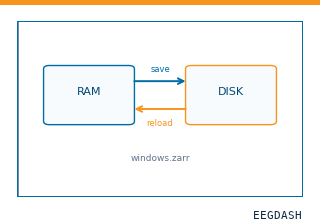 Save and reload prepared dataCache a windowed dataset to disk and reattach it without recompute.
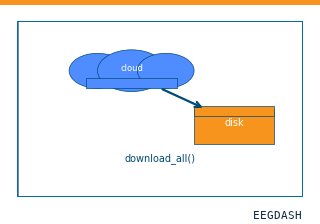 Download a dataset locallyPrefetch BIDS files to a local cache and validate the layout.
Swap any load_dataset(...) call for nm000375 to reproduce the tutorial on this dataset.
Citation
Etienne Combrisson, Ruggero Basanisi, Sylvain Rheims, Philippe Kahane, Julien Bastin, … (2021). Neural interactions in the human frontal cortex dissociate reward and punishment learning (Combrisson et al., 2024): preprocessed SEEG high-gamma power, 16 patients (derivative). 10.82901/nemar.nm000375
Provenance
¹Contributed to nemar in BIDS format.
²Curated & ingested by the EEGDash catalog; see CITATION.cff for canonical reference.
³Persistent identifier: 10.82901/nemar.nm000375.
See Also#
eegdash.dataset.EEGDashDataseteegdash.dataset