


ON007753: eeg dataset, 41 subjects#
BCCWJ-EEG
Access recordings and metadata through EEGDash.
Citation: Yushi Sugimoto, Masayuki Asahara, Hyeonjeong Jeong, Akitake Kanno, Masatoshi Koizumi, Yohei Oseki (2023). BCCWJ-EEG. 10.82901/nemar.on007753
Modality: eeg Subjects: 41 Recordings: 41 License: CC0 Source: nemar
Metadata: Complete (100%)
41-participant EEG dataset — BCCWJ-EEG.
Quickstart#
Install
pip install eegdash
Access the data
from eegdash.dataset import ON007753

dataset = ON007753(cache_dir="./data")
# Get the raw object of the first recording
raw = dataset.datasets[0].raw
print(raw.info)
Filter by subject
dataset = ON007753(cache_dir="./data", subject="01")
Advanced query
dataset = ON007753(
    cache_dir="./data",
    query={"subject": {"$in": ["01", "02"]}},
)
Iterate recordings
for rec in dataset:
    print(rec.subject, rec.raw.info['sfreq'])
If you use this dataset in your research, please cite the original authors.
BibTeX
@dataset{on007753,
  title = {BCCWJ-EEG},
  author = {Yushi Sugimoto and Masayuki Asahara and Hyeonjeong Jeong and Akitake Kanno and Masatoshi Koizumi and Yohei Oseki},
  doi = {10.82901/nemar.on007753},
  url = {https://doi.org/10.82901/nemar.on007753},
}
About This Dataset#
This dataset contains EEG data collected while Japanese native speakers read Japanese newspaper articles from the Balanced Corpus of Contemporary Written Japanese (BCCWJ; Maekawa et al., 2014). Stimuli were presented word by word. This dataset is part of BCCWJ-Brain, This dataset is part of BCCWJ-Brain; three types of brain data (fMRI, MEG, and EEG) were acquired from separate groups of participants using the same stimuli, enabling cross-modality comparisons of language processing with high spatial and temporal resolution respectively.
The BCCWJ-Brain collection consists of the following datasets:
BCCWJ-fMRI: ds007752 (https://openneuro.org/datasets/ds007752)
BCCWJ-MEG: ds007763 (https://openneuro.org/datasets/ds007763)
BCCWJ-EEG: ds007753 (https://openneuro.org/datasets/ds007753)
Overview
Participants
Data from forty-one participants were included in the dataset (22 females and 19 males; mean age=20.5 (SD = 2.89)). All participants were right-handed, had no neurological illness, and had normal or corrected-to-normal vision.
Data Acquisition
View full README
Overview
Participants
Data from forty-one participants were included in the dataset (22 females and 19 males; mean age=20.5 (SD = 2.89)). All participants were right-handed, had no neurological illness, and had normal or corrected-to-normal vision.
Data Acquisition
EEG data were recorded using a BrainAmp amplifier (Brain Products GmbH, Germany) with a 64-channel electrode cap. The online reference electrode was placed at FCz, and the ground electrode was placed at AFz. An electrode was placed below the right eye (IO) to monitor ocular artifacts. Electrode impedances were kept below 20kΩ prior to the recording. Data were recorded at a sampling rate of 1,000Hz.
Experiment Procedure
Twenty Japanese newspaper articles were used as stimuli. Stimuli were presented word by word using rapid serial visual presentation (RSVP) implemented in PsychoPy (Peirce, 2007, 2009). Each stimulus was presented for 500 ms, followed by a 500 ms blank screen. The order of the newspaper articles were randomized.
Data Preprocessing
EEG data were preprocessed using MNE-Python (v1.9.0; Gramfort et al., 2013) and Eelbrain (v0.40.3; Brodbeck et al., 2023). Continuous EEG was recorded with an easycap-M1 electrode layout and one bipolar EOG channel (IO). Independent component analysis (ICA) was then applied, and components reflecting ocular artifacts were identified and removed. The ICA decomposition was subsequently applied to the 0.1–40 Hz bandpass filtered data, and the cleaned signal was re-referenced to the common average. Data were then segmented into epochs from −100 to 1,000 ms relative to word onset and downsampled to 200 Hz. Baseline correction was applied using the pre-stimulus interval (−100 to 0 ms). The preprocessed EEG data can be found in the derivatives.
derivatives/
├── eeg/
    ├── sub-XX_task-BCCWJreading_eeg_0.1-40_raw.fif (bandpass filter applied files)
    ├── sub-XX_task-BCCWJreading_eeg_raw.fif (raw data converted to fif files (without downsampling (1,000Hz)))
    ├── sub-XX_task-BCCWJreading_eeg_reref0.1-40-ica_raw.fif (preprocessed files)
    └── sub-XX_task-BCCWJreading_eeg_reref0.1-40-ica_ave.fif (evoked files)
Notes
Since the BCCWJ texts are not copyright-free, texts for the experiment is not included in this dataset. To obtain the text, users must register for access to BCCWJ (https://bccwj-data.ninjal.ac.jp/) separately. See https://clrd.ninjal.ac.jp/bccwj/en/subscription.html for the details. Once access is granted, we provide a script to incorporate the text into the corresponding events.tsv files.
References
Brodbeck, C., Das, P., Gillis, M., Kulasingham, J. P., Bhattasali, S., Gaston, P., Resnik, P., & Simon, J. Z. (2023). Eelbrain, a Python toolkit for time-continuous analysis with temporal response functions. eLife, 12, e85012. https://doi.org/10.7554/eLife.85012 Gramfort, A., Luessi, M., Larson, E., Engemann, D. A., Strohmeier, D., Brodbeck, C., Goj, R., Jas, M., Brooks, T., Parkkonen, L., & Hämäläinen, M. (2013). MEG and EEG data analysis with MNE-Python. Frontiers in Neuroinformatics, 7, 267. https://doi.org/10.3389/fnins.2013.00267 Maekawa, K., Yamazaki, M., Ogiso, T., Maruyama, T., Ogura, H., Kashino, W., Koiso, H., Yamaguchi, M., Tanaka, M., & Den, Y. (2014). Balanced corpus of contemporary written Japanese. Language Resources and Evaluation, 48, 345–371. https://doi.org/10.1007/s10579-013-9261-0 Peirce, J. W. (2007). PsychoPy—Psychophysics software in Python. Journal of Neuroscience Methods, 162(1–2), 8–13. https://doi.org/10.1016/j.jneumeth.2006.11.017 Peirce, J. W. (2009). Generating stimuli for neuroscience using PsychoPy. Frontiers in Neuroinformatics, 2, 10. https://doi.org/10.3389/neuro.11.010.2008
Cohort#
Dataset Statistics#
Age distribution by gender (n=41, range 18–35 yr, mean 20.5 yr)
Sex composition
Channel counts: 64 ch (n=41 recordings)
Sampling frequencies: 1000.0 Hz (n=41 recordings)
Total recording duration: 25 h
Signal · Electrodes & live trace#
Live trace viewer — sub-17 · task-BCCWJreading
Showing one representative recording out of
41 subjects and 41 recordings in this dataset.
Browse the full set on OpenNeuro;
drop any other _eeg.{set,edf,bdf,vhdr} file onto the
viewer (or pass ?eeg=<url>) to inspect it.
Electrode layout — EEG · 63 sensors — 63 channels
NEMAR Processing Statistics#
The plots below are generated by NEMAR’s automated EEG pipeline. The histogram shows pipeline success for data cleaning and ICA decomposition, the percentage of data frames and EEG channels retained after artefact removal, line noise per channel (RMS, dB), and the age/gender distribution of participants.

HED event descriptors word cloud

Manifest#
File Explorer#
Browse the BIDS file structure of this dataset. Records are fetched on demand from the EEGDash catalog the first time you open the explorer.
Full dataset metadata table
Dataset ID |
|
Title |
BCCWJ-EEG |
Author (year) |
— |
Canonical |
— |
Importable as |
|
Year |
2023 |
Authors |
Yushi Sugimoto, Masayuki Asahara, Hyeonjeong Jeong, Akitake Kanno, Masatoshi Koizumi, Yohei Oseki |
License |
CC0 |
Citation / DOI |
|
Source links |
OpenNeuro | NeMAR | Source URL |
Copy-paste BibTeX
@dataset{on007753,
  title = {BCCWJ-EEG},
  author = {Yushi Sugimoto and Masayuki Asahara and Hyeonjeong Jeong and Akitake Kanno and Masatoshi Koizumi and Yohei Oseki},
  doi = {10.82901/nemar.on007753},
  url = {https://doi.org/10.82901/nemar.on007753},
}
API Reference#
eegdash.datasetEEGDashDataset- class eegdash.dataset.ON007753(cache_dir: str, query: dict | None = None, s3_bucket: str | None = None, **kwargs)[source]#
BCCWJ-EEG
- Study:
on007753(NeMAR)- Author (year):
—
- Canonical:
—
Also importable as:
ON007753.Modality:
eeg; Experiment type:Language; Subject type:Healthy. Subjects: 41; recordings: 0; tasks: 1.- Parameters:
cache_dir (str | Path) – Directory where data are cached locally.
query (dict | None) – Additional MongoDB-style filters to AND with the dataset selection. Must not contain the key
dataset.s3_bucket (str | None) – Base S3 bucket used to locate the data.
**kwargs (dict) – Additional keyword arguments forwarded to
EEGDashDataset.
- data_dir#
Local dataset cache directory (
cache_dir / dataset_id).- Type:
Path
Notes
Each item is a recording; recording-level metadata are available via
dataset.description.querysupports MongoDB-style filters on fields inALLOWED_QUERY_FIELDSand is combined with the dataset filter. Dataset-specific caveats are not provided in the summary metadata.References
OpenNeuro dataset: https://openneuro.org/datasets/on007753 NeMAR dataset: https://nemar.org/dataexplorer/detail?dataset_id=on007753 DOI: https://doi.org/10.82901/nemar.on007753
Examples
>>> from eegdash.dataset import ON007753
>>> dataset = ON007753(cache_dir="./data")
>>> recording = dataset[0]
>>> raw = recording.load()
- __init__(cache_dir: str, query: dict | None = None, s3_bucket: str | None = None, **kwargs)[source]#
- save(path: str, overwrite: bool = False, offset: int = 0)[source]#
Save datasets to files by creating one subdirectory for each dataset:
path/
    0/
        0-raw.fif | 0-epo.fif
        description.json
        raw_preproc_kwargs.json (if raws were preprocessed)
        window_kwargs.json (if this is a windowed dataset)
        window_preproc_kwargs.json  (if windows were preprocessed)
        target_name.json (if target_name is not None and dataset is raw)
    1/
        1-raw.fif | 1-epo.fif
        description.json
        raw_preproc_kwargs.json (if raws were preprocessed)
        window_kwargs.json (if this is a windowed dataset)
        window_preproc_kwargs.json  (if windows were preprocessed)
        target_name.json (if target_name is not None and dataset is raw)
- Parameters:
path (str) –
- Directory in which subdirectories are created to store
-raw.fif | -epo.fif and .json files to.
overwrite (bool) – Whether to delete old subdirectories that will be saved to in this call.
offset (int) – If provided, the integer is added to the id of the dataset in the concat. This is useful in the setting of very large datasets, where one dataset has to be processed and saved at a time to account for its original position.
BaseDataset from braindecode — windowed via create_windows_from_events.braindecodeDataLoader; supports parallel workers and on-the-fly augmentations.pytorch Find datasets with the EEGDash APIQuery the catalogue, filter by task or modality, list candidates.
 Load one EEG recordingResolve a single record to an MNE Raw with channels and events.
 EEG recording to PyTorch DataLoaderWrap braindecode windows in a DataLoader for model training.
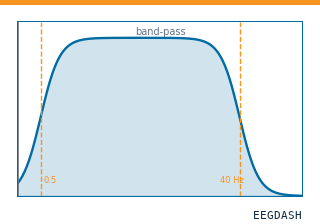 Preprocess EEG and create windowsFilter, resample, epoch — and persist the windowed dataset.
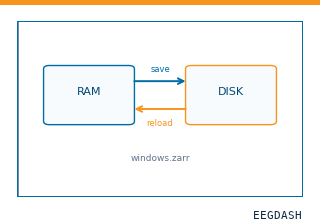 Save and reload prepared dataCache a windowed dataset to disk and reattach it without recompute.
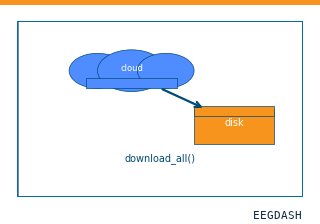 Download a dataset locallyPrefetch BIDS files to a local cache and validate the layout.
Swap any load_dataset(...) call for on007753 to reproduce the tutorial on this dataset.
Citation
Yushi Sugimoto, Masayuki Asahara, Hyeonjeong Jeong, Akitake Kanno, Masatoshi Koizumi, … (2023). BCCWJ-EEG. 10.82901/nemar.on007753
Provenance
¹Contributed to nemar in BIDS format.
²Curated & ingested by the EEGDash catalog; see CITATION.cff for canonical reference.
³Persistent identifier: 10.82901/nemar.on007753.
See Also#
eegdash.dataset.EEGDashDataseteegdash.dataset