


ON008862: eeg dataset, 30 subjects#
EEG and hedonic responses to sonic-seasoning soundscapes
Access recordings and metadata through EEGDash.
Citation: Attila Pohlmann, Felipe Reinoso-Carvalho, Brayan Rodríguez (—). EEG and hedonic responses to sonic-seasoning soundscapes. 10.82901/nemar.on008862
Modality: eeg Subjects: 30 Recordings: 30 License: CC0 Source: nemar
Metadata: Complete (100%)
30-participant EEG dataset — EEG and hedonic responses to sonic-seasoning soundscapes.
Quickstart#
Install
pip install eegdash
Access the data
from eegdash.dataset import ON008862

dataset = ON008862(cache_dir="./data")
# Get the raw object of the first recording
raw = dataset.datasets[0].raw
print(raw.info)
Filter by subject
dataset = ON008862(cache_dir="./data", subject="01")
Advanced query
dataset = ON008862(
    cache_dir="./data",
    query={"subject": {"$in": ["01", "02"]}},
)
Iterate recordings
for rec in dataset:
    print(rec.subject, rec.raw.info['sfreq'])
If you use this dataset in your research, please cite the original authors.
BibTeX
@dataset{on008862,
  title = {EEG and hedonic responses to sonic-seasoning soundscapes},
  author = {Attila Pohlmann and Felipe Reinoso-Carvalho and Brayan Rodríguez},
  doi = {10.82901/nemar.on008862},
  url = {https://doi.org/10.82901/nemar.on008862},
}
About This Dataset#
EEG and liking responses to sonic-seasoning soundscapes.
Per participant: one combined EEG file (eyes-open + eyes-closed baseline + ~17 s exposure to jungle and deconstruct
soundscapes), events.tsv marking segments, with liking ratings and baseline-state survey items in participants.tsv, and stimulus audio in /stimuli. Released as recorded (EPOC X hardware bandpass only; no additional software filtering). Recording timestamps removed.
Participant IDs are de-identified (sequential sub-NN); the mapping to original recording IDs is held privately and is not part of this dataset. See the associated Data in Brief article for full description.
All participants completed the four conditions in the same fixed order: eyes-open, eyes-closed, jungle, deconstruct. The soundscape order was not counterbalanced.
QUALITY CHANNELS
View full README
Participant IDs are de-identified (sequential sub-NN); the mapping to original recording IDs is held privately and is not part of this dataset. See the associated Data in Brief article for full description.
All participants completed the four conditions in the same fixed order: eyes-open, eyes-closed, jungle, deconstruct. The soundscape order was not counterbalanced.
QUALITY CHANNELS
Each EDF carries, alongside the 14 EEG channels, the manufacturer’s continuously logged quality signals, all sampled at 128 Hz and listed in each channels.tsv:
CQ_<electrode> per-channel contact quality, ordinal 0-4 (0 = no contact, 4 = good) CQ_Overall overall contact quality, percent CQ_CMS, CQ_DRL contact quality of the CMS and DRL reference electrodes, ordinal 0-4 EQ_<electrode> per-channel EEG quality, ordinal 0-4 EQ_Overall overall EEG-quality index, percent EQ_SampleRate achieved/nominal sampling-rate ratio, -1 to 1
Across the 30 released sessions contact quality was uniformly high (CQ_Overall M = 100.0, SD = 0.2, range 99.2-100.0; no channel fell below the acceptable level in any session), while the EEG-quality index was considerably more variable (EQ_Overall M = 62.0, SD = 18.4, range 22.1-90.4). Re-users are encouraged to apply their own thresholds to the per-channel indices rather than relying on a single summary.
EEGLAB USERS
A processed, EEGLAB-ready version of the two soundscape conditions (jungle, deconstruct) is provided under derivatives/eeglab/ as per-condition .set files that import directly into an EEGLAB STUDY with conditions assigned. See derivatives/eeglab/README for details.
These derivative files contain the 14 EEG channels only; the quality channels are in the raw EDFs at the repository root, which remain the primary, archival data.
READING THESE FILES
Use an EDF reader that handles the EMOTIV header correctly (e.g. pyedflib in Python, or EEGLAB’s BIOSIG importer). Some general-purpose readers misinterpret the header and return flat or zero-valued signals; if a channel loads as all zeros, the reader is at fault, not the data.
Always sanity-plot one channel after loading.
RESTING CALIBRATION (eyes-open / eyes-closed) — IMPORTANT NOTE
The eyes-open and eyes-closed segments are resting baselines, not length-matched counterparts to the 17 s soundscape exposures. Each had a fixed intended duration of ~20 s, but in the experiment builder each advanced on a participant-controlled “continue” button (not a hard timer). Segment markers therefore span from segment start to that button press, so recorded durations vary across participants: eyes-open 23.9-202.1 s (M = 32.1) and eyes-closed 26.3-63.4 s (M = 32.5). The button-press times were not logged and are unrecoverable.
The full segments are released unmodified; how to trim or average them is left to the user. => If a length-matched comparison with the soundscape exposures is wanted, the first 17 s of
each calibration segment falls within the fixed instructed window for all participants and precedes any post-task advance interval.
Cohort#
Dataset Statistics#
Age distribution by gender (n=30, range 22–40 yr, mean 30.1 yr)
Sex composition
Channel counts: 47 ch (n=30 recordings)
Sampling frequencies: 128.0 Hz (n=30 recordings)
Total recording duration: 1 h 1 min
Signal · Electrodes & live trace#
Live trace viewer — sub-25 · task-soundscape
Showing one representative recording out of
30 subjects and 30 recordings in this dataset.
Browse the full set on OpenNeuro;
drop any other _eeg.{set,edf,bdf,vhdr} file onto the
viewer (or pass ?eeg=<url>) to inspect it.
Electrode layout — EEG · 14 sensors — 14 channels
NEMAR Processing Statistics#
The plots below are generated by NEMAR’s automated EEG pipeline. The histogram shows pipeline success for data cleaning and ICA decomposition, the percentage of data frames and EEG channels retained after artefact removal, line noise per channel (RMS, dB), and the age/gender distribution of participants.

HED event descriptors word cloud

Manifest#
File Explorer#
Browse the BIDS file structure of this dataset. Records are fetched on demand from the EEGDash catalog the first time you open the explorer.
Full dataset metadata table
Dataset ID |
|
Title |
EEG and hedonic responses to sonic-seasoning soundscapes |
Author (year) |
— |
Canonical |
— |
Importable as |
|
Year |
— |
Authors |
Attila Pohlmann, Felipe Reinoso-Carvalho, Brayan Rodríguez |
License |
CC0 |
Citation / DOI |
|
Source links |
OpenNeuro | NeMAR | Source URL |
Copy-paste BibTeX
@dataset{on008862,
  title = {EEG and hedonic responses to sonic-seasoning soundscapes},
  author = {Attila Pohlmann and Felipe Reinoso-Carvalho and Brayan Rodríguez},
  doi = {10.82901/nemar.on008862},
  url = {https://doi.org/10.82901/nemar.on008862},
}
API Reference#
eegdash.datasetEEGDashDataset- class eegdash.dataset.ON008862(cache_dir: str, query: dict | None = None, s3_bucket: str | None = None, **kwargs)[source]#
EEG and hedonic responses to sonic-seasoning soundscapes
- Study:
on008862(NeMAR)- Author (year):
—
- Canonical:
—
Also importable as:
ON008862.Modality:
eeg; Subject type:Unknown. Subjects: 30; recordings: 30; tasks: 1.- Parameters:
cache_dir (str | Path) – Directory where data are cached locally.
query (dict | None) – Additional MongoDB-style filters to AND with the dataset selection. Must not contain the key
dataset.s3_bucket (str | None) – Base S3 bucket used to locate the data.
**kwargs (dict) – Additional keyword arguments forwarded to
EEGDashDataset.
- data_dir#
Local dataset cache directory (
cache_dir / dataset_id).- Type:
Path
Notes
Each item is a recording; recording-level metadata are available via
dataset.description.querysupports MongoDB-style filters on fields inALLOWED_QUERY_FIELDSand is combined with the dataset filter. Dataset-specific caveats are not provided in the summary metadata.References
OpenNeuro dataset: https://openneuro.org/datasets/on008862 NeMAR dataset: https://nemar.org/dataexplorer/detail?dataset_id=on008862 DOI: https://doi.org/10.82901/nemar.on008862
Examples
>>> from eegdash.dataset import ON008862
>>> dataset = ON008862(cache_dir="./data")
>>> recording = dataset[0]
>>> raw = recording.load()
- __init__(cache_dir: str, query: dict | None = None, s3_bucket: str | None = None, **kwargs)[source]#
- save(path: str, overwrite: bool = False, offset: int = 0)[source]#
Save datasets to files by creating one subdirectory for each dataset:
path/
    0/
        0-raw.fif | 0-epo.fif
        description.json
        raw_preproc_kwargs.json (if raws were preprocessed)
        window_kwargs.json (if this is a windowed dataset)
        window_preproc_kwargs.json  (if windows were preprocessed)
        target_name.json (if target_name is not None and dataset is raw)
    1/
        1-raw.fif | 1-epo.fif
        description.json
        raw_preproc_kwargs.json (if raws were preprocessed)
        window_kwargs.json (if this is a windowed dataset)
        window_preproc_kwargs.json  (if windows were preprocessed)
        target_name.json (if target_name is not None and dataset is raw)
- Parameters:
path (str) –
- Directory in which subdirectories are created to store
-raw.fif | -epo.fif and .json files to.
overwrite (bool) – Whether to delete old subdirectories that will be saved to in this call.
offset (int) – If provided, the integer is added to the id of the dataset in the concat. This is useful in the setting of very large datasets, where one dataset has to be processed and saved at a time to account for its original position.
BaseDataset from braindecode — windowed via create_windows_from_events.braindecodeDataLoader; supports parallel workers and on-the-fly augmentations.pytorch Find datasets with the EEGDash APIQuery the catalogue, filter by task or modality, list candidates.
 Load one EEG recordingResolve a single record to an MNE Raw with channels and events.
 EEG recording to PyTorch DataLoaderWrap braindecode windows in a DataLoader for model training.
 Preprocess EEG and create windowsFilter, resample, epoch — and persist the windowed dataset.
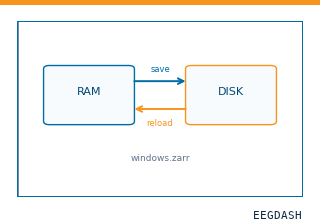 Save and reload prepared dataCache a windowed dataset to disk and reattach it without recompute.
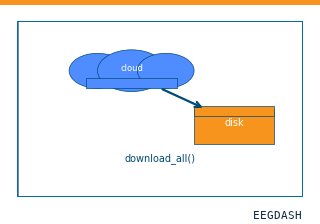 Download a dataset locallyPrefetch BIDS files to a local cache and validate the layout.
Swap any load_dataset(...) call for on008862 to reproduce the tutorial on this dataset.
Citation
Attila Pohlmann, Felipe Reinoso-Carvalho, Brayan Rodríguez (n.d.). EEG and hedonic responses to sonic-seasoning soundscapes. 10.82901/nemar.on008862
Provenance
¹Contributed to nemar in BIDS format.
²Curated & ingested by the EEGDash catalog; see CITATION.cff for canonical reference.
³Persistent identifier: 10.82901/nemar.on008862.
See Also#
eegdash.dataset.EEGDashDataseteegdash.dataset