


NM000364: ieeg dataset, 7 subjects#
Task-SEEG recordings from epilepsy patients performing a visual working memory task (Tian, Figshare 32189838)
Access recordings and metadata through EEGDash.
Citation: Ziwei Tian (2026). Task-SEEG recordings from epilepsy patients performing a visual working memory task (Tian, Figshare 32189838). 10.82901/nemar.nm000364
Modality: ieeg Subjects: 7 Recordings: 8 License: CC-BY-NC-4.0 Source: nemar
Metadata: Complete (100%)
7-participant iEEG dataset — Task-SEEG recordings from epilepsy patients performing a visual working memory task (Tian, Figshare 32189838).
Quickstart#
Install
pip install eegdash
Access the data
from eegdash.dataset import NM000364

dataset = NM000364(cache_dir="./data")
# Get the raw object of the first recording
raw = dataset.datasets[0].raw
print(raw.info)
Filter by subject
dataset = NM000364(cache_dir="./data", subject="01")
Advanced query
dataset = NM000364(
    cache_dir="./data",
    query={"subject": {"$in": ["01", "02"]}},
)
Iterate recordings
for rec in dataset:
    print(rec.subject, rec.raw.info['sfreq'])
If you use this dataset in your research, please cite the original authors.
BibTeX
@dataset{nm000364,
  title = {Task-SEEG recordings from epilepsy patients performing a visual working memory task (Tian, Figshare 32189838)},
  author = {Ziwei Tian},
  doi = {10.82901/nemar.nm000364},
  url = {https://doi.org/10.82901/nemar.nm000364},
}
About This Dataset#
This is a BIDS (iEEG) copy of the Figshare dataset
Tian, Ziwei (2026). task-SEEG data from epilepsy patients. figshare. Dataset. https://doi.org/10.6084/m9.figshare.32189838.v1 (article 32189838, version 1, published 2026-05-07)
Task-SEEG recordings from epilepsy patients performing a visual working memory task
Source description (Figshare, verbatim): “This dataset contains stereo-electroencephalography (SEEG) recordings acquired from epilepsy patients while they performed a visual working memory task. The data were collected to investigate the neural mechanisms underlying working memory processes in the human brain.” Participants: “patients with drug-resistant epilepsy who underwent SEEG implantation for clinical evaluation. Electrode placement was determined solely by clinical requirements, with no additional electrodes implanted for research purposes.” Electrodes: “Intracranial multi-contact depth electrodes (8–16 contacts; length, 2 mm; diameter, 0.8 mm; spacing,
View full README
Task-SEEG recordings from epilepsy patients performing a visual working memory task
Source description (Figshare, verbatim): “This dataset contains stereo-electroencephalography (SEEG) recordings acquired from epilepsy patients while they performed a visual working memory task. The data were collected to investigate the neural mechanisms underlying working memory processes in the human brain.” Participants: “patients with drug-resistant epilepsy who underwent SEEG implantation for clinical evaluation. Electrode placement was determined solely by clinical requirements, with no additional electrodes implanted for research purposes.” Electrodes: “Intracranial multi-contact depth electrodes (8–16 contacts; length, 2 mm; diameter, 0.8 mm; spacing, 1.5 mm; Huake-Hengsheng Medical Technology, Beijing, China) were stereotactically implanted with robotic assistance.” Recording: “Amplifier: Nicolet EEG; Sampling rate: 2048 Hz; Online reference: A white matter site selected by the clinical team.” Task: “Participants performed a visual working memory task. Further details of the experimental paradigm can be found in the accompanying research article.”
Contents
7 participants (sub-01 to sub-07), 8 continuous EDF recordings (sub-03 has two runs), task label
vwm.2048 Hz, 148 signals per recording (the EDF+ annotation signal of sub-06 and sub-07 is not counted).
Total duration 22,168 s (6.2 h): 1,080.6 to 4,010.9 s per recording (exact values in each
_ieeg.json).Units as in the EDF headers (µV for SEEG contacts). No filtering, resampling, re-referencing or channel removal was done for this copy. The EDF prefilter fields are empty, so
low_cutoff/high_cutoffare n/a.participants.tsv: age, sex, years of education, seizure-onset zone, and the contacts the authors list as frontal eye field and hippocampus. Values are verbatim from the source (columns renamed to snake_case;male/femalecoded M/F).
What the source does not contain
No events, trial or behavioural files. The Figshare record has none, and the EDFs have no task annotations (sub-07 has one EDF+ annotation “renwu”, pinyin for “task”, at 0.75 s; sub-06 and sub-07 also have machine log entries). The
TRIGchannel carries a few analog-like transitions per recording (about 80 to 170 sample-to-sample changes), not a clean digital code. It was kept but not decoded into events. Users need the paradigm from the authors’ article.No electrode coordinates and no imaging.
electrodes.tsvlists the SEEG contact names with x/y/z = n/a.coordsystem.jsonsays “Other” with units n/a.No ethics statement and no funding statement are given in the record.
Channel types (changed from the source)
The source channels.tsv (MNE-BIDS output) typed all 148 signals as SEEG. Here the types follow the EDF labels:
SEEG for electrode contacts (letter, optional prime marks, number); ADC for DC1–DC16 (Nicolet DC auxiliary
inputs); TRIG for TRIG; MISC for OSAT, PR, Pleth and for amplifier inputs with the Nicolet default names
C123–C128, which the source does not assign to an electrode. Channels whose digital value is constant over the
whole recording are marked bad with status_description “flat”. The source channel tables are kept in
sourcedata/.
Power-line frequency
The source sidecars say “n/a”. PowerLineFrequency is set to 50 because the recordings show a clear 50 Hz peak
(spectral peak-to-neighbour ratio 18 to 6,400 at 50 Hz, about 1 at 60 Hz, in every recording).
Licence
CC-BY-NC-4.0
Associated publications
The Figshare record refers to “the accompanying research article” but does not name it. These articles by the same first author describe SEEG recordings during a visual working memory task with eye tracking in epilepsy patients. The link is inferred from author, paradigm and dates; the record does not state it: - Tian Z, Huang S, Liu D, Yang Z, Li S, Hu B, Feng L, Wang Q. Hippocampal interictal spikes disrupt theta-band
hippocampal-frontal eye field connectivity: fixation skewness as an indicator of transient network instability. Epilepsy & Behavior 181:111071 (2026). https://doi.org/10.1016/j.yebeh.2026.111071 (seven epilepsy patients with hippocampal and frontal-eye-field iEEG; published two days after the Figshare record).
Tian Z, Huang S, Liu D, Yang Z, Li S, Hu B, Wang Q, Feng L. Distinct and coordinated contributions of hippocampus and frontal eye field to novelty exploration and revisitation. NeuroImage 329:121838 (2026). https://doi.org/10.1016/j.neuroimage.2026.121838
Both list affiliations at the Xi’an Institute of Optics and Precision Mechanics (CAS) and Xiangya Hospital, Central South University. The Figshare record names neither institution.
De-identification done for this copy
The source EDF headers contain a hospital record number, the date of birth and the real recording date. The
source scans.tsv files contain the real recording dates. The EDF+ annotation signals of sub-06 and sub-07 hold a
Montage: entry that contains a personal name (the files do not say whose; it may be the name of a montage or of a
staff member, or a patient). For this copy:
Dates truncated to month (day set to 01).
- EDF patient field set to the EDF+ form X <sex> X X: sex (M/F, same as participants.tsv) is kept; the hospital
record number and the date of birth are removed (birthdate subfield
X; EDF+ allows only a full date orX). The year of birth from the source header is kept in participants.tsv (birth_year; day and month removed); it agrees within one year withageand the recording year for every participant. Recording field set toStartdate 01-MMM-YYYY X X Xand start date to01.MM.YY, keeping the source year and month. The time of day is kept.
In sub-06 and sub-07, the text after
Montage:in the EDF+ annotation signal is replaced byXcharacters of the same byte length. Other annotations (“Clip Note”, “Gain/Filter Change”, “renwu”) are kept.scans.tsvacq_time keeps year, month and time of day, with the day set to 01. The two sub-03 runs were recorded on the same day, so the interval between them is kept.A byte comparison against the source confirmed that no other byte changed: all signal samples are identical to the Figshare files.
The source EDF and
scans.tsvfiles are therefore not included insourcedata/. The other source files (README, dataset_description, participants, channels and sidecar JSON) are included unchanged insourcedata/figshare-32189838-v1/.PROVENANCE.tsvthere lists every source file with its Figshare MD5 and whether it is included.
NEMAR Metadata#
[](https://doi.org/10.82901/nemar.nm000364) # Task-SEEG recordings from epilepsy patients performing a visual working memory task This is a BIDS (iEEG) copy of the Figshare dataset > Tian, Ziwei (2026). task-SEEG data from epilepsy patients. figshare. Dataset. > https://doi.org/10.6084/m9.figshare.32189838.v1 (article 32189838, version 1, published 2026-05-07) Source description (Figshare, verbatim): “This dataset contains stereo-electroencephalography (SEEG) recordings acquired from epilepsy patients while they performed a visual working memory task. The data were collected to investigate the neural mechanisms underlying working memory processes in the human brain.” Participants: “patients with drug-resistant epilepsy who underwent SEEG implantation for clinical evaluation. Electrode placement was determined solely by clinical requirements, with no additional electrodes implanted for research purposes.” Electrodes: “Intracranial multi-contact depth electrodes (8–16 contacts; length, 2 mm; diameter, 0.8 mm; spacing, 1.5 mm; Huake-Hengsheng Medical Technology, Beijing, China) were stereotactically implanted with robotic assistance.” Recording: “Amplifier: Nicolet EEG; Sampling rate: 2048 Hz; Online reference: A white matter site selected by the clinical team.” Task: “Participants performed a visual working memory task. Further details of the experimental paradigm can be found in the accompanying research article.” ## Contents - 7 participants (sub-01 to sub-07), 8 continuous EDF recordings (sub-03 has two runs), task label vwm. - 2048 Hz, 148 signals per recording (the EDF+ annotation signal of sub-06 and sub-07 is not counted). - Total duration 22,168 s (6.2 h): 1,080.6 to 4,010.9 s per recording (exact values in each _ieeg.json). - Units as in the EDF headers (µV for SEEG contacts). No filtering, resampling, re-referencing or channel removal
was done for this copy. The EDF prefilter fields are empty, so low_cutoff/high_cutoff are n/a.
participants.tsv: age, sex, years of education, seizure-onset zone, and the contacts the authors list as frontal eye field and hippocampus. Values are verbatim from the source (columns renamed to snake_case; male/female coded M/F).
## What the source does not contain - No events, trial or behavioural files. The Figshare record has none, and the EDFs have no task annotations
(sub-07 has one EDF+ annotation “renwu”, pinyin for “task”, at 0.75 s; sub-06 and sub-07 also have machine log entries). The TRIG channel carries a few analog-like transitions per recording (about 80 to 170 sample-to-sample changes), not a clean digital code. It was kept but not decoded into events. Users need the paradigm from the authors’ article.
No electrode coordinates and no imaging. electrodes.tsv lists the SEEG contact names with x/y/z = n/a. coordsystem.json says “Other” with units n/a.
No ethics statement and no funding statement are given in the record.
## Channel types (changed from the source) The source channels.tsv (MNE-BIDS output) typed all 148 signals as SEEG. Here the types follow the EDF labels: SEEG for electrode contacts (letter, optional prime marks, number); ADC for DC1–DC16 (Nicolet DC auxiliary inputs); TRIG for TRIG; MISC for OSAT, PR, Pleth and for amplifier inputs with the Nicolet default names C123–C128, which the source does not assign to an electrode. Channels whose digital value is constant over the whole recording are marked bad with status_description “flat”. The source channel tables are kept in sourcedata/. ## Power-line frequency The source sidecars say “n/a”. PowerLineFrequency is set to 50 because the recordings show a clear 50 Hz peak (spectral peak-to-neighbour ratio 18 to 6,400 at 50 Hz, about 1 at 60 Hz, in every recording). ## Licence CC-BY-NC-4.0 ## Associated publications The Figshare record refers to “the accompanying research article” but does not name it. These articles by the same first author describe SEEG recordings during a visual working memory task with eye tracking in epilepsy patients. The link is inferred from author, paradigm and dates; the record does not state it: - Tian Z, Huang S, Liu D, Yang Z, Li S, Hu B, Feng L, Wang Q. Hippocampal interictal spikes disrupt theta-band
hippocampal-frontal eye field connectivity: fixation skewness as an indicator of transient network instability. Epilepsy & Behavior 181:111071 (2026). https://doi.org/10.1016/j.yebeh.2026.111071 (seven epilepsy patients with hippocampal and frontal-eye-field iEEG; published two days after the Figshare record).
Tian Z, Huang S, Liu D, Yang Z, Li S, Hu B, Wang Q, Feng L. Distinct and coordinated contributions of hippocampus and frontal eye field to novelty exploration and revisitation. NeuroImage 329:121838 (2026). https://doi.org/10.1016/j.neuroimage.2026.121838
Both list affiliations at the Xi’an Institute of Optics and Precision Mechanics (CAS) and Xiangya Hospital, Central South University. The Figshare record names neither institution. ## De-identification done for this copy The source EDF headers contain a hospital record number, the date of birth and the real recording date. The source scans.tsv files contain the real recording dates. The EDF+ annotation signals of sub-06 and sub-07 hold a Montage: entry that contains a personal name (the files do not say whose; it may be the name of a montage or of a staff member, or a patient). For this copy: Dates truncated to month (day set to 01). - EDF patient field set to the EDF+ form X <sex> X X: sex (M/F, same as participants.tsv) is kept; the hospital
record number and the date of birth are removed (birthdate subfield X; EDF+ allows only a full date or X). The year of birth from the source header is kept in participants.tsv (birth_year; day and month removed); it agrees within one year with age and the recording year for every participant. Recording field set to Startdate 01-MMM-YYYY X X X and start date to 01.MM.YY, keeping the source year and month. The time of day is kept.
In sub-06 and sub-07, the text after Montage: in the EDF+ annotation signal is replaced by X characters of the same byte length. Other annotations (“Clip Note”, “Gain/Filter Change”, “renwu”) are kept.
scans.tsv acq_time keeps year, month and time of day, with the day set to 01. The two sub-03 runs were recorded on the same day, so the interval between them is kept.
A byte comparison against the source confirmed that no other byte changed: all signal samples are identical to the Figshare files.
The source EDF and scans.tsv files are therefore not included in sourcedata/. The other source files (README, dataset_description, participants, channels and sidecar JSON) are included unchanged in sourcedata/figshare-32189838-v1/. PROVENANCE.tsv there lists every source file with its Figshare MD5 and whether it is included.
License: CC-BY-NC-4.0
Authors:
Ziwei Tian
Versions:
Version |
DOI |
Released |
|---|---|---|
|
Cohort#
Dataset Statistics#
Age distribution by gender (n=7, range 18–56 yr, mean 29.0 yr)
Sex composition
Channel counts: 148 ch (n=8 recordings)
Sampling frequencies: 2048.0 Hz (n=8 recordings)
Total recording duration: 6 h 9 min
Signal · Electrodes & live trace#
Live trace viewer — sub-04 · task-vwm · run-01
Showing one representative recording out of
7 subjects and 8 recordings in this dataset.
Browse the full set on OpenNeuro;
drop any other _ieeg.{set,edf,bdf,vhdr} file onto the
viewer (or pass ?ieeg=<url>) to inspect it.
No scalp electrode layout is currently indexed for this dataset. Once the eegdash montage registry ingests it, the interactive viewer will appear here automatically.
NEMAR Processing Statistics#
The plots below are generated by NEMAR’s automated EEG pipeline. The histogram shows pipeline success for data cleaning and ICA decomposition, the percentage of data frames and EEG channels retained after artefact removal, line noise per channel (RMS, dB), and the age/gender distribution of participants.

HED event descriptors word cloud

Manifest#
File Explorer#
Browse the BIDS file structure of this dataset. Records are fetched on demand from the EEGDash catalog the first time you open the explorer.
Full dataset metadata table
Dataset ID |
|
Title |
Task-SEEG recordings from epilepsy patients performing a visual working memory task (Tian, Figshare 32189838) |
Author (year) |
— |
Canonical |
— |
Importable as |
|
Year |
2026 |
Authors |
Ziwei Tian |
License |
CC-BY-NC-4.0 |
Citation / DOI |
|
Source links |
OpenNeuro | NeMAR | Source URL |
Copy-paste BibTeX
@dataset{nm000364,
  title = {Task-SEEG recordings from epilepsy patients performing a visual working memory task (Tian, Figshare 32189838)},
  author = {Ziwei Tian},
  doi = {10.82901/nemar.nm000364},
  url = {https://doi.org/10.82901/nemar.nm000364},
}
API Reference#
eegdash.datasetEEGDashDataset- class eegdash.dataset.NM000364(cache_dir: str, query: dict | None = None, s3_bucket: str | None = None, **kwargs)[source]#
Task-SEEG recordings from epilepsy patients performing a visual working memory task (Tian, Figshare 32189838)
- Study:
nm000364(NeMAR)- Author (year):
—
- Canonical:
—
Also importable as:
NM000364.Modality:
ieeg; Subject type:Unknown. Subjects: 7; recordings: 8; tasks: 1.- Parameters:
cache_dir (str | Path) – Directory where data are cached locally.
query (dict | None) – Additional MongoDB-style filters to AND with the dataset selection. Must not contain the key
dataset.s3_bucket (str | None) – Base S3 bucket used to locate the data.
**kwargs (dict) – Additional keyword arguments forwarded to
EEGDashDataset.
- data_dir#
Local dataset cache directory (
cache_dir / dataset_id).- Type:
Path
Notes
Each item is a recording; recording-level metadata are available via
dataset.description.querysupports MongoDB-style filters on fields inALLOWED_QUERY_FIELDSand is combined with the dataset filter. Dataset-specific caveats are not provided in the summary metadata.References
OpenNeuro dataset: https://openneuro.org/datasets/nm000364 NeMAR dataset: https://nemar.org/dataexplorer/detail?dataset_id=nm000364 DOI: https://doi.org/10.82901/nemar.nm000364
Examples
>>> from eegdash.dataset import NM000364
>>> dataset = NM000364(cache_dir="./data")
>>> recording = dataset[0]
>>> raw = recording.load()
- __init__(cache_dir: str, query: dict | None = None, s3_bucket: str | None = None, **kwargs)[source]#
- save(path: str, overwrite: bool = False, offset: int = 0)[source]#
Save datasets to files by creating one subdirectory for each dataset:
path/
    0/
        0-raw.fif | 0-epo.fif
        description.json
        raw_preproc_kwargs.json (if raws were preprocessed)
        window_kwargs.json (if this is a windowed dataset)
        window_preproc_kwargs.json  (if windows were preprocessed)
        target_name.json (if target_name is not None and dataset is raw)
    1/
        1-raw.fif | 1-epo.fif
        description.json
        raw_preproc_kwargs.json (if raws were preprocessed)
        window_kwargs.json (if this is a windowed dataset)
        window_preproc_kwargs.json  (if windows were preprocessed)
        target_name.json (if target_name is not None and dataset is raw)
- Parameters:
path (str) –
- Directory in which subdirectories are created to store
-raw.fif | -epo.fif and .json files to.
overwrite (bool) – Whether to delete old subdirectories that will be saved to in this call.
offset (int) – If provided, the integer is added to the id of the dataset in the concat. This is useful in the setting of very large datasets, where one dataset has to be processed and saved at a time to account for its original position.
BaseDataset from braindecode — windowed via create_windows_from_events.braindecodeDataLoader; supports parallel workers and on-the-fly augmentations.pytorch Find datasets with the EEGDash APIQuery the catalogue, filter by task or modality, list candidates.
 Load one EEG recordingResolve a single record to an MNE Raw with channels and events.
 EEG recording to PyTorch DataLoaderWrap braindecode windows in a DataLoader for model training.
 Preprocess EEG and create windowsFilter, resample, epoch — and persist the windowed dataset.
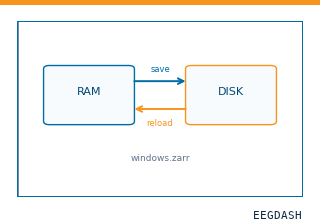 Save and reload prepared dataCache a windowed dataset to disk and reattach it without recompute.
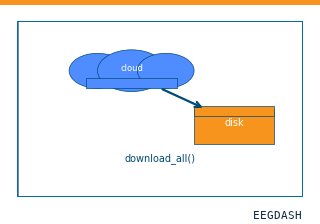 Download a dataset locallyPrefetch BIDS files to a local cache and validate the layout.
Swap any load_dataset(...) call for nm000364 to reproduce the tutorial on this dataset.
Citation
Ziwei Tian (2026). Task-SEEG recordings from epilepsy patients performing a visual working memory task (Tian, Figshare 32189838). 10.82901/nemar.nm000364
Provenance
¹Contributed to nemar in BIDS format.
²Curated & ingested by the EEGDash catalog; see CITATION.cff for canonical reference.
³Persistent identifier: 10.82901/nemar.nm000364.
See Also#
eegdash.dataset.EEGDashDataseteegdash.dataset