


NM000401: ieeg dataset, 14 subjects#
Subthalamic local field potentials during the balloon analogue risk task (Pearson et al., 2017): Parkinson’s disease DBS surgery (derivative: decimated LFP)
Access recordings and metadata through EEGDash.
Citation: John M. Pearson, Patrick T. Hickey, Shivanand P. Lad, Michael L. Platt, Dennis A. Turner (2017). Subthalamic local field potentials during the balloon analogue risk task (Pearson et al., 2017): Parkinson’s disease DBS surgery (derivative: decimated LFP). 10.82901/nemar.nm000401
Modality: ieeg Subjects: 14 Recordings: 17 License: CC0-1.0 Source: nemar
Metadata: Complete (100%)
14-participant iEEG dataset — Subthalamic local field potentials during the balloon analogue risk task (Pearson et al., 2017): Parkinson's disease DBS surgery (derivative: decimated LFP).
Quickstart#
Install
pip install eegdash
Access the data
from eegdash.dataset import NM000401

dataset = NM000401(cache_dir="./data")
# Get the raw object of the first recording
raw = dataset.datasets[0].raw
print(raw.info)
Filter by subject
dataset = NM000401(cache_dir="./data", subject="01")
Advanced query
dataset = NM000401(
    cache_dir="./data",
    query={"subject": {"$in": ["01", "02"]}},
)
Iterate recordings
for rec in dataset:
    print(rec.subject, rec.raw.info['sfreq'])
If you use this dataset in your research, please cite the original authors.
BibTeX
@dataset{nm000401,
  title = {Subthalamic local field potentials during the balloon analogue risk task (Pearson et al., 2017): Parkinson's disease DBS surgery (derivative: decimated LFP)},
  author = {John M. Pearson and Patrick T. Hickey and Shivanand P. Lad and Michael L. Platt and Dennis A. Turner},
  doi = {10.82901/nemar.nm000401},
  url = {https://doi.org/10.82901/nemar.nm000401},
}
About This Dataset#
Intraoperative recordings from the subthalamic nucleus (STN) of patients with Parkinson’s disease during DBS
implantation (Duke University Medical Center) while they played a self-paced balloon analogue risk task (BART).
Single microelectrodes, and in a subset (article: 7 datasets) a 32-channel Pt/Ir microwire array.
THIS IS A DERIVATIVE DATASET: the LFP in the release was “recorded at 1kHz, decimated and stored here at 200Hz” (release README); it is not the raw acquisition.
Subthalamic LFP during the balloon analogue risk task (Pearson et al., 2017) - DERIVATIVE
Source
Dryad: John M. Pearson, Patrick T. Hickey, Shivanand P. Lad, Michael L. Platt, Dennis A. Turner. Data from: Local fields in human subthalamic nucleus track the lead-up to impulsive choices. doi:10.5061/dryad.54tp8q5 (version 1, 2018-08-07). License: CC0 1.0 (Dryad).
Article: Front Neurosci 11:646 (2017), doi:10.3389/fnins.2017.00646 (PMC5703842). Code: https://github.com/jmxpearson/bart_analysis
View full README
Subthalamic LFP during the balloon analogue risk task (Pearson et al., 2017) - DERIVATIVE
Source
Dryad: John M. Pearson, Patrick T. Hickey, Shivanand P. Lad, Michael L. Platt, Dennis A. Turner. Data from: Local fields in human subthalamic nucleus track the lead-up to impulsive choices. doi:10.5061/dryad.54tp8q5 (version 1, 2018-08-07). License: CC0 1.0 (Dryad).
Article: Front Neurosci 11:646 (2017), doi:10.3389/fnins.2017.00646 (PMC5703842). Code: https://github.com/jmxpearson/bart_analysis
Both Dryad files were downloaded through the Dryad API and matched the Dryad md5 digests and sizes.
Contents
sub-<nn>/ieeg/sub-<nn>_task-bart_run-<dataset>_ieeg.*: 17 recordings of 14 patients (sub-<nn>= patient p<nn> of bart.hdf5;run= its dataset number, e.g. the two sides of a bilateral implantation), 4.33 h. Channelsc<k>= channel numbers of the release (1 channel, or 32 for the microwire arrays). Values: the release voltages (V) x 1e6 as float32 µV (max absolute rounding error 0.49 µV). Time zero = time 0 of the release LFP tables.Sampling: 200 Hz (5 ms step) except sub-17 run-1, sub-21 run-1, sub-24 run-1, sub-25 run-1 (4 ms step, 250 Hz), as measured from the time columns; the README states 200 Hz for all.
events.tsv: oneballoonrow per trial with every behavioural column of the release (onset = ‘start inflating’), pluscensoredrows with the artifact intervals per channel from /censor. Event times are used as stored; the release does not state explicitly that behaviour and LFP share the time axis (both are in seconds from the task start in the authors’ analysis).Behaviour tables without LFP (patient/dataset): p10/d1, p25/d2 (behaviour and, for p10, spikes only; in sourcedata).
Spike times of 56 sorted units (/spikes) are NOT converted (BIDS-iEEG has no spike format); they are in
sourcedata/dryad-54tp8q5/bart.hdf5(the complete, unchanged release file) with README_for_bart.md.No electrode coordinates are released;
electrodes.tsvlists the channels with x, y, z = n/a.
Participants
15 patients (5 female, 10 male) per the article; its Table 1 gives age bands, disease duration, LEDD and surgery side per row, without patient numbers, so they are not assigned to subjects here.
Privacy
bart.hdf5 holds patient numbers, times in seconds and behaviour only; no names or dates were found. The file is included unchanged.
Additional metadata and localisation (added 2026-10-08)
Compiled after the upload from the article, its supplement and the source deposit (each statement names its source). Text and sidecar metadata only; no data file was changed.
Sources: P = Pearson, Hickey, Lad, Platt, Turner 2017, Front Neurosci 11:646, doi:10.3389/fnins.2017.00646 (PMC5703842). R = deposit README_for_bart.md. F = bart.hdf5 metadata (Voyager Job). Recording. Plexon MAP system with FHC Guideline 4000. For single-electrode recordings, the high-pass (spike) and low-pass (LFP) signals were recorded; for the 32-channel arrays, LFP came from all 32 channels and high-pass from the 16 most active (P). LFP was recorded at 1 kHz and stored decimated to 200 Hz (R). The time step is 4 ms (250 Hz) in p17/d1, p21, p24 and p25 (measured from the file; atlas note). Spikes were sorted offline with WaveClus (P). Censoring tables mark artifactual epochs (R). Electrodes. Single-channel tungsten microelectrodes (Frederick Haer) were used for STN localisation. In 7 datasets (16.2, 17.2, 18.1, 20.1, 22.1, 23.1, 30.1), after mapping, a 32-channel Pt/Ir microwire array (35 µm wires, Ad-Tech) was passed to the STN through an outer cannula and slowly advanced (P). Reference. Not stated in P. For analysis, the mean across channels was subtracted at each time point (P, LFP preprocessing). Localisation. The STN was targeted indirectly (X 11-12 mm from midline, Y 2 mm behind the AC-PC midpoint, Z 4 mm below AC-PC), refined on FLAIR, and its borders were defined by single-unit mapping (aim: at least 5.5-6 mm of STN multi-unit activity, typically 2-3 passes). Data were mostly collected during localisation, with the electrode left at a well-isolated unit. Both sides were recorded in subjects 14, 16 and 17. 55 of 56 units were judged to be within STN boundaries; one was probably in SNr. The microwire positions are “distributed at random throughout STN” (P, Methods/Results/Discussion). No per-channel coordinates, depths or hemispheres are published or present in F.
NEMAR Metadata#
[](https://doi.org/10.82901/nemar.nm000401) # Subthalamic LFP during the balloon analogue risk task (Pearson et al., 2017) - DERIVATIVE Intraoperative recordings from the subthalamic nucleus (STN) of patients with Parkinson’s disease during DBS implantation (Duke University Medical Center) while they played a self-paced balloon analogue risk task (BART). Single microelectrodes, and in a subset (article: 7 datasets) a 32-channel Pt/Ir microwire array. THIS IS A DERIVATIVE DATASET: the LFP in the release was “recorded at 1kHz, decimated and stored here at 200Hz” (release README); it is not the raw acquisition. ## Source - Dryad: John M. Pearson, Patrick T. Hickey, Shivanand P. Lad, Michael L. Platt, Dennis A. Turner. Data from: Local fields in human subthalamic nucleus track the lead-up to impulsive
choices. doi:10.5061/dryad.54tp8q5 (version 1, 2018-08-07). License: CC0 1.0 (Dryad).
Article: Front Neurosci 11:646 (2017), doi:10.3389/fnins.2017.00646 (PMC5703842). Code: https://github.com/jmxpearson/bart_analysis
Both Dryad files were downloaded through the Dryad API and matched the Dryad md5 digests and sizes.
## Contents - sub-<nn>/ieeg/sub-<nn>_task-bart_run-<dataset>_ieeg.*: 17 recordings of 14 patients (sub-<nn> =
patient p<nn> of bart.hdf5; run = its dataset number, e.g. the two sides of a bilateral implantation), 4.33 h. Channels c<k> = channel numbers of the release (1 channel, or 32 for the microwire arrays). Values: the release voltages (V) x 1e6 as float32 µV (max absolute rounding error 0.49 µV). Time zero = time 0 of the release LFP tables.
Sampling: 200 Hz (5 ms step) except sub-17 run-1, sub-21 run-1, sub-24 run-1, sub-25 run-1 (4 ms step, 250 Hz), as measured from the time columns; the README states 200 Hz for all.
events.tsv: one balloon row per trial with every behavioural column of the release (onset = ‘start inflating’), plus censored rows with the artifact intervals per channel from /censor. Event times are used as stored; the release does not state explicitly that behaviour and LFP share the time axis (both are in seconds from the task start in the authors’ analysis).
Behaviour tables without LFP (patient/dataset): p10/d1, p25/d2 (behaviour and, for p10, spikes only; in sourcedata).
Spike times of 56 sorted units (/spikes) are NOT converted (BIDS-iEEG has no spike format); they are in sourcedata/dryad-54tp8q5/bart.hdf5 (the complete, unchanged release file) with README_for_bart.md.
No electrode coordinates are released; electrodes.tsv lists the channels with x, y, z = n/a.
## Participants 15 patients (5 female, 10 male) per the article; its Table 1 gives age bands, disease duration, LEDD and surgery side per row, without patient numbers, so they are not assigned to subjects here. ## Privacy bart.hdf5 holds patient numbers, times in seconds and behaviour only; no names or dates were found. The file is included unchanged. ## Additional metadata and localisation (added 2026-10-08) Compiled after the upload from the article, its supplement and the source deposit (each statement names its source). Text and sidecar metadata only; no data file was changed. Sources: P = Pearson, Hickey, Lad, Platt, Turner 2017, Front Neurosci 11:646, doi:10.3389/fnins.2017.00646 (PMC5703842). R = deposit README_for_bart.md. F = bart.hdf5 metadata (Voyager Job). Recording. Plexon MAP system with FHC Guideline 4000. For single-electrode recordings, the high-pass (spike) and low-pass (LFP) signals were recorded; for the 32-channel arrays, LFP came from all 32 channels and high-pass from the 16 most active (P). LFP was recorded at 1 kHz and stored decimated to 200 Hz (R). The time step is 4 ms (250 Hz) in p17/d1, p21, p24 and p25 (measured from the file; atlas note). Spikes were sorted offline with WaveClus (P). Censoring tables mark artifactual epochs (R). Electrodes. Single-channel tungsten microelectrodes (Frederick Haer) were used for STN localisation. In 7 datasets (16.2, 17.2, 18.1, 20.1, 22.1, 23.1, 30.1), after mapping, a 32-channel Pt/Ir microwire array (35 µm wires, Ad-Tech) was passed to the STN through an outer cannula and slowly advanced (P). Reference. Not stated in P. For analysis, the mean across channels was subtracted at each time point (P, LFP preprocessing). Localisation. The STN was targeted indirectly (X 11-12 mm from midline, Y 2 mm behind the AC-PC midpoint, Z 4 mm below AC-PC), refined on FLAIR, and its borders were defined by single-unit mapping (aim: at least 5.5-6 mm of STN multi-unit activity, typically 2-3 passes). Data were mostly collected during localisation, with the electrode left at a well-isolated unit. Both sides were recorded in subjects 14, 16 and 17. 55 of 56 units were judged to be within STN boundaries; one was probably in SNr. The microwire positions are “distributed at random throughout STN” (P, Methods/Results/Discussion). No per-channel coordinates, depths or hemispheres are published or present in F.
License: CC0-1.0
Authors:
John M. Pearson
Patrick T. Hickey
Shivanand P. Lad
Michael L. Platt
Dennis A. Turner
Versions:
Version |
DOI |
Released |
|---|---|---|
|
Cohort#
Dataset Statistics#
Channel counts (ch)
Sampling frequencies (Hz)
Total recording duration: 4 h 19 min
Signal · Electrodes & live trace#
Live trace viewer — sub-11 · task-bart · run-1
Showing one representative recording out of
14 subjects and 17 recordings in this dataset.
Browse the full set on OpenNeuro;
drop any other _ieeg.{set,edf,bdf,vhdr} file onto the
viewer (or pass ?ieeg=<url>) to inspect it.
No scalp electrode layout is currently indexed for this dataset. Once the eegdash montage registry ingests it, the interactive viewer will appear here automatically.
NEMAR Processing Statistics#
The plots below are generated by NEMAR’s automated EEG pipeline. The histogram shows pipeline success for data cleaning and ICA decomposition, the percentage of data frames and EEG channels retained after artefact removal, line noise per channel (RMS, dB), and the age/gender distribution of participants.

HED event descriptors word cloud

Manifest#
File Explorer#
Browse the BIDS file structure of this dataset. Records are fetched on demand from the EEGDash catalog the first time you open the explorer.
Full dataset metadata table
Dataset ID |
|
Title |
Subthalamic local field potentials during the balloon analogue risk task (Pearson et al., 2017): Parkinson’s disease DBS surgery (derivative: decimated LFP) |
Author (year) |
— |
Canonical |
— |
Importable as |
|
Year |
2017 |
Authors |
John M. Pearson, Patrick T. Hickey, Shivanand P. Lad, Michael L. Platt, Dennis A. Turner |
License |
CC0-1.0 |
Citation / DOI |
|
Source links |
OpenNeuro | NeMAR | Source URL |
Copy-paste BibTeX
@dataset{nm000401,
  title = {Subthalamic local field potentials during the balloon analogue risk task (Pearson et al., 2017): Parkinson's disease DBS surgery (derivative: decimated LFP)},
  author = {John M. Pearson and Patrick T. Hickey and Shivanand P. Lad and Michael L. Platt and Dennis A. Turner},
  doi = {10.82901/nemar.nm000401},
  url = {https://doi.org/10.82901/nemar.nm000401},
}
API Reference#
eegdash.datasetEEGDashDataset- class eegdash.dataset.NM000401(cache_dir: str, query: dict | None = None, s3_bucket: str | None = None, **kwargs)[source]#
Subthalamic local field potentials during the balloon analogue risk task (Pearson et al., 2017): Parkinson’s disease DBS surgery (derivative: decimated LFP)
- Study:
nm000401(NeMAR)- Author (year):
—
- Canonical:
—
Also importable as:
NM000401.Modality:
ieeg; Subject type:Unknown. Subjects: 14; recordings: 17; tasks: 1.- Parameters:
cache_dir (str | Path) – Directory where data are cached locally.
query (dict | None) – Additional MongoDB-style filters to AND with the dataset selection. Must not contain the key
dataset.s3_bucket (str | None) – Base S3 bucket used to locate the data.
**kwargs (dict) – Additional keyword arguments forwarded to
EEGDashDataset.
- data_dir#
Local dataset cache directory (
cache_dir / dataset_id).- Type:
Path
Notes
Each item is a recording; recording-level metadata are available via
dataset.description.querysupports MongoDB-style filters on fields inALLOWED_QUERY_FIELDSand is combined with the dataset filter. Dataset-specific caveats are not provided in the summary metadata.References
OpenNeuro dataset: https://openneuro.org/datasets/nm000401 NeMAR dataset: https://nemar.org/dataexplorer/detail?dataset_id=nm000401 DOI: https://doi.org/10.82901/nemar.nm000401
Examples
>>> from eegdash.dataset import NM000401
>>> dataset = NM000401(cache_dir="./data")
>>> recording = dataset[0]
>>> raw = recording.load()
- __init__(cache_dir: str, query: dict | None = None, s3_bucket: str | None = None, **kwargs)[source]#
- save(path: str, overwrite: bool = False, offset: int = 0)[source]#
Save datasets to files by creating one subdirectory for each dataset:
path/
    0/
        0-raw.fif | 0-epo.fif
        description.json
        raw_preproc_kwargs.json (if raws were preprocessed)
        window_kwargs.json (if this is a windowed dataset)
        window_preproc_kwargs.json  (if windows were preprocessed)
        target_name.json (if target_name is not None and dataset is raw)
    1/
        1-raw.fif | 1-epo.fif
        description.json
        raw_preproc_kwargs.json (if raws were preprocessed)
        window_kwargs.json (if this is a windowed dataset)
        window_preproc_kwargs.json  (if windows were preprocessed)
        target_name.json (if target_name is not None and dataset is raw)
- Parameters:
path (str) –
- Directory in which subdirectories are created to store
-raw.fif | -epo.fif and .json files to.
overwrite (bool) – Whether to delete old subdirectories that will be saved to in this call.
offset (int) – If provided, the integer is added to the id of the dataset in the concat. This is useful in the setting of very large datasets, where one dataset has to be processed and saved at a time to account for its original position.
BaseDataset from braindecode — windowed via create_windows_from_events.braindecodeDataLoader; supports parallel workers and on-the-fly augmentations.pytorch Find datasets with the EEGDash APIQuery the catalogue, filter by task or modality, list candidates.
 Load one EEG recordingResolve a single record to an MNE Raw with channels and events.
 EEG recording to PyTorch DataLoaderWrap braindecode windows in a DataLoader for model training.
 Preprocess EEG and create windowsFilter, resample, epoch — and persist the windowed dataset.
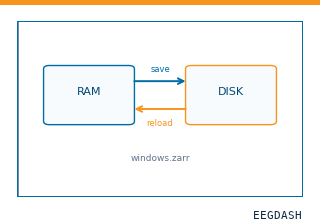 Save and reload prepared dataCache a windowed dataset to disk and reattach it without recompute.
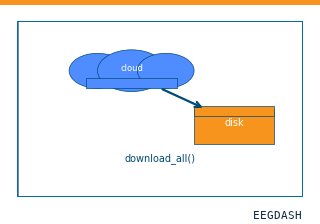 Download a dataset locallyPrefetch BIDS files to a local cache and validate the layout.
Swap any load_dataset(...) call for nm000401 to reproduce the tutorial on this dataset.
Citation
John M. Pearson, Patrick T. Hickey, Shivanand P. Lad, Michael L. Platt, Dennis A. Turner (2017). Subthalamic local field potentials during the balloon analogue risk task (Pearson et al., 2017): Parkinson's disease DBS surgery (derivative: decimated LFP). 10.82901/nemar.nm000401
Provenance
¹Contributed to nemar in BIDS format.
²Curated & ingested by the EEGDash catalog; see CITATION.cff for canonical reference.
³Persistent identifier: 10.82901/nemar.nm000401.
See Also#
eegdash.dataset.EEGDashDataseteegdash.dataset