


NM000133: eeg dataset, 8 subjects#
Alljoined1
Access recordings and metadata through EEGDash.
Citation: Jonathan Xu, Si Kai Lee, Wangshu Jiang (2024). Alljoined1. 10.82901/nemar.nm000133
Modality: eeg Subjects: 8 Recordings: 13 License: CC-BY-NC-ND-4.0 Source: nemar
Metadata: Complete (100%)
8-participant EEG dataset — Alljoined1.
Quickstart#
Install
pip install eegdash
Access the data
from eegdash.dataset import NM000133

dataset = NM000133(cache_dir="./data")
# Get the raw object of the first recording
raw = dataset.datasets[0].raw
print(raw.info)
Filter by subject
dataset = NM000133(cache_dir="./data", subject="01")
Advanced query
dataset = NM000133(
    cache_dir="./data",
    query={"subject": {"$in": ["01", "02"]}},
)
Iterate recordings
for rec in dataset:
    print(rec.subject, rec.raw.info['sfreq'])
If you use this dataset in your research, please cite the original authors.
BibTeX
@dataset{nm000133,
  title = {Alljoined1},
  author = {Jonathan Xu and Si Kai Lee and Wangshu Jiang},
  doi = {10.82901/nemar.nm000133},
  url = {https://doi.org/10.82901/nemar.nm000133},
}
About This Dataset#
Alljoined1 is an EEG dataset of neural responses to rapid serial visual presentation (RSVP) of natural images, designed for EEG-to-image decoding research. Eight healthy right-handed adults (6 male, 2 female; mean age 22 +/- 0.64 years, normal or corrected-to-normal vision) each viewed 10,000 natural images across two recording sessions on separate days.
The original data were recorded in BioSemi Data Format (BDF) via a 64-channel BioSemi ActiveTwo system with 24-bit A/D conversion, digitized at 512 Hz. This BIDS-formatted version preserves the BDF format to maintain full 24-bit data fidelity.
Reference: Xu, J., Aristimunha, B., Feucht, M. E., Qian, E., Liu, C., Shahjahan, T., … & Nestor, A. (2024). Alljoined–A dataset for EEG-to-Image decoding. Workshop Data Curation and Augmentation in Medical Imaging at 2024 IEEE/CVF Conference on Computer Vision and Pattern Recognition (CVPR), 1–9. https://doi.org/10.48550/arXiv.2404.05553
Alljoined1: EEG Responses to Natural Images
Overview
Recording Setup
Equipment: BioSemi ActiveTwo, 64 Ag/AgCl sintered electrodes
View full README
Alljoined1: EEG Responses to Natural Images
Overview
Recording Setup
Equipment: BioSemi ActiveTwo, 64 Ag/AgCl sintered electrodes
Montage: International 10-20 system
Sampling rate: 512 Hz
Reference: CMS/DRL (BioSemi default); average reference applied in preprocessing
Electrode offset: kept below 40 mV
Power line: 60 Hz notch filter applied during preprocessing
Task Paradigm
Participants viewed natural images in a rapid serial visual presentation (RSVP) paradigm with an oddball detection task. Each trial consisted of an image presented for 300 ms, followed by 300 ms of black screen, plus 0-50 ms of random jitter. Participants pressed the space bar when two consecutive trials contained the same image (oddball detection). Oddball trials (24 per block) were excluded from analysis.
Stimulus Set
10,000 natural images per participant drawn from the Natural Scenes Dataset (NSD), which itself is sourced from MS-COCO: - 1,000 shared images: the first 960 images from the NSD “shared1000” subset, shown to all participants (each image repeated 4 times per participant) - 9,000 unique images: different for each participant
Each image was shown 4 times per participant across blocks and sessions (presented twice per block, with blocks repeated within sessions).
The BIDS event tables (every events.tsv) reference the stimuli as
trial_type = "image/N" where N is a 1-indexed position (1..960) into
the shared subset. The full mapping chain is:
events.tsv `value` (N, 1..960)
    ↓

sharedix[N-1]                                    (from code/0_data_collection/nsd_expdesign.mat; 1-indexed NSD id)
    ↓

nsdId = sharedix[N-1] - 1                        (0-indexed)
    ↓

code/1_preprocessing/data/nsd_stim_info_merged.csv
    ↓

cocoId, cocoSplit (val2017 / train2017)
    ↓

stimuli/<cocoSplit>/000000<cocoId:012d>.jpg      (preserves original COCO 2017 layout)
Empirically the 960 shared NSD ids are all in train2017, so every
stimulus path under this dataset is stimuli/train2017/000000<id>.jpg.
To populate stimuli/:
python code/download_stimuli.py            # ~140 MB, fetches only the 960 needed
python code/smoke_test.py                  # confirms every event row resolves
A small alignment helper is provided:
import pandas as pd
from code.align_stimuli import StimulusAligner
aligner = StimulusAligner('.')
events = pd.read_csv('sub-01/ses-01/eeg/sub-01_ses-01_task-images_events.tsv', sep='\t')
paths = aligner.paths_for_events(events, subject=1, session=1)   # list[Path | None]
img   = aligner.image_for_event(events.iloc[0], subject=1, session=1)  # PIL.Image
Subjects and Sessions
8 subjects, 1-2 sessions each (13 sessions total):
| Subject | Sessions | Notes |
|---------|----------|-------|
| sub-01 | ses-01, ses-02 | |
| sub-02 | ses-01 | |
| sub-03 | ses-01, ses-02 | Epoched file missing for ses-01 |
| sub-04 | ses-01, ses-02 | |
| sub-05 | ses-01, ses-02 | |
| sub-06 | ses-01, ses-02 | |
| sub-07 | ses-01 | |
| sub-08 | ses-01 | |
Total: approximately 46,080 epochs across all participants (approximately 3,839 events per session after oddball exclusion).
Data Format
Raw continuous EEG recordings are stored as BDF files (BioSemi Data Format, 24-bit resolution). The original data were distributed as MNE-Python FIF files; conversion to BDF was performed to preserve the native 24-bit precision of the BioSemi ActiveTwo system. Round-trip validation confirmed data integrity to within 1.55e-8 V (sub-nanovolt), and event onsets match exactly (zero timing error). Per-session files:
| Path | Description |
|------|-------------|
| `sub-XX/ses-YY/eeg/sub-XX_ses-YY_task-images_eeg.bdf` | Raw EEG |
| `sub-XX/ses-YY/eeg/sub-XX_ses-YY_task-images_events.tsv` | Event markers |
Shared sidecar files (root level, BIDS inheritance principle):
| File | Description |
|------|-------------|
| `task-images_eeg.json` | Recording parameters |
| `task-images_channels.tsv` | Channel descriptions (64 EEG channels) |
| `task-images_electrodes.tsv` | Electrode positions (standard 10-20, CapTrak) |
| `task-images_coordsystem.json` | Coordinate system specification |
Event values in the events.tsv files represent image indices (1-960+) corresponding to NSD image identifiers. The trial_type column uses the format image/{index}.
Derivatives
The derivatives/epoched/ directory contains preprocessed and epoched data provided by the original authors, stored in MNE-Python FIF format (.fif).
Preprocessing pipeline applied by the original authors: 1. Band-pass filter: 0.5-125 Hz 2. Notch filter: 60 Hz (power line) 3. Independent Component Analysis (ICA): FastICA, retaining 95% of variance 4. Epoch extraction: -50 ms to 600 ms relative to stimulus onset 5. Artifact rejection: AutoReject algorithm (mean 130.75 epochs dropped per subject, SD 260.44) 6. Baseline correction 7. Average re-referencing
These epoched files are derivative products, not raw recordings, and are stored separately per BIDS conventions. Note: the epoched file for sub-03 ses-01 was not available in the source distribution.
Code
The code/ directory contains the original Alljoined1 analysis code, cloned from Alljoined/alljoined-dataset1.
BIDS Conversion
Converted to BIDS by Yahya Shirazi (Swartz Center for Computational Neuroscience, UC San Diego) using MNE-Python and custom scripts. - Source data: OSF repository https://osf.io/kqgs8/ - Conversion validated with round-trip integrity checks (data, channels, sampling frequency, event count, event values, and event timing)
License and Terms of Use
This dataset is distributed under CC-BY-NC-ND-4.0 (Creative Commons Attribution-NonCommercial-NoDerivatives 4.0). The Alljoined team imposes additional terms on their datasets. By using this dataset you agree to all conditions below. 1. Researcher shall use the Dataset only for non-commercial research and educational purposes, in accordance with Alljoined’s Terms of Use. 2. No Warranties: Alljoined makes no representations or warranties regarding the Dataset, including but not limited to warranties of non-infringement or fitness for a particular purpose. 3. Full Responsibility: Researcher accepts full responsibility for his or her use of the Dataset and shall defend and indemnify Alljoined, including their employees, officers and agents, against any and all claims arising from Researcher’s use of the Dataset. 4. Privacy Compliance: Researcher shall comply with Alljoined’s Privacy Policy and ensure that any use of the Dataset respects the privacy rights of individuals whose data may be included. 5. Sharing Rights: Researcher may provide research associates and colleagues with access to the Dataset provided that they first agree to be bound by these terms and conditions. 6. Termination Rights: Alljoined reserves the right to terminate Researcher’s access to the Dataset at any time. 7. Commercial Entity Binding: If Researcher is employed by a for-profit, commercial entity, Researcher’s employer shall also be bound by these terms and conditions, and Researcher hereby represents that he or she is fully authorized to enter into this agreement on behalf of such employer. 8. Governing Law: The law of the State of California shall apply to all disputes under this agreement.
Note: The original Alljoined1 dataset on OSF (https://osf.io/kqgs8/) does not specify an explicit license. The terms above are from the Alljoined-1.6M HuggingFace distribution and the Alljoined website; they are included here as the best available guidance. Contact the Alljoined team (team@alljoined.com) for clarification on redistribution rights.
Full terms: https://www.alljoined.com/terms-of-use
Privacy policy: https://www.alljoined.com/privacy-policy
References
Xu, J., Aristimunha, B., Feucht, M. E., Qian, E., Liu, C., Shahjahan, T., … & Nestor, A. (2024). Alljoined–A dataset for EEG-to-Image decoding. Workshop Data Curation and Augmentation in Medical Imaging at 2024 IEEE/CVF Conference on Computer Vision and Pattern Recognition (CVPR), 1–9. https://doi.org/10.48550/arXiv.2404.05553
NEMAR Metadata#
[](https://doi.org/10.82901/nemar.nm000133) # Alljoined1: EEG Responses to Natural Images ## Overview Alljoined1 is an EEG dataset of neural responses to rapid serial visual presentation (RSVP) of natural images, designed for EEG-to-image decoding research. Eight healthy right-handed adults (6 male, 2 female; mean age 22 +/- 0.64 years, normal or corrected-to-normal vision) each viewed 10,000 natural images across two recording sessions on separate days. The original data were recorded in BioSemi Data Format (BDF) via a 64-channel BioSemi ActiveTwo system with 24-bit A/D conversion, digitized at 512 Hz. This BIDS-formatted version preserves the BDF format to maintain full 24-bit data fidelity. Reference: Xu, J., Aristimunha, B., Feucht, M. E., Qian, E., Liu, C., Shahjahan, T., … & Nestor, A. (2024). Alljoined–A dataset for EEG-to-Image decoding. Workshop Data Curation and Augmentation in Medical Imaging at 2024 IEEE/CVF Conference on Computer Vision and Pattern Recognition (CVPR), 1–9. https://doi.org/10.48550/arXiv.2404.05553 ## Recording Setup - Equipment: BioSemi ActiveTwo, 64 Ag/AgCl sintered electrodes - Montage: International 10-20 system - Sampling rate: 512 Hz - Reference: CMS/DRL (BioSemi default); average reference applied in preprocessing - Electrode offset: kept below 40 mV - Power line: 60 Hz notch filter applied during preprocessing ## Task Paradigm Participants viewed natural images in a rapid serial visual presentation (RSVP) paradigm with an oddball detection task. Each trial consisted of an image presented for 300 ms, followed by 300 ms of black screen, plus 0-50 ms of random jitter. Participants pressed the space bar when two consecutive trials contained the same image (oddball detection). Oddball trials (24 per block) were excluded from analysis. ## Stimulus Set 10,000 natural images per participant drawn from the Natural Scenes Dataset (NSD), which itself is sourced from MS-COCO: - 1,000 shared images: the first 960 images from the NSD “shared1000” subset, shown to all participants (each image repeated 4 times per participant) - 9,000 unique images: different for each participant Each image was shown 4 times per participant across blocks and sessions (presented twice per block, with blocks repeated within sessions). The BIDS event tables (every events.tsv) reference the stimuli as trial_type = “image/N” where N is a 1-indexed position (1..960) into the shared subset. The full mapping chain is: ``` events.tsv value (N, 1..960)
↓
- sharedix[N-1] (from code/0_data_collection/nsd_expdesign.mat; 1-indexed NSD id)
↓
- nsdId = sharedix[N-1] - 1 (0-indexed)
↓
- code/1_preprocessing/data/nsd_stim_info_merged.csv
↓
- cocoId, cocoSplit (val2017 / train2017)
↓
stimuli/<cocoSplit>/000000<cocoId:012d>.jpg (preserves original COCO 2017 layout)
`
Empirically the 960 shared NSD ids are all in `train2017`, so every
stimulus path under this dataset is `stimuli/train2017/000000<id>.jpg`.
To populate `stimuli/`:
```bash
python code/download_stimuli.py            # ~140 MB, fetches only the 960 needed
python code/smoke_test.py                  # confirms every event row resolves
`
A small alignment helper is provided:
`python
import pandas as pd
from code.align_stimuli import StimulusAligner
aligner = StimulusAligner('.')
events = pd.read_csv('sub-01/ses-01/eeg/sub-01_ses-01_task-images_events.tsv', sep='\t')
paths = aligner.paths_for_events(events, subject=1, session=1)   # list[Path | None]
img   = aligner.image_for_event(events.iloc[0], subject=1, session=1)  # PIL.Image
`
## Subjects and Sessions
8 subjects, 1-2 sessions each (13 sessions total):
| Subject | Sessions | Notes |
|---------|———-|-------|
| sub-01 | ses-01, ses-02 | |
| sub-02 | ses-01 | |
| sub-03 | ses-01, ses-02 | Epoched file missing for ses-01 |
| sub-04 | ses-01, ses-02 | |
| sub-05 | ses-01, ses-02 | |
| sub-06 | ses-01, ses-02 | |
| sub-07 | ses-01 | |
| sub-08 | ses-01 | |
Total: approximately 46,080 epochs across all participants (approximately 3,839 events per session after oddball exclusion).
## Data Format
Raw continuous EEG recordings are stored as BDF files (BioSemi Data Format, 24-bit resolution). The original data were distributed as MNE-Python FIF files; conversion to BDF was performed to preserve the native 24-bit precision of the BioSemi ActiveTwo system. Round-trip validation confirmed data integrity to within 1.55e-8 V (sub-nanovolt), and event onsets match exactly (zero timing error).
Per-session files:
| Path | Description |
|------|————-|
| sub-XX/ses-YY/eeg/sub-XX_ses-YY_task-images_eeg.bdf | Raw EEG |
| sub-XX/ses-YY/eeg/sub-XX_ses-YY_task-images_events.tsv | Event markers |
Shared sidecar files (root level, BIDS inheritance principle):
| File | Description |
|------|————-|
| task-images_eeg.json | Recording parameters |
| task-images_channels.tsv | Channel descriptions (64 EEG channels) |
| task-images_electrodes.tsv | Electrode positions (standard 10-20, CapTrak) |
| task-images_coordsystem.json | Coordinate system specification |
Event values in the events.tsv files represent image indices (1-960+) corresponding to NSD image identifiers. The trial_type column uses the format image/{index}.
## Derivatives
The derivatives/epoched/ directory contains preprocessed and epoched data provided by the original authors, stored in MNE-Python FIF format (.fif).
Preprocessing pipeline applied by the original authors:
1. Band-pass filter: 0.5-125 Hz
2. Notch filter: 60 Hz (power line)
3. Independent Component Analysis (ICA): FastICA, retaining 95% of variance
4. Epoch extraction: -50 ms to 600 ms relative to stimulus onset
5. Artifact rejection: AutoReject algorithm (mean 130.75 epochs dropped per subject, SD 260.44)
6. Baseline correction
7. Average re-referencing
These epoched files are derivative products, not raw recordings, and are stored separately per BIDS conventions. Note: the epoched file for sub-03 ses-01 was not available in the source distribution.
## Code
The code/ directory contains the original Alljoined1 analysis code, cloned from <Alljoined/alljoined-dataset1>.
## BIDS Conversion
Converted to BIDS by Yahya Shirazi (Swartz Center for Computational Neuroscience, UC San Diego) using MNE-Python and custom scripts.
- Source data: OSF repository <https://osf.io/kqgs8/>
- Conversion validated with round-trip integrity checks (data, channels, sampling frequency, event count, event values, and event timing)
## License and Terms of Use
This dataset is distributed under CC-BY-NC-ND-4.0 (Creative Commons Attribution-NonCommercial-NoDerivatives 4.0). The Alljoined team imposes additional terms on their datasets. By using this dataset you agree to all conditions below.
1. Researcher shall use the Dataset only for non-commercial research and educational purposes, in accordance with Alljoined’s [Terms of Use](https://www.alljoined.com/terms-of-use).
2. No Warranties: Alljoined makes no representations or warranties regarding the Dataset, including but not limited to warranties of non-infringement or fitness for a particular purpose.
3. Full Responsibility: Researcher accepts full responsibility for his or her use of the Dataset and shall defend and indemnify Alljoined, including their employees, officers and agents, against any and all claims arising from Researcher’s use of the Dataset.
4. Privacy Compliance: Researcher shall comply with Alljoined’s [Privacy Policy](https://www.alljoined.com/privacy-policy) and ensure that any use of the Dataset respects the privacy rights of individuals whose data may be included.
5. Sharing Rights: Researcher may provide research associates and colleagues with access to the Dataset provided that they first agree to be bound by these terms and conditions.
6. Termination Rights: Alljoined reserves the right to terminate Researcher’s access to the Dataset at any time.
7. Commercial Entity Binding: If Researcher is employed by a for-profit, commercial entity, Researcher’s employer shall also be bound by these terms and conditions, and Researcher hereby represents that he or she is fully authorized to enter into this agreement on behalf of such employer.
8. Governing Law: The law of the State of California shall apply to all disputes under this agreement.
> Note: The original Alljoined1 dataset on OSF (<https://osf.io/kqgs8/>) does not specify an explicit license. The terms above are from the Alljoined-1.6M HuggingFace distribution and the Alljoined website; they are included here as the best available guidance. Contact the Alljoined team (team@alljoined.com) for clarification on redistribution rights.
- Full terms: <https://www.alljoined.com/terms-of-use>
- Privacy policy: <https://www.alljoined.com/privacy-policy>
## References
Xu, J., Aristimunha, B., Feucht, M. E., Qian, E., Liu, C., Shahjahan, T., … & Nestor, A. (2024). Alljoined–A dataset for EEG-to-Image decoding. Workshop Data Curation and Augmentation in Medical Imaging at 2024 IEEE/CVF Conference on Computer Vision and Pattern Recognition (CVPR), 1–9. https://doi.org/10.48550/arXiv.2404.05553
License: CC-BY-NC-ND-4.0
Authors:
Jonathan Xu
Si Kai Lee
Wangshu Jiang
Versions:
Version |
DOI |
Released |
|---|---|---|
|
Cohort#
Dataset Statistics#
Channel counts: 64 ch (n=13 recordings)
Sampling frequencies: 512.0 Hz (n=13 recordings)
Signal · Electrodes & live trace#
Live trace viewer — sub-08 · ses-01 · task-images
Showing one representative recording out of
8 subjects and 13 recordings in this dataset.
Browse the full set on OpenNeuro;
drop any other _eeg.{set,edf,bdf,vhdr} file onto the
viewer (or pass ?eeg=<url>) to inspect it.
Electrode layout — EEG · 64 sensors — 64 channels
NEMAR Processing Statistics#
The plots below are generated by NEMAR’s automated EEG pipeline. The histogram shows pipeline success for data cleaning and ICA decomposition, the percentage of data frames and EEG channels retained after artefact removal, line noise per channel (RMS, dB), and the age/gender distribution of participants.

HED event descriptors word cloud

Manifest#
File Explorer#
Browse the BIDS file structure of this dataset. Records are fetched on demand from the EEGDash catalog the first time you open the explorer.
Full dataset metadata table
Dataset ID |
|
Title |
Alljoined1 |
Author (year) |
|
Canonical |
— |
Importable as |
|
Year |
2024 |
Authors |
Jonathan Xu, Si Kai Lee, Wangshu Jiang |
License |
CC-BY-NC-ND-4.0 |
Citation / DOI |
|
Source links |
Copy-paste BibTeX
@dataset{nm000133,
  title = {Alljoined1},
  author = {Jonathan Xu and Si Kai Lee and Wangshu Jiang},
  doi = {10.82901/nemar.nm000133},
  url = {https://doi.org/10.82901/nemar.nm000133},
}
API Reference#
eegdash.datasetEEGDashDatasetNM000133 · Xu2024eegdash/dataset/registry.py · [source ↗]- class eegdash.dataset.NM000133(cache_dir: str, query: dict | None = None, s3_bucket: str | None = None, **kwargs)[source]#
Alljoined1
- Study:
nm000133(NeMAR)- Author (year):
Xu2024- Canonical:
—
Also importable as:
NM000133,Xu2024.Modality:
eeg; Experiment type:Perception; Subject type:Healthy. Subjects: 8; recordings: 0; tasks: 1.- Parameters:
cache_dir (str | Path) – Directory where data are cached locally.
query (dict | None) – Additional MongoDB-style filters to AND with the dataset selection. Must not contain the key
dataset.s3_bucket (str | None) – Base S3 bucket used to locate the data.
**kwargs (dict) – Additional keyword arguments forwarded to
EEGDashDataset.
- data_dir#
Local dataset cache directory (
cache_dir / dataset_id).- Type:
Path
Notes
Each item is a recording; recording-level metadata are available via
dataset.description.querysupports MongoDB-style filters on fields inALLOWED_QUERY_FIELDSand is combined with the dataset filter. Dataset-specific caveats are not provided in the summary metadata.References
OpenNeuro dataset: https://openneuro.org/datasets/nm000133 NeMAR dataset: https://nemar.org/dataexplorer/detail?dataset_id=nm000133 DOI: https://doi.org/10.82901/nemar.nm000133
Examples
>>> from eegdash.dataset import NM000133
>>> dataset = NM000133(cache_dir="./data")
>>> recording = dataset[0]
>>> raw = recording.load()
- __init__(cache_dir: str, query: dict | None = None, s3_bucket: str | None = None, **kwargs)[source]#
- save(path: str, overwrite: bool = False, offset: int = 0)[source]#
Save datasets to files by creating one subdirectory for each dataset:
path/
    0/
        0-raw.fif | 0-epo.fif
        description.json
        raw_preproc_kwargs.json (if raws were preprocessed)
        window_kwargs.json (if this is a windowed dataset)
        window_preproc_kwargs.json  (if windows were preprocessed)
        target_name.json (if target_name is not None and dataset is raw)
    1/
        1-raw.fif | 1-epo.fif
        description.json
        raw_preproc_kwargs.json (if raws were preprocessed)
        window_kwargs.json (if this is a windowed dataset)
        window_preproc_kwargs.json  (if windows were preprocessed)
        target_name.json (if target_name is not None and dataset is raw)
- Parameters:
path (str) –
- Directory in which subdirectories are created to store
-raw.fif | -epo.fif and .json files to.
overwrite (bool) – Whether to delete old subdirectories that will be saved to in this call.
offset (int) – If provided, the integer is added to the id of the dataset in the concat. This is useful in the setting of very large datasets, where one dataset has to be processed and saved at a time to account for its original position.
BaseDataset from braindecode — windowed via create_windows_from_events.braindecodeDataLoader; supports parallel workers and on-the-fly augmentations.pytorchdatasets.load_dataset("EEGDash/nm000133").huggingface Find datasets with the EEGDash APIQuery the catalogue, filter by task or modality, list candidates.
 Load one EEG recordingResolve a single record to an MNE Raw with channels and events.
 EEG recording to PyTorch DataLoaderWrap braindecode windows in a DataLoader for model training.
 Preprocess EEG and create windowsFilter, resample, epoch — and persist the windowed dataset.
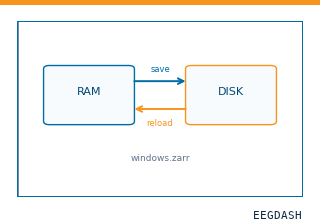 Save and reload prepared dataCache a windowed dataset to disk and reattach it without recompute.
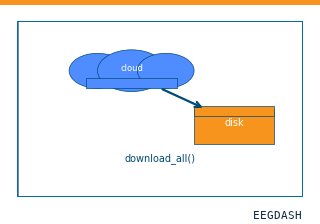 Download a dataset locallyPrefetch BIDS files to a local cache and validate the layout.
Swap any load_dataset(...) call for nm000133 to reproduce the tutorial on this dataset.
Citation
Jonathan Xu, Si Kai Lee, Wangshu Jiang (2024). Alljoined1. 10.82901/nemar.nm000133
Provenance
¹Contributed to nemar in BIDS format.
²Curated & ingested by the EEGDash catalog; see CITATION.cff for canonical reference.
³Persistent identifier: 10.82901/nemar.nm000133.
See Also#
eegdash.dataset.EEGDashDataseteegdash.dataset