


ON003810: eeg dataset, 10 subjects#
Motor Imagery vs Rest - Low-Cost EEG System
Access recordings and metadata through EEGDash.
Citation: Victoria Peterson, Catalina Maria Galvan, Hugo Sacha Hernadez, Ruben Spies (2026). Motor Imagery vs Rest - Low-Cost EEG System. 10.82901/nemar.on003810
Modality: eeg Subjects: 10 Recordings: 50 License: CC0 Source: nemar
Metadata: Complete (100%)
10-participant EEG dataset — Motor Imagery vs Rest - Low-Cost EEG System.
Quickstart#
Install
pip install eegdash
Access the data
from eegdash.dataset import ON003810

dataset = ON003810(cache_dir="./data")
# Get the raw object of the first recording
raw = dataset.datasets[0].raw
print(raw.info)
Filter by subject
dataset = ON003810(cache_dir="./data", subject="01")
Advanced query
dataset = ON003810(
    cache_dir="./data",
    query={"subject": {"$in": ["01", "02"]}},
)
Iterate recordings
for rec in dataset:
    print(rec.subject, rec.raw.info['sfreq'])
If you use this dataset in your research, please cite the original authors.
BibTeX
@dataset{on003810,
  title = {Motor Imagery vs Rest - Low-Cost EEG System},
  author = {Victoria Peterson and Catalina Maria Galvan and Hugo Sacha Hernadez and Ruben Spies},
  doi = {10.82901/nemar.on003810},
  url = {https://doi.org/10.82901/nemar.on003810},
}
About This Dataset#
This dataset consists of electroencephalography (EEG) signals adquired with a low-cost consumer-grade device. The 10 participants had no previous BCI experience. The BCI protocol consisted of two conditions, namely the kinesthetic imagination of grasping movement (MI) of the dominant hand and rest/idle condition.Five protocol runs were asked to be performed by the user. The first run, called RUN0, involved real grasping movement in order to better explain the protocol and to help the subject to focus on the sensation of making the movement. The rest of the runs (RUN1-RUN4) were equal, consisting of MI vs.Rest conditions. The EMG signals of the dominant hand was adquired for protocol control. During acquisition, the EEG signals were filtered between 0.5 and 45 Hz with a 3rd order Butterworth bandpass-filter.
The BIDS validator went from 1 error + 1103 warnings to 0 errors + 352 warnings. None of the raw .edf files were modified, every change is to a text sidecar.
Dataset description (``dataset_description.json``)
- Added DatasetType: "raw" so the dataset is validated as raw data rather than a derivative.
- Updated BIDSVersion from 1.1.1 to 1.11.1 (the version the current validator checks against).
- GeneratedBy was left absent, exactly as the source published it, nothing was added there.
Channel tables (``task-MIvsRest_channels.tsv``, shared by all 50 recordings)
- The column headers were Name, Type, Units; BIDS expects the lowercase forms name, type, units, so they were renamed (the values were already correct).
- The unit string Microv was replaced with the BIDS-canonical µV on every electrode row so the validator recognizes the unit.
Per-recording sidecars (``_eeg.json``, all 50 recordings)
- Each per-recording sidecar carried a TaskName that ended with the run number (for example MIvsRestRUN0). BIDS requires TaskName to match the task- label in the filename exactly, which is MIvsRest, so those run-specific overrides were removed. The correct TaskName: "MIvsRest" is supplied once at the dataset root and inherited.
- The per-recording sidecars were trimmed down to only the value that genuinely varies by recording, RecordingDuration (computed from each EDF). Every other field is now inherited from the shared root sidecar so the same value isn’t repeated 50 times.
Shared recording sidecar added at the dataset root (``task-MIvsRest_eeg.json``)
- A single root sidecar was added so the fields that are identical across all 50 recordings live in one place and are inherited automatically. This closes a large number of “recommended field missing” warnings without duplicating information.
- The values are pulled only from what is already documented: the task name MIvsRest, a task description paraphrased from the abstract above (no new detail invented), the EEG reference Left Ear lobe and sampling frequency 125 Hz taken from the per-recording sidecars, the power-line frequency 50 Hz (Argentina mains), 15 EEG channels with zero counts for EOG/ECG/EMG/MISC/Trigger, the 10-20 placement scheme (the channel names T3/T4/T5/T6 are 10-20 labels), the hardware filter (3rd-order Butterworth bandpass 0.5-45 Hz, stated in the abstract), the institution name from the source dataset, and RecordingType: "continuous". Manufacturer, model, cap, ground, and version fields that the source dataset does not state are recorded as "n/a" rather than guessed.
Events dictionary (``task-MIvsRest_events.json``)
- Added a definition for the sample column so the events tables are fully described.
- Cleaned up the descriptions of the value levels and corrected the duration unit string from "second" to the BIDS-canonical "s".
- The HED tag dictionary was left as-is.
Events tables (``_events.tsv``, all 50 recordings, newly generated)
- The per-recording events tables were missing entirely, which the validator flagged as an error against task-MIvsRest_events.json (a sidecar without a data file) and as a “missing events” warning for every recording.
- Each _events.tsv was generated mechanically from the annotations inside that recording’s own EDF (read with mne.io.read_raw_edf). The annotation labels in the EDF map directly to the value levels already declared in task-MIvsRest_events.json: OVTK_GDF_Right is value=7 (MI) and OVTK_GDF_Tongue is value=9 (Rest). Each event’s duration is the time from the cue annotation to the next OVTK_GDF_End_Of_Trial annotation in the same recording.
- Event counts vary by run, matching the protocol: RUN0 has 10 events (5 MI plus 5 Rest), and RUN1 through RUN4 have 30 to 40 events each (roughly 20 MI plus 20 Rest). No events were synthesized, every row corresponds to an annotation already present in the EDF.
Directory rename (``Code/`` to ``code/``)
- BIDS requires lowercase top-level directory names, so the Code/ folder was renamed to code/. This closes the validator error that flagged Code/ as a not-allowed top-level entry.
Remaining warnings (352), left on purpose
- These are all “recommended but missing” fields that need information from the study, lab, or equipment that isn’t in the dataset. Per recording the validator asks for DeviceSerialNumber, Instructions (the verbatim instructions read to the participant), CogAtlasID and CogPOID (cognitive-atlas task identifiers), HeadCircumference, SubjectArtefactDescription, and StimulusPresentation details. At the dataset level it also asks for HEDVersion and GeneratedBy. GeneratedBy is among the remaining warnings on purpose: the source dataset does not document what tool generated the data, so nothing was added there. The rest were left blank rather than filled with guesses.
Cohort#
Dataset Statistics#
Age distribution by gender (n=10, range 20–30 yr, mean 26.1 yr)
Sex composition
Channel counts: 15 ch (n=50 recordings)
Sampling frequencies: 125 Hz (n=50 recordings)
Total recording duration: 5 h 11 min
Signal · Electrodes & live trace#
Live trace viewer — sub-12 · task-MIvsRest · run-4
Showing one representative recording out of
10 subjects and 50 recordings in this dataset.
Browse the full set on OpenNeuro;
drop any other _eeg.{set,edf,bdf,vhdr} file onto the
viewer (or pass ?eeg=<url>) to inspect it.
Electrode layout — EEG · 15 sensors — 15 channels
NEMAR Processing Statistics#
The plots below are generated by NEMAR’s automated EEG pipeline. The histogram shows pipeline success for data cleaning and ICA decomposition, the percentage of data frames and EEG channels retained after artefact removal, line noise per channel (RMS, dB), and the age/gender distribution of participants.

HED event descriptors word cloud

Manifest#
File Explorer#
Browse the BIDS file structure of this dataset. Records are fetched on demand from the EEGDash catalog the first time you open the explorer.
Full dataset metadata table
Dataset ID |
|
Title |
Motor Imagery vs Rest - Low-Cost EEG System |
Author (year) |
— |
Canonical |
— |
Importable as |
|
Year |
2026 |
Authors |
Victoria Peterson, Catalina Maria Galvan, Hugo Sacha Hernadez, Ruben Spies |
License |
CC0 |
Citation / DOI |
|
Source links |
OpenNeuro | NeMAR | Source URL |
Copy-paste BibTeX
@dataset{on003810,
  title = {Motor Imagery vs Rest - Low-Cost EEG System},
  author = {Victoria Peterson and Catalina Maria Galvan and Hugo Sacha Hernadez and Ruben Spies},
  doi = {10.82901/nemar.on003810},
  url = {https://doi.org/10.82901/nemar.on003810},
}
API Reference#
eegdash.datasetEEGDashDataset- class eegdash.dataset.ON003810(cache_dir: str, query: dict | None = None, s3_bucket: str | None = None, **kwargs)[source]#
Motor Imagery vs Rest - Low-Cost EEG System
- Study:
on003810(NeMAR)- Author (year):
—
- Canonical:
—
Also importable as:
ON003810.Modality:
eeg; Experiment type:Motor; Subject type:Healthy. Subjects: 10; recordings: 50; tasks: 1.- Parameters:
cache_dir (str | Path) – Directory where data are cached locally.
query (dict | None) – Additional MongoDB-style filters to AND with the dataset selection. Must not contain the key
dataset.s3_bucket (str | None) – Base S3 bucket used to locate the data.
**kwargs (dict) – Additional keyword arguments forwarded to
EEGDashDataset.
- data_dir#
Local dataset cache directory (
cache_dir / dataset_id).- Type:
Path
Notes
Each item is a recording; recording-level metadata are available via
dataset.description.querysupports MongoDB-style filters on fields inALLOWED_QUERY_FIELDSand is combined with the dataset filter. Dataset-specific caveats are not provided in the summary metadata.References
OpenNeuro dataset: https://openneuro.org/datasets/on003810 NeMAR dataset: https://nemar.org/dataexplorer/detail?dataset_id=on003810 DOI: https://doi.org/10.82901/nemar.on003810
Examples
>>> from eegdash.dataset import ON003810
>>> dataset = ON003810(cache_dir="./data")
>>> recording = dataset[0]
>>> raw = recording.load()
- __init__(cache_dir: str, query: dict | None = None, s3_bucket: str | None = None, **kwargs)[source]#
- save(path: str, overwrite: bool = False, offset: int = 0, _check_subdirs: bool = True)[source]#
Save datasets to files by creating one subdirectory for each dataset:
path/
    0/
        0-raw.fif | 0-epo.fif
        description.json
        raw_preproc_kwargs.json (if raws were preprocessed)
        window_kwargs.json (if this is a windowed dataset)
        window_preproc_kwargs.json  (if windows were preprocessed)
        target_name.json (if target_name is not None and dataset is raw)
    1/
        1-raw.fif | 1-epo.fif
        description.json
        raw_preproc_kwargs.json (if raws were preprocessed)
        window_kwargs.json (if this is a windowed dataset)
        window_preproc_kwargs.json  (if windows were preprocessed)
        target_name.json (if target_name is not None and dataset is raw)
- Parameters:
path (str) –
- Directory in which subdirectories are created to store
-raw.fif | -epo.fif and .json files to.
overwrite (bool) – Whether to delete old subdirectories that will be saved to in this call. If a dataset still reads its data lazily from one of them, a
ValueErroris raised before anything is deleted: load the data into memory first (preload=True) or save to another directory.offset (int) – If provided, the integer is added to the id of the dataset in the concat. This is useful in the setting of very large datasets, where one dataset has to be processed and saved at a time to account for its original position.
BaseDataset from braindecode — windowed via create_windows_from_events.braindecodeDataLoader; supports parallel workers and on-the-fly augmentations.pytorch Find datasets with the EEGDash APIQuery the catalogue, filter by task or modality, list candidates.
 Load one EEG recordingResolve a single record to an MNE Raw with channels and events.
 EEG recording to PyTorch DataLoaderWrap braindecode windows in a DataLoader for model training.
 Preprocess EEG and create windowsFilter, resample, epoch — and persist the windowed dataset.
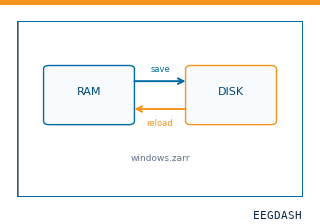 Save and reload prepared dataCache a windowed dataset to disk and reattach it without recompute.
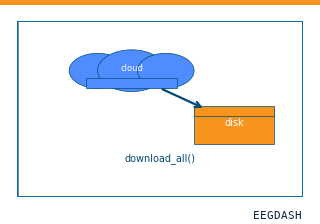 Download a dataset locallyPrefetch BIDS files to a local cache and validate the layout.
Swap any load_dataset(...) call for on003810 to reproduce the tutorial on this dataset.
Citation
Victoria Peterson, Catalina Maria Galvan, Hugo Sacha Hernadez, Ruben Spies (2026). Motor Imagery vs Rest - Low-Cost EEG System. 10.82901/nemar.on003810
Provenance
¹Contributed to nemar in BIDS format.
²Curated & ingested by the EEGDash catalog; see CITATION.cff for canonical reference.
³Persistent identifier: 10.82901/nemar.on003810.
See Also#
eegdash.dataset.EEGDashDataseteegdash.dataset