


ON007262: eeg dataset, 18 subjects#
Cognitive Workload 8-level arithmetic
Access recordings and metadata through EEGDash.
Citation: Matthew Barras, Liam Booth (2019). Cognitive Workload 8-level arithmetic. 10.82901/nemar.on007262
Modality: eeg Subjects: 18 Recordings: 18 License: CC0 Source: nemar
Metadata: Complete (100%)
18-participant EEG dataset — Cognitive Workload 8-level arithmetic.
Quickstart#
Install
pip install eegdash
Access the data
from eegdash.dataset import ON007262

dataset = ON007262(cache_dir="./data")
# Get the raw object of the first recording
raw = dataset.datasets[0].raw
print(raw.info)
Filter by subject
dataset = ON007262(cache_dir="./data", subject="01")
Advanced query
dataset = ON007262(
    cache_dir="./data",
    query={"subject": {"$in": ["01", "02"]}},
)
Iterate recordings
for rec in dataset:
    print(rec.subject, rec.raw.info['sfreq'])
If you use this dataset in your research, please cite the original authors.
BibTeX
@dataset{on007262,
  title = {Cognitive Workload 8-level arithmetic},
  author = {Matthew Barras and Liam Booth},
  doi = {10.82901/nemar.on007262},
  url = {https://doi.org/10.82901/nemar.on007262},
}
About This Dataset#
This dataset was generated from LSL/XDF recordings. Converted to bids with instructions and code presented here
Original recordings are stored under sourcedata/xdf/ as .xdf files (non-BIDS).
EEG was converted to BrainVision format (.vhdr/.eeg/.vmrk) under each sub-*/eeg/.
*_events.tsv was generated from marker streams and then aligned so onset is relative to the EEG start time.
Marker streams include task markers (arithmetic-Markers) and acquisition dropout annotations (UoHDataOffsetStream); events include a marker_stream column and marker definitions are in task-arithmetic_events.json.
Pupil Labs gaze/pupil data was exported from the XDF pupil_capture stream into sub-*/eeg/ as eyetrack physio files (*_recording-eyetrack_physio.tsv.gz + *_recording-eyetrack_physio.json; PhysioType=eyetrack).
ECG is captured on the EEG system; the ECG channel is typed in *_channels.tsv and exported as *_recording-ecg_physio.tsv.gz + *_recording-ecg_physio.json.
ML analysis note: participants excluded from the ML analysis remain in participants.tsv with analysis_included=false; no epoch rejection was applied to this raw dataset.
Participant IDs match the original XDF filenames; missing IDs correspond to excluded participants.
Participants
N_recorded: 20
N_released: 18
Exclusions: 2 participants excluded due to multi-modal acquisition failures (sub-002, sub-017).
Demographics in participants.tsv: age (years), sex, handedness.
Excluded IDs remain in participants.tsv with analysis_included=false.
Hardware and data collection - Combined EEG+ECG mobile EEG system (Bateson and Asghar, 2021; Clewett et al., 2016) and Pupil Labs Pupil Core, synchronized via Lab Streaming Layer (LSL). - EEG: 19-channel 10-20 montage (Fp1, Fp2, F7, F3, Fz, F4, F8, T3, C3, Cz, C4, T4, T5, P3, Pz, P4, T6, O1, O2), Ag/AgCl electrodes with linked-ear reference, 250 Hz; impedances checked and Neurgel EEG gel applied. - ECG: 3-lead on the same system; positive lead right shoulder/clavicle, negative lead left shoulder/clavicle, feedback lead lower left torso. - Pupillometry: Pupil Labs Pupil Core eye tracking with infrared illuminators; LSL relay with asynchronous sampling (timestamps per sample).
Protocol summary
- Arithmetic task difficulty was defined using Q-value ranges and randomized order across trials.
- Task events encode difficulty in trial_type and difficulty_range (e.g.,baseline, 0.6-1.5, 1.5-2.4, …, 6.0-6.9).
- Baseline for 60 seconds and then 70 questions, 10 at each difficulty level presented for 6 seconds each.
Task: arithmetic Release notes - Recorded 20 participants; released 18. - Reason: multi-modal acquisition QC failure. - Participant IDs match original XDF filenames; missing IDs indicate excluded participants.
References
Appelhoff, S., Sanderson, M., Brooks, T., Vliet, M., Quentin, R., Holdgraf, C., Chaumon, M., Mikulan, E., Tavabi, K., Höchenberger, R., Welke, D., Brunner, C., Rockhill, A., Larson, E., Gramfort, A. and Jas, M. (2019). MNE-BIDS: Organizing electrophysiological data into the BIDS format and facilitating their analysis. Journal of Open Source Software 4: (1896).https://doi.org/10.21105/joss.01896 Pernet, C. R., Appelhoff, S., Gorgolewski, K. J., Flandin, G., Phillips, C., Delorme, A., Oostenveld, R. (2019). EEG-BIDS, an extension to the brain imaging data structure for electroencephalography. Scientific Data, 6, 103.https://doi.org/10.1038/s41597-019-0104-8 Clewett CJ, Langley P, Bateson AD et al (2016) Non-invasive, home-based electroencephalography hypoglycaemia warning system for personal monitoring using skin surface electrodes: a single-case feasibility study. Healthc Technol Lett 3:2-5. https://doi.org/10.1049/htl.2015.0037 Bateson AD, Asghar AUR (2021) Development and evaluation of a smartphone-based electroencephalography (EEG) system. IEEE Access. https://doi.org/10.1109/ACCESS.2021.3079992
Cohort#
Dataset Statistics#
Age distribution by gender (n=18, range 18–48 yr, mean 26.4 yr)
Sex composition
Channel counts: 24 ch (n=18 recordings)
Sampling frequencies: 250.0 Hz (n=18 recordings)
Total recording duration: 4 h 35 min
Signal · Electrodes & live trace#
Live trace viewer — sub-019 · task-arithmetic
Showing one representative recording out of
18 subjects and 18 recordings in this dataset.
Browse the full set on OpenNeuro;
drop any other _eeg.{set,edf,bdf,vhdr} file onto the
viewer (or pass ?eeg=<url>) to inspect it.
Electrode layout — EEG · 19 sensors — 19 channels
NEMAR Processing Statistics#
The plots below are generated by NEMAR’s automated EEG pipeline. The histogram shows pipeline success for data cleaning and ICA decomposition, the percentage of data frames and EEG channels retained after artefact removal, line noise per channel (RMS, dB), and the age/gender distribution of participants.

HED event descriptors word cloud

Manifest#
File Explorer#
Browse the BIDS file structure of this dataset. Records are fetched on demand from the EEGDash catalog the first time you open the explorer.
Full dataset metadata table
Dataset ID |
|
Title |
Cognitive Workload 8-level arithmetic |
Author (year) |
— |
Canonical |
— |
Importable as |
|
Year |
2019 |
Authors |
Matthew Barras, Liam Booth |
License |
CC0 |
Citation / DOI |
|
Source links |
Copy-paste BibTeX
@dataset{on007262,
  title = {Cognitive Workload 8-level arithmetic},
  author = {Matthew Barras and Liam Booth},
  doi = {10.82901/nemar.on007262},
  url = {https://doi.org/10.82901/nemar.on007262},
}
API Reference#
eegdash.datasetEEGDashDataset- class eegdash.dataset.ON007262(cache_dir: str, query: dict | None = None, s3_bucket: str | None = None, **kwargs)[source]#
Cognitive Workload 8-level arithmetic
- Study:
on007262(NeMAR)- Author (year):
—
- Canonical:
—
Also importable as:
ON007262.Modality:
eeg; Experiment type:Attention; Subject type:Healthy. Subjects: 18; recordings: 0; tasks: 1.- Parameters:
cache_dir (str | Path) – Directory where data are cached locally.
query (dict | None) – Additional MongoDB-style filters to AND with the dataset selection. Must not contain the key
dataset.s3_bucket (str | None) – Base S3 bucket used to locate the data.
**kwargs (dict) – Additional keyword arguments forwarded to
EEGDashDataset.
- data_dir#
Local dataset cache directory (
cache_dir / dataset_id).- Type:
Path
Notes
Each item is a recording; recording-level metadata are available via
dataset.description.querysupports MongoDB-style filters on fields inALLOWED_QUERY_FIELDSand is combined with the dataset filter. Dataset-specific caveats are not provided in the summary metadata.References
OpenNeuro dataset: https://openneuro.org/datasets/on007262 NeMAR dataset: https://nemar.org/dataexplorer/detail?dataset_id=on007262 DOI: https://doi.org/10.82901/nemar.on007262
Examples
>>> from eegdash.dataset import ON007262
>>> dataset = ON007262(cache_dir="./data")
>>> recording = dataset[0]
>>> raw = recording.load()
- __init__(cache_dir: str, query: dict | None = None, s3_bucket: str | None = None, **kwargs)[source]#
- save(path: str, overwrite: bool = False, offset: int = 0)[source]#
Save datasets to files by creating one subdirectory for each dataset:
path/
    0/
        0-raw.fif | 0-epo.fif
        description.json
        raw_preproc_kwargs.json (if raws were preprocessed)
        window_kwargs.json (if this is a windowed dataset)
        window_preproc_kwargs.json  (if windows were preprocessed)
        target_name.json (if target_name is not None and dataset is raw)
    1/
        1-raw.fif | 1-epo.fif
        description.json
        raw_preproc_kwargs.json (if raws were preprocessed)
        window_kwargs.json (if this is a windowed dataset)
        window_preproc_kwargs.json  (if windows were preprocessed)
        target_name.json (if target_name is not None and dataset is raw)
- Parameters:
path (str) –
- Directory in which subdirectories are created to store
-raw.fif | -epo.fif and .json files to.
overwrite (bool) – Whether to delete old subdirectories that will be saved to in this call.
offset (int) – If provided, the integer is added to the id of the dataset in the concat. This is useful in the setting of very large datasets, where one dataset has to be processed and saved at a time to account for its original position.
BaseDataset from braindecode — windowed via create_windows_from_events.braindecodeDataLoader; supports parallel workers and on-the-fly augmentations.pytorch Find datasets with the EEGDash APIQuery the catalogue, filter by task or modality, list candidates.
 Load one EEG recordingResolve a single record to an MNE Raw with channels and events.
 EEG recording to PyTorch DataLoaderWrap braindecode windows in a DataLoader for model training.
 Preprocess EEG and create windowsFilter, resample, epoch — and persist the windowed dataset.
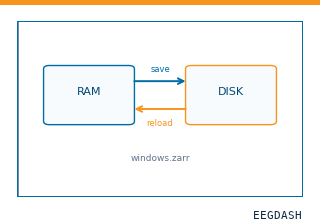 Save and reload prepared dataCache a windowed dataset to disk and reattach it without recompute.
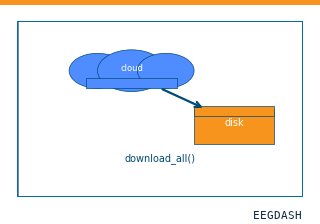 Download a dataset locallyPrefetch BIDS files to a local cache and validate the layout.
Swap any load_dataset(...) call for on007262 to reproduce the tutorial on this dataset.
Citation
Matthew Barras, Liam Booth (2019). Cognitive Workload 8-level arithmetic. 10.82901/nemar.on007262
Provenance
¹Contributed to nemar in BIDS format.
²Curated & ingested by the EEGDash catalog; see CITATION.cff for canonical reference.
³Persistent identifier: 10.82901/nemar.on007262.
See Also#
eegdash.dataset.EEGDashDataseteegdash.dataset