


ON007955: eeg dataset, 9 subjects#
EEG and autonomic responses during emotional word association
Access recordings and metadata through EEGDash.
Citation: Manuel Cebral-Loureda (2024). EEG and autonomic responses during emotional word association. 10.82901/nemar.on007955
Modality: eeg Subjects: 9 Recordings: 9 License: CC0 Source: nemar
Metadata: Complete (100%)
9-participant EEG dataset — EEG and autonomic responses during emotional word association.
Quickstart#
Install
pip install eegdash
Access the data
from eegdash.dataset import ON007955

dataset = ON007955(cache_dir="./data")
# Get the raw object of the first recording
raw = dataset.datasets[0].raw
print(raw.info)
Filter by subject
dataset = ON007955(cache_dir="./data", subject="01")
Advanced query
dataset = ON007955(
    cache_dir="./data",
    query={"subject": {"$in": ["01", "02"]}},
)
Iterate recordings
for rec in dataset:
    print(rec.subject, rec.raw.info['sfreq'])
If you use this dataset in your research, please cite the original authors.
BibTeX
@dataset{on007955,
  title = {EEG and autonomic responses during emotional word association},
  author = {Manuel Cebral-Loureda},
  doi = {10.82901/nemar.on007955},
  url = {https://doi.org/10.82901/nemar.on007955},
}
About This Dataset#
This dataset contains synchronized electroencephalographic (EEG), autonomic physiological recordings, and behavioral responses acquired during an emotional word association task.
Participants were exposed to emotionally relevant lexical prompts and were allowed either to select a suggested word or generate a new word of their own choice. Neural, autonomic, and behavioral responses were recorded throughout the task.
The released dataset includes: * EEG recordings (8 channels, 250 Hz) * Electrodermal Activity (EDA) * Blood Volume Pulse (BVP) * Interbeat Interval (IBI) * Skin Temperature * Behavioral event markers corresponding to word generation and word selection * Semantic similarity measures between consecutive words
EEG and Autonomic Responses During Emotional Word Association
Dataset Overview
Experimental Task
Participants completed a word association task focused on emotionally relevant concepts associated with fear.
View full README
EEG and Autonomic Responses During Emotional Word Association
Dataset Overview
Experimental Task
Participants completed a word association task focused on emotionally relevant concepts associated with fear.
During the task, words were suggested to participants. Participants could either: 1. Select one of the suggested words. 2. Generate a different word of their own choice.
Each response was timestamped and synchronized with physiological recordings.
Experimental sessions lasted approximately three minutes.
EEG Acquisition
EEG signals were acquired using: * OpenBCI Cyton acquisition board * Ultracortex Mark IV headset
Eight EEG channels were positioned at: * Fp1 * Fp2 * F3 * F4 * P7 * P8 * O1 * O2
EEG data were sampled at 250 Hz.
Two ear-clip electrodes attached to the earlobes were used during acquisition.
Physiological Signal Acquisition
Autonomic physiological signals were acquired using an Empatica E4 wristband.
The following physiological signals are included in the released dataset: * Electrodermal Activity (EDA) * Blood Volume Pulse (BVP) * Interbeat Interval (IBI) * Skin Temperature
Although the Empatica E4 device is capable of recording triaxial acceleration, accelerometry data were not available in the exported recordings and are therefore not included in this release.
Event Information
Event files contain the following variables:
| Variable    | Description                                                                                        |
| ----------- | -------------------------------------------------------------------------------------------------- |
| onset       | Time in seconds relative to the beginning of the task                                              |
| duration    | Event duration in seconds (0 for instantaneous events)                                             |
| trial_type  | Event type                                                                                         |
| Word        | Word selected or generated by the participant                                                      |
| Correlation | Semantic similarity score relative to the previous word                                            |
| NewWord     | Indicates whether the participant generated a new word (TRUE) or selected a suggested word (FALSE) |
The Correlation variable represents the semantic similarity between consecutive words produced by the participant and may be useful for studying semantic transitions and associative processes.
Synchronization
All data streams were timestamped during acquisition, allowing synchronization between: * EEG recordings * Physiological recordings * Behavioral word events
Event onset values included in the BIDS event files were derived from these timestamps.
Missing Data
Physiological recordings from participant 7 were unavailable due to a data acquisition error affecting the Empatica E4 recording system. EEG recordings and behavioral event data remain available for this participant.
Anonymization
All participant identifiers were removed prior to publication.
The dataset does not contain: * Personal identifying information * Facial images * Structural MRI data * Functional MRI data
Participants are represented only through anonymized subject identifiers.
Data Quality Notes
The dataset contains raw physiological recordings acquired under real experimental conditions.
Signal quality may vary across participants and channels due to: * Variability in electrode contact * Motion artifacts * Physiological variability * Wireless acquisition conditions
Users are encouraged to perform their own preprocessing and quality control procedures before conducting analyses.
Funding and Citation
This project had financial support from SECIHTI through the awarded Ciencia de Frontera 2023 grant, Project ID: CF-2023-G-583 Please cite the associated publication(s) when using this dataset.
Blanco-Ríos, M. A., Candela-Leal, M. O., Orozco-Romo, C., Remis-Serna, P., Vélez-Saboyá, C. S., Lozoya-Santos, J. D. J., Cebral-Loureda, M., & Ramírez-Moreno, M. A. (2024). Real-time EEG-based emotion recognition for neurohumanities: Perspectives from principal component analysis and tree-based algorithms. Frontiers in Human Neuroscience, 18, 1319574. https://doi.org/10.3389/fnhum.2024.1319574 Ortiz-Espinoza, A., Cebral-Loureda, M., Hernandez-Morales, J., Torres-Huitzil, C., & Ramírez-Moreno, M. A. (2025). Real-time generative AI experience of the Vanitas painting. Cogent Arts & Humanities, 12(1), 2591387. https://doi.org/10.1080/23311983.2025.2591387 Romo-De León, R., Cham-Pérez, M. L. L., Elizondo-Villegas, V. A., Villarreal-Villarreal, A., Ortiz-Espinoza, A. A., Vélez-Saboyá, C. S., Lozoya-Santos, J. D. J., Cebral-Loureda, M., & Ramírez-Moreno, M. A. (2026). Neurophysiological assessment of biometric patterns during semi-immersive and traditional learning experiences in the humanities. Frontiers in Human Neuroscience, 20, 1692599. https://doi.org/10.3389/fnhum.2026.1692599
Cohort#
Dataset Statistics#
Channel counts: 8 ch (n=9 recordings)
Sampling frequencies: 250.0 Hz (n=9 recordings)
Total recording duration: 26 min
Signal · Electrodes & live trace#
Live trace viewer — sub-04 · task-wordassociation
Showing one representative recording out of
9 subjects and 9 recordings in this dataset.
Browse the full set on OpenNeuro;
drop any other _eeg.{set,edf,bdf,vhdr} file onto the
viewer (or pass ?eeg=<url>) to inspect it.
Electrode layout — EEG · 8 sensors — 8 channels
NEMAR Processing Statistics#
The plots below are generated by NEMAR’s automated EEG pipeline. The histogram shows pipeline success for data cleaning and ICA decomposition, the percentage of data frames and EEG channels retained after artefact removal, line noise per channel (RMS, dB), and the age/gender distribution of participants.

HED event descriptors word cloud

Manifest#
File Explorer#
Browse the BIDS file structure of this dataset. Records are fetched on demand from the EEGDash catalog the first time you open the explorer.
Full dataset metadata table
Dataset ID |
|
Title |
EEG and autonomic responses during emotional word association |
Author (year) |
— |
Canonical |
— |
Importable as |
|
Year |
2024 |
Authors |
Manuel Cebral-Loureda |
License |
CC0 |
Citation / DOI |
|
Source links |
OpenNeuro | NeMAR | Source URL |
Copy-paste BibTeX
@dataset{on007955,
  title = {EEG and autonomic responses during emotional word association},
  author = {Manuel Cebral-Loureda},
  doi = {10.82901/nemar.on007955},
  url = {https://doi.org/10.82901/nemar.on007955},
}
API Reference#
eegdash.datasetEEGDashDataset- class eegdash.dataset.ON007955(cache_dir: str, query: dict | None = None, s3_bucket: str | None = None, **kwargs)[source]#
EEG and autonomic responses during emotional word association
- Study:
on007955(NeMAR)- Author (year):
—
- Canonical:
—
Also importable as:
ON007955.Modality:
eeg; Experiment type:Language, Affect; Subject type:Healthy. Subjects: 9; recordings: 0; tasks: 1.- Parameters:
cache_dir (str | Path) – Directory where data are cached locally.
query (dict | None) – Additional MongoDB-style filters to AND with the dataset selection. Must not contain the key
dataset.s3_bucket (str | None) – Base S3 bucket used to locate the data.
**kwargs (dict) – Additional keyword arguments forwarded to
EEGDashDataset.
- data_dir#
Local dataset cache directory (
cache_dir / dataset_id).- Type:
Path
Notes
Each item is a recording; recording-level metadata are available via
dataset.description.querysupports MongoDB-style filters on fields inALLOWED_QUERY_FIELDSand is combined with the dataset filter. Dataset-specific caveats are not provided in the summary metadata.References
OpenNeuro dataset: https://openneuro.org/datasets/on007955 NeMAR dataset: https://nemar.org/dataexplorer/detail?dataset_id=on007955 DOI: https://doi.org/10.82901/nemar.on007955
Examples
>>> from eegdash.dataset import ON007955
>>> dataset = ON007955(cache_dir="./data")
>>> recording = dataset[0]
>>> raw = recording.load()
- __init__(cache_dir: str, query: dict | None = None, s3_bucket: str | None = None, **kwargs)[source]#
- save(path: str, overwrite: bool = False, offset: int = 0)[source]#
Save datasets to files by creating one subdirectory for each dataset:
path/
    0/
        0-raw.fif | 0-epo.fif
        description.json
        raw_preproc_kwargs.json (if raws were preprocessed)
        window_kwargs.json (if this is a windowed dataset)
        window_preproc_kwargs.json  (if windows were preprocessed)
        target_name.json (if target_name is not None and dataset is raw)
    1/
        1-raw.fif | 1-epo.fif
        description.json
        raw_preproc_kwargs.json (if raws were preprocessed)
        window_kwargs.json (if this is a windowed dataset)
        window_preproc_kwargs.json  (if windows were preprocessed)
        target_name.json (if target_name is not None and dataset is raw)
- Parameters:
path (str) –
- Directory in which subdirectories are created to store
-raw.fif | -epo.fif and .json files to.
overwrite (bool) – Whether to delete old subdirectories that will be saved to in this call.
offset (int) – If provided, the integer is added to the id of the dataset in the concat. This is useful in the setting of very large datasets, where one dataset has to be processed and saved at a time to account for its original position.
BaseDataset from braindecode — windowed via create_windows_from_events.braindecodeDataLoader; supports parallel workers and on-the-fly augmentations.pytorch Find datasets with the EEGDash APIQuery the catalogue, filter by task or modality, list candidates.
 Load one EEG recordingResolve a single record to an MNE Raw with channels and events.
 EEG recording to PyTorch DataLoaderWrap braindecode windows in a DataLoader for model training.
 Preprocess EEG and create windowsFilter, resample, epoch — and persist the windowed dataset.
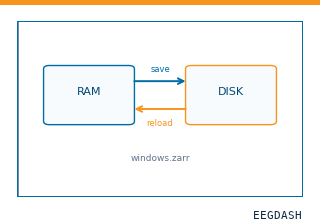 Save and reload prepared dataCache a windowed dataset to disk and reattach it without recompute.
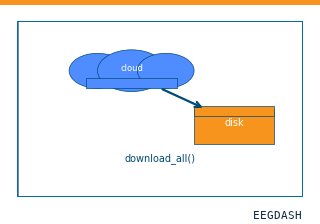 Download a dataset locallyPrefetch BIDS files to a local cache and validate the layout.
Swap any load_dataset(...) call for on007955 to reproduce the tutorial on this dataset.
Citation
Manuel Cebral-Loureda (2024). EEG and autonomic responses during emotional word association. 10.82901/nemar.on007955
Provenance
¹Contributed to nemar in BIDS format.
²Curated & ingested by the EEGDash catalog; see CITATION.cff for canonical reference.
³Persistent identifier: 10.82901/nemar.on007955.
See Also#
eegdash.dataset.EEGDashDataseteegdash.dataset