


NM000276: ieeg dataset, 50 subjects#
Carzaniga-2025-foundation-10.48550/arxiv.2506.20354
Access recordings and metadata through EEGDash.
Citation: Francesco Carzaniga, Michael Hersche, Abu Sebastian, Kaspar Schindler, Abbas Rahimi (2025). Carzaniga-2025-foundation-10.48550/arxiv.2506.20354. 10.82901/nemar.nm000276
Modality: ieeg Subjects: 50 Recordings: 50 License: CDLA-Permissive-2.0 Source: nemar
Metadata: Complete (100%)
50-participant iEEG dataset — Carzaniga-2025-foundation-10.48550/arxiv.2506.20354.
Quickstart#
Install
pip install eegdash
Access the data
from eegdash.dataset import NM000276

dataset = NM000276(cache_dir="./data")
# Get the raw object of the first recording
raw = dataset.datasets[0].raw
print(raw.info)
Filter by subject
dataset = NM000276(cache_dir="./data", subject="01")
Advanced query
dataset = NM000276(
    cache_dir="./data",
    query={"subject": {"$in": ["01", "02"]}},
)
Iterate recordings
for rec in dataset:
    print(rec.subject, rec.raw.info['sfreq'])
If you use this dataset in your research, please cite the original authors.
BibTeX
@dataset{nm000276,
  title = {Carzaniga-2025-foundation-10.48550/arxiv.2506.20354},
  author = {Francesco Carzaniga and Michael Hersche and Abu Sebastian and Kaspar Schindler and Abbas Rahimi},
  doi = {10.82901/nemar.nm000276},
  url = {https://doi.org/10.82901/nemar.nm000276},
}
About This Dataset#
Long-term pre-surgical intracranial EEG (iEEG) from patients with
pharmacoresistant epilepsy, recorded at the Sleep-Wake-Epilepsy-Center (SWEC), Department of Neurology, Inselspital, University of Bern, in collaboration with the Integrated Systems Laboratory, ETH Zurich.
The public SWEC release is FULLY ANONYMIZED. Anatomical channel labels and
electrode locations are NOT disclosed (electrode coordinates + the implied
imaging would be re-identifying for epilepsy-surgery patients). Channels are
therefore named iEEG01..iEEGNN, preserving the original recording order
(1:1 with the source channel index 0..N-1). electrodes.tsv lists every
contact with coordinates set to n/a, and channel type is recorded as the
generic intracranial SEEG (the per-contact strip/grid/depth type is not
disclosed). No locations were fabricated.
SWEC iEEG Dataset (BIDS)
Provenance
v1.0.0 (40 subjects) was converted to BIDS from the public HDF5 release at
https://mb-neuro.medical-blocks.ch/public_access/databases/ieeg/swec_ieeg
(authentic medical-blocks / artorg source) and re-hosted its 40-subject public subset.
v1.1.0 adds the 10 remaining subjects of the same cohort (sub-07, sub-13,
View full README
SWEC iEEG Dataset (BIDS)
Provenance
v1.0.0 (40 subjects) was converted to BIDS from the public HDF5 release at
https://mb-neuro.medical-blocks.ch/public_access/databases/ieeg/swec_ieeg
(authentic medical-blocks / artorg source) and re-hosted its 40-subject public subset.
v1.1.0 adds the 10 remaining subjects of the same cohort (sub-07, sub-13,
sub-14, sub-17, sub-21, sub-25, sub-26, sub-40, sub-44, sub-49)
from the authors’ Hugging Face release NeuroTec/SWEC_iEEG_Dataset, revision
584e9d29313ad6d2ed675b5d5202240f4ff75970
(https://huggingface.co/datasets/NeuroTec/SWEC_iEEG_Dataset). Every source file
was verified against its Hugging Face LFS sha256 before conversion. Conversion is
lossless: the float32 data/ieeg samples of the HDF5 part files are written
unchanged, in part order, into one continuous BrainVision file per subject (no
filtering, resampling, re-referencing, scaling or channel removal), and the
data/seizures onsets/offsets become events.tsv rows. The source holds no
timing information beyond this gap-free concatenation of parts.
Subject crosswalk. sub-NN here is upstream patient NN. In the Hugging Face
release the same patient is folder ID{NN+18} (e.g. sub-07 = ID25,
sub-50 = ID68): the virtual-dataset index of every IDxx_total.h5 still
points to ID{xx-18}_part_*.h5, and the 40 v1.0.0 subjects match folders
ID19-ID68 exactly in channel count, sampling rate, sample count and (for 39 of
40) seizure table. The same converter reproduces 39 of the 40 v1.0.0 .eeg
files byte-for-byte (sha256 identical) from the Hugging Face files. The
exception is sub-02 (see Corrections). The
participants.tsv column source_id records the Hugging Face folder of each
subject.
Hugging Face folders ID01-ID18 are a second copy of 18 of these patients (ID01-ID18 = ID20, ID21, ID22, ID24, ID25, ID27, ID28, ID29, ID30, ID31, ID32, ID34, ID35, ID36, ID37, ID38, ID39, ID40: identical channel count, sampling rate, sample count and seizure table; compressed signal chunks byte-identical where compared). They are not added again. The card’s figures (68 subjects, 9328 hours, 704 ictal events) count these 18 copies; the 50 distinct patients total 6672 hours and 460 annotated seizures.
Corrections in v1.1.0
sub-02: in the v1.0.0 file, 6 of the 20 source parts (parts 1, 6, 9, 14, 15 and 16; 170,454,540 samples, about 92.5 h) were all zeros. The source holds real signal there (Hugging FaceID20); the other 14 parts are identical. v1.1.0 replaces the file with the complete conversion, same size, sampling rate and channels.sub-01: v1.0.0 shipped noevents.tsv. The Hugging Face release annotates 25 seizures for this patient (folderID19), whose signal is byte-identical to the v1.0.0 file. v1.1.0 adds them.
How to cite
Carzaniga, F., Hersche, M., Sebastian, A., Schindler, K. & Rahimi, A. “A foundation model with multi-variate parallel attention to generate neuronal activity.” arXiv:2506.20354 (2025). https://doi.org/10.48550/arXiv.2506.20354 SWEC-ETHZ iEEG Database: http://ieeg-swez.ethz.ch/
License
Community Data License Agreement – Permissive, Version 2.0 (CDLA-Permissive-2.0).
The Hugging Face dataset card (revision 584e9d29) states:
“The iEEG SWEC dataset is licensed using the Community Data License Agreement –
Permissive, Version 2.0” and, under “Disclaimer”: “This dataset may only be used
for research. For other applications any liability is denied. In particular, the
dataset must not be used for diagnostic purposes.”
NEMAR Metadata#
[](https://doi.org/10.82901/nemar.nm000276) # SWEC iEEG Dataset (BIDS) Long-term pre-surgical intracranial EEG (iEEG) from patients with pharmacoresistant epilepsy, recorded at the Sleep-Wake-Epilepsy-Center (SWEC), Department of Neurology, Inselspital, University of Bern, in collaboration with the Integrated Systems Laboratory, ETH Zurich. ## Contents - Subjects: 50 (sub-01 … sub-50; 40 since v1.0.0, 10 added in v1.1.0) - Total recording: 6672 hours of continuous iEEG - Annotated electrographic seizures: 460 - Task label: ltm (long-term monitoring; passive, no task) - Format: BrainVision (IEEE float32), data in microvolts (µV) ## Recording & preprocessing (at source) - Intracranial strip, grid, and depth electrodes (mixed). - 16-bit analog-to-digital conversion. - Sampling rate 512 Hz or 1024 Hz (per subject; see participants.tsv). - Digitally band-pass filtered 0.5-150 Hz (4th-order Butterworth, forward-backward / zero-phase). - Channels with artifacts were removed at the source; remaining channels marked good. - Median reference across channels (per the SWEC-ETHZ long-term protocol). - Seizure onsets/offsets annotated by board-certified epileptologist Prof. Kaspar Schindler. ## Anonymization — channels & electrodes The public SWEC release is FULLY ANONYMIZED. Anatomical channel labels and electrode locations are NOT disclosed (electrode coordinates + the implied imaging would be re-identifying for epilepsy-surgery patients). Channels are therefore named iEEG01..iEEGNN, preserving the original recording order (1:1 with the source channel index 0..N-1). electrodes.tsv lists every contact with coordinates set to n/a, and channel type is recorded as the generic intracranial SEEG (the per-contact strip/grid/depth type is not disclosed). No locations were fabricated. ## Provenance v1.0.0 (40 subjects) was converted to BIDS from the public HDF5 release at https://mb-neuro.medical-blocks.ch/public_access/databases/ieeg/swec_ieeg (authentic medical-blocks / artorg source) and re-hosted its 40-subject public subset. v1.1.0 adds the 10 remaining subjects of the same cohort (sub-07, sub-13, sub-14, sub-17, sub-21, sub-25, sub-26, sub-40, sub-44, sub-49) from the authors’ Hugging Face release NeuroTec/SWEC_iEEG_Dataset, revision 584e9d29313ad6d2ed675b5d5202240f4ff75970 (https://huggingface.co/datasets/NeuroTec/SWEC_iEEG_Dataset). Every source file was verified against its Hugging Face LFS sha256 before conversion. Conversion is lossless: the float32 data/ieeg samples of the HDF5 part files are written unchanged, in part order, into one continuous BrainVision file per subject (no filtering, resampling, re-referencing, scaling or channel removal), and the data/seizures onsets/offsets become events.tsv rows. The source holds no timing information beyond this gap-free concatenation of parts. Subject crosswalk. sub-NN here is upstream patient NN. In the Hugging Face release the same patient is folder ID{NN+18} (e.g. sub-07 = ID25, sub-50 = ID68): the virtual-dataset index of every IDxx_total.h5 still points to ID{xx-18}_part_*.h5, and the 40 v1.0.0 subjects match folders ID19-ID68 exactly in channel count, sampling rate, sample count and (for 39 of 40) seizure table. The same converter reproduces 39 of the 40 v1.0.0 .eeg files byte-for-byte (sha256 identical) from the Hugging Face files. The exception is sub-02 (see Corrections). The participants.tsv column source_id records the Hugging Face folder of each subject. Hugging Face folders ID01-ID18 are a second copy of 18 of these patients (ID01-ID18 = ID20, ID21, ID22, ID24, ID25, ID27, ID28, ID29, ID30, ID31, ID32, ID34, ID35, ID36, ID37, ID38, ID39, ID40: identical channel count, sampling rate, sample count and seizure table; compressed signal chunks byte-identical where compared). They are not added again. The card’s figures (68 subjects, 9328 hours, 704 ictal events) count these 18 copies; the 50 distinct patients total 6672 hours and 460 annotated seizures. ## Corrections in v1.1.0 - sub-02: in the v1.0.0 file, 6 of the 20 source parts (parts 1, 6, 9, 14,
15 and 16; 170,454,540 samples, about 92.5 h) were all zeros. The source holds real signal there (Hugging Face ID20); the other 14 parts are identical. v1.1.0 replaces the file with the complete conversion, same size, sampling rate and channels.
sub-01: v1.0.0 shipped no events.tsv. The Hugging Face release annotates 25 seizures for this patient (folder ID19), whose signal is byte-identical to the v1.0.0 file. v1.1.0 adds them.
## How to cite Carzaniga, F., Hersche, M., Sebastian, A., Schindler, K. & Rahimi, A. “A foundation model with multi-variate parallel attention to generate neuronal activity.” arXiv:2506.20354 (2025). https://doi.org/10.48550/arXiv.2506.20354 SWEC-ETHZ iEEG Database: http://ieeg-swez.ethz.ch/ ## License Community Data License Agreement – Permissive, Version 2.0 (CDLA-Permissive-2.0). The Hugging Face dataset card (revision 584e9d29) states: “The iEEG SWEC dataset is licensed using the Community Data License Agreement – Permissive, Version 2.0” and, under “Disclaimer”: “This dataset may only be used for research. For other applications any liability is denied. In particular, the dataset must not be used for diagnostic purposes.”
License: CDLA-Permissive-2.0
Authors:
Francesco Carzaniga
Michael Hersche
Abu Sebastian
Kaspar Schindler
Abbas Rahimi
Versions:
Version |
DOI |
Released |
|---|---|---|
|
Cohort#
Dataset Statistics#
Channel counts (ch)
Sampling frequencies (Hz)
Total recording duration: 6672 h
Signal · Electrodes & live trace#
Live trace viewer — sub-01 · task-ltm
Showing one representative recording out of
50 subjects and 50 recordings in this dataset.
Browse the full set on OpenNeuro;
drop any other _ieeg.{set,edf,bdf,vhdr} file onto the
viewer (or pass ?ieeg=<url>) to inspect it.
No scalp electrode layout is currently indexed for this dataset. Once the eegdash montage registry ingests it, the interactive viewer will appear here automatically.
NEMAR Processing Statistics#
The plots below are generated by NEMAR’s automated EEG pipeline. The histogram shows pipeline success for data cleaning and ICA decomposition, the percentage of data frames and EEG channels retained after artefact removal, line noise per channel (RMS, dB), and the age/gender distribution of participants.

HED event descriptors word cloud

Manifest#
File Explorer#
Browse the BIDS file structure of this dataset. Records are fetched on demand from the EEGDash catalog the first time you open the explorer.
Full dataset metadata table
Dataset ID |
|
Title |
Carzaniga-2025-foundation-10.48550/arxiv.2506.20354 |
Author (year) |
— |
Canonical |
— |
Importable as |
|
Year |
2025 |
Authors |
Francesco Carzaniga, Michael Hersche, Abu Sebastian, Kaspar Schindler, Abbas Rahimi |
License |
CDLA-Permissive-2.0 |
Citation / DOI |
|
Source links |
OpenNeuro | NeMAR | Source URL |
Copy-paste BibTeX
@dataset{nm000276,
  title = {Carzaniga-2025-foundation-10.48550/arxiv.2506.20354},
  author = {Francesco Carzaniga and Michael Hersche and Abu Sebastian and Kaspar Schindler and Abbas Rahimi},
  doi = {10.82901/nemar.nm000276},
  url = {https://doi.org/10.82901/nemar.nm000276},
}
API Reference#
eegdash.datasetEEGDashDataset- class eegdash.dataset.NM000276(cache_dir: str, query: dict | None = None, s3_bucket: str | None = None, **kwargs)[source]#
Carzaniga-2025-foundation-10.48550/arxiv.2506.20354
- Study:
nm000276(NeMAR)- Author (year):
—
- Canonical:
—
Also importable as:
NM000276.Modality:
ieeg; Experiment type:Clinical; Subject type:Epilepsy. Subjects: 50; recordings: 50; tasks: 1.- Parameters:
cache_dir (str | Path) – Directory where data are cached locally.
query (dict | None) – Additional MongoDB-style filters to AND with the dataset selection. Must not contain the key
dataset.s3_bucket (str | None) – Base S3 bucket used to locate the data.
**kwargs (dict) – Additional keyword arguments forwarded to
EEGDashDataset.
- data_dir#
Local dataset cache directory (
cache_dir / dataset_id).- Type:
Path
Notes
Each item is a recording; recording-level metadata are available via
dataset.description.querysupports MongoDB-style filters on fields inALLOWED_QUERY_FIELDSand is combined with the dataset filter. Dataset-specific caveats are not provided in the summary metadata.References
OpenNeuro dataset: https://openneuro.org/datasets/nm000276 NeMAR dataset: https://nemar.org/dataexplorer/detail?dataset_id=nm000276 DOI: https://doi.org/10.82901/nemar.nm000276
Examples
>>> from eegdash.dataset import NM000276
>>> dataset = NM000276(cache_dir="./data")
>>> recording = dataset[0]
>>> raw = recording.load()
- __init__(cache_dir: str, query: dict | None = None, s3_bucket: str | None = None, **kwargs)[source]#
- save(path: str, overwrite: bool = False, offset: int = 0)[source]#
Save datasets to files by creating one subdirectory for each dataset:
path/
    0/
        0-raw.fif | 0-epo.fif
        description.json
        raw_preproc_kwargs.json (if raws were preprocessed)
        window_kwargs.json (if this is a windowed dataset)
        window_preproc_kwargs.json  (if windows were preprocessed)
        target_name.json (if target_name is not None and dataset is raw)
    1/
        1-raw.fif | 1-epo.fif
        description.json
        raw_preproc_kwargs.json (if raws were preprocessed)
        window_kwargs.json (if this is a windowed dataset)
        window_preproc_kwargs.json  (if windows were preprocessed)
        target_name.json (if target_name is not None and dataset is raw)
- Parameters:
path (str) –
- Directory in which subdirectories are created to store
-raw.fif | -epo.fif and .json files to.
overwrite (bool) – Whether to delete old subdirectories that will be saved to in this call. If a dataset still reads its data lazily from one of them, a
ValueErroris raised before anything is deleted: load the data into memory first (preload=True) or save to another directory.offset (int) – If provided, the integer is added to the id of the dataset in the concat. This is useful in the setting of very large datasets, where one dataset has to be processed and saved at a time to account for its original position.
BaseDataset from braindecode — windowed via create_windows_from_events.braindecodeDataLoader; supports parallel workers and on-the-fly augmentations.pytorch Find datasets with the EEGDash APIQuery the catalogue, filter by task or modality, list candidates.
 Load one EEG recordingResolve a single record to an MNE Raw with channels and events.
 EEG recording to PyTorch DataLoaderWrap braindecode windows in a DataLoader for model training.
 Preprocess EEG and create windowsFilter, resample, epoch — and persist the windowed dataset.
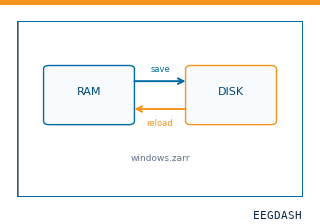 Save and reload prepared dataCache a windowed dataset to disk and reattach it without recompute.
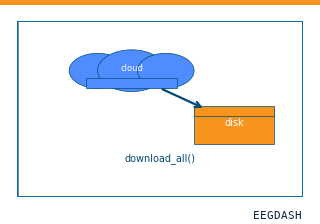 Download a dataset locallyPrefetch BIDS files to a local cache and validate the layout.
Swap any load_dataset(...) call for nm000276 to reproduce the tutorial on this dataset.
Citation
Francesco Carzaniga, Michael Hersche, Abu Sebastian, Kaspar Schindler, Abbas Rahimi (2025). Carzaniga-2025-foundation-10.48550/arxiv.2506.20354. 10.82901/nemar.nm000276
Provenance
¹Contributed to nemar in BIDS format.
²Curated & ingested by the EEGDash catalog; see CITATION.cff for canonical reference.
³Persistent identifier: 10.82901/nemar.nm000276.
See Also#
eegdash.dataset.EEGDashDataseteegdash.dataset