


NM000404: ieeg dataset, 25 subjects#
Internal-external attention switching SEEG epochs, DMN and DAN channels, 25 epilepsy patients (Hammer et al. 2024)
Access recordings and metadata through EEGDash.
Citation: Jiri Hammer (2024). Internal-external attention switching SEEG epochs, DMN and DAN channels, 25 epilepsy patients (Hammer et al. 2024). 10.82901/nemar.nm000404
Modality: ieeg Subjects: 25 Recordings: 25 License: CC-BY-4.0 Source: nemar
Metadata: Complete (100%)
25-participant iEEG dataset — Internal-external attention switching SEEG epochs, DMN and DAN channels, 25 epilepsy patients (Hammer et al. 2024).
Quickstart#
Install
pip install eegdash
Access the data
from eegdash.dataset import NM000404

dataset = NM000404(cache_dir="./data")
# Get the raw object of the first recording
raw = dataset.datasets[0].raw
print(raw.info)
Filter by subject
dataset = NM000404(cache_dir="./data", subject="01")
Advanced query
dataset = NM000404(
    cache_dir="./data",
    query={"subject": {"$in": ["01", "02"]}},
)
Iterate recordings
for rec in dataset:
    print(rec.subject, rec.raw.info['sfreq'])
If you use this dataset in your research, please cite the original authors.
BibTeX
@dataset{nm000404,
  title = {Internal-external attention switching SEEG epochs, DMN and DAN channels, 25 epilepsy patients (Hammer et al. 2024)},
  author = {Jiri Hammer},
  doi = {10.82901/nemar.nm000404},
  url = {https://doi.org/10.82901/nemar.nm000404},
}
About This Dataset#
Stereo-EEG epochs released with:
Hammer J, Kajsova M, Kalina A, Krysl D, Fabera P, Kudr M, Jezdik P, Janca R, Krsek P, Marusic P (2024). Antagonistic behavior of brain networks mediated by low-frequency oscillations: electrophysiological dynamics during internal-external attention switching. Communications Biology 7:1105. https://doi.org/10.1038/s42003-024-06732-2
Internal-external attention switching: SEEG epochs from 25 epilepsy patients (derivative)
Source record: Zenodo https://doi.org/10.5281/zenodo.12796062 (v3, CC-BY-4.0): msSEI_exportTrials.zip.
This is a derivative dataset. The release contains the authors’ preprocessed epochs, not the continuous recordings.
Participants and task (from the paper)
25 patients with drug-resistant epilepsy (15 female; age 34 +/- 12 years) in presurgical SEEG monitoring at Motol
View full README
Internal-external attention switching: SEEG epochs from 25 epilepsy patients (derivative)
Source record: Zenodo https://doi.org/10.5281/zenodo.12796062 (v3, CC-BY-4.0): msSEI_exportTrials.zip.
This is a derivative dataset. The release contains the authors’ preprocessed epochs, not the continuous recordings.
Participants and task (from the paper)
25 patients with drug-resistant epilepsy (15 female; age 34 +/- 12 years) in presurgical SEEG monitoring at Motol
University Hospital, Prague; implantation by clinical need only; approved by the hospital’s ethics committee; written
informed consent. Per-subject age and sex are not in the release; since 2026-10-08 participants.tsv gives them from the article’s Supplementary Table 1.
Subjects alternated between an external-attention task (visual search: find the T among 35 Ls on a 6x6 grid and report whether it is in the upper or lower half) and an internal-attention task (yes/no answer to a statement about their own past experiences), answering on a gamepad within 5 s, with no pause between trials and not switching on every trial.
Four sessions of several minutes (about 30 min). Each epoch is centred on a task switch: E-I (external to internal)
or I-E (internal to external).
Recording and preprocessing (by the authors)
DIXI Medical depth electrodes, Quantum amplifiers / NeuroWorks, 2048 Hz (0.01-682 Hz), reference and ground in white matter. The authors downsampled to 512 Hz, removed broken channels and channels in the seizure-onset or irritative zone or in heterotopic cortex, built bipolar derivations along each shank, high-pass filtered at 0.1 Hz and notch filtered at 50 Hz and harmonics (Butterworth, 6th order, zero phase), cut epochs from -4 to +4 s around each switch, and kept only channels assigned to the default mode network (DMN) or dorsal attention network (DAN) by the Yeo-7 atlas.
Files
sub-P<k>/ieeg/*_ieeg.vhdr|.eeg|.vmrk: the epochs written back to back (4097 samples = 8.002 s each), BrainVision IEEE float32. Values are the release’s float64 values rounded to float32; no other change. The release does not state the physical unit; the channels are labelled µV because amplitudes of a few to tens of units match µV-scaled iEEG, but this is our assumption, not a statement of the authors.*_events.tsv: one row per epoch at the switch time, withtrial_type(E-I / I-E), epoch number, epoch start and the fraction of samples marked rejected in the release.*_channels.tsv: bipolar channel names as released, with thenetworklabel (DMN / DAN).*_space-Other_electrodes.tsv: the release’s MNI coordinates per bipolar channel.sourcedata/zenodo-12796062/: the originaltrials_P<k>.matfiles (including the per-sample rejection masks) and the release read-me, unchanged.
The figure source data (code_figures.zip) and analysis code (code_pipeline.zip) of the record are not copied; they
are available from the source record and GitHub.
Licence
CC-BY-4.0, as the source record. Please cite the paper and the Zenodo record.
Additional metadata and localisation (added 2026-10-08)
Compiled after the upload from the article, its supplement and the source deposit (each statement names its source). Text and sidecar metadata only; no data file was changed.
Recording system. Medical amplifiers (Quantum, NeuroWorks), sampled at 2048 Hz (bandwidth 0.01-682 Hz), later downsampled to 512 Hz (doi:10.1038/s42003-024-06732-2, Methods ‘iEEG data recording and preprocessing’). Deposited trials: 4097 samples from -4.0 to 4.0 s (512 Hz), trials x channels per subject in D.trials (Voyager Job ieeg-b3enr-c-hammer-1007220748). The deposited data are bipolar referenced, high-pass filtered at 0.1 Hz and notch filtered at 50 Hz and harmonics; D.rejected marks rejected samples (deposit readme).
Reference scheme. Recording reference and ground electrodes in white matter (subject-specific locations) (doi:10.1038/s42003-024-06732-2); the deposited channels are bipolar pairs of neighbouring contacts (e.g. ‘A1-A2’) (deposit readme; doi:10.1038/s42003-024-06732-2 Results).
Electrode types. Intracerebral (SEEG) electrodes, DIXI Medical; cylindrical contacts 0.8 mm diameter, 2 mm height, 1.5 mm spacing (doi:10.1038/s42003-024-06732-2).
Localisation method. Contacts localised on post-implantation CT coregistered to pre-implantation MRI, verified on post-implantation MRI, MRI normalised to MNI space with SPM12; each bipolar channel was given the MNI coordinate of the centre between its contacts and assigned to the DMN or DAN with the Yeo-7 atlas; only DMN/DAN channels are exported (doi:10.1038/s42003-024-06732-2, Methods ‘iEEG channel assignment’; deposit readme). The deposit gives channels_MNI for every exported channel; the column atlas_label_AAL3v1 of each electrodes.tsv adds an AAL3v1 atlas lookup of these coordinates (ieeg-atlas coord_regions.py, nearest labelled voxel; a derived label, not given by the authors).
NEMAR Metadata#
[](https://doi.org/10.82901/nemar.nm000404) # Internal-external attention switching: SEEG epochs from 25 epilepsy patients (derivative) Stereo-EEG epochs released with: > Hammer J, Kajsova M, Kalina A, Krysl D, Fabera P, Kudr M, Jezdik P, Janca R, Krsek P, Marusic P (2024). > Antagonistic behavior of brain networks mediated by low-frequency oscillations: electrophysiological dynamics during > internal-external attention switching. Communications Biology 7:1105. https://doi.org/10.1038/s42003-024-06732-2 Source record: Zenodo https://doi.org/10.5281/zenodo.12796062 (v3, CC-BY-4.0): msSEI_exportTrials.zip. This is a derivative dataset. The release contains the authors’ preprocessed epochs, not the continuous recordings. ## Participants and task (from the paper) 25 patients with drug-resistant epilepsy (15 female; age 34 +/- 12 years) in presurgical SEEG monitoring at Motol University Hospital, Prague; implantation by clinical need only; approved by the hospital’s ethics committee; written informed consent. Per-subject age and sex are not in the release; since 2026-10-08 participants.tsv gives them from the article’s Supplementary Table 1. Subjects alternated between an external-attention task (visual search: find the T among 35 Ls on a 6x6 grid and report whether it is in the upper or lower half) and an internal-attention task (yes/no answer to a statement about their own past experiences), answering on a gamepad within 5 s, with no pause between trials and not switching on every trial. Four sessions of several minutes (about 30 min). Each epoch is centred on a task switch: E-I (external to internal) or I-E (internal to external). ## Recording and preprocessing (by the authors) DIXI Medical depth electrodes, Quantum amplifiers / NeuroWorks, 2048 Hz (0.01-682 Hz), reference and ground in white matter. The authors downsampled to 512 Hz, removed broken channels and channels in the seizure-onset or irritative zone or in heterotopic cortex, built bipolar derivations along each shank, high-pass filtered at 0.1 Hz and notch filtered at 50 Hz and harmonics (Butterworth, 6th order, zero phase), cut epochs from -4 to +4 s around each switch, and kept only channels assigned to the default mode network (DMN) or dorsal attention network (DAN) by the Yeo-7 atlas. ## Files - sub-P<k>/ieeg/*_ieeg.vhdr|.eeg|.vmrk: the epochs written back to back (4097 samples = 8.002 s each), BrainVision
IEEE float32. Values are the release’s float64 values rounded to float32; no other change. The release does not state the physical unit; the channels are labelled µV because amplitudes of a few to tens of units match µV-scaled iEEG, but this is our assumption, not a statement of the authors.
*_events.tsv: one row per epoch at the switch time, with trial_type (E-I / I-E), epoch number, epoch start and the fraction of samples marked rejected in the release.
*_channels.tsv: bipolar channel names as released, with the network label (DMN / DAN).
*_space-Other_electrodes.tsv: the release’s MNI coordinates per bipolar channel.
sourcedata/zenodo-12796062/: the original trials_P<k>.mat files (including the per-sample rejection masks) and the release read-me, unchanged.
The figure source data (code_figures.zip) and analysis code (code_pipeline.zip) of the record are not copied; they are available from the source record and GitHub. ## Licence CC-BY-4.0, as the source record. Please cite the paper and the Zenodo record. ## Additional metadata and localisation (added 2026-10-08) Compiled after the upload from the article, its supplement and the source deposit (each statement names its source). Text and sidecar metadata only; no data file was changed. Recording system. Medical amplifiers (Quantum, NeuroWorks), sampled at 2048 Hz (bandwidth 0.01-682 Hz), later downsampled to 512 Hz (doi:10.1038/s42003-024-06732-2, Methods ‘iEEG data recording and preprocessing’). Deposited trials: 4097 samples from -4.0 to 4.0 s (512 Hz), trials x channels per subject in D.trials (Voyager Job ieeg-b3enr-c-hammer-1007220748). The deposited data are bipolar referenced, high-pass filtered at 0.1 Hz and notch filtered at 50 Hz and harmonics; D.rejected marks rejected samples (deposit readme). Reference scheme. Recording reference and ground electrodes in white matter (subject-specific locations) (doi:10.1038/s42003-024-06732-2); the deposited channels are bipolar pairs of neighbouring contacts (e.g. ‘A1-A2’) (deposit readme; doi:10.1038/s42003-024-06732-2 Results). Electrode types. Intracerebral (SEEG) electrodes, DIXI Medical; cylindrical contacts 0.8 mm diameter, 2 mm height, 1.5 mm spacing (doi:10.1038/s42003-024-06732-2). Localisation method. Contacts localised on post-implantation CT coregistered to pre-implantation MRI, verified on post-implantation MRI, MRI normalised to MNI space with SPM12; each bipolar channel was given the MNI coordinate of the centre between its contacts and assigned to the DMN or DAN with the Yeo-7 atlas; only DMN/DAN channels are exported (doi:10.1038/s42003-024-06732-2, Methods ‘iEEG channel assignment’; deposit readme). The deposit gives channels_MNI for every exported channel; the column atlas_label_AAL3v1 of each electrodes.tsv adds an AAL3v1 atlas lookup of these coordinates (ieeg-atlas coord_regions.py, nearest labelled voxel; a derived label, not given by the authors).
License: CC-BY-4.0
Authors:
Jiri Hammer
Versions:
Version |
DOI |
Released |
|---|---|---|
|
Cohort#
Dataset Statistics#
Age distribution by gender (n=25, range 12–55 yr, mean 34.3 yr)
Sex composition
Channel counts (ch)
Sampling frequencies: 512.0 Hz (n=25 recordings)
Total recording duration: 6 h 53 min
Signal · Electrodes & live trace#
Live trace viewer — sub-P1 · task-attentionswitch
Showing one representative recording out of
25 subjects and 25 recordings in this dataset.
Browse the full set on OpenNeuro;
drop any other _ieeg.{set,edf,bdf,vhdr} file onto the
viewer (or pass ?ieeg=<url>) to inspect it.
Electrode layout — iEEG · 63 sensors — 63 channels
NEMAR Processing Statistics#
The plots below are generated by NEMAR’s automated EEG pipeline. The histogram shows pipeline success for data cleaning and ICA decomposition, the percentage of data frames and EEG channels retained after artefact removal, line noise per channel (RMS, dB), and the age/gender distribution of participants.

HED event descriptors word cloud

Manifest#
File Explorer#
Browse the BIDS file structure of this dataset. Records are fetched on demand from the EEGDash catalog the first time you open the explorer.
Full dataset metadata table
Dataset ID |
|
Title |
Internal-external attention switching SEEG epochs, DMN and DAN channels, 25 epilepsy patients (Hammer et al. 2024) |
Author (year) |
— |
Canonical |
— |
Importable as |
|
Year |
2024 |
Authors |
Jiri Hammer |
License |
CC-BY-4.0 |
Citation / DOI |
|
Source links |
OpenNeuro | NeMAR | Source URL |
Copy-paste BibTeX
@dataset{nm000404,
  title = {Internal-external attention switching SEEG epochs, DMN and DAN channels, 25 epilepsy patients (Hammer et al. 2024)},
  author = {Jiri Hammer},
  doi = {10.82901/nemar.nm000404},
  url = {https://doi.org/10.82901/nemar.nm000404},
}
API Reference#
eegdash.datasetEEGDashDataset- class eegdash.dataset.NM000404(cache_dir: str, query: dict | None = None, s3_bucket: str | None = None, **kwargs)[source]#
Internal-external attention switching SEEG epochs, DMN and DAN channels, 25 epilepsy patients (Hammer et al. 2024)
- Study:
nm000404(NeMAR)- Author (year):
—
- Canonical:
—
Also importable as:
NM000404.Modality:
ieeg; Subject type:Unknown. Subjects: 25; recordings: 25; tasks: 1.- Parameters:
cache_dir (str | Path) – Directory where data are cached locally.
query (dict | None) – Additional MongoDB-style filters to AND with the dataset selection. Must not contain the key
dataset.s3_bucket (str | None) – Base S3 bucket used to locate the data.
**kwargs (dict) – Additional keyword arguments forwarded to
EEGDashDataset.
- data_dir#
Local dataset cache directory (
cache_dir / dataset_id).- Type:
Path
Notes
Each item is a recording; recording-level metadata are available via
dataset.description.querysupports MongoDB-style filters on fields inALLOWED_QUERY_FIELDSand is combined with the dataset filter. Dataset-specific caveats are not provided in the summary metadata.References
OpenNeuro dataset: https://openneuro.org/datasets/nm000404 NeMAR dataset: https://nemar.org/dataexplorer/detail?dataset_id=nm000404 DOI: https://doi.org/10.82901/nemar.nm000404
Examples
>>> from eegdash.dataset import NM000404
>>> dataset = NM000404(cache_dir="./data")
>>> recording = dataset[0]
>>> raw = recording.load()
- __init__(cache_dir: str, query: dict | None = None, s3_bucket: str | None = None, **kwargs)[source]#
- save(path: str, overwrite: bool = False, offset: int = 0)[source]#
Save datasets to files by creating one subdirectory for each dataset:
path/
    0/
        0-raw.fif | 0-epo.fif
        description.json
        raw_preproc_kwargs.json (if raws were preprocessed)
        window_kwargs.json (if this is a windowed dataset)
        window_preproc_kwargs.json  (if windows were preprocessed)
        target_name.json (if target_name is not None and dataset is raw)
    1/
        1-raw.fif | 1-epo.fif
        description.json
        raw_preproc_kwargs.json (if raws were preprocessed)
        window_kwargs.json (if this is a windowed dataset)
        window_preproc_kwargs.json  (if windows were preprocessed)
        target_name.json (if target_name is not None and dataset is raw)
- Parameters:
path (str) –
- Directory in which subdirectories are created to store
-raw.fif | -epo.fif and .json files to.
overwrite (bool) – Whether to delete old subdirectories that will be saved to in this call.
offset (int) – If provided, the integer is added to the id of the dataset in the concat. This is useful in the setting of very large datasets, where one dataset has to be processed and saved at a time to account for its original position.
BaseDataset from braindecode — windowed via create_windows_from_events.braindecodeDataLoader; supports parallel workers and on-the-fly augmentations.pytorch Find datasets with the EEGDash APIQuery the catalogue, filter by task or modality, list candidates.
 Load one EEG recordingResolve a single record to an MNE Raw with channels and events.
 EEG recording to PyTorch DataLoaderWrap braindecode windows in a DataLoader for model training.
 Preprocess EEG and create windowsFilter, resample, epoch — and persist the windowed dataset.
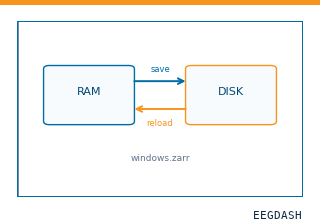 Save and reload prepared dataCache a windowed dataset to disk and reattach it without recompute.
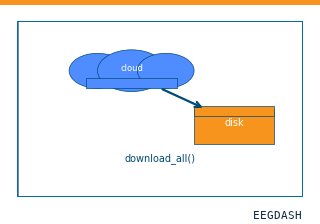 Download a dataset locallyPrefetch BIDS files to a local cache and validate the layout.
Swap any load_dataset(...) call for nm000404 to reproduce the tutorial on this dataset.
Citation
Jiri Hammer (2024). Internal-external attention switching SEEG epochs, DMN and DAN channels, 25 epilepsy patients (Hammer et al. 2024). 10.82901/nemar.nm000404
Provenance
¹Contributed to nemar in BIDS format.
²Curated & ingested by the EEGDash catalog; see CITATION.cff for canonical reference.
³Persistent identifier: 10.82901/nemar.nm000404.
See Also#
eegdash.dataset.EEGDashDataseteegdash.dataset