


ON000117: meg dataset, 17 subjects#
Multisubject, multimodal face processing
Access recordings and metadata through EEGDash.
Citation: Wakeman, DG, Henson, RN (2015). Multisubject, multimodal face processing. 10.82901/nemar.on000117
Modality: meg Subjects: 17 Recordings: 104 License: CC0 Source: nemar
Metadata: Complete (100%)
17-participant MEG dataset — Multisubject, multimodal face processing.
Quickstart#
Install
pip install eegdash
Access the data
from eegdash.dataset import ON000117

dataset = ON000117(cache_dir="./data")
# Get the raw object of the first recording
raw = dataset.datasets[0].raw
print(raw.info)
Filter by subject
dataset = ON000117(cache_dir="./data", subject="01")
Advanced query
dataset = ON000117(
    cache_dir="./data",
    query={"subject": {"$in": ["01", "02"]}},
)
Iterate recordings
for rec in dataset:
    print(rec.subject, rec.raw.info['sfreq'])
If you use this dataset in your research, please cite the original authors.
BibTeX
@dataset{on000117,
  title = {Multisubject, multimodal face processing},
  author = {Wakeman, DG and Henson, RN},
  doi = {10.82901/nemar.on000117},
  url = {https://doi.org/10.82901/nemar.on000117},
}
About This Dataset#
This dataset was obtained from the OpenNeuro project (https://www.openneuro.org). Accession #: ds000117
The same dataset is also available here: ftp://ftp.mrc-cbu.cam.ac.uk/personal/rik.henson/wakemandg_hensonrn/, but in a non-BIDS format (which may be easier to download by subject rather than by modality) Note that it is a subset of the data available on OpenfMRI (http://www.openfmri.org; Accession #: ds000117).
Description: Multi-subject, multi-modal (sMRI+fMRI+MEG+EEG) neuroimaging dataset on face processing
- Please cite the following reference if you use these data:
Wakeman, D.G. & Henson, R.N. (2015). A multi-subject, multi-modal human neuroimaging dataset. Sci. Data 2:150001 doi: 10.1038/sdata.2015.1
- The data have been used in several publications including, for example:
- Henson, R.N., Abdulrahman, H., Flandin, G. & Litvak, V. (2019). Multimodal integration of M/EEG and f/MRI data in SPM12. Frontiers in Neuroscience, Methods, 13, 300.
Henson, R.N., Wakeman, D.G., Litvak, V. & Friston, K.J. (2011). A Parametric Empirical Bayesian framework for the EEG/MEG inverse problem: generative models for multisubject and multimodal integration. Frontiers in Human Neuroscience, 5, 76, 1-16. Chapter 42 of the SPM12 manual (http://www.fil.ion.ucl.ac.uk/spm/doc/manual.pdf)
(see ftp://ftp.mrc-cbu.cam.ac.uk/personal/rik.henson/wakemandg_hensonrn/Publications for full list), as well as the BioMag2010 data competition and the Kaggle competition: https://www.kaggle.com/c/decoding-the-human-brain)
func/
View full README
- The data have been used in several publications including, for example:
- Henson, R.N., Abdulrahman, H., Flandin, G. & Litvak, V. (2019). Multimodal integration of M/EEG and f/MRI data in SPM12. Frontiers in Neuroscience, Methods, 13, 300.
Henson, R.N., Wakeman, D.G., Litvak, V. & Friston, K.J. (2011). A Parametric Empirical Bayesian framework for the EEG/MEG inverse problem: generative models for multisubject and multimodal integration. Frontiers in Human Neuroscience, 5, 76, 1-16. Chapter 42 of the SPM12 manual (http://www.fil.ion.ucl.ac.uk/spm/doc/manual.pdf)
(see ftp://ftp.mrc-cbu.cam.ac.uk/personal/rik.henson/wakemandg_hensonrn/Publications for full list), as well as the BioMag2010 data competition and the Kaggle competition: https://www.kaggle.com/c/decoding-the-human-brain)
func/
Unlike in v1-v3 of this dataset, the first two (dummy) volumes have now been removed (as stated in *.json), so event onset times correctly refer to t=0 at start of third volume Note that, owing to scanner error, Subject 10 only has 170 volumes in last run (Run 9)
meg/
Three anatomical fiducials were digitized for aligning the MEG with the MRI: the nasion (lowest depression between the eyes) and the left and right ears (lowest depression between the tragus and the helix, above the tragus). This procedure is illustrated here: http://neuroimage.usc.edu/brainstorm/CoordinateSystems#Subject_Coordinate_System_.28SCS_.2F_CTF.29 and in task-facerecognition_fidinfo.pdf The following triggers are included in the .fif files and are also used in the “trigger” column of the meg and bold events files:
Trigger Label Simplified Label 5 Initial Famous Face IniFF 6 Immediate Repeat Famous Face ImmFF 7 Delayed Repeat Famous Face DelFF 13 Initial Unfamiliar Face IniUF 14 Immediate Repeat Unfamiliar Face ImmUF 15 Delayed Repeat Unfamiliar Face DelUF 17 Initial Scrambled Face IniSF 18 Immediate Repeat Scrambled Face ImmSF 19 Delayed Repeat Scrambled Face DelSF
stimuli/meg/
The .bmp files correspond to those described in the text. There are 6 additional images in this directory, which were used in the practice experiment to familiarize participants with the task (hence some more BIDS validator warnings)
stimuli/mri/
The .bmp files correspond to those described in the text.
Defacing
Defacing of MPRAGE T1 images was performed by the submitter. A subset of subjects have given consent for non-defaced versions to be shared - in which case, please contact rik.henson@mrc-cbu.cam.ac.uk.
Quality Control
Mriqc was run on the dataset. Results are located in derivatives/mriqc. Learn more about it here: https://mriqc.readthedocs.io/en/latest/
Known Issues
N/A
Relationship of Subject Numbering relative to other versions of Dataset
There are multiple versions of the dataset available on the web (see notes above), and these entailed a renumbering of the subjects for various reasons. Here are all the versions and how to match subjects between them (plus some rationale and history for different versions): 1. Original Paper (N=19): Wakeman & Henson (2015): doi:10.1038/sdata.2015.1
Number refers to order that tested (and some, eg 4, 7, 13 etc were excluded for not completing both MRI and MEG sessions)
- openfMRI, renumbered from paper: http://openfmri.org/s3-browser/?prefix=ds000117/ds000117_R0.1.1/uncompressed/
Numbers 1-19 just made contiguous
- FTP subset of N=16: ftp: ftp://ftp.mrc-cbu.cam.ac.uk/personal/rik.henson/wakemandg_hensonrn/
This set was used for SPM Courses Designed to illustrate multimodal integration, so wanted good MRI+MEG+EEG data for all subjects Removed original subject_01 and subject_06 because bad EEG data; subject_19 because poor EEG and fMRI data (And renumbered subject_14 for some reason).
- Current OpenNeuro subset N=16 used for (BIDS): https://openneuro.org/datasets/ds000117
OpenNeuro was rebranding of openfMRI, and enforced BIDS format Since this version designed to illustrate multi-modal BIDS, kept same numbering as FTP
W&H2015 openfMRI FTP openNeuro ======== ====== === ======= subject_01 sub001 subject_02 sub002 Sub01 sub-01 subject_03 sub003 Sub02 sub-02 subject_05 sub004 Sub03 sub-03 subject_06 sub005 subject_08 sub006 Sub05 sub-05 subject_09 sub007 Sub06 sub-06 subject_10 sub008 Sub07 sub-07 subject_11 sub009 Sub08 sub-08 subject_12 sub010 Sub09 sub-09 subject_14 sub011 Sub04 sub-04 subject_15 sub012 Sub10 sub-10 subject_16 sub013 Sub11 sub-11 subject_17 sub014 Sub12 sub-12 subject_18 sub015 Sub13 sub-13 subject_19 sub016 subject_23 sub017 Sub14 sub-14 subject_24 sub018 Sub15 sub-15 subject_25 sub019 Sub16 sub-16
Cohort#
Dataset Statistics#
Age distribution by gender (n=16, range 23–31 yr, mean 26.4 yr)
Sex composition
Channel counts: 394 ch (n=96 recordings)
Sampling frequencies: 1100.0 Hz (n=96 recordings)
Signal · Electrodes & live trace#
Live trace viewer — sub-13 · ses-meg · task-facerecognition · run-05
Showing one representative recording out of
17 subjects and 104 recordings in this dataset.
Browse the full set on OpenNeuro;
drop any other _meg.{set,edf,bdf,vhdr} file onto the
viewer (or pass ?meg=<url>) to inspect it.
No scalp electrode layout is currently indexed for this dataset. Once the eegdash montage registry ingests it, the interactive viewer will appear here automatically.
NEMAR Processing Statistics#
The plots below are generated by NEMAR’s automated EEG pipeline. The histogram shows pipeline success for data cleaning and ICA decomposition, the percentage of data frames and EEG channels retained after artefact removal, line noise per channel (RMS, dB), and the age/gender distribution of participants.

HED event descriptors word cloud

Manifest#
File Explorer#
Browse the BIDS file structure of this dataset. Records are fetched on demand from the EEGDash catalog the first time you open the explorer.
Full dataset metadata table
Dataset ID |
|
Title |
Multisubject, multimodal face processing |
Author (year) |
— |
Canonical |
— |
Importable as |
|
Year |
2015 |
Authors |
Wakeman, DG, Henson, RN |
License |
CC0 |
Citation / DOI |
|
Source links |
Copy-paste BibTeX
@dataset{on000117,
  title = {Multisubject, multimodal face processing},
  author = {Wakeman, DG and Henson, RN},
  doi = {10.82901/nemar.on000117},
  url = {https://doi.org/10.82901/nemar.on000117},
}
API Reference#
eegdash.datasetEEGDashDataset- class eegdash.dataset.ON000117(cache_dir: str, query: dict | None = None, s3_bucket: str | None = None, **kwargs)[source]#
Multisubject, multimodal face processing
- Study:
on000117(NeMAR)- Author (year):
—
- Canonical:
—
Also importable as:
ON000117.Modality:
meg; Experiment type:Perception; Subject type:Healthy. Subjects: 17; recordings: 0; tasks: 2.- Parameters:
cache_dir (str | Path) – Directory where data are cached locally.
query (dict | None) – Additional MongoDB-style filters to AND with the dataset selection. Must not contain the key
dataset.s3_bucket (str | None) – Base S3 bucket used to locate the data.
**kwargs (dict) – Additional keyword arguments forwarded to
EEGDashDataset.
- data_dir#
Local dataset cache directory (
cache_dir / dataset_id).- Type:
Path
Notes
Each item is a recording; recording-level metadata are available via
dataset.description.querysupports MongoDB-style filters on fields inALLOWED_QUERY_FIELDSand is combined with the dataset filter. Dataset-specific caveats are not provided in the summary metadata.References
OpenNeuro dataset: https://openneuro.org/datasets/on000117 NeMAR dataset: https://nemar.org/dataexplorer/detail?dataset_id=on000117 DOI: https://doi.org/10.82901/nemar.on000117
Examples
>>> from eegdash.dataset import ON000117
>>> dataset = ON000117(cache_dir="./data")
>>> recording = dataset[0]
>>> raw = recording.load()
- __init__(cache_dir: str, query: dict | None = None, s3_bucket: str | None = None, **kwargs)[source]#
- save(path: str, overwrite: bool = False, offset: int = 0)[source]#
Save datasets to files by creating one subdirectory for each dataset:
path/
    0/
        0-raw.fif | 0-epo.fif
        description.json
        raw_preproc_kwargs.json (if raws were preprocessed)
        window_kwargs.json (if this is a windowed dataset)
        window_preproc_kwargs.json  (if windows were preprocessed)
        target_name.json (if target_name is not None and dataset is raw)
    1/
        1-raw.fif | 1-epo.fif
        description.json
        raw_preproc_kwargs.json (if raws were preprocessed)
        window_kwargs.json (if this is a windowed dataset)
        window_preproc_kwargs.json  (if windows were preprocessed)
        target_name.json (if target_name is not None and dataset is raw)
- Parameters:
path (str) –
- Directory in which subdirectories are created to store
-raw.fif | -epo.fif and .json files to.
overwrite (bool) – Whether to delete old subdirectories that will be saved to in this call.
offset (int) – If provided, the integer is added to the id of the dataset in the concat. This is useful in the setting of very large datasets, where one dataset has to be processed and saved at a time to account for its original position.
BaseDataset from braindecode — windowed via create_windows_from_events.braindecodeDataLoader; supports parallel workers and on-the-fly augmentations.pytorch Find datasets with the EEGDash APIQuery the catalogue, filter by task or modality, list candidates.
 Load one EEG recordingResolve a single record to an MNE Raw with channels and events.
 EEG recording to PyTorch DataLoaderWrap braindecode windows in a DataLoader for model training.
 Preprocess EEG and create windowsFilter, resample, epoch — and persist the windowed dataset.
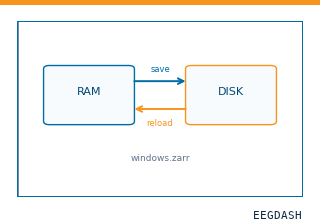 Save and reload prepared dataCache a windowed dataset to disk and reattach it without recompute.
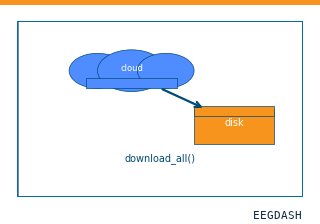 Download a dataset locallyPrefetch BIDS files to a local cache and validate the layout.
Swap any load_dataset(...) call for on000117 to reproduce the tutorial on this dataset.
Citation
Wakeman, DG, Henson, RN (2015). Multisubject, multimodal face processing. 10.82901/nemar.on000117
Provenance
¹Contributed to nemar in BIDS format.
²Curated & ingested by the EEGDash catalog; see CITATION.cff for canonical reference.
³Persistent identifier: 10.82901/nemar.on000117.
See Also#
eegdash.dataset.EEGDashDataseteegdash.dataset