


NM000395: ieeg dataset, 6 subjects#
Categorical processing of Chinese lexical tone: ECoG auditory oddball in 6 epilepsy patients (Si, Zhou & Hong 2017)
Access recordings and metadata through EEGDash.
Citation: Xiaopeng Si, Wenjing Zhou, Bo Hong (2017). Categorical processing of Chinese lexical tone: ECoG auditory oddball in 6 epilepsy patients (Si, Zhou & Hong 2017). 10.82901/nemar.nm000395
Modality: ieeg Subjects: 6 Recordings: 8 License: CC-BY-4.0 Source: nemar
Metadata: Complete (100%)
6-participant iEEG dataset — Categorical processing of Chinese lexical tone: ECoG auditory oddball in 6 epilepsy patients (Si, Zhou & Hong 2017).
Quickstart#
Install
pip install eegdash
Access the data
from eegdash.dataset import NM000395

dataset = NM000395(cache_dir="./data")
# Get the raw object of the first recording
raw = dataset.datasets[0].raw
print(raw.info)
Filter by subject
dataset = NM000395(cache_dir="./data", subject="01")
Advanced query
dataset = NM000395(
    cache_dir="./data",
    query={"subject": {"$in": ["01", "02"]}},
)
Iterate recordings
for rec in dataset:
    print(rec.subject, rec.raw.info['sfreq'])
If you use this dataset in your research, please cite the original authors.
BibTeX
@dataset{nm000395,
  title = {Categorical processing of Chinese lexical tone: ECoG auditory oddball in 6 epilepsy patients (Si, Zhou & Hong 2017)},
  author = {Xiaopeng Si and Wenjing Zhou and Bo Hong},
  doi = {10.82901/nemar.nm000395},
  url = {https://doi.org/10.82901/nemar.nm000395},
}
About This Dataset#
Electrocorticography (ECoG) from 6 patients with medically intractable epilepsy (S1-S6) listening passively to a
two-deviant auditory oddball sequence of Mandarin syllables, released with:
Si X, Zhou W, Hong B (2017). Cooperative cortical network for categorical processing of Chinese lexical tone. PNAS 114(46):12303-12308. https://doi.org/10.1073/pnas.1710752114
Categorical processing of Chinese lexical tone (ECoG, auditory oddball)
Source record: Zenodo https://doi.org/10.5281/zenodo.926082 (CC-BY-4.0, published 2017-10-19).
Task (from the paper)
A synthesized rising-level-falling (T2-T1-T4) tone continuum of the Mandarin syllable /i/ was built. In the ECoG experiment, token 5 (level tone T1) was the frequent standard; tokens 2 (rising, T2) and 8 (level, T1) were the
View full README
Categorical processing of Chinese lexical tone (ECoG, auditory oddball)
Source record: Zenodo https://doi.org/10.5281/zenodo.926082 (CC-BY-4.0, published 2017-10-19).
Task (from the paper)
A synthesized rising-level-falling (T2-T1-T4) tone continuum of the Mandarin syllable /i/ was built. In the ECoG experiment, token 5 (level tone T1) was the frequent standard; tokens 2 (rising, T2) and 8 (level, T1) were the infrequent deviants. Both deviants are the same physical distance from the standard, giving a cross-category pair (2 vs 5) and a within-category pair (8 vs 5). 500 trials (S6: 250), onset-to-onset interval 1100 ms with 5% jitter.
The patients watched a silent movie. Electrode placement was decided by clinical need only; no seizure occurred within 1 h before or after the test. The study was approved by the Ethics Committees of Yuquan Hospital, Tsinghua University, and patients gave written informed consent.
Data
sub-01…sub-06, tasktoneoddball. S2 and S5 were exported as two parts (run-1,run-2).EDF, 1200 Hz, 96 ECoG inputs + 6 trigger inputs per file, named by amplifier input (
Amp<k>-<n>,Amp<k>-trigger) as released. The mapping of inputs to electrode contacts is not part of the release.EDF prefilter field:
HP:0.1Hz LP:0Hz notch HP:48Hz LP:52Hz(hardware high-pass 0.1 Hz and 50 Hz notch).*_events.tsv: pulses of theAmp1-triggerchannel, decoded to digital codes (1, 2, 3; occasionally 255). The release does not document which code is which stimulus. Code 1 accounts for about 80% of pulses (the standard). The stimulus files are numbered01standard_flat_yi5,02deviant_cross_rise_yi2and03deviant_within_flat_yi8, which suggests codes 1/2/3 = standard / cross-category deviant / within-category deviant. This is our inference and is labelled as such intask-toneoddball_events.json.stimuli/: the release’s stimulus files, unchanged (stimuli_ECoG_MMN: the three oddball sounds;stimuli_BehaviorContinumm: the 13-step continuum used in the behavioural pre-test with healthy volunteers).
Changes from the release
EDF header start date: day set to 01 (year and month kept). No other byte of the EDF files changed (SHA-256 of the data sections of the source and BIDS files are equal; recorded in
sourcedata/zenodo-926082/b3w1_provenance.json). The EDF patient and recording fields are empty in the release.Not redistributed:
data_MRI.rar(FreeSurferorig.mgzT1 per patient) anddata_CT.rar(raw CT per patient). A surface render of these volumes shows reconstructable facial features, so they are left out; they remain available from the CC-BY-4.0 source record. The original.rararchives are also not copied because their member timestamps carry full recording dates.Age and sex are not in the release; since 2026-10-08
participants.tsvgives them from the article’s SI Table S2.
Licence
CC-BY-4.0, as the source record. Please cite the paper and the Zenodo record.
Additional metadata and localisation (added 2026-10-08)
Compiled after the upload from the article, its supplement and the source deposit (each statement names its source). Text and sidecar metadata only; no data file was changed. Recording system.**ECoG was recorded with a g.USBamp amplifier/digitizer system (g.tec, Graz, Austria) sampling at 1,200 Hz with a 0.1 Hz high-pass filter and a notch filter centred at 50 Hz harmonics (PNAS SI Appendix (pnas.201710752SI.pdf, via Europe PMC PMC5699060 supplementaryFiles), ‘ECoG Data Acquisition’). The EDF headers agree: every signal 1200 Hz, prefilter field ‘HP:0.1Hz LP:0Hz notch HP:48Hz LP:52Hz’, transducer ‘ECoG’, unit uV (EDF headers of data_ECoG/S1..S6/*.edf, read in Voyager Job ieeg-b3enr-c-si-tone-1007220742). **Reference scheme. Four inactive epidural electrodes were placed on the external surface of the skull with the contacts facing away from the skull and served as ground and reference (two as ground and two as reference, for redundancy) (PNAS SI Appendix (pnas.201710752SI.pdf, via Europe PMC PMC5699060 supplementaryFiles), ‘ECoG Data Acquisition’). Electrode types. Subdural surface grid electrodes; placement was determined solely by clinical need (doi:10.1073/pnas.1710752114, Methods ‘Subjects’; Fig. 3A). **Localisation method.**Presurgical T1 MRI (Philips Achieva 3.0T, MPRAGE, 0.9 x 0.9 x 1 mm, 180 slices) and post-implantation CT (Siemens SOMATOM Sensation 64) were acquired; the CT was aligned to the MRI with FreeSurfer/SPM mutual-information registration (error < 5 mm), and electrodes were classified by anatomical landmarks (STG, MTG, ITG, motor cortex, etc.) in each subject’s anatomical space (Fig. S4); for display, each MRI was coregistered to the FreeSurfer average brain (PNAS SI Appendix (pnas.201710752SI.pdf, via Europe PMC PMC5699060 supplementaryFiles), ‘MRI and CT Acquisition’, ‘Anatomical Location of Electrodes’). The deposit contains the MRI (data_MRI/S*_MRI_orig.mgz) and CT (data_CT/S*_CT_raw.nii) but no electrode coordinate or label file (https://zenodo.org/records/926082; listing of the extracted archives on Voyager).
Regions per participant (as published; no coordinates exist)
| participant | region (as stated) | hemisphere | contacts | source |
|---|---|---|---|---|
| S1 | Lt (left temporal) | left | n/a | doi:10.1073/pnas.1710752114, SI Table S2 (p. 4) |
| S1 | Lf (left frontal) | left | n/a | doi:10.1073/pnas.1710752114, SI Table S2 (p. 4) |
| S1 | Lp (left parietal) | left | n/a | doi:10.1073/pnas.1710752114, SI Table S2 (p. 4) |
| S2 | Lt (left temporal) | left | n/a | doi:10.1073/pnas.1710752114, SI Table S2 (p. 4) |
| S2 | Lf (left frontal) | left | n/a | doi:10.1073/pnas.1710752114, SI Table S2 (p. 4) |
| S2 | Lo (left occipital) | left | n/a | doi:10.1073/pnas.1710752114, SI Table S2 (p. 4) |
| S3 | Lt (left temporal) | left | n/a | doi:10.1073/pnas.1710752114, SI Table S2 (p. 4) |
| S3 | Lp (left parietal) | left | n/a | doi:10.1073/pnas.1710752114, SI Table S2 (p. 4) |
| S3 | Lo (left occipital) | left | n/a | doi:10.1073/pnas.1710752114, SI Table S2 (p. 4) |
| S4 | Rt (right temporal) | right | n/a | doi:10.1073/pnas.1710752114, SI Table S2 (p. 4) |
| S4 | Ro (right occipital) | right | n/a | doi:10.1073/pnas.1710752114, SI Table S2 (p. 4) |
| S5 | Rt (right temporal) | right | n/a | doi:10.1073/pnas.1710752114, SI Table S2 (p. 4) |
| S5 | Rf (right frontal) | right | n/a | doi:10.1073/pnas.1710752114, SI Table S2 (p. 4) |
| S5 | Rp (right parietal) | right | n/a | doi:10.1073/pnas.1710752114, SI Table S2 (p. 4) |
| S6 | Rt (right temporal) | right | n/a | doi:10.1073/pnas.1710752114, SI Table S2 (p. 4) |
| S6 | Rf (right frontal) | right | n/a | doi:10.1073/pnas.1710752114, SI Table S2 (p. 4) |
| S6 | Rp (right parietal) | right | n/a | doi:10.1073/pnas.1710752114, SI Table S2 (p. 4) |
NEMAR Metadata#
[](https://doi.org/10.82901/nemar.nm000395) # Categorical processing of Chinese lexical tone (ECoG, auditory oddball) Electrocorticography (ECoG) from 6 patients with medically intractable epilepsy (S1-S6) listening passively to a two-deviant auditory oddball sequence of Mandarin syllables, released with: > Si X, Zhou W, Hong B (2017). Cooperative cortical network for categorical processing of Chinese lexical tone. > PNAS 114(46):12303-12308. https://doi.org/10.1073/pnas.1710752114 Source record: Zenodo https://doi.org/10.5281/zenodo.926082 (CC-BY-4.0, published 2017-10-19). ## Task (from the paper) A synthesized rising-level-falling (T2-T1-T4) tone continuum of the Mandarin syllable /i/ was built. In the ECoG experiment, token 5 (level tone T1) was the frequent standard; tokens 2 (rising, T2) and 8 (level, T1) were the infrequent deviants. Both deviants are the same physical distance from the standard, giving a cross-category pair (2 vs 5) and a within-category pair (8 vs 5). 500 trials (S6: 250), onset-to-onset interval 1100 ms with 5% jitter. The patients watched a silent movie. Electrode placement was decided by clinical need only; no seizure occurred within 1 h before or after the test. The study was approved by the Ethics Committees of Yuquan Hospital, Tsinghua University, and patients gave written informed consent. ## Data - sub-01 … sub-06, task toneoddball. S2 and S5 were exported as two parts (run-1, run-2). - EDF, 1200 Hz, 96 ECoG inputs + 6 trigger inputs per file, named by amplifier input (Amp<k>-<n>,
Amp<k>-trigger) as released. The mapping of inputs to electrode contacts is not part of the release.
EDF prefilter field: HP:0.1Hz LP:0Hz notch HP:48Hz LP:52Hz (hardware high-pass 0.1 Hz and 50 Hz notch).
*_events.tsv: pulses of the Amp1-trigger channel, decoded to digital codes (1, 2, 3; occasionally 255). The release does not document which code is which stimulus. Code 1 accounts for about 80% of pulses (the standard). The stimulus files are numbered 01standard_flat_yi5, 02deviant_cross_rise_yi2 and 03deviant_within_flat_yi8, which suggests codes 1/2/3 = standard / cross-category deviant / within-category deviant. This is our inference and is labelled as such in task-toneoddball_events.json.
stimuli/: the release’s stimulus files, unchanged (stimuli_ECoG_MMN: the three oddball sounds; stimuli_BehaviorContinumm: the 13-step continuum used in the behavioural pre-test with healthy volunteers).
## Changes from the release - EDF header start date: day set to 01 (year and month kept). No other byte of the EDF files changed (SHA-256 of
the data sections of the source and BIDS files are equal; recorded in sourcedata/zenodo-926082/b3w1_provenance.json). The EDF patient and recording fields are empty in the release.
Not redistributed: data_MRI.rar (FreeSurfer orig.mgz T1 per patient) and data_CT.rar (raw CT per patient). A surface render of these volumes shows reconstructable facial features, so they are left out; they remain available from the CC-BY-4.0 source record. The original .rar archives are also not copied because their member timestamps carry full recording dates.
Age and sex are not in the release; since 2026-10-08 participants.tsv gives them from the article’s SI Table S2.
## Licence CC-BY-4.0, as the source record. Please cite the paper and the Zenodo record. ## Additional metadata and localisation (added 2026-10-08) Compiled after the upload from the article, its supplement and the source deposit (each statement names its source). Text and sidecar metadata only; no data file was changed. Recording system. ECoG was recorded with a g.USBamp amplifier/digitizer system (g.tec, Graz, Austria) sampling at 1,200 Hz with a 0.1 Hz high-pass filter and a notch filter centred at 50 Hz harmonics (PNAS SI Appendix (pnas.201710752SI.pdf, via Europe PMC PMC5699060 supplementaryFiles), ‘ECoG Data Acquisition’). The EDF headers agree: every signal 1200 Hz, prefilter field ‘HP:0.1Hz LP:0Hz notch HP:48Hz LP:52Hz’, transducer ‘ECoG’, unit uV (EDF headers of data_ECoG/S1..S6/.edf, read in Voyager Job ieeg-b3enr-c-si-tone-1007220742). **Reference scheme.* Four inactive epidural electrodes were placed on the external surface of the skull with the contacts facing away from the skull and served as ground and reference (two as ground and two as reference, for redundancy) (PNAS SI Appendix (pnas.201710752SI.pdf, via Europe PMC PMC5699060 supplementaryFiles), ‘ECoG Data Acquisition’). Electrode types. Subdural surface grid electrodes; placement was determined solely by clinical need (doi:10.1073/pnas.1710752114, Methods ‘Subjects’; Fig. 3A). Localisation method. Presurgical T1 MRI (Philips Achieva 3.0T, MPRAGE, 0.9 x 0.9 x 1 mm, 180 slices) and post-implantation CT (Siemens SOMATOM Sensation 64) were acquired; the CT was aligned to the MRI with FreeSurfer/SPM mutual-information registration (error < 5 mm), and electrodes were classified by anatomical landmarks (STG, MTG, ITG, motor cortex, etc.) in each subject’s anatomical space (Fig. S4); for display, each MRI was coregistered to the FreeSurfer average brain (PNAS SI Appendix (pnas.201710752SI.pdf, via Europe PMC PMC5699060 supplementaryFiles), ‘MRI and CT Acquisition’, ‘Anatomical Location of Electrodes’). The deposit contains the MRI (data_MRI/S*_MRI_orig.mgz) and CT (data_CT/S*_CT_raw.nii) but no electrode coordinate or label file (https://zenodo.org/records/926082; listing of the extracted archives on Voyager). ### Regions per participant (as published; no coordinates exist) | participant | region (as stated) | hemisphere | contacts | source | |---|—|---|—|---| | S1 | Lt (left temporal) | left | n/a | doi:10.1073/pnas.1710752114, SI Table S2 (p. 4) | | S1 | Lf (left frontal) | left | n/a | doi:10.1073/pnas.1710752114, SI Table S2 (p. 4) | | S1 | Lp (left parietal) | left | n/a | doi:10.1073/pnas.1710752114, SI Table S2 (p. 4) | | S2 | Lt (left temporal) | left | n/a | doi:10.1073/pnas.1710752114, SI Table S2 (p. 4) | | S2 | Lf (left frontal) | left | n/a | doi:10.1073/pnas.1710752114, SI Table S2 (p. 4) | | S2 | Lo (left occipital) | left | n/a | doi:10.1073/pnas.1710752114, SI Table S2 (p. 4) | | S3 | Lt (left temporal) | left | n/a | doi:10.1073/pnas.1710752114, SI Table S2 (p. 4) | | S3 | Lp (left parietal) | left | n/a | doi:10.1073/pnas.1710752114, SI Table S2 (p. 4) | | S3 | Lo (left occipital) | left | n/a | doi:10.1073/pnas.1710752114, SI Table S2 (p. 4) | | S4 | Rt (right temporal) | right | n/a | doi:10.1073/pnas.1710752114, SI Table S2 (p. 4) | | S4 | Ro (right occipital) | right | n/a | doi:10.1073/pnas.1710752114, SI Table S2 (p. 4) | | S5 | Rt (right temporal) | right | n/a | doi:10.1073/pnas.1710752114, SI Table S2 (p. 4) | | S5 | Rf (right frontal) | right | n/a | doi:10.1073/pnas.1710752114, SI Table S2 (p. 4) | | S5 | Rp (right parietal) | right | n/a | doi:10.1073/pnas.1710752114, SI Table S2 (p. 4) | | S6 | Rt (right temporal) | right | n/a | doi:10.1073/pnas.1710752114, SI Table S2 (p. 4) | | S6 | Rf (right frontal) | right | n/a | doi:10.1073/pnas.1710752114, SI Table S2 (p. 4) | | S6 | Rp (right parietal) | right | n/a | doi:10.1073/pnas.1710752114, SI Table S2 (p. 4) |
License: CC-BY-4.0
Authors:
Xiaopeng Si
Wenjing Zhou
Bo Hong
Versions:
Version |
DOI |
Released |
|---|---|---|
|
Cohort#
Dataset Statistics#
Age distribution by gender (n=6, range 22–48 yr, mean 30.3 yr)
Sex composition
Channel counts: 102 ch (n=8 recordings)
Sampling frequencies: 1200.0 Hz (n=8 recordings)
Total recording duration: 1 h 11 min
Signal · Electrodes & live trace#
Live trace viewer — sub-01 · task-toneoddball
Showing one representative recording out of
6 subjects and 8 recordings in this dataset.
Browse the full set on OpenNeuro;
drop any other _ieeg.{set,edf,bdf,vhdr} file onto the
viewer (or pass ?ieeg=<url>) to inspect it.
No scalp electrode layout is currently indexed for this dataset. Once the eegdash montage registry ingests it, the interactive viewer will appear here automatically.
NEMAR Processing Statistics#
The plots below are generated by NEMAR’s automated EEG pipeline. The histogram shows pipeline success for data cleaning and ICA decomposition, the percentage of data frames and EEG channels retained after artefact removal, line noise per channel (RMS, dB), and the age/gender distribution of participants.

HED event descriptors word cloud

Manifest#
File Explorer#
Browse the BIDS file structure of this dataset. Records are fetched on demand from the EEGDash catalog the first time you open the explorer.
Full dataset metadata table
Dataset ID |
|
Title |
Categorical processing of Chinese lexical tone: ECoG auditory oddball in 6 epilepsy patients (Si, Zhou & Hong 2017) |
Author (year) |
— |
Canonical |
— |
Importable as |
|
Year |
2017 |
Authors |
Xiaopeng Si, Wenjing Zhou, Bo Hong |
License |
CC-BY-4.0 |
Citation / DOI |
|
Source links |
OpenNeuro | NeMAR | Source URL |
Copy-paste BibTeX
@dataset{nm000395,
  title = {Categorical processing of Chinese lexical tone: ECoG auditory oddball in 6 epilepsy patients (Si, Zhou & Hong 2017)},
  author = {Xiaopeng Si and Wenjing Zhou and Bo Hong},
  doi = {10.82901/nemar.nm000395},
  url = {https://doi.org/10.82901/nemar.nm000395},
}
API Reference#
eegdash.datasetEEGDashDataset- class eegdash.dataset.NM000395(cache_dir: str, query: dict | None = None, s3_bucket: str | None = None, **kwargs)[source]#
Categorical processing of Chinese lexical tone: ECoG auditory oddball in 6 epilepsy patients (Si, Zhou & Hong 2017)
- Study:
nm000395(NeMAR)- Author (year):
—
- Canonical:
—
Also importable as:
NM000395.Modality:
ieeg; Subject type:Unknown. Subjects: 6; recordings: 8; tasks: 1.- Parameters:
cache_dir (str | Path) – Directory where data are cached locally.
query (dict | None) – Additional MongoDB-style filters to AND with the dataset selection. Must not contain the key
dataset.s3_bucket (str | None) – Base S3 bucket used to locate the data.
**kwargs (dict) – Additional keyword arguments forwarded to
EEGDashDataset.
- data_dir#
Local dataset cache directory (
cache_dir / dataset_id).- Type:
Path
Notes
Each item is a recording; recording-level metadata are available via
dataset.description.querysupports MongoDB-style filters on fields inALLOWED_QUERY_FIELDSand is combined with the dataset filter. Dataset-specific caveats are not provided in the summary metadata.References
OpenNeuro dataset: https://openneuro.org/datasets/nm000395 NeMAR dataset: https://nemar.org/dataexplorer/detail?dataset_id=nm000395 DOI: https://doi.org/10.82901/nemar.nm000395
Examples
>>> from eegdash.dataset import NM000395
>>> dataset = NM000395(cache_dir="./data")
>>> recording = dataset[0]
>>> raw = recording.load()
- __init__(cache_dir: str, query: dict | None = None, s3_bucket: str | None = None, **kwargs)[source]#
- save(path: str, overwrite: bool = False, offset: int = 0)[source]#
Save datasets to files by creating one subdirectory for each dataset:
path/
    0/
        0-raw.fif | 0-epo.fif
        description.json
        raw_preproc_kwargs.json (if raws were preprocessed)
        window_kwargs.json (if this is a windowed dataset)
        window_preproc_kwargs.json  (if windows were preprocessed)
        target_name.json (if target_name is not None and dataset is raw)
    1/
        1-raw.fif | 1-epo.fif
        description.json
        raw_preproc_kwargs.json (if raws were preprocessed)
        window_kwargs.json (if this is a windowed dataset)
        window_preproc_kwargs.json  (if windows were preprocessed)
        target_name.json (if target_name is not None and dataset is raw)
- Parameters:
path (str) –
- Directory in which subdirectories are created to store
-raw.fif | -epo.fif and .json files to.
overwrite (bool) – Whether to delete old subdirectories that will be saved to in this call.
offset (int) – If provided, the integer is added to the id of the dataset in the concat. This is useful in the setting of very large datasets, where one dataset has to be processed and saved at a time to account for its original position.
BaseDataset from braindecode — windowed via create_windows_from_events.braindecodeDataLoader; supports parallel workers and on-the-fly augmentations.pytorch Find datasets with the EEGDash APIQuery the catalogue, filter by task or modality, list candidates.
 Load one EEG recordingResolve a single record to an MNE Raw with channels and events.
 EEG recording to PyTorch DataLoaderWrap braindecode windows in a DataLoader for model training.
 Preprocess EEG and create windowsFilter, resample, epoch — and persist the windowed dataset.
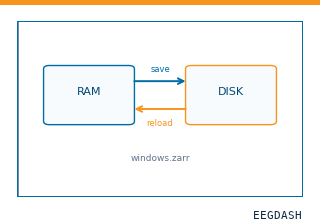 Save and reload prepared dataCache a windowed dataset to disk and reattach it without recompute.
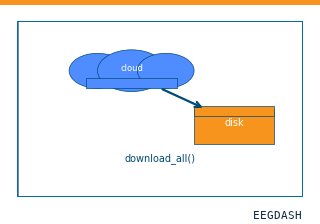 Download a dataset locallyPrefetch BIDS files to a local cache and validate the layout.
Swap any load_dataset(...) call for nm000395 to reproduce the tutorial on this dataset.
Citation
Xiaopeng Si, Wenjing Zhou, Bo Hong (2017). Categorical processing of Chinese lexical tone: ECoG auditory oddball in 6 epilepsy patients (Si, Zhou & Hong 2017). 10.82901/nemar.nm000395
Provenance
¹Contributed to nemar in BIDS format.
²Curated & ingested by the EEGDash catalog; see CITATION.cff for canonical reference.
³Persistent identifier: 10.82901/nemar.nm000395.
See Also#
eegdash.dataset.EEGDashDataseteegdash.dataset