


NM000275: eeg dataset, 27 subjects#
Multi-channel EEG recordings during a sustained-attention driving task
Access recordings and metadata through EEGDash.
Citation: Zehong Cao, Chun-Hsiang Chuang, Jung-Kai King, Chin-Teng Lin (2019). Multi-channel EEG recordings during a sustained-attention driving task. 10.82901/nemar.nm000275
Modality: eeg Subjects: 27 Recordings: 62 License: CC-BY-4.0 Source: nemar
Metadata: Complete (100%)
27-participant EEG dataset — Multi-channel EEG recordings during a sustained-attention driving task.
Quickstart#
Install
pip install eegdash
Access the data
from eegdash.dataset import NM000275

dataset = NM000275(cache_dir="./data")
# Get the raw object of the first recording
raw = dataset.datasets[0].raw
print(raw.info)
Filter by subject
dataset = NM000275(cache_dir="./data", subject="01")
Advanced query
dataset = NM000275(
    cache_dir="./data",
    query={"subject": {"$in": ["01", "02"]}},
)
Iterate recordings
for rec in dataset:
    print(rec.subject, rec.raw.info['sfreq'])
If you use this dataset in your research, please cite the original authors.
BibTeX
@dataset{nm000275,
  title = {Multi-channel EEG recordings during a sustained-attention driving task},
  author = {Zehong Cao and Chun-Hsiang Chuang and Jung-Kai King and Chin-Teng Lin},
  doi = {10.82901/nemar.nm000275},
  url = {https://doi.org/10.82901/nemar.nm000275},
}
About This Dataset#
BIDS-EEG conversion of the raw dataset from:
Cao, Z., Chuang, C.-H., King, J.-K. & Lin, C.-T. (2019). Multi-channel EEG recordings during a sustained-attention driving task. Scientific Data 6, 19. https://doi.org/10.1038/s41597-019-0027-4
Multi-channel EEG recordings during a sustained-attention driving task
Original data (CC BY 4.0): figshare https://doi.org/10.6084/m9.figshare.6427334.v5 (raw), https://doi.org/10.6084/m9.figshare.7666055.v3 (pre-processed). Open-access full text: PMC6472414.
Dataset at a glance
View full README
Multi-channel EEG recordings during a sustained-attention driving task
Original data (CC BY 4.0): figshare https://doi.org/10.6084/m9.figshare.6427334.v5 (raw), https://doi.org/10.6084/m9.figshare.7666055.v3 (pre-processed). Open-access full text: PMC6472414.
Dataset at a glance
| Property | Value |
|---|---|
| Modality | EEG (`eeg`) |
| Task | `driving` (event-related lane-departure, sustained attention) |
| Participants | 27 healthy adults (aged 22-28) |
| Sessions (recordings) | 62 |
| Total recording time | ~82 hours (per-session ~41-118 min) |
| Channels | 32 EEG (30 scalp + A1/A2 mastoid refs) + 1 `vehicle_position` (misc) |
| Sampling rate | 500 Hz, 16-bit |
| Lane-departure (deviation) trials | 27192 total |
| Event markers | 251/252 deviation L/R, 253 response onset, 254 response offset (+ undocumented 255 in 2 recordings) |
| Data format | EEGLAB `.set` (BIDS-EEG) |
| Electrode positions | nominal 10-20 template (not individually measured) |
| License | CC BY 4.0 |
| BIDS version | 1.9.0 |
Authors and affiliations
Zehong Cao (ORCID 0000-0003-3656-0328) - Discipline of ICT, School of Technology, Environments and Design, University of Tasmania, Hobart, TAS, Australia
Chun-Hsiang Chuang - Department of Computer Science and Engineering, National Taiwan Ocean University, Keelung, Taiwan
Jung-Kai King - Brain Research Center, National Chiao Tung University, Hsinchu, Taiwan
Chin-Teng Lin - Centre for Artificial Intelligence, Faculty of Engineering and IT, University of Technology Sydney, Sydney, NSW, Australia
Overview
27 participants (students/staff of National Chiao Tung University, aged 22-28, normal or corrected-to-normal vision, all holding a valid driver’s licence and with no history of psychological/neurological disorders or drug use) performed a sustained-attention driving task (designed for ~90 minutes), at one or more sessions on the same or different days, yielding **62 EEG sessions**. Actual recording durations vary (~41-118 min; median ~70 min).
Recordings were collected between 2005 and 2012. Participants received ~USD $20 per session and completed a pre-test session to rule out simulator sickness.
Task: event-related lane-departure paradigm
A virtual-reality (VR) dynamic driving simulator (built with WorldToolKit R9 and
Visual C++) was mounted on a six-degree-of-freedom Stewart motion platform, with
a real Ford Probe car frame and six projected scenes giving a near-360-degree
field of view. Participants drove a visually monotonous night-time straight
four-lane divided highway with no other traffic at a constant 100 km/h, keeping
the car centred in the third lane. Road position was quantised to 0-255 (lane
width 60 units). Lane-departure events were randomly induced with equal
probability to the left or right (deviation onset); the participant
counter-steered (response onset) to bring the car back to the lane centre
(response offset), using the steering wheel only (no accelerator/brake). The
next trial began 5-10 s after the previous one. The interval from deviation
onset to response onset is the reaction time (RT), an index of fatigue and
drowsiness. The task was designed to run ~90 minutes without breaks; the actual
recorded duration varies by session (see the glance table and each
sub-XX_sessions.tsv).
Acquisition
Amplifier: Compumedics Neuroscan Scan SynAmps2 Express system (Compumedics Ltd., VIC, Australia). NOTE: the source paper inconsistently also refers to a “Scan NuAmps Express” system in one section.
Cap: 32-channel Quik-Cap (Compumedics NeuroScan), Ag/AgCl electrodes.
Acquisition software: Neuroscan Scan 4.5 (raw saved originally as .cnt).
Sampling rate: 500 Hz; 16-bit quantisation.
Electrodes: 30 scalp EEG electrodes (modified international 10-20 system) plus 2 mastoid reference electrodes (A1, A2). Electrode-skin impedance kept < 5 kOhm (NaCl conductive Quik-Gel; Nuprep + 70% isopropyl-alcohol skin prep).
Power-line frequency: 60 Hz (Taiwan).
Channel order (32 EEG): FP1, FP2, F7, F3, FZ, F4, F8, FT7, FC3, FCZ, FC4, FT8, T3, C3, CZ, C4, T4, TP7, CP3, CPZ, CP4, TP8, A1, T5, P3, PZ, P4, T6, A2, O1, OZ, O2. Classic names map to modern ones as T3/T4/T5/T6 = T7/T8/P7/P8.
A 33rd channel,
vehicle_position(BIDS typemisc), stores the simulated car’s lateral position (quantised 0-255) sampled with the EEG at 500 Hz. In the source files it is literally named “vehicle position”; the space was replaced by an underscore for BIDS.
Electrode positions
The source recordings did not include measured electrode coordinates. For
convenience, each recording carries nominal 10-20 template positions (MNE
standard_1020) under the original channel names, written to
*_electrodes.tsv / *_coordsystem.json. These are idealised, identical across
all recordings, and are not individually measured - treat them as
approximate only.
Events
Each *_events.tsv has trial_type (descriptive label) and value (original
integer trigger):
| value | trial_type             | meaning                                          |
|-------|------------------------|--------------------------------------------------|
| 251   | deviation_onset_left   | car drift induced toward the left                |
| 252   | deviation_onset_right  | car drift induced toward the right               |
| 253   | response_onset         | subject starts steering back toward lane centre  |
| 254   | response_offset        | subject finishes steering; car back at centre    |
| 255   | undocumented_255       | extra trigger in sub-54 & sub-55 only (21x); not defined in the source publication, meaning unknown |
Subjects and sessions
Subject labels preserve the original numbering (sub-01 = original s01), so
numbering is non-consecutive. Sessions ses-01, ses-02, … are ordered
chronologically per subject. sub-XX/sub-XX_sessions.tsv maps each session to
the original recording file name, acquisition date, and the original one-letter
filename suffix (m/n) - an opaque label from the source naming whose meaning
is not defined in the original publication.
Relationship to the pre-processed dataset
A separately published pre-processed version (https://doi.org/10.6084/m9.figshare.7666055.v3) applied a 1-Hz high-pass and 50-Hz low-pass FIR filter and removed ocular/muscular artefacts (manual eye-blink rejection + the EEGLAB AAR plug-in). This BIDS dataset contains the raw, unfiltered recordings.
Related publications using this dataset
Loading the data (Python / MNE)
import mne
from mne_bids import BIDSPath, read_raw_bids
bp = BIDSPath(subject="01", session="01", task="driving",
              datatype="eeg", root="/path/to/this/dataset")

raw = read_raw_bids(bp)          # mne Raw with events as annotations
print(raw.info)                  # 32 EEG + vehicle_position (misc), 500 Hz
events, event_id = mne.events_from_annotations(raw)
The vehicle_position channel (type misc) holds the simulated car’s lateral
position (quantised 0-255) and can be epoched alongside the EEG to recover the
steering trajectory and verify reaction times.
Validation
This dataset passes the official bids-validator (Deno schema validator,
v1.15.0+) with **0 errors**. One non-blocking warning remains
(MISSING_SESSION): participants intentionally have different numbers of
sessions (1-5), which is an inherent property of the original study design, not
an error.
Differences from the original figshare release
This is a faithful BIDS repackaging of the raw recordings; signal values and event latencies are unchanged. The following organisational changes were made: - Files renamed to BIDS entities; original names are preserved in each
sub-XX/sub-XX_sessions.tsv(original_filename).
Subject labels keep the original numbers (
sub-01=s01), so they are non-consecutive (no s03, s07, s08, s10, …).The behavioural channel “vehicle position” was renamed
vehicle_position(space -> underscore) and typedmisc.Numeric event codes were given descriptive
trial_typelabels while the original integer code is retained in thevaluecolumn.Nominal 10-20 template electrode coordinates were added (the source provided none); they are documented as template-only in
*_coordsystem.json.Metadata was enriched from the source paper and its ISA-Tab record (equipment, task, ethics, funding, references).
License
Released under CC BY 4.0 (see the LICENSE file), matching the original
data record and publication. When you use these data, please cite the original
Data Descriptor (see “How to acknowledge” / dataset_description.json).
Provenance / source data
sourcedata/ holds the exact materials used for this conversion:
- meta/esm_extracted/ - ISA-Tab study metadata (Springer ESM, CC0).
- meta/pmc_* - open-access full text (PMC6472414) + BioC.
- meta/crossref_article.json, meta/datacite_* - citation metadata.
- meta/figshare_* - figshare API records (file manifests + checksums).
- raw/manifest.tsv, raw/md5sums.txt, raw/download_progress.log - download
manifest, checksums, and verified-download log (all files md5-checked).
raw/*.set- original EEGLAB files;raw/code availability.zipand the tutorial PDF as provided on figshare.
NEMAR Metadata#
[](https://doi.org/10.82901/nemar.nm000275) # Multi-channel EEG recordings during a sustained-attention driving task BIDS-EEG conversion of the raw dataset from: > Cao, Z., Chuang, C.-H., King, J.-K. & Lin, C.-T. (2019). > Multi-channel EEG recordings during a sustained-attention driving task. > Scientific Data 6, 19. https://doi.org/10.1038/s41597-019-0027-4 Original data (CC BY 4.0): figshare https://doi.org/10.6084/m9.figshare.6427334.v5 (raw), https://doi.org/10.6084/m9.figshare.7666055.v3 (pre-processed). Open-access full text: PMC6472414. ## Dataset at a glance | Property | Value | |---|—| | Modality | EEG (eeg) | | Task | driving (event-related lane-departure, sustained attention) | | Participants | 27 healthy adults (aged 22-28) | | Sessions (recordings) | 62 | | Total recording time | ~82 hours (per-session ~41-118 min) | | Channels | 32 EEG (30 scalp + A1/A2 mastoid refs) + 1 vehicle_position (misc) | | Sampling rate | 500 Hz, 16-bit | | Lane-departure (deviation) trials | 27192 total | | Event markers | 251/252 deviation L/R, 253 response onset, 254 response offset (+ undocumented 255 in 2 recordings) | | Data format | EEGLAB .set (BIDS-EEG) | | Electrode positions | nominal 10-20 template (not individually measured) | | License | CC BY 4.0 | | BIDS version | 1.9.0 | ## Authors and affiliations 1. Zehong Cao (ORCID 0000-0003-3656-0328) - Discipline of ICT, School of Technology, Environments and Design, University of Tasmania, Hobart, TAS, Australia 2. Chun-Hsiang Chuang - Department of Computer Science and Engineering, National Taiwan Ocean University, Keelung, Taiwan 3. Jung-Kai King - Brain Research Center, National Chiao Tung University, Hsinchu, Taiwan 4. Chin-Teng Lin - Centre for Artificial Intelligence, Faculty of Engineering and IT, University of Technology Sydney, Sydney, NSW, Australia ## Overview 27 participants (students/staff of National Chiao Tung University, aged 22-28, normal or corrected-to-normal vision, all holding a valid driver’s licence and with no history of psychological/neurological disorders or drug use) performed a sustained-attention driving task (designed for ~90 minutes), at one or more sessions on the same or different days, yielding 62 EEG sessions. Actual recording durations vary (~41-118 min; median ~70 min). Recordings were collected between 2005 and 2012. Participants received ~USD $20 per session and completed a pre-test session to rule out simulator sickness. ### Task: event-related lane-departure paradigm A virtual-reality (VR) dynamic driving simulator (built with WorldToolKit R9 and Visual C++) was mounted on a six-degree-of-freedom Stewart motion platform, with a real Ford Probe car frame and six projected scenes giving a near-360-degree field of view. Participants drove a visually monotonous night-time straight four-lane divided highway with no other traffic at a constant 100 km/h, keeping the car centred in the third lane. Road position was quantised to 0-255 (lane width 60 units). Lane-departure events were randomly induced with equal probability to the left or right (deviation onset); the participant counter-steered (response onset) to bring the car back to the lane centre (response offset), using the steering wheel only (no accelerator/brake). The next trial began 5-10 s after the previous one. The interval from deviation onset to response onset is the reaction time (RT), an index of fatigue and drowsiness. The task was designed to run ~90 minutes without breaks; the actual recorded duration varies by session (see the glance table and each sub-XX_sessions.tsv). ## Acquisition - Amplifier: Compumedics Neuroscan Scan SynAmps2 Express system (Compumedics
Ltd., VIC, Australia). NOTE: the source paper inconsistently also refers to a “Scan NuAmps Express” system in one section.
Cap: 32-channel Quik-Cap (Compumedics NeuroScan), Ag/AgCl electrodes.
Acquisition software: Neuroscan Scan 4.5 (raw saved originally as .cnt).
Sampling rate: 500 Hz; 16-bit quantisation.
Electrodes: 30 scalp EEG electrodes (modified international 10-20 system) plus 2 mastoid reference electrodes (A1, A2). Electrode-skin impedance kept < 5 kOhm (NaCl conductive Quik-Gel; Nuprep + 70% isopropyl-alcohol skin prep).
Power-line frequency: 60 Hz (Taiwan).
Channel order (32 EEG): FP1, FP2, F7, F3, FZ, F4, F8, FT7, FC3, FCZ, FC4, FT8, T3, C3, CZ, C4, T4, TP7, CP3, CPZ, CP4, TP8, A1, T5, P3, PZ, P4, T6, A2, O1, OZ, O2. Classic names map to modern ones as T3/T4/T5/T6 = T7/T8/P7/P8.
A 33rd channel, vehicle_position (BIDS type misc), stores the simulated car’s lateral position (quantised 0-255) sampled with the EEG at 500 Hz. In the source files it is literally named “vehicle position”; the space was replaced by an underscore for BIDS.
### Electrode positions The source recordings did not include measured electrode coordinates. For convenience, each recording carries nominal 10-20 template positions (MNE standard_1020) under the original channel names, written to *_electrodes.tsv / *_coordsystem.json. These are idealised, identical across all recordings, and are not individually measured - treat them as approximate only. ## Events Each *_events.tsv has trial_type (descriptive label) and value (original integer trigger): | value | trial_type | meaning | |-------|————————|--------------------------------------------------| | 251 | deviation_onset_left | car drift induced toward the left | | 252 | deviation_onset_right | car drift induced toward the right | | 253 | response_onset | subject starts steering back toward lane centre | | 254 | response_offset | subject finishes steering; car back at centre | | 255 | undocumented_255 | extra trigger in sub-54 & sub-55 only (21x); not defined in the source publication, meaning unknown | ## Subjects and sessions Subject labels preserve the original numbering (sub-01 = original s01), so numbering is non-consecutive. Sessions ses-01, ses-02, … are ordered chronologically per subject. sub-XX/sub-XX_sessions.tsv maps each session to the original recording file name, acquisition date, and the original one-letter filename suffix (m/n) - an opaque label from the source naming whose meaning is not defined in the original publication. ## Relationship to the pre-processed dataset A separately published pre-processed version (https://doi.org/10.6084/m9.figshare.7666055.v3) applied a 1-Hz high-pass and 50-Hz low-pass FIR filter and removed ocular/muscular artefacts (manual eye-blink rejection + the EEGLAB AAR plug-in). This BIDS dataset contains the raw, unfiltered recordings. ## Related publications using this dataset - https://doi.org/10.1016/j.neuroimage.2014.01.015 - https://doi.org/10.1038/srep21353 - https://doi.org/10.1109/TBCAS.2014.2316224 - https://doi.org/10.1109/TNNLS.2013.2275003 - https://doi.org/10.1016/j.knosys.2015.01.007 - https://doi.org/10.1109/TNNLS.2015.2496330 - https://doi.org/10.1109/TFUZZ.2016.2633379 ## Loading the data (Python / MNE) ```python import mne from mne_bids import BIDSPath, read_raw_bids bp = BIDSPath(subject=”01”, session=”01”, task=”driving”,
datatype=”eeg”, root=”/path/to/this/dataset”)
raw = read_raw_bids(bp) # mne Raw with events as annotations print(raw.info) # 32 EEG + vehicle_position (misc), 500 Hz events, event_id = mne.events_from_annotations(raw) ``` The vehicle_position channel (type misc) holds the simulated car’s lateral position (quantised 0-255) and can be epoched alongside the EEG to recover the steering trajectory and verify reaction times. ## Validation This dataset passes the official bids-validator (Deno schema validator, v1.15.0+) with 0 errors. One non-blocking warning remains (MISSING_SESSION): participants intentionally have different numbers of sessions (1-5), which is an inherent property of the original study design, not an error. ## Differences from the original figshare release This is a faithful BIDS repackaging of the raw recordings; signal values and event latencies are unchanged. The following organisational changes were made: - Files renamed to BIDS entities; original names are preserved in each
sub-XX/sub-XX_sessions.tsv (original_filename).
Subject labels keep the original numbers (sub-01 = s01), so they are non-consecutive (no s03, s07, s08, s10, …).
The behavioural channel “vehicle position” was renamed vehicle_position (space -> underscore) and typed misc.
Numeric event codes were given descriptive trial_type labels while the original integer code is retained in the value column.
Nominal 10-20 template electrode coordinates were added (the source provided none); they are documented as template-only in *_coordsystem.json.
Metadata was enriched from the source paper and its ISA-Tab record (equipment, task, ethics, funding, references).
## License Released under CC BY 4.0 (see the LICENSE file), matching the original data record and publication. When you use these data, please cite the original Data Descriptor (see “How to acknowledge” / dataset_description.json). ## Provenance / source data sourcedata/ holds the exact materials used for this conversion: - meta/esm_extracted/ - ISA-Tab study metadata (Springer ESM, CC0). - meta/pmc_* - open-access full text (PMC6472414) + BioC. - meta/crossref_article.json, meta/datacite_* - citation metadata. - meta/figshare_* - figshare API records (file manifests + checksums). - raw/manifest.tsv, raw/md5sums.txt, raw/download_progress.log - download
manifest, checksums, and verified-download log (all files md5-checked).
raw/*.set - original EEGLAB files; raw/code availability.zip and the tutorial PDF as provided on figshare.
License: CC-BY-4.0
Authors:
Zehong Cao
Chun-Hsiang Chuang
Jung-Kai King
Chin-Teng Lin
Versions:
Version |
DOI |
Released |
|---|---|---|
|
Cohort#
Dataset Statistics#
Channel counts: 33 ch (n=62 recordings)
Sampling frequencies: 500.0 Hz (n=62 recordings)
Total recording duration: 81 h
Signal · Electrodes & live trace#
Live trace viewer — sub-01 · ses-01 · task-driving
Showing one representative recording out of
27 subjects and 62 recordings in this dataset.
Browse the full set on OpenNeuro;
drop any other _eeg.{set,edf,bdf,vhdr} file onto the
viewer (or pass ?eeg=<url>) to inspect it.
Electrode layout — EEG · 30 sensors — 30 channels
NEMAR Processing Statistics#
The plots below are generated by NEMAR’s automated EEG pipeline. The histogram shows pipeline success for data cleaning and ICA decomposition, the percentage of data frames and EEG channels retained after artefact removal, line noise per channel (RMS, dB), and the age/gender distribution of participants.

HED event descriptors word cloud

Manifest#
File Explorer#
Browse the BIDS file structure of this dataset. Records are fetched on demand from the EEGDash catalog the first time you open the explorer.
Full dataset metadata table
Dataset ID |
|
Title |
Multi-channel EEG recordings during a sustained-attention driving task |
Author (year) |
— |
Canonical |
— |
Importable as |
|
Year |
2019 |
Authors |
Zehong Cao, Chun-Hsiang Chuang, Jung-Kai King, Chin-Teng Lin |
License |
CC-BY-4.0 |
Citation / DOI |
|
Source links |
OpenNeuro | NeMAR | Source URL |
Copy-paste BibTeX
@dataset{nm000275,
  title = {Multi-channel EEG recordings during a sustained-attention driving task},
  author = {Zehong Cao and Chun-Hsiang Chuang and Jung-Kai King and Chin-Teng Lin},
  doi = {10.82901/nemar.nm000275},
  url = {https://doi.org/10.82901/nemar.nm000275},
}
API Reference#
eegdash.datasetEEGDashDataset- class eegdash.dataset.NM000275(cache_dir: str, query: dict | None = None, s3_bucket: str | None = None, **kwargs)[source]#
Multi-channel EEG recordings during a sustained-attention driving task
- Study:
nm000275(NeMAR)- Author (year):
—
- Canonical:
—
Also importable as:
NM000275.Modality:
eeg; Experiment type:Attention; Subject type:Healthy. Subjects: 27; recordings: 0; tasks: 1.- Parameters:
cache_dir (str | Path) – Directory where data are cached locally.
query (dict | None) – Additional MongoDB-style filters to AND with the dataset selection. Must not contain the key
dataset.s3_bucket (str | None) – Base S3 bucket used to locate the data.
**kwargs (dict) – Additional keyword arguments forwarded to
EEGDashDataset.
- data_dir#
Local dataset cache directory (
cache_dir / dataset_id).- Type:
Path
Notes
Each item is a recording; recording-level metadata are available via
dataset.description.querysupports MongoDB-style filters on fields inALLOWED_QUERY_FIELDSand is combined with the dataset filter. Dataset-specific caveats are not provided in the summary metadata.References
OpenNeuro dataset: https://openneuro.org/datasets/nm000275 NeMAR dataset: https://nemar.org/dataexplorer/detail?dataset_id=nm000275 DOI: https://doi.org/10.82901/nemar.nm000275
Examples
>>> from eegdash.dataset import NM000275
>>> dataset = NM000275(cache_dir="./data")
>>> recording = dataset[0]
>>> raw = recording.load()
- __init__(cache_dir: str, query: dict | None = None, s3_bucket: str | None = None, **kwargs)[source]#
- save(path: str, overwrite: bool = False, offset: int = 0)[source]#
Save datasets to files by creating one subdirectory for each dataset:
path/
    0/
        0-raw.fif | 0-epo.fif
        description.json
        raw_preproc_kwargs.json (if raws were preprocessed)
        window_kwargs.json (if this is a windowed dataset)
        window_preproc_kwargs.json  (if windows were preprocessed)
        target_name.json (if target_name is not None and dataset is raw)
    1/
        1-raw.fif | 1-epo.fif
        description.json
        raw_preproc_kwargs.json (if raws were preprocessed)
        window_kwargs.json (if this is a windowed dataset)
        window_preproc_kwargs.json  (if windows were preprocessed)
        target_name.json (if target_name is not None and dataset is raw)
- Parameters:
path (str) –
- Directory in which subdirectories are created to store
-raw.fif | -epo.fif and .json files to.
overwrite (bool) – Whether to delete old subdirectories that will be saved to in this call.
offset (int) – If provided, the integer is added to the id of the dataset in the concat. This is useful in the setting of very large datasets, where one dataset has to be processed and saved at a time to account for its original position.
BaseDataset from braindecode — windowed via create_windows_from_events.braindecodeDataLoader; supports parallel workers and on-the-fly augmentations.pytorch Find datasets with the EEGDash APIQuery the catalogue, filter by task or modality, list candidates.
 Load one EEG recordingResolve a single record to an MNE Raw with channels and events.
 EEG recording to PyTorch DataLoaderWrap braindecode windows in a DataLoader for model training.
 Preprocess EEG and create windowsFilter, resample, epoch — and persist the windowed dataset.
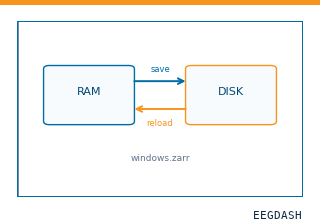 Save and reload prepared dataCache a windowed dataset to disk and reattach it without recompute.
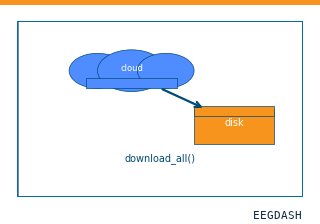 Download a dataset locallyPrefetch BIDS files to a local cache and validate the layout.
Swap any load_dataset(...) call for nm000275 to reproduce the tutorial on this dataset.
Citation
Zehong Cao, Chun-Hsiang Chuang, Jung-Kai King, Chin-Teng Lin (2019). Multi-channel EEG recordings during a sustained-attention driving task. 10.82901/nemar.nm000275
Provenance
¹Contributed to nemar in BIDS format.
²Curated & ingested by the EEGDash catalog; see CITATION.cff for canonical reference.
³Persistent identifier: 10.82901/nemar.nm000275.
See Also#
eegdash.dataset.EEGDashDataseteegdash.dataset