


NM000359: ieeg dataset, 1 subjects#
Bern-Barcelona EEG database: focal and nonfocal intracranial EEG signal pairs (Andrzejak, Schindler & Rummel 2012)
Access recordings and metadata through EEGDash.
Citation: Ralph G. Andrzejak, Kaspar Schindler, Christian Rummel (2012). Bern-Barcelona EEG database: focal and nonfocal intracranial EEG signal pairs (Andrzejak, Schindler & Rummel 2012). 10.82901/nemar.nm000359
Modality: ieeg Subjects: 1 Recordings: 7500 License: CC-BY-4.0 Source: nemar
Metadata: Complete (100%)
1-participant iEEG dataset — Bern-Barcelona EEG database: focal and nonfocal intracranial EEG signal pairs (Andrzejak, Schindler & Rummel 2012).
Quickstart#
Install
pip install eegdash
Access the data
from eegdash.dataset import NM000359

dataset = NM000359(cache_dir="./data")
# Get the raw object of the first recording
raw = dataset.datasets[0].raw
print(raw.info)
Filter by subject
dataset = NM000359(cache_dir="./data", subject="01")
Advanced query
dataset = NM000359(
    cache_dir="./data",
    query={"subject": {"$in": ["01", "02"]}},
)
Iterate recordings
for rec in dataset:
    print(rec.subject, rec.raw.info['sfreq'])
If you use this dataset in your research, please cite the original authors.
BibTeX
@dataset{nm000359,
  title = {Bern-Barcelona EEG database: focal and nonfocal intracranial EEG signal pairs (Andrzejak, Schindler & Rummel 2012)},
  author = {Ralph G. Andrzejak and Kaspar Schindler and Christian Rummel},
  doi = {10.82901/nemar.nm000359},
  url = {https://doi.org/10.82901/nemar.nm000359},
}
About This Dataset#
Focal and non-focal intracranial EEG signal pairs from five patients with pharmacoresistant temporal lobe
epilepsy, published with:
Andrzejak RG, Schindler K, Rummel C (2012). Nonrandomness, nonlinear dependence, and nonstationarity of electroencephalographic recordings from epilepsy patients. Phys. Rev. E 86, 046206. doi:10.1103/PhysRevE.86.046206
Bern-Barcelona EEG database (iEEG-BIDS)
Source dataset: Andrzejak RG, Schindler KA, Rummel C. *Nonrandomness, nonlinear dependence, and nonstationarity of electroencephalographic recordings from epilepsy patients [dataset]*. Repositori Digital de la UPF, 2012. doi:10.34810/data502, hdl:10230/42829.
The authors ask users to refer to the resources as the “Bern-Barcelona EEG database” and to cite the paper. This BIDS dataset is a lossless re-packaging of that source. Every sample is identical to the published text
View full README
Bern-Barcelona EEG database (iEEG-BIDS)
Source dataset: Andrzejak RG, Schindler KA, Rummel C. *Nonrandomness, nonlinear dependence, and nonstationarity of electroencephalographic recordings from epilepsy patients [dataset]*. Repositori Digital de la UPF, 2012. doi:10.34810/data502, hdl:10230/42829.
The authors ask users to refer to the resources as the “Bern-Barcelona EEG database” and to cite the paper. This BIDS dataset is a lossless re-packaging of that source. Every sample is identical to the published text files; nothing was filtered, resampled, re-referenced or rescaled during conversion.
Content
| | |
|---|---|
| Signal pairs | 7500 (3750 focal + 3750 non-focal) |
| Channels per run | 2 (`x`, `y`: neighbouring channels of the same class) |
| Samples per channel | 10240 |
| Sampling rate | 512 Hz |
| Duration per run | 20 s |
| Patients | 5 (pooled, not identifiable per run; see below) |
| Value range | -2223.068115 to 3469.565918 (source units, see "Units") |
Recordings (from the paper, Sec. II)
Five patients with longstanding pharmacoresistant temporal lobe epilepsy, candidates for epilepsy surgery, underwent long-term intracranial EEG recordings at the Department of Neurology of the University of Bern (Inselspital) because non-invasive studies had not localized the seizure onset zone.
Intracranial strip and depth electrodes, all manufactured by AD-TECH (Racine, WI, USA). An extracranial reference electrode was placed between 10-20 positions Fz and Pz.
Signals were sampled at 512 or 1024 Hz depending on whether they were recorded with more or less than 64 channels.
All five patients had good surgical outcome (three seizure-free; two with auras only; ILAE class 1 and 2).
Ethics: “Retrospective EEG data analysis has been approved by the ethics committee of the Kanton of Bern. In addition, all patients gave written informed consent that their data from long-term EEG might be used for research purposes.”
Preprocessing applied by the source (before publication)
From the paper, Sec. II B, and the source code comments (ASR_Setparameters.m):
1. Digital band-pass filter 0.5-150 Hz, fourth-order Butterworth, applied forward and backward (zero phase).
2. Signals recorded at 1024 Hz were down-sampled to 512 Hz. Which pairs were down-sampled is not recorded.
3. Re-referencing against the median of all channels free of permanent artifacts (visual inspection).
ASR_Setparameters.m: “The data as provided on the page is sampled at 512 HZ and band-pass filtered between
0.5Hz and 150Hz.” The additional 40 Hz low-pass and 46.5-53.5 Hz band-stop filters used in the paper’s analysis
are part of the analysis code. They were not applied to the published data, and they were not applied here.
Selection of the signal pairs (paper, Sec. II C)
“Focal EEG channels”: all channels that detected the first ictal EEG signal changes, as judged by visual inspection by at least two board-certified electroencephalographers. All other channels are “non-focal”.
The recordings were divided into 20-s windows (10240 samples). Seizure recordings and the three hours after the last seizure were excluded.
For each focal pair the authors randomly selected a patient, one of that patient’s focal channels (signal
x), one neighbouring focal channel (signaly) and one time window. Sampling was uniform and without replacement. Non-focal pairs were drawn the same way from non-focal channels.Pairs with prominent measurement artifacts were discarded after visual inspection. Moderate 50 Hz line noise was not an exclusion criterion. No clinical criteria (presence or absence of epileptiform activity) were applied.
“the focal EEG signal pairs were stored in the order in which they were drawn. Their origin (patient, channel, window) was not stored.”
BIDS layout and source-to-BIDS mapping
The source holds no patient, channel or time information for any pair, so per-patient subjects cannot be
built. All runs sit under one pseudo-subject, sub-pooled. This is not one person: it pools anonymous
segments from five patients. Do not treat runs as independent subjects. Pairs from the same patient cannot
be grouped either, so cross-validation by patient is not possible with this dataset.
| Source | BIDS |
|---|---|
| `Data_F_Ind_<a>_<b>.zip` / `Data_F_Ind<NNNN>.txt` (focal pair NNNN) | `sub-pooled/ieeg/sub-pooled_task-interictal_acq-focal_run-<NNNN>_ieeg.{vhdr,vmrk,eeg}` |
| `Data_N_Ind_<a>_<b>.zip` / `Data_N_Ind<NNNN>.txt` (non-focal pair NNNN) | `sub-pooled/ieeg/sub-pooled_task-interictal_acq-nonfocal_run-<NNNN>_ieeg.{vhdr,vmrk,eeg}` |
| column 1 / column 2 of each text file | channels `x` / `y` |
| `Results_F_All.txt`, `Results_N_All.txt` (published test outcomes) | columns of `sub-pooled/sub-pooled_scans.tsv` (described in `sub-pooled_scans.json`) |
| `Data_F_50.zip`, `Data_N_50.zip` (preview subsets) | not converted: their 100 members are byte-identical (SHA-256) to pairs 1-50 of the full archives |
| `ASR_Sources_2013_06_11.zip` (MATLAB analysis code) | kept in `sourcedata/` only |
| all of the above + repository metadata | byte-identical copies in `sourcedata/upf-repositori-10230-42829/` |
The run number equals the source pair index (run-0007 = Data_F_Ind0007.txt for acq-focal).
sub-pooled_scans.tsv lists for every run the source archive, source file, the SHA-256 of the
uncompressed source file and the published test outcomes. Sidecars are shared by inheritance:
sub-pooled_task-interictal_ieeg.json, sub-pooled_task-interictal_channels.tsv, and one
..._acq-<focal|nonfocal>_events.tsv per class with a single event spanning the run (trial_type =
focal or nonfocal).
task-interictal is a label for the brain state (seizure-free interval of clinical monitoring). There
was no task. acq-focal / acq-nonfocal encode the signal class defined by the source.
Data format and exactness
The source stores values as text with six decimals. Every value was converted to IEEE float32 (BrainVision
IEEE_FLOAT_32, multiplexed, resolution 1). For all 7500 files and all 153,600,000 values, formatting the
stored float32 value with %.6f reproduces the source text token exactly. The conversion is therefore
lossless with respect to the published text. A separate round-trip check re-read every BrainVision file and
compared it with the source text (see the campaign ledger).
Units
Neither the paper nor the download page states the physical unit or scale of the stored values. The paper’s
example figure shows values of roughly +/-100 to +/-200 with no unit label. Channel units are therefore
n/a in channels.tsv and in the BrainVision header. Values are exactly the source numbers. Magnitudes are
consistent with microvolts, but this is not documented by the source.
Channel type is OTHER because the source does not record whether a signal comes from a strip (ECoG) or a
depth (SEEG) contact. Electrode positions are not available, so there is no electrodes.tsv.
Privacy
The published files contain only numeric samples (no headers, names, dates or identifiers). The source
randomized pairs across patients and did not store patient, channel or time of origin. Converted headers
contain no dates or identifiers. Repository metadata (item.json, bundles.json) contains only
bibliographic information.
License and terms of use
Repository record (dc.rights): “Licensed under a Creative Commons License (CC-BY) 4.0” (https://creativecommons.org/licenses/by/4.0/). This dataset is released under **CC-BY-4.0**.
The UPF NTSA download page for the same material (https://www.upf.edu/web/ntsa/downloads, captured 2026-10-06; text in
sourcedata/upf-repositori-10230-42829/_repository_metadata/) adds a “Legal Agreement”: “The source codes, data and results on these sites are free of charge for research and education purposes only. Any commercial or military use is prohibited. All resources are provided without any expressed or implied warranty. In no event the authors of the article or any of their host institutions are liable for any damages arising from the use of the software, data or results.” This statement is not part of the repository record’s rights field for this item. It is reproduced here so users can respect the authors’ stated intent.
Funding
R.G.A. acknowledges grant FIS-2010-18204 of the Spanish Ministry of Education and Science.
How to load
Example with MNE-Python / MNE-BIDS (after nemar dataset get or datalad get of the files you need):
import mne
from mne_bids import BIDSPath, read_raw_bids
bp = BIDSPath(root="<dataset root>", subject="pooled", task="interictal",
              acquisition="focal", run="0007", datatype="ieeg", suffix="ieeg", extension=".vhdr")

raw = read_raw_bids(bp)          # 2 channels (x, y), 10240 samples at 512 Hz
data = raw.get_data()            # values exactly as in the source text; physical unit not stated by the source
The published test outcomes per pair are in
sub-pooled/sub-pooled_scans.tsv (e.g. pandas.read_csv(..., sep="\t")).
How to cite
Cite the paper (doi:10.1103/PhysRevE.86.046206) and the dataset (doi:10.34810/data502). Also cite this BIDS release by its NEMAR identifier.
References
Andrzejak RG, Schindler K, Rummel C (2012). Phys. Rev. E 86, 046206. doi:10.1103/PhysRevE.86.046206
Andrzejak RG, Schindler KA, Rummel C (2012). Dataset, Repositori Digital de la UPF. doi:10.34810/data502
Andrzejak RG et al. (2001). Phys. Rev. E 64, 061907. doi:10.1103/PhysRevE.64.061907 (methods referenced by the analysis code)
Conversion provenance
Converted 2026-10-06 on SDSC Voyager (Kubernetes jobs) by the iEEG-NEMAR campaign (lane G) with
laneG_convert.py and laneG_finalize.py. Source files were downloaded through the repository’s DSpace REST
API, and every bitstream’s MD5 matched the repository checksum. See sourcedata/provenance.json. Paper
details were taken from the published version deposited at hdl:10230/43557 (repository full-text extraction)
and from the UPF NTSA download page.
NEMAR Metadata#
[](https://doi.org/10.82901/nemar.nm000359) # Bern-Barcelona EEG database (iEEG-BIDS) Focal and non-focal intracranial EEG signal pairs from five patients with pharmacoresistant temporal lobe epilepsy, published with: > Andrzejak RG, Schindler K, Rummel C (2012). Nonrandomness, nonlinear dependence, and nonstationarity of > electroencephalographic recordings from epilepsy patients. Phys. Rev. E 86, 046206. > doi:[10.1103/PhysRevE.86.046206](https://doi.org/10.1103/PhysRevE.86.046206) Source dataset: Andrzejak RG, Schindler KA, Rummel C. Nonrandomness, nonlinear dependence, and nonstationarity of electroencephalographic recordings from epilepsy patients [dataset]. Repositori Digital de la UPF, 2012. doi:[10.34810/data502](https://doi.org/10.34810/data502), hdl:[10230/42829](http://hdl.handle.net/10230/42829). The authors ask users to refer to the resources as the “Bern-Barcelona EEG database” and to cite the paper. This BIDS dataset is a lossless re-packaging of that source. Every sample is identical to the published text files; nothing was filtered, resampled, re-referenced or rescaled during conversion. ## Content | | | |---|—| | Signal pairs | 7500 (3750 focal + 3750 non-focal) | | Channels per run | 2 (x, y: neighbouring channels of the same class) | | Samples per channel | 10240 | | Sampling rate | 512 Hz | | Duration per run | 20 s | | Patients | 5 (pooled, not identifiable per run; see below) | | Value range | -2223.068115 to 3469.565918 (source units, see “Units”) | ## Recordings (from the paper, Sec. II) - Five patients with longstanding pharmacoresistant temporal lobe epilepsy, candidates for epilepsy surgery,
underwent long-term intracranial EEG recordings at the Department of Neurology of the University of Bern (Inselspital) because non-invasive studies had not localized the seizure onset zone.
Intracranial strip and depth electrodes, all manufactured by AD-TECH (Racine, WI, USA). An extracranial reference electrode was placed between 10-20 positions Fz and Pz.
Signals were sampled at 512 or 1024 Hz depending on whether they were recorded with more or less than 64 channels.
All five patients had good surgical outcome (three seizure-free; two with auras only; ILAE class 1 and 2).
Ethics: “Retrospective EEG data analysis has been approved by the ethics committee of the Kanton of Bern. In addition, all patients gave written informed consent that their data from long-term EEG might be used for research purposes.”
## Preprocessing applied by the source (before publication) From the paper, Sec. II B, and the source code comments (ASR_Setparameters.m): 1. Digital band-pass filter 0.5-150 Hz, fourth-order Butterworth, applied forward and backward (zero phase). 2. Signals recorded at 1024 Hz were down-sampled to 512 Hz. Which pairs were down-sampled is not recorded. 3. Re-referencing against the median of all channels free of permanent artifacts (visual inspection). ASR_Setparameters.m: “The data as provided on the page is sampled at 512 HZ and band-pass filtered between 0.5Hz and 150Hz.” The additional 40 Hz low-pass and 46.5-53.5 Hz band-stop filters used in the paper’s analysis are part of the analysis code. They were not applied to the published data, and they were not applied here. ## Selection of the signal pairs (paper, Sec. II C) - “Focal EEG channels”: all channels that detected the first ictal EEG signal changes, as judged by visual
inspection by at least two board-certified electroencephalographers. All other channels are “non-focal”.
The recordings were divided into 20-s windows (10240 samples). Seizure recordings and the three hours after the last seizure were excluded.
For each focal pair the authors randomly selected a patient, one of that patient’s focal channels (signal x), one neighbouring focal channel (signal y) and one time window. Sampling was uniform and without replacement. Non-focal pairs were drawn the same way from non-focal channels.
Pairs with prominent measurement artifacts were discarded after visual inspection. Moderate 50 Hz line noise was not an exclusion criterion. No clinical criteria (presence or absence of epileptiform activity) were applied.
“the focal EEG signal pairs were stored in the order in which they were drawn. Their origin (patient, channel, window) was not stored.”
## BIDS layout and source-to-BIDS mapping The source holds no patient, channel or time information for any pair, so per-patient subjects cannot be built. All runs sit under one pseudo-subject, sub-pooled. This is not one person: it pools anonymous segments from five patients. Do not treat runs as independent subjects. Pairs from the same patient cannot be grouped either, so cross-validation by patient is not possible with this dataset. | Source | BIDS | |---|—| | Data_F_Ind_<a>_<b>.zip / Data_F_Ind<NNNN>.txt (focal pair NNNN) | sub-pooled/ieeg/sub-pooled_task-interictal_acq-focal_run-<NNNN>_ieeg.{vhdr,vmrk,eeg} | | Data_N_Ind_<a>_<b>.zip / Data_N_Ind<NNNN>.txt (non-focal pair NNNN) | sub-pooled/ieeg/sub-pooled_task-interictal_acq-nonfocal_run-<NNNN>_ieeg.{vhdr,vmrk,eeg} | | column 1 / column 2 of each text file | channels x / y | | Results_F_All.txt, Results_N_All.txt (published test outcomes) | columns of sub-pooled/sub-pooled_scans.tsv (described in sub-pooled_scans.json) | | Data_F_50.zip, Data_N_50.zip (preview subsets) | not converted: their 100 members are byte-identical (SHA-256) to pairs 1-50 of the full archives | | ASR_Sources_2013_06_11.zip (MATLAB analysis code) | kept in sourcedata/ only | | all of the above + repository metadata | byte-identical copies in sourcedata/upf-repositori-10230-42829/ | The run number equals the source pair index (run-0007 = Data_F_Ind0007.txt for acq-focal). sub-pooled_scans.tsv lists for every run the source archive, source file, the SHA-256 of the uncompressed source file and the published test outcomes. Sidecars are shared by inheritance: sub-pooled_task-interictal_ieeg.json, sub-pooled_task-interictal_channels.tsv, and one …_acq-<focal|nonfocal>_events.tsv per class with a single event spanning the run (trial_type = focal or nonfocal). task-interictal is a label for the brain state (seizure-free interval of clinical monitoring). There was no task. acq-focal / acq-nonfocal encode the signal class defined by the source. ## Data format and exactness The source stores values as text with six decimals. Every value was converted to IEEE float32 (BrainVision IEEE_FLOAT_32, multiplexed, resolution 1). For all 7500 files and all 153,600,000 values, formatting the stored float32 value with %.6f reproduces the source text token exactly. The conversion is therefore lossless with respect to the published text. A separate round-trip check re-read every BrainVision file and compared it with the source text (see the campaign ledger). ## Units Neither the paper nor the download page states the physical unit or scale of the stored values. The paper’s example figure shows values of roughly +/-100 to +/-200 with no unit label. Channel units are therefore n/a in channels.tsv and in the BrainVision header. Values are exactly the source numbers. Magnitudes are consistent with microvolts, but this is not documented by the source. Channel type is OTHER because the source does not record whether a signal comes from a strip (ECoG) or a depth (SEEG) contact. Electrode positions are not available, so there is no electrodes.tsv. ## Privacy The published files contain only numeric samples (no headers, names, dates or identifiers). The source randomized pairs across patients and did not store patient, channel or time of origin. Converted headers contain no dates or identifiers. Repository metadata (item.json, bundles.json) contains only bibliographic information. ## License and terms of use - Repository record (dc.rights): “Licensed under a Creative Commons License (CC-BY) 4.0”
(https://creativecommons.org/licenses/by/4.0/). This dataset is released under CC-BY-4.0.
The UPF NTSA download page for the same material (https://www.upf.edu/web/ntsa/downloads, captured 2026-10-06; text in sourcedata/upf-repositori-10230-42829/_repository_metadata/) adds a “Legal Agreement”: “The source codes, data and results on these sites are free of charge for research and education purposes only. Any commercial or military use is prohibited. All resources are provided without any expressed or implied warranty. In no event the authors of the article or any of their host institutions are liable for any damages arising from the use of the software, data or results.” This statement is not part of the repository record’s rights field for this item. It is reproduced here so users can respect the authors’ stated intent.
## Funding R.G.A. acknowledges grant FIS-2010-18204 of the Spanish Ministry of Education and Science. ## How to load Example with MNE-Python / MNE-BIDS (after nemar dataset get or datalad get of the files you need): ```python import mne from mne_bids import BIDSPath, read_raw_bids bp = BIDSPath(root=”<dataset root>”, subject=”pooled”, task=”interictal”,
acquisition=”focal”, run=”0007”, datatype=”ieeg”, suffix=”ieeg”, extension=”.vhdr”)
raw = read_raw_bids(bp) # 2 channels (x, y), 10240 samples at 512 Hz data = raw.get_data() # values exactly as in the source text; physical unit not stated by the source ``` The published test outcomes per pair are in sub-pooled/sub-pooled_scans.tsv (e.g. pandas.read_csv(…, sep=”t”)). ## How to cite Cite the paper (doi:10.1103/PhysRevE.86.046206) and the dataset (doi:10.34810/data502). Also cite this BIDS release by its NEMAR identifier. ## References - Andrzejak RG, Schindler K, Rummel C (2012). Phys. Rev. E 86, 046206. doi:10.1103/PhysRevE.86.046206 - Andrzejak RG, Schindler KA, Rummel C (2012). Dataset, Repositori Digital de la UPF. doi:10.34810/data502 - Andrzejak RG et al. (2001). Phys. Rev. E 64, 061907. doi:10.1103/PhysRevE.64.061907 (methods referenced by
the analysis code)
## Conversion provenance Converted 2026-10-06 on SDSC Voyager (Kubernetes jobs) by the iEEG-NEMAR campaign (lane G) with laneG_convert.py and laneG_finalize.py. Source files were downloaded through the repository’s DSpace REST API, and every bitstream’s MD5 matched the repository checksum. See sourcedata/provenance.json. Paper details were taken from the published version deposited at hdl:10230/43557 (repository full-text extraction) and from the UPF NTSA download page.
License: CC-BY-4.0
Authors:
Ralph G. Andrzejak
Kaspar Schindler
Christian Rummel
Versions:
Version |
DOI |
Released |
|---|---|---|
|
Cohort#
Dataset Statistics#
Channel counts: 2 ch (n=7500 recordings)
Sampling frequencies: 512.0 Hz (n=7500 recordings)
Total recording duration: 41 h
Signal · Electrodes & live trace#
Live trace viewer — sub-pooled · task-interictal · run-2904
Showing one representative recording out of
1 subjects and 7500 recordings in this dataset.
Browse the full set on OpenNeuro;
drop any other _ieeg.{set,edf,bdf,vhdr} file onto the
viewer (or pass ?ieeg=<url>) to inspect it.
No scalp electrode layout is currently indexed for this dataset. Once the eegdash montage registry ingests it, the interactive viewer will appear here automatically.
NEMAR Processing Statistics#
The plots below are generated by NEMAR’s automated EEG pipeline. The histogram shows pipeline success for data cleaning and ICA decomposition, the percentage of data frames and EEG channels retained after artefact removal, line noise per channel (RMS, dB), and the age/gender distribution of participants.

HED event descriptors word cloud

Manifest#
File Explorer#
Browse the BIDS file structure of this dataset. Records are fetched on demand from the EEGDash catalog the first time you open the explorer.
Full dataset metadata table
Dataset ID |
|
Title |
Bern-Barcelona EEG database: focal and nonfocal intracranial EEG signal pairs (Andrzejak, Schindler & Rummel 2012) |
Author (year) |
— |
Canonical |
— |
Importable as |
|
Year |
2012 |
Authors |
Ralph G. Andrzejak, Kaspar Schindler, Christian Rummel |
License |
CC-BY-4.0 |
Citation / DOI |
|
Source links |
OpenNeuro | NeMAR | Source URL |
Copy-paste BibTeX
@dataset{nm000359,
  title = {Bern-Barcelona EEG database: focal and nonfocal intracranial EEG signal pairs (Andrzejak, Schindler & Rummel 2012)},
  author = {Ralph G. Andrzejak and Kaspar Schindler and Christian Rummel},
  doi = {10.82901/nemar.nm000359},
  url = {https://doi.org/10.82901/nemar.nm000359},
}
API Reference#
eegdash.datasetEEGDashDataset- class eegdash.dataset.NM000359(cache_dir: str, query: dict | None = None, s3_bucket: str | None = None, **kwargs)[source]#
Bern-Barcelona EEG database: focal and nonfocal intracranial EEG signal pairs (Andrzejak, Schindler & Rummel 2012)
- Study:
nm000359(NeMAR)- Author (year):
—
- Canonical:
—
Also importable as:
NM000359.Modality:
ieeg; Subject type:Unknown. Subjects: 1; recordings: 7500; tasks: 1.- Parameters:
cache_dir (str | Path) – Directory where data are cached locally.
query (dict | None) – Additional MongoDB-style filters to AND with the dataset selection. Must not contain the key
dataset.s3_bucket (str | None) – Base S3 bucket used to locate the data.
**kwargs (dict) – Additional keyword arguments forwarded to
EEGDashDataset.
- data_dir#
Local dataset cache directory (
cache_dir / dataset_id).- Type:
Path
Notes
Each item is a recording; recording-level metadata are available via
dataset.description.querysupports MongoDB-style filters on fields inALLOWED_QUERY_FIELDSand is combined with the dataset filter. Dataset-specific caveats are not provided in the summary metadata.References
OpenNeuro dataset: https://openneuro.org/datasets/nm000359 NeMAR dataset: https://nemar.org/dataexplorer/detail?dataset_id=nm000359 DOI: https://doi.org/10.82901/nemar.nm000359
Examples
>>> from eegdash.dataset import NM000359
>>> dataset = NM000359(cache_dir="./data")
>>> recording = dataset[0]
>>> raw = recording.load()
- __init__(cache_dir: str, query: dict | None = None, s3_bucket: str | None = None, **kwargs)[source]#
- save(path: str, overwrite: bool = False, offset: int = 0)[source]#
Save datasets to files by creating one subdirectory for each dataset:
path/
    0/
        0-raw.fif | 0-epo.fif
        description.json
        raw_preproc_kwargs.json (if raws were preprocessed)
        window_kwargs.json (if this is a windowed dataset)
        window_preproc_kwargs.json  (if windows were preprocessed)
        target_name.json (if target_name is not None and dataset is raw)
    1/
        1-raw.fif | 1-epo.fif
        description.json
        raw_preproc_kwargs.json (if raws were preprocessed)
        window_kwargs.json (if this is a windowed dataset)
        window_preproc_kwargs.json  (if windows were preprocessed)
        target_name.json (if target_name is not None and dataset is raw)
- Parameters:
path (str) –
- Directory in which subdirectories are created to store
-raw.fif | -epo.fif and .json files to.
overwrite (bool) – Whether to delete old subdirectories that will be saved to in this call.
offset (int) – If provided, the integer is added to the id of the dataset in the concat. This is useful in the setting of very large datasets, where one dataset has to be processed and saved at a time to account for its original position.
BaseDataset from braindecode — windowed via create_windows_from_events.braindecodeDataLoader; supports parallel workers and on-the-fly augmentations.pytorch Find datasets with the EEGDash APIQuery the catalogue, filter by task or modality, list candidates.
 Load one EEG recordingResolve a single record to an MNE Raw with channels and events.
 EEG recording to PyTorch DataLoaderWrap braindecode windows in a DataLoader for model training.
 Preprocess EEG and create windowsFilter, resample, epoch — and persist the windowed dataset.
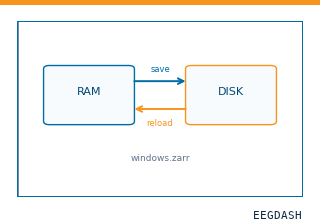 Save and reload prepared dataCache a windowed dataset to disk and reattach it without recompute.
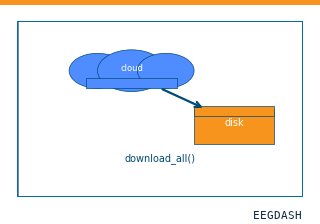 Download a dataset locallyPrefetch BIDS files to a local cache and validate the layout.
Swap any load_dataset(...) call for nm000359 to reproduce the tutorial on this dataset.
Citation
Ralph G. Andrzejak, Kaspar Schindler, Christian Rummel (2012). Bern-Barcelona EEG database: focal and nonfocal intracranial EEG signal pairs (Andrzejak, Schindler & Rummel 2012). 10.82901/nemar.nm000359
Provenance
¹Contributed to nemar in BIDS format.
²Curated & ingested by the EEGDash catalog; see CITATION.cff for canonical reference.
³Persistent identifier: 10.82901/nemar.nm000359.
See Also#
eegdash.dataset.EEGDashDataseteegdash.dataset