


NM000358: ieeg dataset, 12 subjects#
AJILE12: long-term naturalistic ECoG with wrist-movement events and behaviour labels (DANDI 000055)
Access recordings and metadata through EEGDash.
Citation: Steven M. Peterson, Satpreet H. Singh, Benjamin Dichter, Michael Scheid, Rajesh P. N. Rao, Bingni W. Brunton (2022). AJILE12: long-term naturalistic ECoG with wrist-movement events and behaviour labels (DANDI 000055). 10.82901/nemar.nm000358
Modality: ieeg Subjects: 12 Recordings: 55 License: CC-BY-4.0 Source: nemar
Metadata: Complete (100%)
12-participant iEEG dataset — AJILE12: long-term naturalistic ECoG with wrist-movement events and behaviour labels (DANDI 000055).
Quickstart#
Install
pip install eegdash
Access the data
from eegdash.dataset import NM000358

dataset = NM000358(cache_dir="./data")
# Get the raw object of the first recording
raw = dataset.datasets[0].raw
print(raw.info)
Filter by subject
dataset = NM000358(cache_dir="./data", subject="01")
Advanced query
dataset = NM000358(
    cache_dir="./data",
    query={"subject": {"$in": ["01", "02"]}},
)
Iterate recordings
for rec in dataset:
    print(rec.subject, rec.raw.info['sfreq'])
If you use this dataset in your research, please cite the original authors.
BibTeX
@dataset{nm000358,
  title = {AJILE12: long-term naturalistic ECoG with wrist-movement events and behaviour labels (DANDI 000055)},
  author = {Steven M. Peterson and Satpreet H. Singh and Benjamin Dichter and Michael Scheid and Rajesh P. N. Rao and Bingni W. Brunton},
  doi = {10.82901/nemar.nm000358},
  url = {https://doi.org/10.82901/nemar.nm000358},
}
About This Dataset#
AJILE12: long-term naturalistic ECoG with wrist-movement events and behaviour labels (DANDI 000055)
Electrocorticography (ECoG; grids, strips and in some participants depth electrodes) recorded
opportunistically from 12 participants during clinical long-term epilepsy monitoring at Harborview Medical Center (Seattle, USA), with simultaneous video from which the authors estimated upper-body pose, detected and visually validated wrist-movement initiation events, and annotated coarse behavioural states (sleep/rest, TV, talking, eating, computer/phone, …). One recording per participant per monitoring day (days 3-7 after implantation), each covering one day from midnight to midnight, 55 days in total. There is no experimental task.
- This is an iEEG-BIDS representation of the ECoG released by the authors in NWB on DANDI:
Peterson SM, Singh SH, Dichter B, Scheid M, Rao RPN, Brunton BW (2022). AJILE12: Long-term naturalistic human intracranial neural recordings and pose (Version 0.220127.0436). DANDI archive. https://doi.org/10.48324/dandi.000055/0.220127.0436 (license CC-BY-4.0) Data descriptor: Peterson SM et al. AJILE12: Long-term naturalistic human intracranial neural recordings and pose. Sci Data 9, 184 (2022). https://doi.org/10.1038/s41597-022-01280-y
Please cite both. The 30 Hz pose trajectories (9 keypoints, image pixels) are not converted; they
View full README
- This is an iEEG-BIDS representation of the ECoG released by the authors in NWB on DANDI:
Peterson SM, Singh SH, Dichter B, Scheid M, Rao RPN, Brunton BW (2022). AJILE12: Long-term naturalistic human intracranial neural recordings and pose (Version 0.220127.0436). DANDI archive. https://doi.org/10.48324/dandi.000055/0.220127.0436 (license CC-BY-4.0) Data descriptor: Peterson SM et al. AJILE12: Long-term naturalistic human intracranial neural recordings and pose. Sci Data 9, 184 (2022). https://doi.org/10.1038/s41597-022-01280-y
Please cite both. The 30 Hz pose trajectories (9 keypoints, image pixels) are not converted; they remain, unchanged, in the original NWB files under sourcedata/dandi-000055/ and on DANDI.
Cohort and acquisition
From Peterson et al. (2022), Methods (“Participants”, “Data collection”): - 12 participants (8 male, 4 female; age 29.4 +/- 7.6 years, mean +/- SD) recorded during clinical
epilepsy monitoring at Harborview Medical Center, Seattle, USA. ECoG electrodes were placed based on clinical need; participants were selected because they were generally active during monitoring and had ECoG electrodes near motor cortex.
Semi-continuous ECoG and video were recorded passively during 24-hour clinical monitoring; monitoring lasted 7.4 +/- 2.2 days per participant, with 8.3 +/- 2.2 breaks per participant of 1.9 +/- 2.4 h. Only days 3-7 after implantation were included; days with corrupted or missing files were excluded.
Acquisition rates: ECoG 1 kHz (released at 500 Hz after the authors’ processing, see Signal), video 30 frames per second. The paper does not name the amplifier, electrode manufacturer or acquisition reference; these fields are left unset.
Ethics
Peterson et al. (2022): all participants provided written informed consent; the protocol was approved by the University of Washington Institutional Review Board (DANDI ethics record STUDY00000623). This deposit redistributes the publicly released data under its CC-BY-4.0 license.
Contents
12 participants (sub-01 … sub-12), 55 recording days (ses-3 … ses-7 = day after implantation), 64-126 ECoG/depth channels per participant at 500 Hz (plus EOGL/EOGR/ECGL/ECGR for sub-01), about 1295 h of recording including NaN monitoring breaks. 52 recordings span the full day (86400 s); 3 start later in the day (sub-01 ses-7, sub-04 ses-3, sub-06 ses-3) and, like all others, end at midnight.
Events: 8088 wrist-movement events (ReachEvents, left or right wrist as stated per file) and 74339 coarse behaviour-label intervals. (The data descriptor text reports 6931 visually validated wrist movement events; the ReachEvents tables of the released NWB files, as converted here, hold 8088 rows.)
ieeg/*_ieeg.vhdr/.vmrk/.eeg BrainVision, IEEE float32, microvolts (resolution 1). ieeg/*_channels.tsv channel type, author bad-channel flags and per-electrode source statistics. ieeg/*_electrodes.tsv MNI coordinates from the source (see Coordinates). ieeg/*_events.tsv wrist-movement events, coarse behaviour labels, NaN segments. sourcedata/dandi-000055/ byte-identical NWB files (+ dandiset.yaml); sourcedata_provenance.json
lists size, SHA-256 and DANDI asset id.
Signal
The .eeg payload is byte-for-byte the float32 array stored in acquisition/ElectricalSeries of each NWB file (stored in microvolts; NWB conversion 1e-6 to volts), multiplexed, channel order as the source electrode region. NaN samples (monitoring breaks) are kept as NaN. This conversion applied no filtering, resampling, re-referencing or channel removal.
Processing already applied by the authors (Peterson et al. 2022, “ECoG data processing”): median DC removal per electrode; data within 2 s of high-amplitude discontinuities set to 0; 1-200 Hz band-pass; 60 Hz (and harmonics) notch; downsampling from 1 kHz to 500 Hz; re-referencing to the common median of each grid, strip or depth electrode group. The NWB “filtering” column reads “250 Hz lowpass” and is reported verbatim. “raw” in dataset_description therefore means “earliest released form”, not the acquisition signal.
Channel names: the source does not store the clinical contact labels. Names are generated as <electrode group>_<NWB electrode id> (e.g. GRID_012); the number is not a clinical contact number.
Type is ECOG unless the group description states a depth electrode (then SEEG); the source group descriptions are given in iEEGElectrodeGroups. status = bad where the source “good” column is False (author QC: abnormal standard deviation or kurtosis). Source columns (SD, kurtosis, MAD, R2 of the authors’ decoding models) are kept in channels.tsv.
Clocks and events
The NWB file holds two clocks. The ECoG starts at the NWB session_start_time (dates were replaced by the authors; the time of day is kept) and has no stored timestamps. The pose, the coarse behaviour labels (intervals/epochs) and the reach features (intervals/reaches, “Time of day (sec)”) are on a day clock that starts at midnight. The NWB ReachEvents timestamps are on the ECoG clock.
- For each file this conversion computes D = UTC seconds-of-day of session_start_time and requires
D + ECoG duration = 86400 s within one sample (the ECoG ends at midnight), and
for every row, reaches.start_time - ReachEvents.timestamps - D is within 2 ms (the event resolution) of a whole number of days (0 except where the authors’ time of day wrapped past midnight, e.g. 86440.332 s for an event 40.332 s after midnight).
All 55 recordings pass both gates (maximum residual 1 ms; one row in sub-08 ses-4 has a time of day of 86440.332 s for an event 40.332 s after midnight). D is 0 for 52 recordings and 30682.414, 30048.322 and 29240.566 s for the 3 recordings that start later in the day.
- Event onsets (seconds from the first ECoG sample):
reach_onset ReachEvents timestamp, with the reach features of the same row and its duration; coarse_label epochs start - D; labels that start before the first ECoG sample have negative onsets
(validator warning SUSPICIOUS_NEGATIVE_EVENT_ONSET; sample is n/a for them);
nan_segment runs of samples that are NaN on every channel in the source.
source_time_of_day keeps the original day-clock time. Coarse-label boundaries follow the source converter, which assigns each change to the last frame of the previous label (one 30 Hz frame).
Coordinates
x/y/z are copied from the NWB electrodes table: electrodes were localised with FieldTrip (pre-operative MRI co-registered to post-operative CT, manual selection) and warped to MNI space (Peterson et al. 2022). The MNI template variant is not stated, so coordsystem.json uses “Other” with this description, units mm.
Participants and privacy
participants.tsv gives, per participant: species (NWB subject record) and, from Peterson et al. (2022) Table 2 “Individual participant characteristics”, age (years), sex (M/F), hemisphere_implanted (L/R), recording_days_used, surface_electrodes_good / surface_electrodes_total and depth_electrodes_good / depth_electrodes_total; participants.json describes each column and its source. Paper participants P01-P12 = sub-01 … sub-12 (the electrode totals equal the electrodes.tsv row counts and the recording days equal the number of ses-* folders). The authors stripped recording dates (session dates in the NWB are placeholders, 2000-01-0x); BIDS files carry no dates.
How to load
Example with MNE-Python / MNE-BIDS (fetch the files you need first, e.g. nemar dataset get or
datalad get):
from mne_bids import BIDSPath, read_raw_bids bp = BIDSPath(root=”<dataset root>”, subject=”01”, session=”3”, task=”naturalistic”,
datatype=”ieeg”, suffix=”ieeg”, extension=”.vhdr”)
raw = read_raw_bids(bp) # 500 Hz, microvolts in file, volts in MNE; NaN = monitoring break import pandas as pd ev = pd.read_csv(bp.copy().update(suffix=”events”, extension=”.tsv”).fpath, sep=”t”) reaches = ev[ev.trial_type == “reach_onset”]
Each file spans a full day (up to 86400 s at 500 Hz, about 43 M samples per channel); load lazily or crop before calling load_data().
Conversion checks
Source: 55/55 DANDI assets (845,869,698,341 bytes) verified by SHA-256 against the DANDI digests; sourcedata copies re-verified after copying.
Signal: every .eeg payload is bit-identical (incl. NaN) to the NWB stored float32 values in source channel order; MNE reads the same channel names, rate and sample count, and its scaled values match stored x 1e-6 V on start/middle/end windows.
Events: reach_onset onsets equal the NWB ReachEvents timestamps; coarse_label onsets equal the NWB epochs start - D (1e-6 s); clock gates as above.
BIDS validator (bids-validator 3.0.2): 0 errors; warnings are recommended fields not documented by the source and SUSPICIOUS_NEGATIVE_EVENT_ONSET for labels that begin before the ECoG start.
Provenance
Source: DANDI:000055 version 0.220127.0436, all 55 assets downloaded with the dandi CLI (0.81.0) on 2026-10-06 and verified against the DANDI SHA-256 digests. Conversion scripts: laneB_ieeg002_bids.py, checks laneB_ieeg002_check.py (h5py 3.16, numpy 2.5, MNE 1.13). An earlier automated nwb2bids attempt for this Dandiset (github.com/bids-dandisets/000055) converted 0 of the sessions; no BIDS copy of these recordings was found on DANDI, OpenNeuro or NEMAR as of 2026-10-06.
NEMAR Metadata#
[](https://doi.org/10.82901/nemar.nm000358) AJILE12: long-term naturalistic ECoG with wrist-movement events and behaviour labels (DANDI 000055) ==================================================================================================== Overview ——– Electrocorticography (ECoG; grids, strips and in some participants depth electrodes) recorded opportunistically from 12 participants during clinical long-term epilepsy monitoring at Harborview Medical Center (Seattle, USA), with simultaneous video from which the authors estimated upper-body pose, detected and visually validated wrist-movement initiation events, and annotated coarse behavioural states (sleep/rest, TV, talking, eating, computer/phone, …). One recording per participant per monitoring day (days 3-7 after implantation), each covering one day from midnight to midnight, 55 days in total. There is no experimental task. This is an iEEG-BIDS representation of the ECoG released by the authors in NWB on DANDI:
Peterson SM, Singh SH, Dichter B, Scheid M, Rao RPN, Brunton BW (2022). AJILE12: Long-term naturalistic human intracranial neural recordings and pose (Version 0.220127.0436). DANDI archive. https://doi.org/10.48324/dandi.000055/0.220127.0436 (license CC-BY-4.0) Data descriptor: Peterson SM et al. AJILE12: Long-term naturalistic human intracranial neural recordings and pose. Sci Data 9, 184 (2022). https://doi.org/10.1038/s41597-022-01280-y
Please cite both. The 30 Hz pose trajectories (9 keypoints, image pixels) are not converted; they remain, unchanged, in the original NWB files under sourcedata/dandi-000055/ and on DANDI. Cohort and acquisition ———————- From Peterson et al. (2022), Methods (“Participants”, “Data collection”): - 12 participants (8 male, 4 female; age 29.4 +/- 7.6 years, mean +/- SD) recorded during clinical
epilepsy monitoring at Harborview Medical Center, Seattle, USA. ECoG electrodes were placed based on clinical need; participants were selected because they were generally active during monitoring and had ECoG electrodes near motor cortex.
Semi-continuous ECoG and video were recorded passively during 24-hour clinical monitoring; monitoring lasted 7.4 +/- 2.2 days per participant, with 8.3 +/- 2.2 breaks per participant of 1.9 +/- 2.4 h. Only days 3-7 after implantation were included; days with corrupted or missing files were excluded.
Acquisition rates: ECoG 1 kHz (released at 500 Hz after the authors’ processing, see Signal), video 30 frames per second. The paper does not name the amplifier, electrode manufacturer or acquisition reference; these fields are left unset.
Ethics#
Peterson et al. (2022): all participants provided written informed consent; the protocol was approved by the University of Washington Institutional Review Board (DANDI ethics record STUDY00000623). This deposit redistributes the publicly released data under its CC-BY-4.0 license. Contents ——– 12 participants (sub-01 … sub-12), 55 recording days (ses-3 … ses-7 = day after implantation), 64-126 ECoG/depth channels per participant at 500 Hz (plus EOGL/EOGR/ECGL/ECGR for sub-01), about 1295 h of recording including NaN monitoring breaks. 52 recordings span the full day (86400 s); 3 start later in the day (sub-01 ses-7, sub-04 ses-3, sub-06 ses-3) and, like all others, end at midnight. Events: 8088 wrist-movement events (ReachEvents, left or right wrist as stated per file) and 74339 coarse behaviour-label intervals. (The data descriptor text reports 6931 visually validated wrist movement events; the ReachEvents tables of the released NWB files, as converted here, hold 8088 rows.)
ieeg/*_ieeg.vhdr/.vmrk/.eeg BrainVision, IEEE float32, microvolts (resolution 1). ieeg/*_channels.tsv channel type, author bad-channel flags and per-electrode source statistics. ieeg/*_electrodes.tsv MNI coordinates from the source (see Coordinates). ieeg/*_events.tsv wrist-movement events, coarse behaviour labels, NaN segments. sourcedata/dandi-000055/ byte-identical NWB files (+ dandiset.yaml); sourcedata_provenance.json
lists size, SHA-256 and DANDI asset id.
Signal#
The .eeg payload is byte-for-byte the float32 array stored in acquisition/ElectricalSeries of each NWB file (stored in microvolts; NWB conversion 1e-6 to volts), multiplexed, channel order as the source electrode region. NaN samples (monitoring breaks) are kept as NaN. This conversion applied no filtering, resampling, re-referencing or channel removal. Processing already applied by the authors (Peterson et al. 2022, “ECoG data processing”): median DC removal per electrode; data within 2 s of high-amplitude discontinuities set to 0; 1-200 Hz band-pass; 60 Hz (and harmonics) notch; downsampling from 1 kHz to 500 Hz; re-referencing to the common median of each grid, strip or depth electrode group. The NWB “filtering” column reads “250 Hz lowpass” and is reported verbatim. “raw” in dataset_description therefore means “earliest released form”, not the acquisition signal. Channel names: the source does not store the clinical contact labels. Names are generated as <electrode group>_<NWB electrode id> (e.g. GRID_012); the number is not a clinical contact number. Type is ECOG unless the group description states a depth electrode (then SEEG); the source group descriptions are given in iEEGElectrodeGroups. status = bad where the source “good” column is False (author QC: abnormal standard deviation or kurtosis). Source columns (SD, kurtosis, MAD, R2 of the authors’ decoding models) are kept in channels.tsv. Clocks and events —————– The NWB file holds two clocks. The ECoG starts at the NWB session_start_time (dates were replaced by the authors; the time of day is kept) and has no stored timestamps. The pose, the coarse behaviour labels (intervals/epochs) and the reach features (intervals/reaches, “Time of day (sec)”) are on a day clock that starts at midnight. The NWB ReachEvents timestamps are on the ECoG clock. For each file this conversion computes D = UTC seconds-of-day of session_start_time and requires
D + ECoG duration = 86400 s within one sample (the ECoG ends at midnight), and
for every row, reaches.start_time - ReachEvents.timestamps - D is within 2 ms (the event resolution) of a whole number of days (0 except where the authors’ time of day wrapped past midnight, e.g. 86440.332 s for an event 40.332 s after midnight).
All 55 recordings pass both gates (maximum residual 1 ms; one row in sub-08 ses-4 has a time of day of 86440.332 s for an event 40.332 s after midnight). D is 0 for 52 recordings and 30682.414, 30048.322 and 29240.566 s for the 3 recordings that start later in the day. Event onsets (seconds from the first ECoG sample):
reach_onset ReachEvents timestamp, with the reach features of the same row and its duration; coarse_label epochs start - D; labels that start before the first ECoG sample have negative onsets
(validator warning SUSPICIOUS_NEGATIVE_EVENT_ONSET; sample is n/a for them);
nan_segment runs of samples that are NaN on every channel in the source.
source_time_of_day keeps the original day-clock time. Coarse-label boundaries follow the source converter, which assigns each change to the last frame of the previous label (one 30 Hz frame). Coordinates ———– x/y/z are copied from the NWB electrodes table: electrodes were localised with FieldTrip (pre-operative MRI co-registered to post-operative CT, manual selection) and warped to MNI space (Peterson et al. 2022). The MNI template variant is not stated, so coordsystem.json uses “Other” with this description, units mm. Participants and privacy ———————— participants.tsv gives, per participant: species (NWB subject record) and, from Peterson et al. (2022) Table 2 “Individual participant characteristics”, age (years), sex (M/F), hemisphere_implanted (L/R), recording_days_used, surface_electrodes_good / surface_electrodes_total and depth_electrodes_good / depth_electrodes_total; participants.json describes each column and its source. Paper participants P01-P12 = sub-01 … sub-12 (the electrode totals equal the electrodes.tsv row counts and the recording days equal the number of ses-* folders). The authors stripped recording dates (session dates in the NWB are placeholders, 2000-01-0x); BIDS files carry no dates. How to load ———– Example with MNE-Python / MNE-BIDS (fetch the files you need first, e.g. nemar dataset get or datalad get):
from mne_bids import BIDSPath, read_raw_bids bp = BIDSPath(root=”<dataset root>”, subject=”01”, session=”3”, task=”naturalistic”,
datatype=”ieeg”, suffix=”ieeg”, extension=”.vhdr”)
raw = read_raw_bids(bp) # 500 Hz, microvolts in file, volts in MNE; NaN = monitoring break import pandas as pd ev = pd.read_csv(bp.copy().update(suffix=”events”, extension=”.tsv”).fpath, sep=”t”) reaches = ev[ev.trial_type == “reach_onset”]
Each file spans a full day (up to 86400 s at 500 Hz, about 43 M samples per channel); load lazily or crop before calling load_data(). Conversion checks —————– - Source: 55/55 DANDI assets (845,869,698,341 bytes) verified by SHA-256 against the DANDI digests;
sourcedata copies re-verified after copying.
Signal: every .eeg payload is bit-identical (incl. NaN) to the NWB stored float32 values in source channel order; MNE reads the same channel names, rate and sample count, and its scaled values match stored x 1e-6 V on start/middle/end windows.
Events: reach_onset onsets equal the NWB ReachEvents timestamps; coarse_label onsets equal the NWB epochs start - D (1e-6 s); clock gates as above.
BIDS validator (bids-validator 3.0.2): 0 errors; warnings are recommended fields not documented by the source and SUSPICIOUS_NEGATIVE_EVENT_ONSET for labels that begin before the ECoG start.
Provenance#
Source: DANDI:000055 version 0.220127.0436, all 55 assets downloaded with the dandi CLI (0.81.0) on 2026-10-06 and verified against the DANDI SHA-256 digests. Conversion scripts: laneB_ieeg002_bids.py, checks laneB_ieeg002_check.py (h5py 3.16, numpy 2.5, MNE 1.13). An earlier automated nwb2bids attempt for this Dandiset (github.com/bids-dandisets/000055) converted 0 of the sessions; no BIDS copy of these recordings was found on DANDI, OpenNeuro or NEMAR as of 2026-10-06.
License: CC-BY-4.0
Authors:
Steven M. Peterson
Satpreet H. Singh
Benjamin Dichter
Michael Scheid
Rajesh P. N. Rao
… and 1 more
Versions:
Version |
DOI |
Released |
|---|---|---|
|
Cohort#
Dataset Statistics#
Age distribution by gender (n=12, range 19–44 yr, mean 29.4 yr)
Sex composition
Channel counts (ch)
Sampling frequencies: 500.0 Hz (n=55 recordings)
Total recording duration: 1295 h
Signal · Electrodes & live trace#
Live trace viewer — sub-04 · ses-5 · task-naturalistic
Showing one representative recording out of
12 subjects and 55 recordings in this dataset.
Browse the full set on OpenNeuro;
drop any other _ieeg.{set,edf,bdf,vhdr} file onto the
viewer (or pass ?ieeg=<url>) to inspect it.
Electrode layout — iEEG · 106 sensors — 106 channels
NEMAR Processing Statistics#
The plots below are generated by NEMAR’s automated EEG pipeline. The histogram shows pipeline success for data cleaning and ICA decomposition, the percentage of data frames and EEG channels retained after artefact removal, line noise per channel (RMS, dB), and the age/gender distribution of participants.

HED event descriptors word cloud

Manifest#
File Explorer#
Browse the BIDS file structure of this dataset. Records are fetched on demand from the EEGDash catalog the first time you open the explorer.
Full dataset metadata table
Dataset ID |
|
Title |
AJILE12: long-term naturalistic ECoG with wrist-movement events and behaviour labels (DANDI 000055) |
Author (year) |
— |
Canonical |
— |
Importable as |
|
Year |
2022 |
Authors |
Steven M. Peterson, Satpreet H. Singh, Benjamin Dichter, Michael Scheid, Rajesh P. N. Rao, Bingni W. Brunton |
License |
CC-BY-4.0 |
Citation / DOI |
|
Source links |
OpenNeuro | NeMAR | Source URL |
Copy-paste BibTeX
@dataset{nm000358,
  title = {AJILE12: long-term naturalistic ECoG with wrist-movement events and behaviour labels (DANDI 000055)},
  author = {Steven M. Peterson and Satpreet H. Singh and Benjamin Dichter and Michael Scheid and Rajesh P. N. Rao and Bingni W. Brunton},
  doi = {10.82901/nemar.nm000358},
  url = {https://doi.org/10.82901/nemar.nm000358},
}
API Reference#
eegdash.datasetEEGDashDataset- class eegdash.dataset.NM000358(cache_dir: str, query: dict | None = None, s3_bucket: str | None = None, **kwargs)[source]#
AJILE12: long-term naturalistic ECoG with wrist-movement events and behaviour labels (DANDI 000055)
- Study:
nm000358(NeMAR)- Author (year):
—
- Canonical:
—
Also importable as:
NM000358.Modality:
ieeg; Subject type:Unknown. Subjects: 12; recordings: 55; tasks: 1.- Parameters:
cache_dir (str | Path) – Directory where data are cached locally.
query (dict | None) – Additional MongoDB-style filters to AND with the dataset selection. Must not contain the key
dataset.s3_bucket (str | None) – Base S3 bucket used to locate the data.
**kwargs (dict) – Additional keyword arguments forwarded to
EEGDashDataset.
- data_dir#
Local dataset cache directory (
cache_dir / dataset_id).- Type:
Path
Notes
Each item is a recording; recording-level metadata are available via
dataset.description.querysupports MongoDB-style filters on fields inALLOWED_QUERY_FIELDSand is combined with the dataset filter. Dataset-specific caveats are not provided in the summary metadata.References
OpenNeuro dataset: https://openneuro.org/datasets/nm000358 NeMAR dataset: https://nemar.org/dataexplorer/detail?dataset_id=nm000358 DOI: https://doi.org/10.82901/nemar.nm000358
Examples
>>> from eegdash.dataset import NM000358
>>> dataset = NM000358(cache_dir="./data")
>>> recording = dataset[0]
>>> raw = recording.load()
- __init__(cache_dir: str, query: dict | None = None, s3_bucket: str | None = None, **kwargs)[source]#
- save(path: str, overwrite: bool = False, offset: int = 0)[source]#
Save datasets to files by creating one subdirectory for each dataset:
path/
    0/
        0-raw.fif | 0-epo.fif
        description.json
        raw_preproc_kwargs.json (if raws were preprocessed)
        window_kwargs.json (if this is a windowed dataset)
        window_preproc_kwargs.json  (if windows were preprocessed)
        target_name.json (if target_name is not None and dataset is raw)
    1/
        1-raw.fif | 1-epo.fif
        description.json
        raw_preproc_kwargs.json (if raws were preprocessed)
        window_kwargs.json (if this is a windowed dataset)
        window_preproc_kwargs.json  (if windows were preprocessed)
        target_name.json (if target_name is not None and dataset is raw)
- Parameters:
path (str) –
- Directory in which subdirectories are created to store
-raw.fif | -epo.fif and .json files to.
overwrite (bool) – Whether to delete old subdirectories that will be saved to in this call.
offset (int) – If provided, the integer is added to the id of the dataset in the concat. This is useful in the setting of very large datasets, where one dataset has to be processed and saved at a time to account for its original position.
BaseDataset from braindecode — windowed via create_windows_from_events.braindecodeDataLoader; supports parallel workers and on-the-fly augmentations.pytorch Find datasets with the EEGDash APIQuery the catalogue, filter by task or modality, list candidates.
 Load one EEG recordingResolve a single record to an MNE Raw with channels and events.
 EEG recording to PyTorch DataLoaderWrap braindecode windows in a DataLoader for model training.
 Preprocess EEG and create windowsFilter, resample, epoch — and persist the windowed dataset.
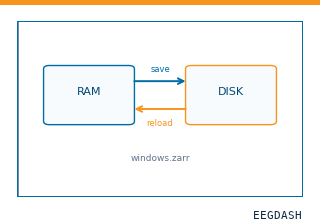 Save and reload prepared dataCache a windowed dataset to disk and reattach it without recompute.
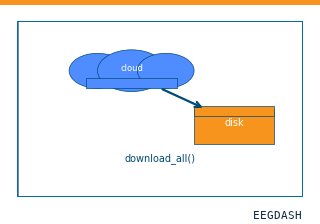 Download a dataset locallyPrefetch BIDS files to a local cache and validate the layout.
Swap any load_dataset(...) call for nm000358 to reproduce the tutorial on this dataset.
Citation
Steven M. Peterson, Satpreet H. Singh, Benjamin Dichter, Michael Scheid, Rajesh P. N. Rao, … (2022). AJILE12: long-term naturalistic ECoG with wrist-movement events and behaviour labels (DANDI 000055). 10.82901/nemar.nm000358
Provenance
¹Contributed to nemar in BIDS format.
²Curated & ingested by the EEGDash catalog; see CITATION.cff for canonical reference.
³Persistent identifier: 10.82901/nemar.nm000358.
See Also#
eegdash.dataset.EEGDashDataseteegdash.dataset