


NM000408: ieeg dataset, 1 subjects#
Motor imagination and execution with a chronic wireless epidural ECoG BCI (WIMAGINE), one participant with tetraplegia (Pollina et al. 2026)
Access recordings and metadata through EEGDash.
Citation: Leonardo Pollina, Lucas Struber, Valeria De Seta, Eleonora Russo, Serpil Karakas, Stephan Chabardes, Tetiana Aksenova, Guillaume Charvet, Solaiman Shokur, Silvestro Micera (2026). Motor imagination and execution with a chronic wireless epidural ECoG BCI (WIMAGINE), one participant with tetraplegia (Pollina et al. 2026). 10.82901/nemar.nm000408
Modality: ieeg Subjects: 1 Recordings: 110 License: CC-BY-4.0 Source: nemar
Metadata: Complete (100%)
1-participant iEEG dataset — Motor imagination and execution with a chronic wireless epidural ECoG BCI (WIMAGINE), one participant with tetraplegia (Pollina et al. 2026).
Quickstart#
Install
pip install eegdash
Access the data
from eegdash.dataset import NM000408

dataset = NM000408(cache_dir="./data")
# Get the raw object of the first recording
raw = dataset.datasets[0].raw
print(raw.info)
Filter by subject
dataset = NM000408(cache_dir="./data", subject="01")
Advanced query
dataset = NM000408(
    cache_dir="./data",
    query={"subject": {"$in": ["01", "02"]}},
)
Iterate recordings
for rec in dataset:
    print(rec.subject, rec.raw.info['sfreq'])
If you use this dataset in your research, please cite the original authors.
BibTeX
@dataset{nm000408,
  title = {Motor imagination and execution with a chronic wireless epidural ECoG BCI (WIMAGINE), one participant with tetraplegia (Pollina et al. 2026)},
  author = {Leonardo Pollina and Lucas Struber and Valeria De Seta and Eleonora Russo and Serpil Karakas and Stephan Chabardes and Tetiana Aksenova and Guillaume Charvet and Solaiman Shokur and Silvestro Micera},
  doi = {10.82901/nemar.nm000408},
  url = {https://doi.org/10.82901/nemar.nm000408},
}
About This Dataset#
Data released with:
Pollina L, Struber L, De Seta V, Russo E, Karakas S, Chabardes S, Aksenova T, Charvet G, Shokur S, Micera S (2026). Decoupling simultaneous motor imagination and execution via orthogonal ECoG neural representations. *Nature Communications*. https://doi.org/10.1038/s41467-026-71234-0
Motor imagination and execution with a chronic epidural ECoG implant (derivative)
Source record: Zenodo https://doi.org/10.5281/zenodo.18703801 (CC-BY-4.0). Analysis code: https://doi.org/10.5281/zenodo.18317718. This is a derivative dataset: the release contains band-pass filtered ECoG (1-250 Hz) and band-envelope epochs, not the raw implant recordings (“only bandpass filtered in [1,250] Hz as well as fully preprocessed”, paper data availability statement).
Participant (from the paper)
View full README
Motor imagination and execution with a chronic epidural ECoG implant (derivative)
Source record: Zenodo https://doi.org/10.5281/zenodo.18703801 (CC-BY-4.0). Analysis code: https://doi.org/10.5281/zenodo.18317718. This is a derivative dataset: the release contains band-pass filtered ECoG (1-250 Hz) and band-envelope epochs, not the raw implant recordings (“only bandpass filtered in [1,250] Hz as well as fully preprocessed”, paper data availability statement).
Participant (from the paper)
One 34-year-old man with incomplete tetraplegia after a C6 spinal cord injury, implanted in November 2019 (14 years after the injury) with the WIMAGINE wireless epidural ECoG device within clinical trial NCT02550522 (ANSM 2015-A00650-49, CPP 15-CHUG-19), written informed consent. This release holds 32 channels of the left implant over primary motor and sensory cortex.
Task (from the paper)
Seated in front of a screen with movement instructions and a progress bar, the participant executed or imagined right-arm
reaching (RE) and wrist-extension (WE) movements, singly or simultaneously (one executed and one imagined); EMG of the
extensor digitorum and lateral deltoid monitored execution. Condition labels (trial_type) are kept as released.
Files
sub-01/ses-001..008/ieeg/*_desc-bandpass1to250_ieeg.*: each experimental run ofAll_data_BP.pickle(BP_data), 32 channels, 585.137507314219 Hz (value from the authors’Global_parameters.py), BrainVision float32 (float64 values rounded). The authors applied a zero-phase 5th-order Butterworth band-pass 1-250 Hz (Preprocessing.py); the implant itself applies a 0.5-300 Hz analog band-pass and a 292.8 Hz FIR low-pass.*_task-baselineeo_*: baseline (“eo”) runs from the same pickle, as loaded by the authors (their loading code does not filter them).*_events.tsv:Trials_infoof each run (onset, duration, sample, trial_type, value) as released.The release does not state the physical unit of the signals; the channels are labelled µV as an assumption.
No electrode coordinates are released (
electrodes.tsvhas names only).sourcedata/zenodo-18703801/: both pickles unchanged (All_data_BP.pickle, which also holds the EMG recordings at 2000 Hz with their time stamps and sync triggers, andAll_data_preprocessed.pickle: per-trial band envelopes for seven bands, trial labels and artifact indices) and the two source-data spreadsheets of the paper.
Licence
CC-BY-4.0, as the source record. Please cite the paper and the Zenodo record.
Additional metadata and localisation (added 2026-10-08)
Compiled after the upload from the article, its supplement and the source deposit (each statement names its source). Text and sidecar metadata only; no data file was changed. Recording system. WIMAGINE epidural wireless ECoG implant (Clinatec, CEA-LETI/CHU Grenoble Alpes); analog band-pass 0.5-300 Hz in the implant, then a digital low-pass FIR at 292.8 Hz (doi:10.1038/s41467-026-71234-0, Methods ‘Data acquisition and signal preprocessing’). The sampling rate is not stated in the paper; the trial tables in the deposit give sample/onset ratios of about 585 Hz (e.g. sample 6995 at 11.95 s; derived, not stated). EMG: 6 bipolar channels (Noraxon Delsys via LabJack) from session 4 (doi:10.1038/s41467-026-71234-0). Deposited signals. All_data_BP.pickle: ‘only bandpass filtered in [1,250] Hz’; All_data_preprocessed.pickle: band envelopes (delta..high gamma), 2446 trials x 32 channels x 850 samples (doi:10.1038/s41467-026-71234-0, Data availability; Voyager Jobs ieeg-b3enr-c-pollina-1007220751 and -1007221212). Reference scheme. Offline common median reference across channels (doi:10.1038/s41467-026-71234-0, Methods). The hardware reference of the implant is not stated (n/a). Electrode types. Epidural planar electrodes, 2.3 mm diameter, 4-4.5 mm inter-electrode spacing, 64 per implant; 32 electrodes of the left implant were selected in a checkerboard-like pattern because of radio-link data-rate limits and a malfunction of the right implant (doi:10.1038/s41467-026-71234-0, Methods ‘Participant’). Localisation method. The implant is over the left primary motor (M1) and sensory (S1) cortices; medical reconstruction images of the implant were made with FreeSurfer, BrainStorm and MeshLab (Fig. 1c) (doi:10.1038/s41467-026-71234-0). Per-channel M1/S1 assignments for all 32 channels are in the deposit’s source-data workbook (Source_Data_File_Main_Figures_Pollina_2026.xlsx (deposit), sheet ‘Figure 3’, panels a/c/d/f, columns ‘Channel’/’Location’ (same table in Source_Data_File_Suppl_Figures_Pollina_2026.xlsx sheet ‘Figure S5’)); no coordinates are deposited.
These M1/S1 assignments are now in the anat_label column of every session’s electrodes.tsv (n/a in session 7, which recorded the complementary set of 32 electrodes that the workbook does not label).
NEMAR Metadata#
[](https://doi.org/10.82901/nemar.nm000408) # Motor imagination and execution with a chronic epidural ECoG implant (derivative) Data released with: > Pollina L, Struber L, De Seta V, Russo E, Karakas S, Chabardes S, Aksenova T, Charvet G, Shokur S, Micera S (2026). > Decoupling simultaneous motor imagination and execution via orthogonal ECoG neural representations. > Nature Communications. https://doi.org/10.1038/s41467-026-71234-0 Source record: Zenodo https://doi.org/10.5281/zenodo.18703801 (CC-BY-4.0). Analysis code: https://doi.org/10.5281/zenodo.18317718. This is a derivative dataset: the release contains band-pass filtered ECoG (1-250 Hz) and band-envelope epochs, not the raw implant recordings (“only bandpass filtered in [1,250] Hz as well as fully preprocessed”, paper data availability statement). ## Participant (from the paper) One 34-year-old man with incomplete tetraplegia after a C6 spinal cord injury, implanted in November 2019 (14 years after the injury) with the WIMAGINE wireless epidural ECoG device within clinical trial NCT02550522 (ANSM 2015-A00650-49, CPP 15-CHUG-19), written informed consent. This release holds 32 channels of the left implant over primary motor and sensory cortex. ## Task (from the paper) Seated in front of a screen with movement instructions and a progress bar, the participant executed or imagined right-arm reaching (RE) and wrist-extension (WE) movements, singly or simultaneously (one executed and one imagined); EMG of the extensor digitorum and lateral deltoid monitored execution. Condition labels (trial_type) are kept as released. ## Files - sub-01/ses-001..008/ieeg/*_desc-bandpass1to250_ieeg.*: each experimental run of All_data_BP.pickle (BP_data),
32 channels, 585.137507314219 Hz (value from the authors’ Global_parameters.py), BrainVision float32 (float64 values rounded). The authors applied a zero-phase 5th-order Butterworth band-pass 1-250 Hz (Preprocessing.py); the implant itself applies a 0.5-300 Hz analog band-pass and a 292.8 Hz FIR low-pass.
*_task-baselineeo_*: baseline (“eo”) runs from the same pickle, as loaded by the authors (their loading code does not filter them).
*_events.tsv: Trials_info of each run (onset, duration, sample, trial_type, value) as released.
The release does not state the physical unit of the signals; the channels are labelled µV as an assumption.
No electrode coordinates are released (electrodes.tsv has names only).
sourcedata/zenodo-18703801/: both pickles unchanged (All_data_BP.pickle, which also holds the EMG recordings at 2000 Hz with their time stamps and sync triggers, and All_data_preprocessed.pickle: per-trial band envelopes for seven bands, trial labels and artifact indices) and the two source-data spreadsheets of the paper.
## Licence CC-BY-4.0, as the source record. Please cite the paper and the Zenodo record. ## Additional metadata and localisation (added 2026-10-08) Compiled after the upload from the article, its supplement and the source deposit (each statement names its source). Text and sidecar metadata only; no data file was changed. Recording system. WIMAGINE epidural wireless ECoG implant (Clinatec, CEA-LETI/CHU Grenoble Alpes); analog band-pass 0.5-300 Hz in the implant, then a digital low-pass FIR at 292.8 Hz (doi:10.1038/s41467-026-71234-0, Methods ‘Data acquisition and signal preprocessing’). The sampling rate is not stated in the paper; the trial tables in the deposit give sample/onset ratios of about 585 Hz (e.g. sample 6995 at 11.95 s; derived, not stated). EMG: 6 bipolar channels (Noraxon Delsys via LabJack) from session 4 (doi:10.1038/s41467-026-71234-0). Deposited signals. All_data_BP.pickle: ‘only bandpass filtered in [1,250] Hz’; All_data_preprocessed.pickle: band envelopes (delta..high gamma), 2446 trials x 32 channels x 850 samples (doi:10.1038/s41467-026-71234-0, Data availability; Voyager Jobs ieeg-b3enr-c-pollina-1007220751 and -1007221212). Reference scheme. Offline common median reference across channels (doi:10.1038/s41467-026-71234-0, Methods). The hardware reference of the implant is not stated (n/a). Electrode types. Epidural planar electrodes, 2.3 mm diameter, 4-4.5 mm inter-electrode spacing, 64 per implant; 32 electrodes of the left implant were selected in a checkerboard-like pattern because of radio-link data-rate limits and a malfunction of the right implant (doi:10.1038/s41467-026-71234-0, Methods ‘Participant’). Localisation method. The implant is over the left primary motor (M1) and sensory (S1) cortices; medical reconstruction images of the implant were made with FreeSurfer, BrainStorm and MeshLab (Fig. 1c) (doi:10.1038/s41467-026-71234-0). Per-channel M1/S1 assignments for all 32 channels are in the deposit’s source-data workbook (Source_Data_File_Main_Figures_Pollina_2026.xlsx (deposit), sheet ‘Figure 3’, panels a/c/d/f, columns ‘Channel’/’Location’ (same table in Source_Data_File_Suppl_Figures_Pollina_2026.xlsx sheet ‘Figure S5’)); no coordinates are deposited. These M1/S1 assignments are now in the anat_label column of every session’s electrodes.tsv (n/a in session 7, which recorded the complementary set of 32 electrodes that the workbook does not label).
License: CC-BY-4.0
Authors:
Leonardo Pollina
Lucas Struber
Valeria De Seta
Eleonora Russo
Serpil Karakas
… and 5 more
Versions:
Version |
DOI |
Released |
|---|---|---|
|
Cohort#
Dataset Statistics#
Age distribution by gender (n=1, range 34–34 yr, mean 34.0 yr)
Sex composition
Channel counts: 32 ch (n=110 recordings)
Sampling frequencies: 585.137507314219 Hz (n=110 recordings)
Total recording duration: 7 h 38 min
Signal · Electrodes & live trace#
Live trace viewer — sub-01 · ses-002 · task-mappingrewe · run-04
Showing one representative recording out of
1 subjects and 110 recordings in this dataset.
Browse the full set on OpenNeuro;
drop any other _ieeg.{set,edf,bdf,vhdr} file onto the
viewer (or pass ?ieeg=<url>) to inspect it.
No scalp electrode layout is currently indexed for this dataset. Once the eegdash montage registry ingests it, the interactive viewer will appear here automatically.
NEMAR Processing Statistics#
The plots below are generated by NEMAR’s automated EEG pipeline. The histogram shows pipeline success for data cleaning and ICA decomposition, the percentage of data frames and EEG channels retained after artefact removal, line noise per channel (RMS, dB), and the age/gender distribution of participants.

HED event descriptors word cloud

Manifest#
File Explorer#
Browse the BIDS file structure of this dataset. Records are fetched on demand from the EEGDash catalog the first time you open the explorer.
Full dataset metadata table
Dataset ID |
|
Title |
Motor imagination and execution with a chronic wireless epidural ECoG BCI (WIMAGINE), one participant with tetraplegia (Pollina et al. 2026) |
Author (year) |
— |
Canonical |
— |
Importable as |
|
Year |
2026 |
Authors |
Leonardo Pollina, Lucas Struber, Valeria De Seta, Eleonora Russo, Serpil Karakas, Stephan Chabardes, Tetiana Aksenova, Guillaume Charvet, Solaiman Shokur, Silvestro Micera |
License |
CC-BY-4.0 |
Citation / DOI |
|
Source links |
OpenNeuro | NeMAR | Source URL |
Copy-paste BibTeX
@dataset{nm000408,
  title = {Motor imagination and execution with a chronic wireless epidural ECoG BCI (WIMAGINE), one participant with tetraplegia (Pollina et al. 2026)},
  author = {Leonardo Pollina and Lucas Struber and Valeria De Seta and Eleonora Russo and Serpil Karakas and Stephan Chabardes and Tetiana Aksenova and Guillaume Charvet and Solaiman Shokur and Silvestro Micera},
  doi = {10.82901/nemar.nm000408},
  url = {https://doi.org/10.82901/nemar.nm000408},
}
API Reference#
eegdash.datasetEEGDashDataset- class eegdash.dataset.NM000408(cache_dir: str, query: dict | None = None, s3_bucket: str | None = None, **kwargs)[source]#
Motor imagination and execution with a chronic wireless epidural ECoG BCI (WIMAGINE), one participant with tetraplegia (Pollina et al. 2026)
- Study:
nm000408(NeMAR)- Author (year):
—
- Canonical:
—
Also importable as:
NM000408.Modality:
ieeg; Subject type:Unknown. Subjects: 1; recordings: 110; tasks: 8.- Parameters:
cache_dir (str | Path) – Directory where data are cached locally.
query (dict | None) – Additional MongoDB-style filters to AND with the dataset selection. Must not contain the key
dataset.s3_bucket (str | None) – Base S3 bucket used to locate the data.
**kwargs (dict) – Additional keyword arguments forwarded to
EEGDashDataset.
- data_dir#
Local dataset cache directory (
cache_dir / dataset_id).- Type:
Path
Notes
Each item is a recording; recording-level metadata are available via
dataset.description.querysupports MongoDB-style filters on fields inALLOWED_QUERY_FIELDSand is combined with the dataset filter. Dataset-specific caveats are not provided in the summary metadata.References
OpenNeuro dataset: https://openneuro.org/datasets/nm000408 NeMAR dataset: https://nemar.org/dataexplorer/detail?dataset_id=nm000408 DOI: https://doi.org/10.82901/nemar.nm000408
Examples
>>> from eegdash.dataset import NM000408
>>> dataset = NM000408(cache_dir="./data")
>>> recording = dataset[0]
>>> raw = recording.load()
- __init__(cache_dir: str, query: dict | None = None, s3_bucket: str | None = None, **kwargs)[source]#
- save(path: str, overwrite: bool = False, offset: int = 0)[source]#
Save datasets to files by creating one subdirectory for each dataset:
path/
    0/
        0-raw.fif | 0-epo.fif
        description.json
        raw_preproc_kwargs.json (if raws were preprocessed)
        window_kwargs.json (if this is a windowed dataset)
        window_preproc_kwargs.json  (if windows were preprocessed)
        target_name.json (if target_name is not None and dataset is raw)
    1/
        1-raw.fif | 1-epo.fif
        description.json
        raw_preproc_kwargs.json (if raws were preprocessed)
        window_kwargs.json (if this is a windowed dataset)
        window_preproc_kwargs.json  (if windows were preprocessed)
        target_name.json (if target_name is not None and dataset is raw)
- Parameters:
path (str) –
- Directory in which subdirectories are created to store
-raw.fif | -epo.fif and .json files to.
overwrite (bool) – Whether to delete old subdirectories that will be saved to in this call.
offset (int) – If provided, the integer is added to the id of the dataset in the concat. This is useful in the setting of very large datasets, where one dataset has to be processed and saved at a time to account for its original position.
BaseDataset from braindecode — windowed via create_windows_from_events.braindecodeDataLoader; supports parallel workers and on-the-fly augmentations.pytorch Find datasets with the EEGDash APIQuery the catalogue, filter by task or modality, list candidates.
 Load one EEG recordingResolve a single record to an MNE Raw with channels and events.
 EEG recording to PyTorch DataLoaderWrap braindecode windows in a DataLoader for model training.
 Preprocess EEG and create windowsFilter, resample, epoch — and persist the windowed dataset.
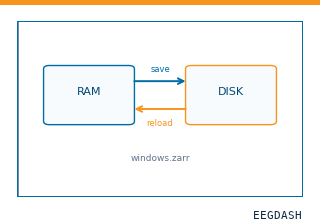 Save and reload prepared dataCache a windowed dataset to disk and reattach it without recompute.
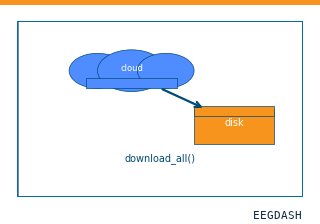 Download a dataset locallyPrefetch BIDS files to a local cache and validate the layout.
Swap any load_dataset(...) call for nm000408 to reproduce the tutorial on this dataset.
Citation
Leonardo Pollina, Lucas Struber, Valeria De Seta, Eleonora Russo, Serpil Karakas, … (2026). Motor imagination and execution with a chronic wireless epidural ECoG BCI (WIMAGINE), one participant with tetraplegia (Pollina et al. 2026). 10.82901/nemar.nm000408
Provenance
¹Contributed to nemar in BIDS format.
²Curated & ingested by the EEGDash catalog; see CITATION.cff for canonical reference.
³Persistent identifier: 10.82901/nemar.nm000408.
See Also#
eegdash.dataset.EEGDashDataseteegdash.dataset