


ON005342: eeg dataset, 32 subjects#
EEG data offline and online during motor imagery for standing and sitting
Access recordings and metadata through EEGDash.
Citation: Nayid Triana-Guzman, Alvaro D Orjuela-Cañon, Andres L Jutinico, Omar Mendoza-Montoya, Javier M Antelis (—). EEG data offline and online during motor imagery for standing and sitting. 10.82901/nemar.on005342
Modality: eeg Subjects: 32 Recordings: 32 License: CC0 Source: nemar
Metadata: Good (80%)
32-participant EEG dataset — EEG data offline and online during motor imagery for standing and sitting.
Quickstart#
Install
pip install eegdash
Access the data
from eegdash.dataset import ON005342

dataset = ON005342(cache_dir="./data")
# Get the raw object of the first recording
raw = dataset.datasets[0].raw
print(raw.info)
Filter by subject
dataset = ON005342(cache_dir="./data", subject="01")
Advanced query
dataset = ON005342(
    cache_dir="./data",
    query={"subject": {"$in": ["01", "02"]}},
)
Iterate recordings
for rec in dataset:
    print(rec.subject, rec.raw.info['sfreq'])
If you use this dataset in your research, please cite the original authors.
BibTeX
@dataset{on005342,
  title = {EEG data offline and online during motor imagery for standing and sitting},
  author = {Nayid Triana-Guzman and Alvaro D Orjuela-Cañon and Andres L Jutinico and Omar Mendoza-Montoya and Javier M Antelis},
  doi = {10.82901/nemar.on005342},
  url = {https://doi.org/10.82901/nemar.on005342},
}
About This Dataset#
The experiments were conducted in an acoustically isolated room where only the participant and the experimenter were present. Participants voluntarily signed an informed consent form in accordance with the experimental protocol approved by the ethics committee of the Universidad Antonio Nariño. The participant was seated in a chair in a posture that was comfortable for him/her but did not affect data collection. In front of the participant, a 40-inch TV screen was placed at about 3 m. On this screen, a graphical user interface (GUI) displayed images that guided the participant through the experiment. Each experimental session was divided into two phases: an offline phase and an online phase.
The offline experiments consisted of recording participants´ EEG signals during motor imagery trials for standing and sitting that were guided by the GUI presented on the TV screen. Six offline runs were conducted in which the participants were standing in three runs and sitting in the other three runs. In each run, the participant had to repeat a block of 30 trials of mental tasks indicated by visual cues continuously presented on the screen in a pseudo-random sequence.
The first phase of the experimental session was conducted to construct the offline parts of the dataset: (A) Sit-to-stand and (B) Stand-to-sit. The participant´s EEG data were collected from 90 sequences for part A (45 trials of MotorImageryA tasks and 45 trials of IdleStateA tasks) and 90 sequences for part B (45 trials of MotorImageryB tasks and 45 trials of IdleStateB tasks).
For each participant, the two machine learning models obtained in the offline phase were used to carry out the online experiment parts of the dataset: (C) Sit-to-stand and (D) Stand-to-sit. Each participant was instructed to select, in no particular order, 30 sequences for part C (15 trials of MotorImageryA tasks and 15 trials of IdleStateA tasks) and 30 other sequences for part D (15 trials of MotorImageryB tasks and 15 trials of IdleStateB tasks). Each trial was unique and was generated pseudo-randomly before the experiment. The database consisted of 32 electroencephalographic files corresponding to the 32 participants. All recordings were collected on channels F3, Fz, F4, FC5, FC1, FC2, FC6, C3, Cz, C4, CP5, CP1, CP2, CP6, P3, Pz, and P4 according to the 10-20 EEG electrode placement standard, grounded to AFz channel and referenced to right mastoid (M2). Each data file contained the data stream in a 2D matrix where rows corresponded to channels and columns corresponded to time samples with a sampling frequency of 250Hz.
The following marker numbers encoded information about the execution of the experiment. Marker numbers 200, 201, 202, and 203, indicated the beginning and end of the four steps of the sequence in a trial (resting, fixation, action observation, and imagining). Marker numbers 1, 2, 3, and 4, indicated the figure activated on the screen to the participant perform the task corresponding to 1. actively imagining the sit-to-stand movement (labeled as MotorImageryA), 2. sitting motionless without imagining the sit-to-stand movement (labeled as IdleStateA), 3. standing motionless while actively imagining the stand-to-sit movement (labeled as MotorImageryB), or 4. standing motionless without imagining the stand-to-sit movement (labeled as IdleStateB). Finally, marker numbers 101, 102, 103, and 104, indicated the task detected by the BCI in real time during the online experiment: 101. MotorImageryA, 102. IdleStateA, 103. MotorImageryB, or 104. IdleStateB.
Cohort#
Dataset Statistics#
Age distribution (n=32, range 19–29 yr, mean 23.0 yr · sex per subject not reported)
Sex composition
Signal · Electrodes & live trace#
No scalp electrode layout is currently indexed for this dataset. Once the eegdash montage registry ingests it, the interactive viewer will appear here automatically.
NEMAR Processing Statistics#
The plots below are generated by NEMAR’s automated EEG pipeline. The histogram shows pipeline success for data cleaning and ICA decomposition, the percentage of data frames and EEG channels retained after artefact removal, line noise per channel (RMS, dB), and the age/gender distribution of participants.

HED event descriptors word cloud

Manifest#
File Explorer#
Browse the BIDS file structure of this dataset. Records are fetched on demand from the EEGDash catalog the first time you open the explorer.
Full dataset metadata table
Dataset ID |
|
Title |
EEG data offline and online during motor imagery for standing and sitting |
Author (year) |
— |
Canonical |
— |
Importable as |
|
Year |
— |
Authors |
Nayid Triana-Guzman, Alvaro D Orjuela-Cañon, Andres L Jutinico, Omar Mendoza-Montoya, Javier M Antelis |
License |
CC0 |
Citation / DOI |
|
Source links |
OpenNeuro | NeMAR | Source URL |
Copy-paste BibTeX
@dataset{on005342,
  title = {EEG data offline and online during motor imagery for standing and sitting},
  author = {Nayid Triana-Guzman and Alvaro D Orjuela-Cañon and Andres L Jutinico and Omar Mendoza-Montoya and Javier M Antelis},
  doi = {10.82901/nemar.on005342},
  url = {https://doi.org/10.82901/nemar.on005342},
}
API Reference#
eegdash.datasetEEGDashDataset- class eegdash.dataset.ON005342(cache_dir: str, query: dict | None = None, s3_bucket: str | None = None, **kwargs)[source]#
EEG data offline and online during motor imagery for standing and sitting
- Study:
on005342(NeMAR)- Author (year):
—
- Canonical:
—
Also importable as:
ON005342.Modality:
eeg; Subject type:Unknown. Subjects: 32; recordings: 32; tasks: 1.- Parameters:
cache_dir (str | Path) – Directory where data are cached locally.
query (dict | None) – Additional MongoDB-style filters to AND with the dataset selection. Must not contain the key
dataset.s3_bucket (str | None) – Base S3 bucket used to locate the data.
**kwargs (dict) – Additional keyword arguments forwarded to
EEGDashDataset.
- data_dir#
Local dataset cache directory (
cache_dir / dataset_id).- Type:
Path
Notes
Each item is a recording; recording-level metadata are available via
dataset.description.querysupports MongoDB-style filters on fields inALLOWED_QUERY_FIELDSand is combined with the dataset filter. Dataset-specific caveats are not provided in the summary metadata.References
OpenNeuro dataset: https://openneuro.org/datasets/on005342 NeMAR dataset: https://nemar.org/dataexplorer/detail?dataset_id=on005342 DOI: https://doi.org/10.82901/nemar.on005342
Examples
>>> from eegdash.dataset import ON005342
>>> dataset = ON005342(cache_dir="./data")
>>> recording = dataset[0]
>>> raw = recording.load()
- __init__(cache_dir: str, query: dict | None = None, s3_bucket: str | None = None, **kwargs)[source]#
- save(path: str, overwrite: bool = False, offset: int = 0)[source]#
Save datasets to files by creating one subdirectory for each dataset:
path/
    0/
        0-raw.fif | 0-epo.fif
        description.json
        raw_preproc_kwargs.json (if raws were preprocessed)
        window_kwargs.json (if this is a windowed dataset)
        window_preproc_kwargs.json  (if windows were preprocessed)
        target_name.json (if target_name is not None and dataset is raw)
    1/
        1-raw.fif | 1-epo.fif
        description.json
        raw_preproc_kwargs.json (if raws were preprocessed)
        window_kwargs.json (if this is a windowed dataset)
        window_preproc_kwargs.json  (if windows were preprocessed)
        target_name.json (if target_name is not None and dataset is raw)
- Parameters:
path (str) –
- Directory in which subdirectories are created to store
-raw.fif | -epo.fif and .json files to.
overwrite (bool) – Whether to delete old subdirectories that will be saved to in this call.
offset (int) – If provided, the integer is added to the id of the dataset in the concat. This is useful in the setting of very large datasets, where one dataset has to be processed and saved at a time to account for its original position.
BaseDataset from braindecode — windowed via create_windows_from_events.braindecodeDataLoader; supports parallel workers and on-the-fly augmentations.pytorch Find datasets with the EEGDash APIQuery the catalogue, filter by task or modality, list candidates.
 Load one EEG recordingResolve a single record to an MNE Raw with channels and events.
 EEG recording to PyTorch DataLoaderWrap braindecode windows in a DataLoader for model training.
 Preprocess EEG and create windowsFilter, resample, epoch — and persist the windowed dataset.
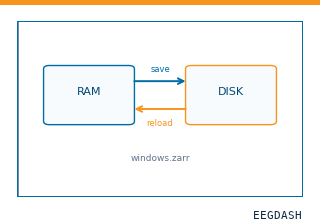 Save and reload prepared dataCache a windowed dataset to disk and reattach it without recompute.
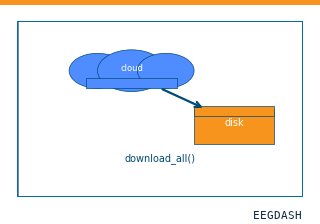 Download a dataset locallyPrefetch BIDS files to a local cache and validate the layout.
Swap any load_dataset(...) call for on005342 to reproduce the tutorial on this dataset.
Citation
Nayid Triana-Guzman, Alvaro D Orjuela-Cañon, Andres L Jutinico, Omar Mendoza-Montoya, Javier M Antelis (n.d.). EEG data offline and online during motor imagery for standing and sitting. 10.82901/nemar.on005342
Provenance
¹Contributed to nemar in BIDS format.
²Curated & ingested by the EEGDash catalog; see CITATION.cff for canonical reference.
³Persistent identifier: 10.82901/nemar.on005342.
See Also#
eegdash.dataset.EEGDashDataseteegdash.dataset