


ON005007: ieeg dataset, 40 subjects#
Auditory naming task with questions that begin or end with a wh-interrogative
Access recordings and metadata through EEGDash.
Citation: Yu Kitazawa, Eishi Asano (2026). Auditory naming task with questions that begin or end with a wh-interrogative. 10.82901/nemar.on005007
Modality: ieeg Subjects: 40 Recordings: 42 License: CC0 Source: nemar
Metadata: Complete (100%)
40-participant iEEG dataset — Auditory naming task with questions that begin or end with a wh-interrogative.
Quickstart#
Install
pip install eegdash
Access the data
from eegdash.dataset import ON005007

dataset = ON005007(cache_dir="./data")
# Get the raw object of the first recording
raw = dataset.datasets[0].raw
print(raw.info)
Filter by subject
dataset = ON005007(cache_dir="./data", subject="01")
Advanced query
dataset = ON005007(
    cache_dir="./data",
    query={"subject": {"$in": ["01", "02"]}},
)
Iterate recordings
for rec in dataset:
    print(rec.subject, rec.raw.info['sfreq'])
If you use this dataset in your research, please cite the original authors.
BibTeX
@dataset{on005007,
  title = {Auditory naming task with questions that begin or end with a wh-interrogative},
  author = {Yu Kitazawa and Eishi Asano},
  doi = {10.82901/nemar.on005007},
  url = {https://doi.org/10.82901/nemar.on005007},
}
About This Dataset#
<!– nemar:provenance –>
This dataset is mirrored on NEMAR from OpenNeuro.
Source: ds005007
Channel names follow the data headers (18 Oct 2026)
In 42 recordings the channel list of channels.tsv did not equal the data-file header (names, order or count). In the 42 with a different channel count, mne_bids.read_raw_bids warned and kept the header names, so the channels.tsv types and bad-channel status reached only the channels whose names happen to be identical; a reader that applies the channels.tsv rows by position gives wrong labels wherever the two lists are not aligned. Since 18 Oct 2026 every channels.tsv lists exactly the header channels, in header order, with the header names (MNE names: duplicated header labels numbered -0, -1).
Rows were matched to header channels BY NAME, never by position (exact; then case/whitespace; then the recorder prefix ‘EEG ‘/’POL ‘, ‘_’ and zero padding; then a trailing ‘-<reference>’ token). Matched rows keep all their columns (type, units, status, …); 4368 rows took the header name (the header labels carry ‘POL ‘ prefix, ‘EEG ‘ prefix + ‘-Ref’ suffix).
1057 header channels had no channels.tsv row (42 files) and got a new row: type from the name (ECG/EMG/EOG/trigger) or from the other contacts of the same shaft, else MISC; units from the header; status n/a. Examples: sub-01_ses-01_task-namingtask_run-01_ieeg.edf: POL ECG, POL L4, POL L5, POL L6; sub-02_ses-01_task-namingtask_run-01_ieeg.edf: POL ECG, POL K2, POL K3, POL K4; sub-03_ses-01_task-namingtask_run-01_ieeg.edf: POL ECG, EEG M2-Ref, POL M3, POL M4.
55 channels.tsv rows had no channel in the data file (2 files) and were removed; they are kept verbatim under sourcedata/channels-removed-2026-10-18/ (same relative path). Examples: sub-08_ses-01_task-namingtask_run-01_ieeg.edf: F09, F10, G05, G06, G07; sub-10_ses-01_task-namingtask_run-01_ieeg.edf: J1, J5, J6, K1, K2.
41 files listed the channels in another order than the header; rows now follow the header order.
Applied by position, the former rows would have given wrong labels to 4337 channels in 42 files (rows missing, extra or out of order before that position).
electrodes.tsv is unchanged and keeps the contact names (e.g. A1), while channels.tsv follows the recording headers (e.g. POL A1, EEG M2-Ref). To pair a channel with its contact, drop a leading POL `` or ``EEG `` and a trailing reference suffix (-Ref``, -AV).
Sampling frequency follows the data headers (18 Oct 2026)
sampling_frequency: 58 channels.tsv rows in 1 files and SamplingFrequency in 1 *_ieeg.json set to the rate of the data-file header (e.g. sub-02_ses-01_task-namingtask_run-01_channels.tsv POL J5: 1000 -> 2000; sub-02_ses-01_task-namingtask_run-01_channels.tsv POL J6: 1000 -> 2000; sub-02_ses-01_task-namingtask_run-01_channels.tsv POL J7: 1000 -> 2000).
Check (header level, 22 Oct 2026): the EDF header of sub-02_ses-01_task-namingtask_run-01_ieeg.edf gives a sampling rate of 2000 Hz (samples per data record divided by the record duration). After this change the sidecar SamplingFrequency and every channels.tsv sampling_frequency of that recording equal the header rate, as in the other 41 recordings.
Electrode coordinate system (19 Oct 2026; revised 20 Nov 2026)
A coordsystem.json (fsaverage, mm) sits next to each of the 42 electrodes.tsv. This deposit does not state a coordinate system, so the frame is inferred, not documented: every contact’s x/y/z (3388 contacts in 42 files) equals a vertex of the fsaverage pial surface (within 0.001 mm), which is consistent with FreeSurfer surface-based normalization of subdural contacts. fsaverage is FreeSurfer’s template whose volumetric frame is FreeSurfer’s MNI305 space. Other deposits from the same group give identical coordinates and call the space MNI305 or fsaverage. Each sidecar’s iEEGCoordinateSystemDescription states the same evidence.
Limitation: these sidecars declare the frame and units only. electrodes.tsv is unchanged and no coordinate value changed. Positions do not attach to channels in mne_bids or EEGDash, because the channel names (data-header labels, e.g. prefixed labels or bipolar derivations) differ from the contact names in electrodes.tsv; a channel-to-contact mapping is not part of this change. This dataset mirrors OpenNeuro; the same change belongs upstream.
Cohort#
Dataset Statistics#
Age distribution by gender (n=40, range 6–54 yr, mean 25.0 yr)
Sex composition
Channel counts (ch)
Sampling frequencies (Hz)
Total recording duration: 9 h 25 min
Signal · Electrodes & live trace#
Live trace viewer — sub-17 · ses-01 · task-namingtask · run-01
Showing one representative recording out of
40 subjects and 42 recordings in this dataset.
Browse the full set on OpenNeuro;
drop any other _ieeg.{set,edf,bdf,vhdr} file onto the
viewer (or pass ?ieeg=<url>) to inspect it.
Electrode layout — iEEG · 264 sensors — 264 channels
NEMAR Processing Statistics#
The plots below are generated by NEMAR’s automated EEG pipeline. The histogram shows pipeline success for data cleaning and ICA decomposition, the percentage of data frames and EEG channels retained after artefact removal, line noise per channel (RMS, dB), and the age/gender distribution of participants.

HED event descriptors word cloud

Manifest#
File Explorer#
Browse the BIDS file structure of this dataset. Records are fetched on demand from the EEGDash catalog the first time you open the explorer.
Full dataset metadata table
Dataset ID |
|
Title |
Auditory naming task with questions that begin or end with a wh-interrogative |
Author (year) |
— |
Canonical |
— |
Importable as |
|
Year |
2026 |
Authors |
Yu Kitazawa, Eishi Asano |
License |
CC0 |
Citation / DOI |
|
Source links |
OpenNeuro | NeMAR | Source URL |
Copy-paste BibTeX
@dataset{on005007,
  title = {Auditory naming task with questions that begin or end with a wh-interrogative},
  author = {Yu Kitazawa and Eishi Asano},
  doi = {10.82901/nemar.on005007},
  url = {https://doi.org/10.82901/nemar.on005007},
}
API Reference#
eegdash.datasetEEGDashDataset- class eegdash.dataset.ON005007(cache_dir: str, query: dict | None = None, s3_bucket: str | None = None, **kwargs)[source]#
Auditory naming task with questions that begin or end with a wh-interrogative
- Study:
on005007(NeMAR)- Author (year):
—
- Canonical:
—
Also importable as:
ON005007.Modality:
ieeg; Experiment type:Language; Subject type:Healthy. Subjects: 40; recordings: 42; tasks: 1.- Parameters:
cache_dir (str | Path) – Directory where data are cached locally.
query (dict | None) – Additional MongoDB-style filters to AND with the dataset selection. Must not contain the key
dataset.s3_bucket (str | None) – Base S3 bucket used to locate the data.
**kwargs (dict) – Additional keyword arguments forwarded to
EEGDashDataset.
- data_dir#
Local dataset cache directory (
cache_dir / dataset_id).- Type:
Path
Notes
Each item is a recording; recording-level metadata are available via
dataset.description.querysupports MongoDB-style filters on fields inALLOWED_QUERY_FIELDSand is combined with the dataset filter. Dataset-specific caveats are not provided in the summary metadata.References
OpenNeuro dataset: https://openneuro.org/datasets/on005007 NeMAR dataset: https://nemar.org/dataexplorer/detail?dataset_id=on005007 DOI: https://doi.org/10.82901/nemar.on005007
Examples
>>> from eegdash.dataset import ON005007
>>> dataset = ON005007(cache_dir="./data")
>>> recording = dataset[0]
>>> raw = recording.load()
- __init__(cache_dir: str, query: dict | None = None, s3_bucket: str | None = None, **kwargs)[source]#
- save(path: str, overwrite: bool = False, offset: int = 0)[source]#
Save datasets to files by creating one subdirectory for each dataset:
path/
    0/
        0-raw.fif | 0-epo.fif
        description.json
        raw_preproc_kwargs.json (if raws were preprocessed)
        window_kwargs.json (if this is a windowed dataset)
        window_preproc_kwargs.json  (if windows were preprocessed)
        target_name.json (if target_name is not None and dataset is raw)
    1/
        1-raw.fif | 1-epo.fif
        description.json
        raw_preproc_kwargs.json (if raws were preprocessed)
        window_kwargs.json (if this is a windowed dataset)
        window_preproc_kwargs.json  (if windows were preprocessed)
        target_name.json (if target_name is not None and dataset is raw)
- Parameters:
path (str) –
- Directory in which subdirectories are created to store
-raw.fif | -epo.fif and .json files to.
overwrite (bool) – Whether to delete old subdirectories that will be saved to in this call. If a dataset still reads its data lazily from one of them, a
ValueErroris raised before anything is deleted: load the data into memory first (preload=True) or save to another directory.offset (int) – If provided, the integer is added to the id of the dataset in the concat. This is useful in the setting of very large datasets, where one dataset has to be processed and saved at a time to account for its original position.
BaseDataset from braindecode — windowed via create_windows_from_events.braindecodeDataLoader; supports parallel workers and on-the-fly augmentations.pytorch Find datasets with the EEGDash APIQuery the catalogue, filter by task or modality, list candidates.
 Load one EEG recordingResolve a single record to an MNE Raw with channels and events.
 EEG recording to PyTorch DataLoaderWrap braindecode windows in a DataLoader for model training.
 Preprocess EEG and create windowsFilter, resample, epoch — and persist the windowed dataset.
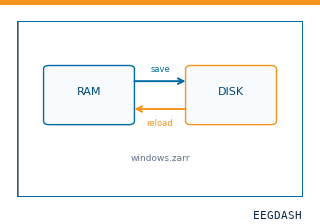 Save and reload prepared dataCache a windowed dataset to disk and reattach it without recompute.
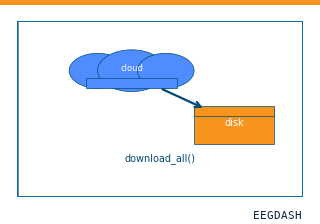 Download a dataset locallyPrefetch BIDS files to a local cache and validate the layout.
Swap any load_dataset(...) call for on005007 to reproduce the tutorial on this dataset.
Citation
Yu Kitazawa, Eishi Asano (2026). Auditory naming task with questions that begin or end with a wh-interrogative. 10.82901/nemar.on005007
Provenance
¹Contributed to nemar in BIDS format.
²Curated & ingested by the EEGDash catalog; see CITATION.cff for canonical reference.
³Persistent identifier: 10.82901/nemar.on005007.
See Also#
eegdash.dataset.EEGDashDataseteegdash.dataset