


NM000452: ieeg dataset, 1 subjects#
ECoG_HB_02: hybrid-density ECoG high-gamma features with synchronised speech, one participant (derivative)
Access recordings and metadata through EEGDash.
Citation: Xupeng Chen (2024). ECoG_HB_02: hybrid-density ECoG high-gamma features with synchronised speech, one participant (derivative). 10.82901/nemar.nm000452
Modality: ieeg Subjects: 1 Recordings: 1 License: CC-BY-4.0 Source: nemar
Metadata: Complete (100%)
1-participant iEEG dataset — ECoG_HB_02: hybrid-density ECoG high-gamma features with synchronised speech, one participant (derivative).
Quickstart#
Install
pip install eegdash
Access the data
from eegdash.dataset import NM000452

dataset = NM000452(cache_dir="./data")
# Get the raw object of the first recording
raw = dataset.datasets[0].raw
print(raw.info)
Filter by subject
dataset = NM000452(cache_dir="./data", subject="01")
Advanced query
dataset = NM000452(
    cache_dir="./data",
    query={"subject": {"$in": ["01", "02"]}},
)
Iterate recordings
for rec in dataset:
    print(rec.subject, rec.raw.info['sfreq'])
If you use this dataset in your research, please cite the original authors.
BibTeX
@dataset{nm000452,
  title = {ECoG_HB_02: hybrid-density ECoG high-gamma features with synchronised speech, one participant (derivative)},
  author = {Xupeng Chen},
  doi = {10.82901/nemar.nm000452},
  url = {https://doi.org/10.82901/nemar.nm000452},
}
About This Dataset#
This is a DERIVATIVE dataset. It repackages the single file of the Mendeley Data record “ECoG_HB_02”
(Xupeng Chen, doi:10.17632/fp4bv9gtwk.2, CC-BY-4.0), the one participant of Chen et al. 2024 (Nature Machine Intelligence) who consented to public release of neural and audio data. The raw ECoG voltage recordings were not released by the authors; what is shared is their processed 125 Hz feature matrix.
“hybrid-density ECoG data with synchronized speech and other features”.
ECoGHB02 (derivative): hybrid-density ECoG high-gamma features with synchronised speech
Processing, as stated in the paper Methods (not re-done here): ECoG sampled at 2,048 Hz and downsampled to 512 Hz; electrodes with artefacts (line noise, poor contact, high-amplitude shifts) or interictal/epileptiform activity rejected; common average reference subtracted; Hilbert envelope of the high gamma (70-150 Hz) component, downsampled to 125 Hz; each electrode normalised (z-scored) to the mean and variance of 250-ms silent periods before each trial’s stimulus in the training set.
View full README
ECoGHB02 (derivative): hybrid-density ECoG high-gamma features with synchronised speech
Processing, as stated in the paper Methods (not re-done here): ECoG sampled at 2,048 Hz and downsampled to 512 Hz; electrodes with artefacts (line noise, poor contact, high-amplitude shifts) or interictal/epileptiform activity rejected; common average reference subtracted; Hilbert envelope of the high gamma (70-150 Hz) component, downsampled to 125 Hz; each electrode normalised (z-scored) to the mean and variance of 250-ms silent periods before each trial’s stimulus in the training set.
Measured here: values -2.388 to 4.466, unitless (z-score). 128 columns carry signal and 97 columns are exactly 0 for every frame; those are marked
status=badin channels.tsv (1-based columns: 2, 4, 6, 8, 16, 17, 18, 19, 20, 21, 22, 23, 32, 34, 36, 38, 46, 47, 48, 49, 50, 51, 52, 53, 62, 64, 66, 68, 76, 77, 78, 79, 80, 81, 82, 83, 92, 94, 98, 104, 106, 107, 108, 113, 118, 119, 120, 122, 124, 128, 134, 136, 137, 138, 139, 143, 147, 148, 149, 150, 152, 154, 158, 162, 164, 166, 167, 168, 169, 173, 177, 178, 179, 180, 182, 184, 188, 192, 194, 196, 197, 198, 199, 203, 204, 206, 207, 208, 209, 210, 212, 214, 216, 218, 220, 222, 224). The paper describes the hybrid-density grid as 128 contacts (64 macro contacts in an 8 x 8 layout at 10-mm spacing plus 64 interspersed 1-mm contacts). The mapping from the 225 columns to grid contacts, and contact coordinates, were not released; electrodes.tsv therefore lists the columns with n/a coordinates only.Implant hemisphere left and sex female, per the authors’
configs/AllSubjectInfo.jsonin the code repository.
Time axis: not a continuous raw recording
The file is a single run, one BIDS sample per frame of ecog_alldataset (125 Hz, 1352.6 s, 0.376 h).
The release does not document how the 169075 frames were assembled (the authors’ notebook calls the arrays
*_alldataset and segments trials by onset/offset indices). The trial order in the file is not chronological along
the array (start_ind_re_valid_alldataset jumps backward after trial index 321),
so the array is probably assembled from separate pieces. Do not treat the time axis as one continuous session and do not filter across the whole run without
checking. RecordingType is therefore discontinuous.
Events
events.tsv has one row per entry of label_alldataset (372 trials, 51 distinct words), sorted by onset,
with onset/duration from start_ind_re_valid_alldataset / end_ind_re_valid_alldataset (frames / 125 Hz), the word,
and source_index (position in the deposit arrays). TestNum_cum in the file is 50; per the paper, 50 trials per
participant were held out for testing (which ones is not encoded in the file).
Data format and fidelity
BrainVision, IEEE float32, multiplexed, 125 Hz. The float64 values were cast to float32: max absolute deviation
2.38e-07 (max relative 5.96e-08). The .eeg file reads back bit-exactly equal to float32 of the
deposit, also through MNE-BIDS. The BrainVision header carries no unit (readers default to microvolts); the values are
z-scores, and channels.tsv says units n/a.
sourcedata/
sourcedata/HB02.h5 is the deposit file, byte-identical (SHA-256 018294464a291521a6f6c14878ec04dd95ac3e953123dfe3c54a75d1f9c8aa5d). Besides the ECoG
features it holds the synchronised speech audio (wave_re_alldataset, 16 kHz, 128 audio samples per ECoG frame),
spectrograms (wave_re_spec_alldataset, wave_re_spec_amp_alldataset), formants, pitch, intensity, the noise
profile (noisesample_re_alldataset) and the trial labels/indices. The speech audio was published by the authors under
CC-BY-4.0 with the participant’s consent (paper, Data availability).
Source and licence
Data: Chen, Xupeng (2024), “ECoG_HB_02”, Mendeley Data, V2, doi:10.17632/fp4bv9gtwk.2. Licence CC-BY-4.0 (kept).
Paper: Chen, X., Wang, R., Khalilian-Gourtani, A., Yu, L., Dugan, P., Friedman, D., Doyle, W., Devinsky, O., Wang, Y. & Flinker, A. A neural speech decoding framework leveraging deep learning and speech synthesis. Nature Machine Intelligence 6, 467-480 (2024). doi:10.1038/s42256-024-00824-8
Ethics (paper): Institutional Review Board of NYU Grossman School of Medicine; written and oral consent.
Funding: NSF IIS-1912286 and 2309057; NIH R01NS109367, R01NS115929, R01DC018805.
Changes made here (CC-BY “indicate if changes were made”): format conversion only (float64 -> float32 BrainVision), sidecars and events added; the original file is included unchanged.
NEMAR Metadata#
[](https://doi.org/10.82901/nemar.nm000452) # ECoG_HB_02 (derivative): hybrid-density ECoG high-gamma features with synchronised speech This is a DERIVATIVE dataset. It repackages the single file of the Mendeley Data record “ECoG_HB_02” (Xupeng Chen, doi:10.17632/fp4bv9gtwk.2, CC-BY-4.0), the one participant of Chen et al. 2024 (Nature Machine Intelligence) who consented to public release of neural and audio data. The raw ECoG voltage recordings were not released by the authors; what is shared is their processed 125 Hz feature matrix. ## What the signal is - Source: ecog_alldataset in HB02.h5 (169075 frames x 225 columns, float64), described by the record as
“hybrid-density ECoG data with synchronized speech and other features”.
Processing, as stated in the paper Methods (not re-done here): ECoG sampled at 2,048 Hz and downsampled to 512 Hz; electrodes with artefacts (line noise, poor contact, high-amplitude shifts) or interictal/epileptiform activity rejected; common average reference subtracted; Hilbert envelope of the high gamma (70-150 Hz) component, downsampled to 125 Hz; each electrode normalised (z-scored) to the mean and variance of 250-ms silent periods before each trial’s stimulus in the training set.
Measured here: values -2.388 to 4.466, unitless (z-score). 128 columns carry signal and 97 columns are exactly 0 for every frame; those are marked status=bad in channels.tsv (1-based columns: 2, 4, 6, 8, 16, 17, 18, 19, 20, 21, 22, 23, 32, 34, 36, 38, 46, 47, 48, 49, 50, 51, 52, 53, 62, 64, 66, 68, 76, 77, 78, 79, 80, 81, 82, 83, 92, 94, 98, 104, 106, 107, 108, 113, 118, 119, 120, 122, 124, 128, 134, 136, 137, 138, 139, 143, 147, 148, 149, 150, 152, 154, 158, 162, 164, 166, 167, 168, 169, 173, 177, 178, 179, 180, 182, 184, 188, 192, 194, 196, 197, 198, 199, 203, 204, 206, 207, 208, 209, 210, 212, 214, 216, 218, 220, 222, 224). The paper describes the hybrid-density grid as 128 contacts (64 macro contacts in an 8 x 8 layout at 10-mm spacing plus 64 interspersed 1-mm contacts). The mapping from the 225 columns to grid contacts, and contact coordinates, were not released; electrodes.tsv therefore lists the columns with n/a coordinates only.
Implant hemisphere left and sex female, per the authors’ configs/AllSubjectInfo.json in the code repository.
## Time axis: not a continuous raw recording The file is a single run, one BIDS sample per frame of ecog_alldataset (125 Hz, 1352.6 s, 0.376 h). The release does not document how the 169075 frames were assembled (the authors’ notebook calls the arrays *_alldataset and segments trials by onset/offset indices). The trial order in the file is not chronological along the array (start_ind_re_valid_alldataset jumps backward after trial index 321), so the array is probably assembled from separate pieces. Do not treat the time axis as one continuous session and do not filter across the whole run without checking. RecordingType is therefore discontinuous. ## Events events.tsv has one row per entry of label_alldataset (372 trials, 51 distinct words), sorted by onset, with onset/duration from start_ind_re_valid_alldataset / end_ind_re_valid_alldataset (frames / 125 Hz), the word, and source_index (position in the deposit arrays). TestNum_cum in the file is 50; per the paper, 50 trials per participant were held out for testing (which ones is not encoded in the file). ## Data format and fidelity BrainVision, IEEE float32, multiplexed, 125 Hz. The float64 values were cast to float32: max absolute deviation 2.38e-07 (max relative 5.96e-08). The .eeg file reads back bit-exactly equal to float32 of the deposit, also through MNE-BIDS. The BrainVision header carries no unit (readers default to microvolts); the values are z-scores, and channels.tsv says units n/a. ## sourcedata/ sourcedata/HB02.h5 is the deposit file, byte-identical (SHA-256 018294464a291521a6f6c14878ec04dd95ac3e953123dfe3c54a75d1f9c8aa5d). Besides the ECoG features it holds the synchronised speech audio (wave_re_alldataset, 16 kHz, 128 audio samples per ECoG frame), spectrograms (wave_re_spec_alldataset, wave_re_spec_amp_alldataset), formants, pitch, intensity, the noise profile (noisesample_re_alldataset) and the trial labels/indices. The speech audio was published by the authors under CC-BY-4.0 with the participant’s consent (paper, Data availability). ## Source and licence - Data: Chen, Xupeng (2024), “ECoG_HB_02”, Mendeley Data, V2, doi:10.17632/fp4bv9gtwk.2. Licence CC-BY-4.0 (kept). - Paper: Chen, X., Wang, R., Khalilian-Gourtani, A., Yu, L., Dugan, P., Friedman, D., Doyle, W., Devinsky, O., Wang, Y. & Flinker, A. A neural speech decoding framework leveraging deep learning and speech synthesis. Nature Machine Intelligence 6, 467-480 (2024). doi:10.1038/s42256-024-00824-8 - Code: https://github.com/flinkerlab/neural_speech_decoding - Ethics (paper): Institutional Review Board of NYU Grossman School of Medicine; written and oral consent. - Funding: NSF IIS-1912286 and 2309057; NIH R01NS109367, R01NS115929, R01DC018805. - Changes made here (CC-BY “indicate if changes were made”): format conversion only (float64 -> float32 BrainVision),
sidecars and events added; the original file is included unchanged.
License: CC-BY-4.0
Authors:
Xupeng Chen
Versions:
Version |
DOI |
Released |
|---|---|---|
|
Cohort#
Dataset Statistics#
Sex composition
Channel counts: 225 ch (n=1 recordings)
Sampling frequencies: 125.0 Hz (n=1 recordings)
Total recording duration: 22 min
Signal · Electrodes & live trace#
Live trace viewer — sub-HB02 · task-speech
Showing one representative recording out of
1 subjects and 1 recordings in this dataset.
Browse the full set on OpenNeuro;
drop any other _ieeg.{set,edf,bdf,vhdr} file onto the
viewer (or pass ?ieeg=<url>) to inspect it.
No scalp electrode layout is currently indexed for this dataset. Once the eegdash montage registry ingests it, the interactive viewer will appear here automatically.
NEMAR Processing Statistics#
The plots below are generated by NEMAR’s automated EEG pipeline. The histogram shows pipeline success for data cleaning and ICA decomposition, the percentage of data frames and EEG channels retained after artefact removal, line noise per channel (RMS, dB), and the age/gender distribution of participants.

HED event descriptors word cloud

Manifest#
File Explorer#
Browse the BIDS file structure of this dataset. Records are fetched on demand from the EEGDash catalog the first time you open the explorer.
Full dataset metadata table
Dataset ID |
|
Title |
ECoG_HB_02: hybrid-density ECoG high-gamma features with synchronised speech, one participant (derivative) |
Author (year) |
— |
Canonical |
— |
Importable as |
|
Year |
2024 |
Authors |
Xupeng Chen |
License |
CC-BY-4.0 |
Citation / DOI |
|
Source links |
OpenNeuro | NeMAR | Source URL |
Copy-paste BibTeX
@dataset{nm000452,
  title = {ECoG_HB_02: hybrid-density ECoG high-gamma features with synchronised speech, one participant (derivative)},
  author = {Xupeng Chen},
  doi = {10.82901/nemar.nm000452},
  url = {https://doi.org/10.82901/nemar.nm000452},
}
API Reference#
eegdash.datasetEEGDashDataset- class eegdash.dataset.NM000452(cache_dir: str, query: dict | None = None, s3_bucket: str | None = None, **kwargs)[source]#
ECoG_HB_02: hybrid-density ECoG high-gamma features with synchronised speech, one participant (derivative)
- Study:
nm000452(NeMAR)- Author (year):
—
- Canonical:
—
Also importable as:
NM000452.Modality:
ieeg; Subject type:Unknown. Subjects: 1; recordings: 1; tasks: 1.- Parameters:
cache_dir (str | Path) – Directory where data are cached locally.
query (dict | None) – Additional MongoDB-style filters to AND with the dataset selection. Must not contain the key
dataset.s3_bucket (str | None) – Base S3 bucket used to locate the data.
**kwargs (dict) – Additional keyword arguments forwarded to
EEGDashDataset.
- data_dir#
Local dataset cache directory (
cache_dir / dataset_id).- Type:
Path
Notes
Each item is a recording; recording-level metadata are available via
dataset.description.querysupports MongoDB-style filters on fields inALLOWED_QUERY_FIELDSand is combined with the dataset filter. Dataset-specific caveats are not provided in the summary metadata.References
OpenNeuro dataset: https://openneuro.org/datasets/nm000452 NeMAR dataset: https://nemar.org/dataexplorer/detail?dataset_id=nm000452 DOI: https://doi.org/10.82901/nemar.nm000452
Examples
>>> from eegdash.dataset import NM000452
>>> dataset = NM000452(cache_dir="./data")
>>> recording = dataset[0]
>>> raw = recording.load()
- __init__(cache_dir: str, query: dict | None = None, s3_bucket: str | None = None, **kwargs)[source]#
- save(path: str, overwrite: bool = False, offset: int = 0)[source]#
Save datasets to files by creating one subdirectory for each dataset:
path/
    0/
        0-raw.fif | 0-epo.fif
        description.json
        raw_preproc_kwargs.json (if raws were preprocessed)
        window_kwargs.json (if this is a windowed dataset)
        window_preproc_kwargs.json  (if windows were preprocessed)
        target_name.json (if target_name is not None and dataset is raw)
    1/
        1-raw.fif | 1-epo.fif
        description.json
        raw_preproc_kwargs.json (if raws were preprocessed)
        window_kwargs.json (if this is a windowed dataset)
        window_preproc_kwargs.json  (if windows were preprocessed)
        target_name.json (if target_name is not None and dataset is raw)
- Parameters:
path (str) –
- Directory in which subdirectories are created to store
-raw.fif | -epo.fif and .json files to.
overwrite (bool) – Whether to delete old subdirectories that will be saved to in this call.
offset (int) – If provided, the integer is added to the id of the dataset in the concat. This is useful in the setting of very large datasets, where one dataset has to be processed and saved at a time to account for its original position.
BaseDataset from braindecode — windowed via create_windows_from_events.braindecodeDataLoader; supports parallel workers and on-the-fly augmentations.pytorch Find datasets with the EEGDash APIQuery the catalogue, filter by task or modality, list candidates.
 Load one EEG recordingResolve a single record to an MNE Raw with channels and events.
 EEG recording to PyTorch DataLoaderWrap braindecode windows in a DataLoader for model training.
 Preprocess EEG and create windowsFilter, resample, epoch — and persist the windowed dataset.
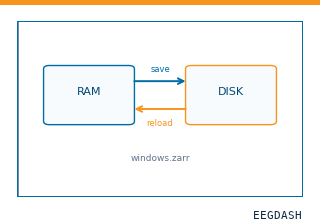 Save and reload prepared dataCache a windowed dataset to disk and reattach it without recompute.
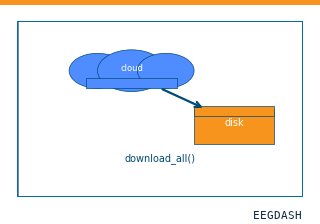 Download a dataset locallyPrefetch BIDS files to a local cache and validate the layout.
Swap any load_dataset(...) call for nm000452 to reproduce the tutorial on this dataset.
Citation
Xupeng Chen (2024). ECoG_HB_02: hybrid-density ECoG high-gamma features with synchronised speech, one participant (derivative). 10.82901/nemar.nm000452
Provenance
¹Contributed to nemar in BIDS format.
²Curated & ingested by the EEGDash catalog; see CITATION.cff for canonical reference.
³Persistent identifier: 10.82901/nemar.nm000452.
See Also#
eegdash.dataset.EEGDashDataseteegdash.dataset