


NM000406: ieeg dataset, 14 subjects#
Microelectrode recordings (MER) from deep brain stimulation surgery in Parkinson’s disease (STN targeting, 14 patients)
Access recordings and metadata through EEGDash.
Citation: Alfredo Rosado-Muñoz, Juan Francisco Guerrero-Martínez, Antonio Gutierrez Martín (2017). Microelectrode recordings (MER) from deep brain stimulation surgery in Parkinson’s disease (STN targeting, 14 patients). 10.82901/nemar.nm000406
Modality: ieeg Subjects: 14 Recordings: 830 License: CC-BY-4.0 Source: nemar
Metadata: Complete (100%)
14-participant iEEG dataset — Microelectrode recordings (MER) from deep brain stimulation surgery in Parkinson's disease (STN targeting, 14 patients).
Quickstart#
Install
pip install eegdash
Access the data
from eegdash.dataset import NM000406

dataset = NM000406(cache_dir="./data")
# Get the raw object of the first recording
raw = dataset.datasets[0].raw
print(raw.info)
Filter by subject
dataset = NM000406(cache_dir="./data", subject="01")
Advanced query
dataset = NM000406(
    cache_dir="./data",
    query={"subject": {"$in": ["01", "02"]}},
)
Iterate recordings
for rec in dataset:
    print(rec.subject, rec.raw.info['sfreq'])
If you use this dataset in your research, please cite the original authors.
BibTeX
@dataset{nm000406,
  title = {Microelectrode recordings (MER) from deep brain stimulation surgery in Parkinson's disease (STN targeting, 14 patients)},
  author = {Alfredo Rosado-Muñoz and Juan Francisco Guerrero-Martínez and Antonio Gutierrez Martín},
  doi = {10.82901/nemar.nm000406},
  url = {https://doi.org/10.82901/nemar.nm000406},
}
About This Dataset#
Intraoperative microelectrode recordings (MER) from 14 patients with Parkinson’s disease (9 male, 5 female;
65.1 ± 5.6 years) during stereotactic surgery to implant deep brain stimulation (DBS) electrodes in the subthalamic nucleus (STN). Re-packaged in iEEG-BIDS from the authors’ public release (Zenodo record 7352058, “Microelectrode register (MER) data from Deep Brain Stimulation (DBS) surgery in Parkinson’s disease patients”, Rosado-Muñoz, Guerrero-Martínez and Gutierrez Martín, CC-BY-4.0).
The release description says: “MER data consist of brain signal in different depths when DBS surgery is being done.
In each depth, a data file is created, with different duration depending on the depth, and up to three channels.” Depths are grouped into STN-IN and STN-OUT (inside / outside the subthalamic nucleus), “classification […] made by the neurophysiologists and surgeons”. Eight patients have left and right trajectories, one right only and five left only. “No filtering or data processing was made, they are directly obtained from the MER acquisition system.” The record lists one related article as using these data: Tepper et al. (2017), *Selection of the Optimal Algorithm for Real-Time Estimation of Beta Band Power during DBS Surgeries in Patients with Parkinson’s Disease*, Computational Intelligence and Neuroscience 2017:1512504 (https://doi.org/10.1155/2017/1512504). It describes MER from 9 bilateral STN-DBS surgeries at La Fe Hospital, Valencia, Spain, with the MicroGuide system (Alpha Omega) and tungsten microelectrodes, amplified 10000 times, band-pass 200-6000 Hz, 12 kHz sampling, 12-bit A/D. The release does not say which of its 14 patients are those 9, so these settings are not copied into the sidecars.
Microelectrode recordings (MER) from deep brain stimulation surgery in Parkinson’s disease
Layout
sub-<NN>= release patientP<NN>(P1-P14). Age and sex are given only at group level, soparticipants.tsvhasn/afor them.task-mer,acq-left/acq-right= trajectory side,run-<k>= one release file (one depth). Runs are numbered per
View full README
Microelectrode recordings (MER) from deep brain stimulation surgery in Parkinson’s disease
Layout
sub-<NN>= release patientP<NN>(P1-P14). Age and sex are given only at group level, soparticipants.tsvhasn/afor them.task-mer,acq-left/acq-right= trajectory side,run-<k>= one release file (one depth). Runs are numbered per side in ascending order of the release file name (the “depth label”). The release does not document this label’s unit or origin; it is kept verbatim insub-<NN>_scans.tsv(source_depth_label) together with the STN-IN / STN-OUT classification (stn_classification) and the source path.Three channels per file (
Electrode1-Electrode3, as named in the release; type SEEG, units n/a: the release stores int16 values without a scale factor). Channel 1 is close to flat in most files; the release does not say why.Sampling frequency per run is computed from the release time vector as (N-1)/time[-1]: 12000 Hz in 432 files and about 12019 Hz in the other 398 (exact value per run in the sidecar and in
scans.tsv).In 226 of the 830 files the three channels have different lengths (differences are whole 752-sample blocks). The release does not document how channels of unequal length line up. Every channel is written from its first sample, and shorter channels are NaN after their last sample.
channels.tsvgives each channel’s source length (source_n_samples), and the sidecar’sRecordingDescriptionrepeats the lengths.There are no electrode coordinates in the release.
electrodes.tsv(per side) lists the three channels withn/acoordinates.
What was converted, and how
Each .mat (struct signal: channel, data int16, time) became one BrainVision run (IEEE float32: int16 values
are exact). The round-trip check compares every run with its source file. No filtering, resampling or re-referencing
was applied. sourcedata/zenodo-7352058/data/... holds the original .mat files. The only change is that the MATLAB
header text “Created on” (file export date, 2018 or 2021) has its weekday and day masked (--- Mon 01). Year, month
and all data are unchanged, and the provenance JSON gives the SHA-256 of each file before and after masking.
License
CC-BY-4.0
Ethics
The recordings in this dataset are covered by the Ethical Committee for Biomedical Research of La Fe Hospital (Valencia, Spain), registration number 2015/0824, approved 17 May 2016. Patients signed an informed consent for DBS surgery with microelectrode recording (MER).
Statement from Bellino et al. (2019), section 2.1 “Database” (verbatim), describing MER from DBS surgery at La Fe Hospital by the same group (J. Guerrero, A. Rosado-Muñoz):
All of the patients met medical accepted selection criteria and signed an informed consent for DBS surgery with MER. These investigations that use human data were carried out following the rules of the Declaration of Helsinki. The Ethical Committee for Biomedical Research of La Fe Hospital approved the research procedures for the project with registration number 2015/0824 in May 17, 2016.
Bellino GM, Schiaffino L, Battisti M, Guerrero J, Rosado-Muñoz A (2019). Optimization of the KNN Supervised Classification Algorithm as a Support Tool for the Implantation of Deep Brain Stimulators in Patients with Parkinson’s Disease. Entropy 21(4):346. https://doi.org/10.3390/e21040346 (PMC7514830).
The Zenodo record 7352058 itself contains no ethics statement. Coverage of the recordings in this release by La Fe approval 2015/0824 is attested by the depositor (Bruno Aristimunha, 2026-10-08).
NEMAR Metadata#
[](https://doi.org/10.82901/nemar.nm000406) # Microelectrode recordings (MER) from deep brain stimulation surgery in Parkinson’s disease Intraoperative microelectrode recordings (MER) from 14 patients with Parkinson’s disease (9 male, 5 female; 65.1 ± 5.6 years) during stereotactic surgery to implant deep brain stimulation (DBS) electrodes in the subthalamic nucleus (STN). Re-packaged in iEEG-BIDS from the authors’ public release (Zenodo record [7352058](https://doi.org/10.5281/zenodo.7352058), “Microelectrode register (MER) data from Deep Brain Stimulation (DBS) surgery in Parkinson’s disease patients”, Rosado-Muñoz, Guerrero-Martínez and Gutierrez Martín, CC-BY-4.0). The release description says: “MER data consist of brain signal in different depths when DBS surgery is being done. In each depth, a data file is created, with different duration depending on the depth, and up to three channels.” Depths are grouped into STN-IN and STN-OUT (inside / outside the subthalamic nucleus), “classification […] made by the neurophysiologists and surgeons”. Eight patients have left and right trajectories, one right only and five left only. “No filtering or data processing was made, they are directly obtained from the MER acquisition system.” The record lists one related article as using these data: Tepper et al. (2017), Selection of the Optimal Algorithm for Real-Time Estimation of Beta Band Power during DBS Surgeries in Patients with Parkinson’s Disease, Computational Intelligence and Neuroscience 2017:1512504 (https://doi.org/10.1155/2017/1512504). It describes MER from 9 bilateral STN-DBS surgeries at La Fe Hospital, Valencia, Spain, with the MicroGuide system (Alpha Omega) and tungsten microelectrodes, amplified 10000 times, band-pass 200-6000 Hz, 12 kHz sampling, 12-bit A/D. The release does not say which of its 14 patients are those 9, so these settings are not copied into the sidecars. ## Layout - sub-<NN> = release patient P<NN> (P1-P14). Age and sex are given only at group level, so participants.tsv has
n/a for them.
task-mer, acq-left / acq-right = trajectory side, run-<k> = one release file (one depth). Runs are numbered per side in ascending order of the release file name (the “depth label”). The release does not document this label’s unit or origin; it is kept verbatim in sub-<NN>_scans.tsv (source_depth_label) together with the STN-IN / STN-OUT classification (stn_classification) and the source path.
Three channels per file (Electrode1-Electrode3, as named in the release; type SEEG, units n/a: the release stores int16 values without a scale factor). Channel 1 is close to flat in most files; the release does not say why.
Sampling frequency per run is computed from the release time vector as (N-1)/time[-1]: 12000 Hz in 432 files and about 12019 Hz in the other 398 (exact value per run in the sidecar and in scans.tsv).
In 226 of the 830 files the three channels have different lengths (differences are whole 752-sample blocks). The release does not document how channels of unequal length line up. Every channel is written from its first sample, and shorter channels are NaN after their last sample. channels.tsv gives each channel’s source length (source_n_samples), and the sidecar’s RecordingDescription repeats the lengths.
There are no electrode coordinates in the release. electrodes.tsv (per side) lists the three channels with n/a coordinates.
## What was converted, and how Each .mat (struct signal: channel, data int16, time) became one BrainVision run (IEEE float32: int16 values are exact). The round-trip check compares every run with its source file. No filtering, resampling or re-referencing was applied. sourcedata/zenodo-7352058/data/… holds the original .mat files. The only change is that the MATLAB header text “Created on” (file export date, 2018 or 2021) has its weekday and day masked (— Mon 01). Year, month and all data are unchanged, and the provenance JSON gives the SHA-256 of each file before and after masking. ## License CC-BY-4.0 ## Ethics The recordings in this dataset are covered by the Ethical Committee for Biomedical Research of La Fe Hospital (Valencia, Spain), registration number 2015/0824, approved 17 May 2016. Patients signed an informed consent for DBS surgery with microelectrode recording (MER). Statement from Bellino et al. (2019), section 2.1 “Database” (verbatim), describing MER from DBS surgery at La Fe Hospital by the same group (J. Guerrero, A. Rosado-Muñoz): > All of the patients met medical accepted selection criteria and signed an informed consent for DBS surgery with MER. These investigations that use human data were carried out following the rules of the Declaration of Helsinki. The Ethical Committee for Biomedical Research of La Fe Hospital approved the research procedures for the project with registration number 2015/0824 in May 17, 2016. Bellino GM, Schiaffino L, Battisti M, Guerrero J, Rosado-Muñoz A (2019). Optimization of the KNN Supervised Classification Algorithm as a Support Tool for the Implantation of Deep Brain Stimulators in Patients with Parkinson’s Disease. Entropy 21(4):346. https://doi.org/10.3390/e21040346 (PMC7514830). The Zenodo record 7352058 itself contains no ethics statement. Coverage of the recordings in this release by La Fe approval 2015/0824 is attested by the depositor (Bruno Aristimunha, 2026-10-08).
License: CC-BY-4.0
Authors:
Alfredo Rosado-Muñoz
Juan Francisco Guerrero-Martínez
Antonio Gutierrez Martín
Versions:
Version |
DOI |
Released |
|---|---|---|
|
Cohort#
Dataset Statistics#
Channel counts: 3 ch (n=830 recordings)
Sampling frequencies (Hz)
Total recording duration: 10 h 58 min
Signal · Electrodes & live trace#
Live trace viewer — sub-01 · task-mer · run-23
Showing one representative recording out of
14 subjects and 830 recordings in this dataset.
Browse the full set on OpenNeuro;
drop any other _ieeg.{set,edf,bdf,vhdr} file onto the
viewer (or pass ?ieeg=<url>) to inspect it.
No scalp electrode layout is currently indexed for this dataset. Once the eegdash montage registry ingests it, the interactive viewer will appear here automatically.
NEMAR Processing Statistics#
The plots below are generated by NEMAR’s automated EEG pipeline. The histogram shows pipeline success for data cleaning and ICA decomposition, the percentage of data frames and EEG channels retained after artefact removal, line noise per channel (RMS, dB), and the age/gender distribution of participants.

HED event descriptors word cloud

Manifest#
File Explorer#
Browse the BIDS file structure of this dataset. Records are fetched on demand from the EEGDash catalog the first time you open the explorer.
Full dataset metadata table
Dataset ID |
|
Title |
Microelectrode recordings (MER) from deep brain stimulation surgery in Parkinson’s disease (STN targeting, 14 patients) |
Author (year) |
— |
Canonical |
— |
Importable as |
|
Year |
2017 |
Authors |
Alfredo Rosado-Muñoz, Juan Francisco Guerrero-Martínez, Antonio Gutierrez Martín |
License |
CC-BY-4.0 |
Citation / DOI |
|
Source links |
OpenNeuro | NeMAR | Source URL |
Copy-paste BibTeX
@dataset{nm000406,
  title = {Microelectrode recordings (MER) from deep brain stimulation surgery in Parkinson's disease (STN targeting, 14 patients)},
  author = {Alfredo Rosado-Muñoz and Juan Francisco Guerrero-Martínez and Antonio Gutierrez Martín},
  doi = {10.82901/nemar.nm000406},
  url = {https://doi.org/10.82901/nemar.nm000406},
}
API Reference#
eegdash.datasetEEGDashDataset- class eegdash.dataset.NM000406(cache_dir: str, query: dict | None = None, s3_bucket: str | None = None, **kwargs)[source]#
Microelectrode recordings (MER) from deep brain stimulation surgery in Parkinson’s disease (STN targeting, 14 patients)
- Study:
nm000406(NeMAR)- Author (year):
—
- Canonical:
—
Also importable as:
NM000406.Modality:
ieeg; Subject type:Unknown. Subjects: 14; recordings: 830; tasks: 1.- Parameters:
cache_dir (str | Path) – Directory where data are cached locally.
query (dict | None) – Additional MongoDB-style filters to AND with the dataset selection. Must not contain the key
dataset.s3_bucket (str | None) – Base S3 bucket used to locate the data.
**kwargs (dict) – Additional keyword arguments forwarded to
EEGDashDataset.
- data_dir#
Local dataset cache directory (
cache_dir / dataset_id).- Type:
Path
Notes
Each item is a recording; recording-level metadata are available via
dataset.description.querysupports MongoDB-style filters on fields inALLOWED_QUERY_FIELDSand is combined with the dataset filter. Dataset-specific caveats are not provided in the summary metadata.References
OpenNeuro dataset: https://openneuro.org/datasets/nm000406 NeMAR dataset: https://nemar.org/dataexplorer/detail?dataset_id=nm000406 DOI: https://doi.org/10.82901/nemar.nm000406
Examples
>>> from eegdash.dataset import NM000406
>>> dataset = NM000406(cache_dir="./data")
>>> recording = dataset[0]
>>> raw = recording.load()
- __init__(cache_dir: str, query: dict | None = None, s3_bucket: str | None = None, **kwargs)[source]#
- save(path: str, overwrite: bool = False, offset: int = 0)[source]#
Save datasets to files by creating one subdirectory for each dataset:
path/
    0/
        0-raw.fif | 0-epo.fif
        description.json
        raw_preproc_kwargs.json (if raws were preprocessed)
        window_kwargs.json (if this is a windowed dataset)
        window_preproc_kwargs.json  (if windows were preprocessed)
        target_name.json (if target_name is not None and dataset is raw)
    1/
        1-raw.fif | 1-epo.fif
        description.json
        raw_preproc_kwargs.json (if raws were preprocessed)
        window_kwargs.json (if this is a windowed dataset)
        window_preproc_kwargs.json  (if windows were preprocessed)
        target_name.json (if target_name is not None and dataset is raw)
- Parameters:
path (str) –
- Directory in which subdirectories are created to store
-raw.fif | -epo.fif and .json files to.
overwrite (bool) – Whether to delete old subdirectories that will be saved to in this call.
offset (int) – If provided, the integer is added to the id of the dataset in the concat. This is useful in the setting of very large datasets, where one dataset has to be processed and saved at a time to account for its original position.
BaseDataset from braindecode — windowed via create_windows_from_events.braindecodeDataLoader; supports parallel workers and on-the-fly augmentations.pytorch Find datasets with the EEGDash APIQuery the catalogue, filter by task or modality, list candidates.
 Load one EEG recordingResolve a single record to an MNE Raw with channels and events.
 EEG recording to PyTorch DataLoaderWrap braindecode windows in a DataLoader for model training.
 Preprocess EEG and create windowsFilter, resample, epoch — and persist the windowed dataset.
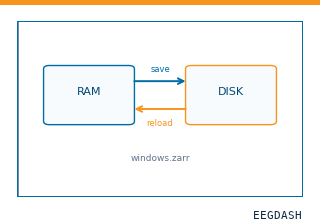 Save and reload prepared dataCache a windowed dataset to disk and reattach it without recompute.
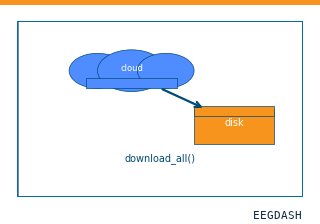 Download a dataset locallyPrefetch BIDS files to a local cache and validate the layout.
Swap any load_dataset(...) call for nm000406 to reproduce the tutorial on this dataset.
Citation
Alfredo Rosado-Muñoz, Juan Francisco Guerrero-Martínez, Antonio Gutierrez Martín (2017). Microelectrode recordings (MER) from deep brain stimulation surgery in Parkinson's disease (STN targeting, 14 patients). 10.82901/nemar.nm000406
Provenance
¹Contributed to nemar in BIDS format.
²Curated & ingested by the EEGDash catalog; see CITATION.cff for canonical reference.
³Persistent identifier: 10.82901/nemar.nm000406.
See Also#
eegdash.dataset.EEGDashDataseteegdash.dataset