


ON008968: eeg dataset, 25 subjects#
Spell-IT-Out
Access recordings and metadata through EEGDash.
Citation: Tommaso Cortecchia, Stefano Tortora, Jeff Kiesner, Emanuele Menegatti, Luca Tonin (2019). Spell-IT-Out. 10.82901/nemar.on008968
Modality: eeg Subjects: 25 Recordings: 150 License: CC0 Source: nemar
Metadata: Complete (100%)
25-participant EEG dataset — Spell-IT-Out.
Quickstart#
Install
pip install eegdash
Access the data
from eegdash.dataset import ON008968

dataset = ON008968(cache_dir="./data")
# Get the raw object of the first recording
raw = dataset.datasets[0].raw
print(raw.info)
Filter by subject
dataset = ON008968(cache_dir="./data", subject="01")
Advanced query
dataset = ON008968(
    cache_dir="./data",
    query={"subject": {"$in": ["01", "02"]}},
)
Iterate recordings
for rec in dataset:
    print(rec.subject, rec.raw.info['sfreq'])
If you use this dataset in your research, please cite the original authors.
BibTeX
@dataset{on008968,
  title = {Spell-IT-Out},
  author = {Tommaso Cortecchia and Stefano Tortora and Jeff Kiesner and Emanuele Menegatti and Luca Tonin},
  doi = {10.82901/nemar.on008968},
  url = {https://doi.org/10.82901/nemar.on008968},
}
About This Dataset#
EEG recorded while native Italian speakers listened to sentences, repeated
them, and then produced them again syllable by syllable at a fixed pace,
either aloud (task-overt) or in their mind without moving (task-covert).
For the overt task, the participants’ speech was recorded and its word and
syllable timing aligned by hand; the timing is released as events, the voice recordings are not. - 25 participants, one session each (about one hour) - 2 tasks × 3 runs × 20 trials = 150 recordings, 3000 trials - 20 sentences, 161 distinct words, 192 distinct syllables - 61 EEG channels + 1 EOG channel at 2048 Hz, BrainVision format
Spell-IT-OUT
Participants
25 native Italian speakers (14 male, 11 female), aged 22–33. Three were left-handed (2 male, 1 female), the others predominantly right-handed. None reported neurological or psychiatric disorders; all had normal hearing and normal or corrected-to-normal vision. Some had taken part in motor-imagery
View full README
Spell-IT-OUT
Participants
25 native Italian speakers (14 male, 11 female), aged 22–33. Three were left-handed (2 male, 1 female), the others predominantly right-handed. None reported neurological or psychiatric disorders; all had normal hearing and normal or corrected-to-normal vision. Some had taken part in motor-imagery BCI experiments before. Per-participant demographics are not released.
Participants gave written consent to the collection and dissemination of their data. The study was approved by the Ethics Committee for Psychological Research, Area 17, University of Padova (ref. 1801-a), in accordance with the Declaration of Helsinki. Participant IDs were randomized and recording dates removed.
Protocol
Participants sat in an electrically shielded, acoustically isolated room, 30–50 cm from a screen. Before the recording they read the sentence list to get familiar with the words and the phonetic notation used for the syllables.
The overt block (3 runs) always came first, followed by the covert block
(3 runs). Each run lasted about 10 minutes and presented the 20 sentences once,
in random order. A trial (about 35 s) went as follows:
1. Fixation (fixation, 2 s): a cross at the centre of the screen.
2. Listening (listening_cue, ~8 s): the sentence is shown and played by a
text-to-speech synthesizer (Google gTTS); a 3 s pause after playback lets participants finish reading.
Repetition (
repetition_cue, 5 s): the sentence disappears and participants repeat it aloud (overt) or imagine repeating it (covert).Syllabification: a three-dot countdown (
pre_syllabification_dot, 0.6 s each) sets the pace, then the syllables scroll on screen one every 0.6 s (syllabification_cue), with the current one highlighted. Participants pronounce, or imagine pronouncing, each syllable as it appears.Trial end: a visual cue, then a 4 s pause.
Covert instructions: *”Imagine that you have something to say, but you cannot say it out loud or show any facial expression. You should feel your jaw, lips, tongue, and vocal cords as if they were about to activate, but in reality, you remain motionless.”* Participants were also asked not to grind their teeth or nod to keep the rhythm. During the overt runs the experimenter noted production errors and gave feedback after each run.
Stimuli
20 handcrafted sentences with a similar structure (subject–verb–complement),
10–13 words and 20–26 syllables each, about 4–4.5 s when spoken. Words were
chosen to cover the Italian phonetic inventory with a phoneme distribution
close to PhonItalia, which also provided the syllabification and phonetic
transcription.
stimuli/wordlist.tsv has no header; its columns are sentence id, sentence,
and syllabification (syllables separated by ., words by spaces).
stimuli/audio/ holds the synthesized sentences with their TextGrids.
Acquisition
ANT Neuro waveguard original cap, 64 Ag/AgCl electrodes, extended 10–20 layout; ANT Neuro eego sports amplifier.
2048 Hz, reference CPz, ground AFz, impedances below 10 kΩ.
EOG electrode below the left eye.
Recorded with ROS-Neuro on Linux. EEG was stored as GDF and audio as ROS bags; the two streams were aligned through the event markers logged in both. The residual synchronization error was not measured.
Overt speech was recorded with the computer’s built-in microphone, then resampled to 44112 Hz and saved as mono 16-bit WAV.
EEG and audio were cropped from 0.5 s before the first event to 0.5 s after the last one.
Electrode positions are the standard 10–20 template, not digitized positions.
Speech annotations
Speech in the overt runs was segmented with Silero-VAD, aligned to the
transcriptions with the Montreal Forced Aligner, and then checked and
corrected by hand in Praat at sentence, word and syllable level. Syllables
that were skipped or produced incorrectly have no annotation (45 in the
syllabification phase). The resulting timings are in the events files
(repetition_word, repetition_syllable, syllabification_syllable). The
voice recordings themselves are not distributed, to protect the participants’
identity.
Files
sub-XX/ses-01/eeg/              raw EEG (BrainVision), events, channels, electrodes
stimuli/                        sentence list, synthesized sentences and TextGrids
derivatives/preprocessing/      cleaned continuous EEG (see its README)
derivatives/syllable-datasets/  syllable epochs in HDF5, ready for ML (see its README)
Events
*_events.tsv has one row per event:
| Column | Content |
|---|---|
| `onset`, `duration` | seconds |
| `trial_type` | event name (below) |
| `phase` | trial phase the event belongs to |
| `trial_index`, `token_index` | trial and word/syllable position |
| `token` | word or syllable (phonetic notation) |
| `trigger_code` | original trigger, for trigger-based events |
| `event_source` | `gdf_trigger`, `textgrid_word` or `textgrid_syllable` |
| `stimulus_id`, `stim_file` | sentence id and stimulus audio |
Event names:
- from triggers: trial_start, fixation, listening_cue, repetition_cue,
pre_syllabification_dot,syllabification_cue,trial_end;
from the stimulus alignment:
listening_word,listening_syllable;from the participant’s speech (overt only):
repetition_word,repetition_syllable,syllabification_syllable.
na is a real syllable. When reading the TSVs with pandas use
keep_default_na=False, otherwise it becomes a missing value. Missing values
are written as n/a.
Things to keep in mind
The overt block always preceded the covert one, so condition comparisons may include practice or fatigue effects.
Syllables were shown on screen, so cue-aligned EEG also contains visual responses, in both tasks.
Overt recordings contain muscle activity from speaking, also after preprocessing, which was deliberately conservative.
Consecutive syllable epochs overlap. For machine learning, split by trial, run or participant rather than by epoch; we suggest training on the first two runs and testing on the third.
Getting started
The spellitout Python package loads the dataset through MNE-BIDS:
neurorobotics-iaslab/spell-it-out.
from spellitout import SpellItOutDataset
dataset = SpellItOutDataset("path/to/spellitout")
run = dataset.get_run(subject=1, task="overt", run=1)
run.raw, run.events
License and citation
Released under CC0. If you use this dataset, please cite:
Cortecchia, T., Tortora, S., Kiesner, J., Menegatti, E., Tonin, L. *Spell-It-Out, a speech EEG dataset for overt and covert production of Italian syllables.* TODO: journal and DOI.
Contact: Tommaso Cortecchia (tommaso.cortecchia@polito.it), Luca Tonin (luca.tonin@unipd.it).
References
Appelhoff, S., Sanderson, M., Brooks, T., Vliet, M., Quentin, R., Holdgraf, C., Chaumon, M., Mikulan, E., Tavabi, K., Höchenberger, R., Welke, D., Brunner, C., Rockhill, A., Larson, E., Gramfort, A. and Jas, M. (2019). MNE-BIDS: Organizing electrophysiological data into the BIDS format and facilitating their analysis. Journal of Open Source Software 4: (1896). https://doi.org/10.21105/joss.01896 Pernet, C. R., Appelhoff, S., Gorgolewski, K. J., Flandin, G., Phillips, C., Delorme, A., Oostenveld, R. (2019). EEG-BIDS, an extension to the brain imaging data structure for electroencephalography. Scientific Data, 6, 103. https://doi.org/10.1038/s41597-019-0104-8 Goslin, J., Galluzzi, C. & Romani, C. (2014). PhonItalia: a phonological lexicon for Italian. Behavior Research Methods, 46, 872–886.
Cohort#
Dataset Statistics#
Channel counts: 62 ch (n=150 recordings)
Sampling frequencies: 2048.0 Hz (n=150 recordings)
Total recording duration: 29 h
Signal · Electrodes & live trace#
Live trace viewer — sub-21 · ses-01 · task-covert · run-01
Showing one representative recording out of
25 subjects and 150 recordings in this dataset.
Browse the full set on OpenNeuro;
drop any other _eeg.{set,edf,bdf,vhdr} file onto the
viewer (or pass ?eeg=<url>) to inspect it.
Electrode layout — EEG · 61 sensors — 61 channels
NEMAR Processing Statistics#
The plots below are generated by NEMAR’s automated EEG pipeline. The histogram shows pipeline success for data cleaning and ICA decomposition, the percentage of data frames and EEG channels retained after artefact removal, line noise per channel (RMS, dB), and the age/gender distribution of participants.

HED event descriptors word cloud

Manifest#
File Explorer#
Browse the BIDS file structure of this dataset. Records are fetched on demand from the EEGDash catalog the first time you open the explorer.
Full dataset metadata table
Dataset ID |
|
Title |
Spell-IT-Out |
Author (year) |
— |
Canonical |
— |
Importable as |
|
Year |
2019 |
Authors |
Tommaso Cortecchia, Stefano Tortora, Jeff Kiesner, Emanuele Menegatti, Luca Tonin |
License |
CC0 |
Citation / DOI |
|
Source links |
OpenNeuro | NeMAR | Source URL |
Copy-paste BibTeX
@dataset{on008968,
  title = {Spell-IT-Out},
  author = {Tommaso Cortecchia and Stefano Tortora and Jeff Kiesner and Emanuele Menegatti and Luca Tonin},
  doi = {10.82901/nemar.on008968},
  url = {https://doi.org/10.82901/nemar.on008968},
}
API Reference#
eegdash.datasetEEGDashDataset- class eegdash.dataset.ON008968(cache_dir: str, query: dict | None = None, s3_bucket: str | None = None, **kwargs)[source]#
Spell-IT-Out
- Study:
on008968(NeMAR)- Author (year):
—
- Canonical:
—
Also importable as:
ON008968.Modality:
eeg; Subject type:Unknown. Subjects: 25; recordings: 150; tasks: 2.- Parameters:
cache_dir (str | Path) – Directory where data are cached locally.
query (dict | None) – Additional MongoDB-style filters to AND with the dataset selection. Must not contain the key
dataset.s3_bucket (str | None) – Base S3 bucket used to locate the data.
**kwargs (dict) – Additional keyword arguments forwarded to
EEGDashDataset.
- data_dir#
Local dataset cache directory (
cache_dir / dataset_id).- Type:
Path
Notes
Each item is a recording; recording-level metadata are available via
dataset.description.querysupports MongoDB-style filters on fields inALLOWED_QUERY_FIELDSand is combined with the dataset filter. Dataset-specific caveats are not provided in the summary metadata.References
OpenNeuro dataset: https://openneuro.org/datasets/on008968 NeMAR dataset: https://nemar.org/dataexplorer/detail?dataset_id=on008968 DOI: https://doi.org/10.82901/nemar.on008968
Examples
>>> from eegdash.dataset import ON008968
>>> dataset = ON008968(cache_dir="./data")
>>> recording = dataset[0]
>>> raw = recording.load()
- __init__(cache_dir: str, query: dict | None = None, s3_bucket: str | None = None, **kwargs)[source]#
- save(path: str, overwrite: bool = False, offset: int = 0)[source]#
Save datasets to files by creating one subdirectory for each dataset:
path/
    0/
        0-raw.fif | 0-epo.fif
        description.json
        raw_preproc_kwargs.json (if raws were preprocessed)
        window_kwargs.json (if this is a windowed dataset)
        window_preproc_kwargs.json  (if windows were preprocessed)
        target_name.json (if target_name is not None and dataset is raw)
    1/
        1-raw.fif | 1-epo.fif
        description.json
        raw_preproc_kwargs.json (if raws were preprocessed)
        window_kwargs.json (if this is a windowed dataset)
        window_preproc_kwargs.json  (if windows were preprocessed)
        target_name.json (if target_name is not None and dataset is raw)
- Parameters:
path (str) –
- Directory in which subdirectories are created to store
-raw.fif | -epo.fif and .json files to.
overwrite (bool) – Whether to delete old subdirectories that will be saved to in this call. If a dataset still reads its data lazily from one of them, a
ValueErroris raised before anything is deleted: load the data into memory first (preload=True) or save to another directory.offset (int) – If provided, the integer is added to the id of the dataset in the concat. This is useful in the setting of very large datasets, where one dataset has to be processed and saved at a time to account for its original position.
BaseDataset from braindecode — windowed via create_windows_from_events.braindecodeDataLoader; supports parallel workers and on-the-fly augmentations.pytorch Find datasets with the EEGDash APIQuery the catalogue, filter by task or modality, list candidates.
 Load one EEG recordingResolve a single record to an MNE Raw with channels and events.
 EEG recording to PyTorch DataLoaderWrap braindecode windows in a DataLoader for model training.
 Preprocess EEG and create windowsFilter, resample, epoch — and persist the windowed dataset.
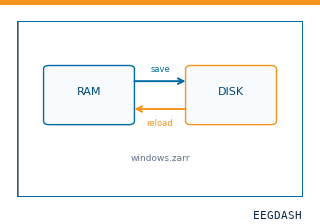 Save and reload prepared dataCache a windowed dataset to disk and reattach it without recompute.
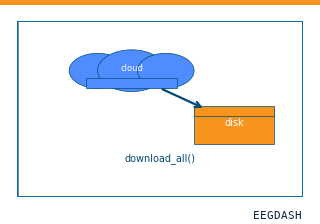 Download a dataset locallyPrefetch BIDS files to a local cache and validate the layout.
Swap any load_dataset(...) call for on008968 to reproduce the tutorial on this dataset.
Citation
Tommaso Cortecchia, Stefano Tortora, Jeff Kiesner, Emanuele Menegatti, Luca Tonin (2019). Spell-IT-Out. 10.82901/nemar.on008968
Provenance
¹Contributed to nemar in BIDS format.
²Curated & ingested by the EEGDash catalog; see CITATION.cff for canonical reference.
³Persistent identifier: 10.82901/nemar.on008968.
See Also#
eegdash.dataset.EEGDashDataseteegdash.dataset