


Note
Go to the end to download the full example code or to run this example in your browser via Binder.
Find a small cohort with the EEGDash API#
Search real catalogue records before downloading EEG. We select the same three Nakanishi2015 SSVEP participants used by the following tutorials. This page needs internet for metadata only; signal files are not opened.
Before you start#
Install EEGDash with its dependencies and run this file in Python or a
notebook with network access. Familiarity with a pandas DataFrame is useful;
no MNE, PyTorch or model-training knowledge is needed. The result is a checked
cohort query that you can pass to EEGDashDataset in tutorial 01.
import matplotlib.pyplot as plt
import pandas as pd
from eegdash import EEGDash
1. Query an explicit cohort#
A catalogue row describes one recording file. subject, session and
run are identifiers, so keep values such as "0" as strings. The
$in expression accepts any of the three named participants; the other
fields must all match. This bounds the later signal acquisition before we
open a recording.
limit=10 is a result cap, not a request for ten participants. The assertion
checks that this particular query currently resolves to the three expected
recordings. If it fails, inspect the returned identifiers before changing the
query; silently taking the first three rows could select a different cohort.
    dataset subject session run   task
0  nm000118       1       0   0  ssvep
1  nm000118       2       0   0  ssvep
2  nm000118       3       0   0  ssvep
2. Inspect the signal metadata before committing to downloads#
Read sampling_frequency as samples per second, nchans as recorded
channels, and ntimes as time samples per channel. Thus ntimes divided
by sampling_frequency estimates a file’s signal duration. These fields
help plan memory and window lengths, but they do not establish signal quality.
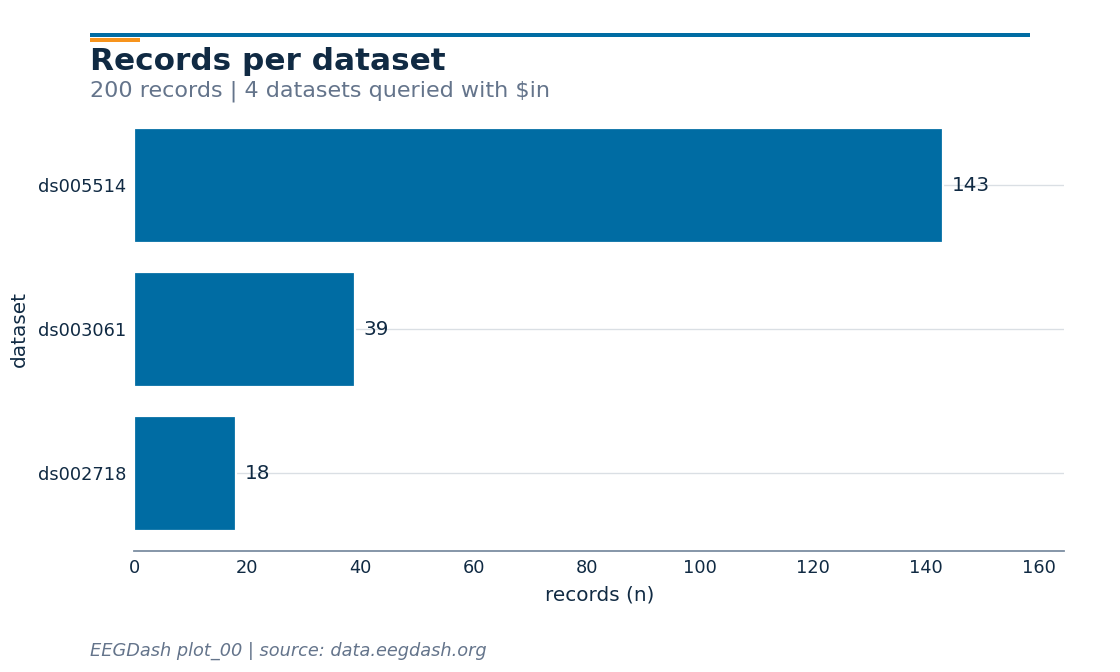
The two counts deliberately answer different questions: a participant may contribute multiple runs. In the bar chart, each bar counts matched files for one participant; it does not count trials or measure EEG amplitude.
fields = ["subject", "sampling_frequency", "nchans", "ntimes"]
print(records[fields])
print("Recording count:", len(records))
print("Participant count:", records["subject"].nunique())
# This particular subset has approximately 21.1 MB of signal files. The
# next tutorial opens only subject 1 (about 7 MB) with EEGDashDataset.
fig, ax = plt.subplots(figsize=(6, 3), layout="constrained")
records["subject"].value_counts().sort_index().plot.bar(ax=ax, rot=0)
ax.set(xlabel="Subject", ylabel="Matched recordings", title="Explicit SSVEP subset")
plt.show()
  subject  sampling_frequency  nchans  ntimes
0       1               256.0       8  218519
1       2               256.0       8  218519
2       3               256.0       8  218519
Recording count: 3
Participant count: 3
3. Broaden discovery without treating a limited sample as a census#
An unfiltered sample is useful for discovering dataset and task names. It cannot estimate how common a task is across the whole catalogue: the first 20 rows need not be randomly sampled or balanced across datasets. Choose a specific dataset from discovery, then query its relevant recordings before summarizing a cohort.
sample = pd.DataFrame(client.find({}, limit=20))
print("First 20 catalogue records (not representative cohort counts):")
print(sample[["dataset", "subject", "task"]])
# Change the dataset/task query to explore another paradigm, then inspect
# its real participant and event metadata before choosing a decoding target.
First 20 catalogue records (not representative cohort counts):
      dataset       subject                     task
0   EEG2025r1           NaN               ThePresent
1   EEG2025r1           NaN       seqLearning6target
2   EEG2025r1           NaN          FunwithFractals
3   EEG2025r1           NaN       seqLearning8target
4   EEG2025r1           NaN             symbolSearch
5   EEG2025r1           NaN             RestingState
6   EEG2025r1           NaN         DiaryOfAWimpyKid
7   EEG2025r1           NaN  contrastChangeDetection
8   EEG2025r1           NaN             DespicableMe
9   EEG2025r1           NaN             surroundSupp
10  EEG2025r1  NDARCJ475WJP               ThePresent
11  EEG2025r1  NDARCJ475WJP             RestingState
12  EEG2025r1  NDARCJ475WJP          FunwithFractals
13  EEG2025r1  NDARCJ475WJP          FunwithFractals
14  EEG2025r1  NDARCJ475WJP          FunwithFractals
15  EEG2025r1  NDARCJ475WJP         DiaryOfAWimpyKid
16  EEG2025r1  NDARCJ475WJP             DespicableMe
17  EEG2025r1  NDARCJ475WJP             RestingState
18  EEG2025r1  NDARCJ475WJP         DiaryOfAWimpyKid
19  EEG2025r1  NDARCJ475WJP         DiaryOfAWimpyKid
