


NM000329: eeg dataset, 16 subjects#
Brandl et al. 2020 — Motor Imagery Under Distraction: An Open Access BCI Dataset
Access recordings and metadata through EEGDash.
Citation: Stephanie Brandl, Benjamin Blankertz, Tobias Dahne (2020). Brandl et al. 2020 — Motor Imagery Under Distraction: An Open Access BCI Dataset. 10.82901/nemar.nm000329
Modality: eeg Subjects: 16 Recordings: 112 License: CC-BY-NC-ND-4.0 Source: nemar
Metadata: Complete (100%)
16-participant EEG dataset — Brandl et al. 2020 — Motor Imagery Under Distraction: An Open Access BCI Dataset.
Quickstart#
Install
pip install eegdash
Access the data
from eegdash.dataset import NM000329

dataset = NM000329(cache_dir="./data")
# Get the raw object of the first recording
raw = dataset.datasets[0].raw
print(raw.info)
Filter by subject
dataset = NM000329(cache_dir="./data", subject="01")
Advanced query
dataset = NM000329(
    cache_dir="./data",
    query={"subject": {"$in": ["01", "02"]}},
)
Iterate recordings
for rec in dataset:
    print(rec.subject, rec.raw.info['sfreq'])
If you use this dataset in your research, please cite the original authors.
BibTeX
@dataset{nm000329,
  title = {Brandl et al. 2020 — Motor Imagery Under Distraction: An Open Access BCI Dataset},
  author = {Stephanie Brandl and Benjamin Blankertz and Tobias Dahne},
  doi = {10.82901/nemar.nm000329},
  url = {https://doi.org/10.82901/nemar.nm000329},
}
About This Dataset#
Motor Imagery under distraction dataset from Brandl and Blankertz 2020.
Code: Brandl2020
Paradigm: imagery DOI: 10.3389/fnins.2020.566147 Subjects: 16 Sessions per subject: 1 Events: left_hand=1, right_hand=2 Trial interval: [0, 4.5] s Runs per session: 7 File format: MAT (HDF5 v7.3)
Brandl2020
Acquisition
Sampling rate: 1000.0 Hz Number of channels: 63 Channel types: eeg=63 Channel names: AF3, AF4, AF7, AF8, AFz, C1, C2, C3, C4, C5, C6, CP1, CP2, CP3, CP4, CP5, CP6, CPz, Cz, F1, F2, F3, F4, F5, F6, F7, F8, FC1, FC2, FC3, FC4, FC5, FC6, FCz, FT7, FT8, Fp1, Fp2, Fpz, Fz, O1, O2, Oz, P1, P2, P3, P4, P5, P6, P7, P8, PO3, PO4, PO7, PO8, POz, Pz, T7, T8, TP10, TP7, TP8, TP9
View full README
Brandl2020
Acquisition
Sampling rate: 1000.0 Hz Number of channels: 63 Channel types: eeg=63 Channel names: AF3, AF4, AF7, AF8, AFz, C1, C2, C3, C4, C5, C6, CP1, CP2, CP3, CP4, CP5, CP6, CPz, Cz, F1, F2, F3, F4, F5, F6, F7, F8, FC1, FC2, FC3, FC4, FC5, FC6, FCz, FT7, FT8, Fp1, Fp2, Fpz, Fz, O1, O2, Oz, P1, P2, P3, P4, P5, P6, P7, P8, PO3, PO4, PO7, PO8, POz, Pz, T7, T8, TP10, TP7, TP8, TP9 Montage: standard_1005 Hardware: 2x BrainAmp (Brain Products) Software: BBCI Toolbox (MATLAB) Reference: nose Sensor type: Ag/AgCl wet Line frequency: 50.0 Hz Cap manufacturer: EasyCap Cap model: Fast’n Easy Cap
Participants
Number of subjects: 16 Health status: healthy Age: mean=26.3 Gender distribution: female=6, male=10 BCI experience: mostly naive (3/16 had prior BCI experience)
Experimental Protocol
Paradigm: imagery Number of classes: 2 Class labels: left_hand, right_hand Trial duration: 4.5 s Tasks: calibration, clean, eyesclosed, news, numbers, flicker, stimulation Study design: Motor imagery under distraction: 1 calibration run (no feedback, no distraction) + 6 feedback runs with different distraction conditions (clean, eyes closed, news, number search, flicker, vibro-tactile stimulation) Feedback type: auditory Stimulus type: auditory Stimulus modalities: auditory Primary modality: auditory Synchronicity: cue-based Mode: online Training/test split: False Instructions: Subjects received auditory cues (‘links’ for left, ‘rechts’ for right) and performed motor imagery of left or right hand movement
HED Event Annotations
Schema: HED 8.4.0 | Browse: https://www.hedtags.org/hed-schema-browser left_hand
     ├─ Sensory-event, Experimental-stimulus, Visual-presentation
     └─ Agent-action
        └─ Imagine
           ├─ Move
           └─ Left, Hand

right_hand
├─ Sensory-event, Experimental-stimulus, Visual-presentation
└─ Agent-action
   └─ Imagine
      ├─ Move
      └─ Right, Hand
Paradigm-Specific Parameters
Detected paradigm: motor_imagery Imagery tasks: left_hand, right_hand Imagery duration: 4.5 s
Data Structure
Trials: 504 Trials per class: left_hand=252, right_hand=252 Blocks per session: 7 Trials context: 7 runs per subject: 1 calibration (72 trials) + 6 feedback runs (72 trials each, 6 distraction conditions)
Preprocessing
Data state: raw Preprocessing applied: False
Signal Processing
Classifiers: CSP+LDA Feature extraction: CSP, bandpower Frequency bands: mu=[8.0, 13.0] Hz; beta=[13.0, 30.0] Hz Spatial filters: CSP
Cross-Validation
Method: holdout Evaluation type: within_subject
BCI Application
Applications: motor_control Environment: laboratory Online feedback: True
Tags
Pathology: Healthy Modality: Motor Type: Motor Imagery
Documentation
DOI: 10.3389/fnins.2020.566147 License: CC-BY-NC-ND-4.0 Investigators: Stephanie Brandl, Benjamin Blankertz, Tobias Dahne Senior author: Benjamin Blankertz Institution: Technische Universitaet Berlin Department: Department of Neurotechnology Country: DE Repository: DepositOnce TU Berlin Data URL: https://depositonce.tu-berlin.de/handle/11303/10934.2 Publication year: 2020 Funding: BMBF/BIFOLD (01IS18025A, 01IS18037A) Ethics approval: Approved by the ethics committee of the Charite University Medicine Berlin How to acknowledge: Please cite: Brandl, S. and Blankertz, B. (2020). Motor Imagery Under Distraction – An Open Access BCI Dataset. Frontiers in Neuroscience, 14, 566147. https://doi.org/10.3389/fnins.2020.566147 Keywords: brain-computer interface, motor imagery, EEG, distraction, open access, BCI
Abstract
We present an open-access dataset of a motor imagery brain-computer interface (BCI) experiment conducted under six different distraction conditions. Sixteen healthy participants performed left vs. right hand motor imagery while being distracted by flickering video, number search tasks, news listening, eyes closed, vibro-tactile stimulation, or no distraction. Each participant completed one calibration run without feedback and six feedback runs under the different distraction conditions, resulting in 504 trials per subject.
Methodology
Participants completed one session with 7 runs of 72 trials each. Run 1 was calibration (no feedback, no distraction). Runs 2-7 included auditory feedback and one of six distraction conditions. Auditory cues indicated left or right hand imagery. Trial duration was 4.5 s with 2.5 s ITI. Online classification used CSP with LDA. EEG recorded at 1000 Hz with 63 channels, nose reference, using two BrainAmp amplifiers.
References
Brandl, S. and Blankertz, B. (2020). Motor Imagery Under Distraction – An Open Access BCI Dataset. Frontiers in Neuroscience, 14, 566147. https://doi.org/10.3389/fnins.2020.566147 Notes .. versionadded:: 1.2.0 Appelhoff, S., Sanderson, M., Brooks, T., Vliet, M., Quentin, R., Holdgraf, C., Chaumon, M., Mikulan, E., Tavabi, K., Hochenberger, R., Welke, D., Brunner, C., Rockhill, A., Larson, E., Gramfort, A. and Jas, M. (2019). MNE-BIDS: Organizing electrophysiological data into the BIDS format and facilitating their analysis. Journal of Open Source Software 4: (1896). https://doi.org/10.21105/joss.01896 Pernet, C. R., Appelhoff, S., Gorgolewski, K. J., Flandin, G., Phillips, C., Delorme, A., Oostenveld, R. (2019). EEG-BIDS, an extension to the brain imaging data structure for electroencephalography. Scientific Data, 6, 103. https://doi.org/10.1038/s41597-019-0104-8 Generated by MOABB 1.5.0 (Mother of All BCI Benchmarks) NeuroTechX/moabb
NEMAR Metadata#
[](https://doi.org/10.82901/nemar.nm000329) Brandl2020 ========== Motor Imagery under distraction dataset from Brandl and Blankertz 2020. Dataset Overview —————-
Code: Brandl2020 Paradigm: imagery DOI: 10.3389/fnins.2020.566147 Subjects: 16 Sessions per subject: 1 Events: left_hand=1, right_hand=2 Trial interval: [0, 4.5] s Runs per session: 7 File format: MAT (HDF5 v7.3)
Acquisition#
Sampling rate: 1000.0 Hz Number of channels: 63 Channel types: eeg=63 Channel names: AF3, AF4, AF7, AF8, AFz, C1, C2, C3, C4, C5, C6, CP1, CP2, CP3, CP4, CP5, CP6, CPz, Cz, F1, F2, F3, F4, F5, F6, F7, F8, FC1, FC2, FC3, FC4, FC5, FC6, FCz, FT7, FT8, Fp1, Fp2, Fpz, Fz, O1, O2, Oz, P1, P2, P3, P4, P5, P6, P7, P8, PO3, PO4, PO7, PO8, POz, Pz, T7, T8, TP10, TP7, TP8, TP9 Montage: standard_1005 Hardware: 2x BrainAmp (Brain Products) Software: BBCI Toolbox (MATLAB) Reference: nose Sensor type: Ag/AgCl wet Line frequency: 50.0 Hz Cap manufacturer: EasyCap Cap model: Fast’n Easy Cap
Participants#
Number of subjects: 16 Health status: healthy Age: mean=26.3 Gender distribution: female=6, male=10 BCI experience: mostly naive (3/16 had prior BCI experience)
Experimental Protocol#
Paradigm: imagery Number of classes: 2 Class labels: left_hand, right_hand Trial duration: 4.5 s Tasks: calibration, clean, eyesclosed, news, numbers, flicker, stimulation Study design: Motor imagery under distraction: 1 calibration run (no feedback, no distraction) + 6 feedback runs with different distraction conditions (clean, eyes closed, news, number search, flicker, vibro-tactile stimulation) Feedback type: auditory Stimulus type: auditory Stimulus modalities: auditory Primary modality: auditory Synchronicity: cue-based Mode: online Training/test split: False Instructions: Subjects received auditory cues (‘links’ for left, ‘rechts’ for right) and performed motor imagery of left or right hand movement
HED Event Annotations#
Schema: HED 8.4.0 | Browse: https://www.hedtags.org/hed-schema-browser left_hand
├─ Sensory-event, Experimental-stimulus, Visual-presentation └─ Agent-action
- └─ Imagine
├─ Move └─ Left, Hand
- right_hand
├─ Sensory-event, Experimental-stimulus, Visual-presentation └─ Agent-action
- └─ Imagine
├─ Move └─ Right, Hand
Paradigm-Specific Parameters#
Detected paradigm: motor_imagery Imagery tasks: left_hand, right_hand Imagery duration: 4.5 s
Data Structure#
Trials: 504 Trials per class: left_hand=252, right_hand=252 Blocks per session: 7 Trials context: 7 runs per subject: 1 calibration (72 trials) + 6 feedback runs (72 trials each, 6 distraction conditions)
Preprocessing#
Data state: raw Preprocessing applied: False
Signal Processing#
Classifiers: CSP+LDA Feature extraction: CSP, bandpower Frequency bands: mu=[8.0, 13.0] Hz; beta=[13.0, 30.0] Hz Spatial filters: CSP
Cross-Validation#
Method: holdout Evaluation type: within_subject
BCI Application#
Applications: motor_control Environment: laboratory Online feedback: True
Documentation#
DOI: 10.3389/fnins.2020.566147 License: CC-BY-NC-ND-4.0 Investigators: Stephanie Brandl, Benjamin Blankertz, Tobias Dahne Senior author: Benjamin Blankertz Institution: Technische Universitaet Berlin Department: Department of Neurotechnology Country: DE Repository: DepositOnce TU Berlin Data URL: https://depositonce.tu-berlin.de/handle/11303/10934.2 Publication year: 2020 Funding: BMBF/BIFOLD (01IS18025A, 01IS18037A) Ethics approval: Approved by the ethics committee of the Charite University Medicine Berlin How to acknowledge: Please cite: Brandl, S. and Blankertz, B. (2020). Motor Imagery Under Distraction – An Open Access BCI Dataset. Frontiers in Neuroscience, 14, 566147. https://doi.org/10.3389/fnins.2020.566147 Keywords: brain-computer interface, motor imagery, EEG, distraction, open access, BCI
Abstract#
We present an open-access dataset of a motor imagery brain-computer interface (BCI) experiment conducted under six different distraction conditions. Sixteen healthy participants performed left vs. right hand motor imagery while being distracted by flickering video, number search tasks, news listening, eyes closed, vibro-tactile stimulation, or no distraction. Each participant completed one calibration run without feedback and six feedback runs under the different distraction conditions, resulting in 504 trials per subject. Methodology ———– Participants completed one session with 7 runs of 72 trials each. Run 1 was calibration (no feedback, no distraction). Runs 2-7 included auditory feedback and one of six distraction conditions. Auditory cues indicated left or right hand imagery. Trial duration was 4.5 s with 2.5 s ITI. Online classification used CSP with LDA. EEG recorded at 1000 Hz with 63 channels, nose reference, using two BrainAmp amplifiers. References ———- Brandl, S. and Blankertz, B. (2020). Motor Imagery Under Distraction – An Open Access BCI Dataset. Frontiers in Neuroscience, 14, 566147. https://doi.org/10.3389/fnins.2020.566147 Notes .. versionadded:: 1.2.0 Appelhoff, S., Sanderson, M., Brooks, T., Vliet, M., Quentin, R., Holdgraf, C., Chaumon, M., Mikulan, E., Tavabi, K., Hochenberger, R., Welke, D., Brunner, C., Rockhill, A., Larson, E., Gramfort, A. and Jas, M. (2019). MNE-BIDS: Organizing electrophysiological data into the BIDS format and facilitating their analysis. Journal of Open Source Software 4: (1896). https://doi.org/10.21105/joss.01896 Pernet, C. R., Appelhoff, S., Gorgolewski, K. J., Flandin, G., Phillips, C., Delorme, A., Oostenveld, R. (2019). EEG-BIDS, an extension to the brain imaging data structure for electroencephalography. Scientific Data, 6, 103. https://doi.org/10.1038/s41597-019-0104-8 — Generated by MOABB 1.5.0 (Mother of All BCI Benchmarks) NeuroTechX/moabb
License: CC-BY-NC-ND-4.0
Authors:
Stephanie Brandl
Benjamin Blankertz
Tobias Dahne
Versions:
Version |
DOI |
Released |
|---|---|---|
|
Cohort#
Dataset Statistics#
Age distribution by gender (n=16, range 26–26 yr, mean 26.0 yr)
Channel counts: 63 ch (n=224 recordings)
Sampling frequencies: 1000.0 Hz (n=224 recordings)
Total recording duration: 194 h
Signal · Electrodes & live trace#
Live trace viewer — sub-13 · ses-0 · task-imagery · run-1
Showing one representative recording out of
16 subjects and 112 recordings in this dataset.
Browse the full set on OpenNeuro;
drop any other _eeg.{set,edf,bdf,vhdr} file onto the
viewer (or pass ?eeg=<url>) to inspect it.
Electrode layout — EEG · 53 sensors — 53 channels
NEMAR Processing Statistics#
The plots below are generated by NEMAR’s automated EEG pipeline. The histogram shows pipeline success for data cleaning and ICA decomposition, the percentage of data frames and EEG channels retained after artefact removal, line noise per channel (RMS, dB), and the age/gender distribution of participants.

HED event descriptors word cloud

Manifest#
File Explorer#
Browse the BIDS file structure of this dataset. Records are fetched on demand from the EEGDash catalog the first time you open the explorer.
Full dataset metadata table
Dataset ID |
|
Title |
Brandl et al. 2020 — Motor Imagery Under Distraction: An Open Access BCI Dataset |
Author (year) |
|
Canonical |
— |
Importable as |
|
Year |
2020 |
Authors |
Stephanie Brandl, Benjamin Blankertz, Tobias Dahne |
License |
CC-BY-NC-ND-4.0 |
Citation / DOI |
|
Source links |
OpenNeuro | NeMAR | Source URL |
Copy-paste BibTeX
@dataset{nm000329,
  title = {Brandl et al. 2020 — Motor Imagery Under Distraction: An Open Access BCI Dataset},
  author = {Stephanie Brandl and Benjamin Blankertz and Tobias Dahne},
  doi = {10.82901/nemar.nm000329},
  url = {https://doi.org/10.82901/nemar.nm000329},
}
API Reference#
eegdash.datasetEEGDashDatasetNM000329 · Brandl2020eegdash/dataset/registry.py · [source ↗]- class eegdash.dataset.NM000329(cache_dir: str, query: dict | None = None, s3_bucket: str | None = None, **kwargs)[source]#
Brandl et al. 2020 — Motor Imagery Under Distraction: An Open Access BCI Dataset
- Study:
nm000329(NeMAR)- Author (year):
Brandl2020- Canonical:
—
Also importable as:
NM000329,Brandl2020.Modality:
eeg; Experiment type:Motor; Subject type:Healthy. Subjects: 16; recordings: 0; tasks: 1.- Parameters:
cache_dir (str | Path) – Directory where data are cached locally.
query (dict | None) – Additional MongoDB-style filters to AND with the dataset selection. Must not contain the key
dataset.s3_bucket (str | None) – Base S3 bucket used to locate the data.
**kwargs (dict) – Additional keyword arguments forwarded to
EEGDashDataset.
- data_dir#
Local dataset cache directory (
cache_dir / dataset_id).- Type:
Path
Notes
Each item is a recording; recording-level metadata are available via
dataset.description.querysupports MongoDB-style filters on fields inALLOWED_QUERY_FIELDSand is combined with the dataset filter. Dataset-specific caveats are not provided in the summary metadata.References
OpenNeuro dataset: https://openneuro.org/datasets/nm000329 NeMAR dataset: https://nemar.org/dataexplorer/detail?dataset_id=nm000329 DOI: https://doi.org/10.82901/nemar.nm000329
Examples
>>> from eegdash.dataset import NM000329
>>> dataset = NM000329(cache_dir="./data")
>>> recording = dataset[0]
>>> raw = recording.load()
- __init__(cache_dir: str, query: dict | None = None, s3_bucket: str | None = None, **kwargs)[source]#
- save(path: str, overwrite: bool = False, offset: int = 0)[source]#
Save datasets to files by creating one subdirectory for each dataset:
path/
    0/
        0-raw.fif | 0-epo.fif
        description.json
        raw_preproc_kwargs.json (if raws were preprocessed)
        window_kwargs.json (if this is a windowed dataset)
        window_preproc_kwargs.json  (if windows were preprocessed)
        target_name.json (if target_name is not None and dataset is raw)
    1/
        1-raw.fif | 1-epo.fif
        description.json
        raw_preproc_kwargs.json (if raws were preprocessed)
        window_kwargs.json (if this is a windowed dataset)
        window_preproc_kwargs.json  (if windows were preprocessed)
        target_name.json (if target_name is not None and dataset is raw)
- Parameters:
path (str) –
- Directory in which subdirectories are created to store
-raw.fif | -epo.fif and .json files to.
overwrite (bool) – Whether to delete old subdirectories that will be saved to in this call.
offset (int) – If provided, the integer is added to the id of the dataset in the concat. This is useful in the setting of very large datasets, where one dataset has to be processed and saved at a time to account for its original position.
BaseDataset from braindecode — windowed via create_windows_from_events.braindecodeDataLoader; supports parallel workers and on-the-fly augmentations.pytorchdatasets.load_dataset("EEGDash/nm000329").huggingface Find datasets with the EEGDash APIQuery the catalogue, filter by task or modality, list candidates.
 Load one EEG recordingResolve a single record to an MNE Raw with channels and events.
 EEG recording to PyTorch DataLoaderWrap braindecode windows in a DataLoader for model training.
 Preprocess EEG and create windowsFilter, resample, epoch — and persist the windowed dataset.
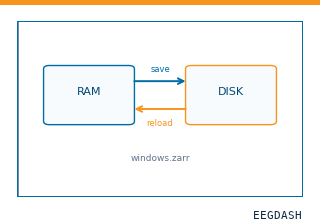 Save and reload prepared dataCache a windowed dataset to disk and reattach it without recompute.
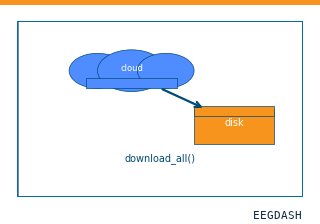 Download a dataset locallyPrefetch BIDS files to a local cache and validate the layout.
Swap any load_dataset(...) call for nm000329 to reproduce the tutorial on this dataset.
Citation
Stephanie Brandl, Benjamin Blankertz, Tobias Dahne (2020). Brandl et al. 2020 — Motor Imagery Under Distraction: An Open Access BCI Dataset. 10.82901/nemar.nm000329
Provenance
¹Contributed to nemar in BIDS format.
²Curated & ingested by the EEGDash catalog; see CITATION.cff for canonical reference.
³Persistent identifier: 10.82901/nemar.nm000329.
See Also#
eegdash.dataset.EEGDashDataseteegdash.dataset