


ON006233: ieeg dataset, 108 subjects#
Picture naming
Access recordings and metadata through EEGDash.
Citation: Ryuzaburo Kochi, Aya Kanno, Hiroshi Uda, Keisuke Hatano, Hidenori Endo, Michael Cools, Robert Rothermel, Aimee F. Luat, Eishi Asano (2025). Picture naming. 10.82901/nemar.on006233
Modality: ieeg Subjects: 108 Recordings: 347 License: CC0 Source: nemar
Metadata: Complete (100%)
108-participant iEEG dataset — Picture naming.
Quickstart#
Install
pip install eegdash
Access the data
from eegdash.dataset import ON006233

dataset = ON006233(cache_dir="./data")
# Get the raw object of the first recording
raw = dataset.datasets[0].raw
print(raw.info)
Filter by subject
dataset = ON006233(cache_dir="./data", subject="01")
Advanced query
dataset = ON006233(
    cache_dir="./data",
    query={"subject": {"$in": ["01", "02"]}},
)
Iterate recordings
for rec in dataset:
    print(rec.subject, rec.raw.info['sfreq'])
If you use this dataset in your research, please cite the original authors.
BibTeX
@dataset{on006233,
  title = {Picture naming},
  author = {Ryuzaburo Kochi and Aya Kanno and Hiroshi Uda and Keisuke Hatano and Hidenori Endo and Michael Cools and Robert Rothermel and Aimee F. Luat and Eishi Asano},
  doi = {10.82901/nemar.on006233},
  url = {https://doi.org/10.82901/nemar.on006233},
}
About This Dataset#
This dataset, used in the analysis reported by Kochi et al., (2025), contains intracranial EEG recordings from 108 individuals who performed an picture‑naming task. Electrode coordinates are provided in MNI‑305 space.
Each EDF file is tagged for the auditory naming task with the following event codes:
401 – stimulus onset 501 – response onset Reference:
Ryuzaburo Kochi, Aya Kanno, Hiroshi Uda, Keisuke Hatano, Hidenori Endo, Michael Cools, Robert Rothermel, Aimee F. Luat, Eishi Asano. Naming is Shaped by Early Facilitative and Late Compensatory Neural Interactions: An Intracranial Study of 125 Patients
Channel names follow the data headers (18 Oct 2026)
In 347 recordings the channel list of channels.tsv did not equal the data-file header (names, order or count). In the 347 with a different channel count, mne_bids.read_raw_bids warned and kept the header names, so the channels.tsv types and bad-channel status reached only the channels whose names happen to be identical; a reader that applies the channels.tsv rows by position gives wrong labels wherever the two lists are not aligned. Since 18 Oct 2026 every channels.tsv lists exactly the header channels, in header order, with the header names (MNE names: duplicated header labels numbered -0, -1).
Rows were matched to header channels BY NAME, never by position (exact; then case/whitespace; then the recorder prefix ‘EEG ‘/’POL ‘, ‘_’ and zero padding; then a trailing ‘-<reference>’ token). Matched rows keep all their columns (type, units, status, …); 0 rows took the header name.
17354 header channels had no channels.tsv row (347 files) and got a new row: type from the name (ECG/EMG/EOG/trigger) or from the other contacts of the same shaft, else MISC; units from the header; status n/a. Examples: sub-007_ses-1_task-picture_ieeg.edf: POL A1-A2, POL A11-A12, POL A17-A18, POL A23-A24; sub-007_ses-2_task-picture_ieeg.edf: POL A26-A31, POL A27-A32, POL DC01, POL DC02; sub-007_ses-3_task-picture_ieeg.edf: POL B1-B2, POL B17-B18, POL B25-B26, POL B33-B34.
View full README
Ryuzaburo Kochi, Aya Kanno, Hiroshi Uda, Keisuke Hatano, Hidenori Endo, Michael Cools, Robert Rothermel, Aimee F. Luat, Eishi Asano. Naming is Shaped by Early Facilitative and Late Compensatory Neural Interactions: An Intracranial Study of 125 Patients
Channel names follow the data headers (18 Oct 2026)
In 347 recordings the channel list of channels.tsv did not equal the data-file header (names, order or count). In the 347 with a different channel count, mne_bids.read_raw_bids warned and kept the header names, so the channels.tsv types and bad-channel status reached only the channels whose names happen to be identical; a reader that applies the channels.tsv rows by position gives wrong labels wherever the two lists are not aligned. Since 18 Oct 2026 every channels.tsv lists exactly the header channels, in header order, with the header names (MNE names: duplicated header labels numbered -0, -1).
Rows were matched to header channels BY NAME, never by position (exact; then case/whitespace; then the recorder prefix ‘EEG ‘/’POL ‘, ‘_’ and zero padding; then a trailing ‘-<reference>’ token). Matched rows keep all their columns (type, units, status, …); 0 rows took the header name.
17354 header channels had no channels.tsv row (347 files) and got a new row: type from the name (ECG/EMG/EOG/trigger) or from the other contacts of the same shaft, else MISC; units from the header; status n/a. Examples: sub-007_ses-1_task-picture_ieeg.edf: POL A1-A2, POL A11-A12, POL A17-A18, POL A23-A24; sub-007_ses-2_task-picture_ieeg.edf: POL A26-A31, POL A27-A32, POL DC01, POL DC02; sub-007_ses-3_task-picture_ieeg.edf: POL B1-B2, POL B17-B18, POL B25-B26, POL B33-B34.
44820 channels.tsv rows had no channel in the data file (347 files) and were removed; they are kept verbatim under sourcedata/channels-removed-2026-10-18/ (same relative path). Examples: sub-007_ses-1_task-picture_ieeg.edf: A1, A2, A3, A4, A5; sub-007_ses-2_task-picture_ieeg.edf: A1, A2, A3, A4, A5; sub-007_ses-3_task-picture_ieeg.edf: A1, A2, A3, A4, A5.
Applied by position, the former rows would have given wrong labels to 17352 channels in 347 files (rows missing, extra or out of order before that position).
Bipolar data: in 344 files the data header holds bipolar derivations named after two contacts (e.g. POL A1-A2), while channels.tsv listed the monopolar contacts (A1, A2, …). A derivation is not matched to the row of its first contact: each of the 16648 bipolar channels got its own row (type = the type of both contacts, reference = the second contact, columns shared by both contact rows copied, status bad when either contact was bad (5607 rows), good when both were good (11041 rows)), and the contact rows not recorded as such moved to sourcedata/channels-removed-2026-10-18/. electrodes.tsv (contact positions) is unchanged; a derivation X-Y lies between contacts X and Y.
Electrode locations (19 Oct 2026; revised 22 Oct 2026)
Add coordsystem.json MNI305/mm next to 347 electrodes.tsv. Evidence: Wayne State (Asano/Kanno/Kochi) deposits use FreeSurfer-standard (MNI305/fsaverage) electrode coordinates; MNI305 is a millimetre space by definition. No OpenNeuro S3 version of this dataset ever held a coordsystem.json (all versions listed 2026-10-19). README: “Electrode coordinates are provided in MNI-305 space.” Paper PMC12746732 (“Intracranial Electrodes”): “electrode coordinates were aligned to the FreeSurfer standard brain”.
Primary source: this dataset’s own README (line 3 of README.md on main, nemarDatasets/on006233@396692f0), quoted above. Reproducible check (22 Oct 2026): for each of the 347 electrodes.tsv, every contact’s x/y/z was compared (to 0.001 mm) with every electrodes.tsv of other deposits from the same group at pinned nemarDatasets commits (on004551@c4c035f6, on004859@db21ebb2, on005007@b59363aa, on005545@948f2825, on005931@cbd529e5, on006107@b37dcbfc, on006910@9eb96ebd, on006914@1956b035, on007118@8f2c41fa, on007119@c099745b, on007120@66296ebd). 347 files have all contacts identical to one file of another deposit: 198 to a deposit whose coordsystem.json declares fsaverage/mm (on007118, on007119, on007120) and 347 to a deposit whose README states MNI305/MNI-305 (on004551, on005545, on006910, on006914); a file can match both.
Limitation: these sidecars declare the frame and units only. electrodes.tsv is unchanged and no coordinate value changed. Positions do not attach to channels in mne_bids or EEGDash, because the channel names (data-header labels, e.g. prefixed labels or bipolar derivations) differ from the contact names in electrodes.tsv; a channel-to-contact mapping is not part of this change. This dataset mirrors OpenNeuro; the same change belongs upstream.
Units of the picture-naming recordings (20 Nov 2026)
The EDF headers of the picture-naming recordings label the unit “V”, but the values are microvolts (for example, the physical range of sub-007 ses-1 is about ±934 and ±243, which is not plausible in volts).
The units column of every *_task-picture_channels.tsv therefore says µV (micro sign, U+00B5).
Electrode coordinate frame (20 Nov 2026)
The coordsystem.json files declare fsaverage (millimeters) instead of MNI305.
Every contact’s x/y/z in the 347 electrodes.tsv (39567 contacts) equals a vertex of the FreeSurfer fsaverage pial surface (left or right hemisphere) within 0.001 mm, which is the signature of FreeSurfer surface-based normalization to the fsaverage template. The volumetric frame of fsaverage is FreeSurfer’s MNI305 space, which is why the README above calls the space MNI-305.
No coordinate value changed.
Cohort#
Dataset Statistics#
Age distribution by gender (n=108, range 5–49 yr, mean 14.8 yr)
Sex composition
Channel counts (ch)
Sampling frequencies (Hz)
Total recording duration: 50 h
Signal · Electrodes & live trace#
Live trace viewer — sub-098 · ses-3 · task-picture
Showing one representative recording out of
108 subjects and 347 recordings in this dataset.
Browse the full set on OpenNeuro;
drop any other _ieeg.{set,edf,bdf,vhdr} file onto the
viewer (or pass ?ieeg=<url>) to inspect it.
Electrode layout — iEEG · 154 sensors — 154 channels
NEMAR Processing Statistics#
The plots below are generated by NEMAR’s automated EEG pipeline. The histogram shows pipeline success for data cleaning and ICA decomposition, the percentage of data frames and EEG channels retained after artefact removal, line noise per channel (RMS, dB), and the age/gender distribution of participants.

HED event descriptors word cloud

Manifest#
File Explorer#
Browse the BIDS file structure of this dataset. Records are fetched on demand from the EEGDash catalog the first time you open the explorer.
Full dataset metadata table
Dataset ID |
|
Title |
Picture naming |
Author (year) |
— |
Canonical |
— |
Importable as |
|
Year |
2025 |
Authors |
Ryuzaburo Kochi, Aya Kanno, Hiroshi Uda, Keisuke Hatano, Hidenori Endo, Michael Cools, Robert Rothermel, Aimee F. Luat, Eishi Asano |
License |
CC0 |
Citation / DOI |
|
Source links |
OpenNeuro | NeMAR | Source URL |
Copy-paste BibTeX
@dataset{on006233,
  title = {Picture naming},
  author = {Ryuzaburo Kochi and Aya Kanno and Hiroshi Uda and Keisuke Hatano and Hidenori Endo and Michael Cools and Robert Rothermel and Aimee F. Luat and Eishi Asano},
  doi = {10.82901/nemar.on006233},
  url = {https://doi.org/10.82901/nemar.on006233},
}
API Reference#
eegdash.datasetEEGDashDataset- class eegdash.dataset.ON006233(cache_dir: str, query: dict | None = None, s3_bucket: str | None = None, **kwargs)[source]#
Picture naming
- Study:
on006233(NeMAR)- Author (year):
—
- Canonical:
—
Also importable as:
ON006233.Modality:
ieeg; Experiment type:Language; Subject type:Epilepsy. Subjects: 108; recordings: 347; tasks: 1.- Parameters:
cache_dir (str | Path) – Directory where data are cached locally.
query (dict | None) – Additional MongoDB-style filters to AND with the dataset selection. Must not contain the key
dataset.s3_bucket (str | None) – Base S3 bucket used to locate the data.
**kwargs (dict) – Additional keyword arguments forwarded to
EEGDashDataset.
- data_dir#
Local dataset cache directory (
cache_dir / dataset_id).- Type:
Path
Notes
Each item is a recording; recording-level metadata are available via
dataset.description.querysupports MongoDB-style filters on fields inALLOWED_QUERY_FIELDSand is combined with the dataset filter. Dataset-specific caveats are not provided in the summary metadata.References
OpenNeuro dataset: https://openneuro.org/datasets/on006233 NeMAR dataset: https://nemar.org/dataexplorer/detail?dataset_id=on006233 DOI: https://doi.org/10.82901/nemar.on006233
Examples
>>> from eegdash.dataset import ON006233
>>> dataset = ON006233(cache_dir="./data")
>>> recording = dataset[0]
>>> raw = recording.load()
- __init__(cache_dir: str, query: dict | None = None, s3_bucket: str | None = None, **kwargs)[source]#
- save(path: str, overwrite: bool = False, offset: int = 0)[source]#
Save datasets to files by creating one subdirectory for each dataset:
path/
    0/
        0-raw.fif | 0-epo.fif
        description.json
        raw_preproc_kwargs.json (if raws were preprocessed)
        window_kwargs.json (if this is a windowed dataset)
        window_preproc_kwargs.json  (if windows were preprocessed)
        target_name.json (if target_name is not None and dataset is raw)
    1/
        1-raw.fif | 1-epo.fif
        description.json
        raw_preproc_kwargs.json (if raws were preprocessed)
        window_kwargs.json (if this is a windowed dataset)
        window_preproc_kwargs.json  (if windows were preprocessed)
        target_name.json (if target_name is not None and dataset is raw)
- Parameters:
path (str) –
- Directory in which subdirectories are created to store
-raw.fif | -epo.fif and .json files to.
overwrite (bool) – Whether to delete old subdirectories that will be saved to in this call. If a dataset still reads its data lazily from one of them, a
ValueErroris raised before anything is deleted: load the data into memory first (preload=True) or save to another directory.offset (int) – If provided, the integer is added to the id of the dataset in the concat. This is useful in the setting of very large datasets, where one dataset has to be processed and saved at a time to account for its original position.
BaseDataset from braindecode — windowed via create_windows_from_events.braindecodeDataLoader; supports parallel workers and on-the-fly augmentations.pytorch Find datasets with the EEGDash APIQuery the catalogue, filter by task or modality, list candidates.
 Load one EEG recordingResolve a single record to an MNE Raw with channels and events.
 EEG recording to PyTorch DataLoaderWrap braindecode windows in a DataLoader for model training.
 Preprocess EEG and create windowsFilter, resample, epoch — and persist the windowed dataset.
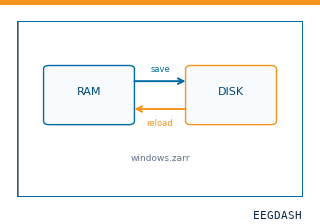 Save and reload prepared dataCache a windowed dataset to disk and reattach it without recompute.
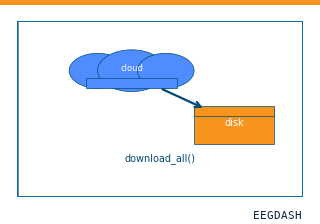 Download a dataset locallyPrefetch BIDS files to a local cache and validate the layout.
Swap any load_dataset(...) call for on006233 to reproduce the tutorial on this dataset.
Citation
Ryuzaburo Kochi, Aya Kanno, Hiroshi Uda, Keisuke Hatano, Hidenori Endo, … (2025). Picture naming. 10.82901/nemar.on006233
Provenance
¹Contributed to nemar in BIDS format.
²Curated & ingested by the EEGDash catalog; see CITATION.cff for canonical reference.
³Persistent identifier: 10.82901/nemar.on006233.
See Also#
eegdash.dataset.EEGDashDataseteegdash.dataset