


NM000349: eeg dataset, 39 subjects#
Chamanzar2020: Ultra high-density EEG of interictal migraine and controls during visual, auditory stimulation and rest
Access recordings and metadata through EEGDash.
Citation: Alireza Chamanzar, Sarah M. Haigh, Pulkit Grover, Marlene Behrmann (2021). Chamanzar2020: Ultra high-density EEG of interictal migraine and controls during visual, auditory stimulation and rest. 10.82901/nemar.nm000349
Modality: eeg Subjects: 39 Recordings: 117 License: CC-BY-4.0 Source: nemar
Metadata: Complete (100%)
39-participant EEG dataset — Chamanzar2020: Ultra high-density EEG of interictal migraine and controls during visual, auditory stimulation and rest.
Quickstart#
Install
pip install eegdash
Access the data
from eegdash.dataset import NM000349

dataset = NM000349(cache_dir="./data")
# Get the raw object of the first recording
raw = dataset.datasets[0].raw
print(raw.info)
Filter by subject
dataset = NM000349(cache_dir="./data", subject="01")
Advanced query
dataset = NM000349(
    cache_dir="./data",
    query={"subject": {"$in": ["01", "02"]}},
)
Iterate recordings
for rec in dataset:
    print(rec.subject, rec.raw.info['sfreq'])
If you use this dataset in your research, please cite the original authors.
BibTeX
@dataset{nm000349,
  title = {Chamanzar2020: Ultra high-density EEG of interictal migraine and controls during visual, auditory stimulation and rest},
  author = {Alireza Chamanzar and Sarah M. Haigh and Pulkit Grover and Marlene Behrmann},
  doi = {10.82901/nemar.nm000349},
  url = {https://doi.org/10.82901/nemar.nm000349},
}
About This Dataset#
BIDS conversion of the Carnegie Mellon University KiltHub release doi:10.1184/R1/12636731
(Chamanzar, Haigh, Grover, Behrmann; CC BY 4.0), data for Chamanzar et al. (2021), “Abnormalities in cortical pattern of coherence in migraine detected using ultra high-density EEG”, Brain Communications, doi:10.1093/braincomms/fcab061.
39 participants: 18 with migraine recorded interictally (sub-M01..sub-M18) and
21 healthy controls (sub-C01..sub-C21). The published analysis used 17 migraine (14 after
excluding M2, M6, M18 for medication; M13 lacks the auditory task) and 18 matched controls; C2, C6 and
C12 are additional controls without demographics. See participants.tsv (in_paper_analysis, notes).
Ultra high-density EEG of interictal migraine and controls: sensory and rest
Recording
128-channel BioSemi ActiveTwo, 512 Hz, 24-bit, custom ultra-high-density cap (~14 mm spacing) over occipital, parietal and frontal areas, inside a Faraday cage. Channel labels use 10-5 names, but the positions are custom and no digitized coordinates were released, so no electrodes.tsv is provided.
View full README
Ultra high-density EEG of interictal migraine and controls: sensory and rest
Recording
128-channel BioSemi ActiveTwo, 512 Hz, 24-bit, custom ultra-high-density cap (~14 mm spacing) over occipital, parietal and frontal areas, inside a Faraday cage. Channel labels use 10-5 names, but the positions are custom and no digitized coordinates were released, so no electrodes.tsv is provided.
Auxiliary channels: mastoids M1/M2 (type EEG), EOG LO1/LO2/IO1/SO1, ECG (collar bone), IO2 (role not documented, type MISC), GSR1/2, Erg1/2, Resp, Plet, Temp. Online reference CMS/DRL; no offline processing.
Mains frequency 60 Hz.
Tasks
task-ssvep: vertical grating flickering at 4 or 6 Hz for 2 s (100 trials each), ISI 1-1.5 s.task-ssaep: 1 kHz tone amplitude-modulated at 4 or 6 Hz for 2 s (100 trials each), ISI 1-1.5 s.task-rest: eyes open, fixation cross, 2-min blocks.
About 10% of task trials are attention trials with a key press (colour change of the fixation cross).
Event codes are decoded from the Status channel; see task-*_events.json. The Status channel’s bit 16
(value 65536) toggles occasionally; it is masked out and is not an event.
Known irregularities (from the original files)
sub-M13 has no SSAEP recording (documented in the release).
sub-C14 SSAEP was recorded in two files (run-1: 75+75 trials, run-2: 25+25 trials).
sub-C12 SSVEP is truncated (25+25 trials, ~215 s); not documented in the release.
Most resting files contain 2-3 blocks (~400 s) rather than the six blocks in the protocol; sub-M01 and sub-M02 contain ~800 s.
Trigger value 5 at the end of some resting files and one value 23 (sub-M03 SSVEP) are not described in the protocol; they are kept as
undocumented_code_*.Original file names: M15’s files are named
P15_*; M1/M3 resting useM1resting/M3Resting.
Additional material
stimuli/: MATLAB/Psychtoolbox code of the three paradigms and SSVEP pattern files (from the release).sourcedata/original_release/: the complete original KiltHub release, all 43 files byte-identical to doi:10.1184/R1/12636731 (per-subject zips, README.txt, protocol PDF, demographics sheet, stimulus zip).sourcedata/sub-*/: per-subject feedback reaction-time files extracted from the zips (*aud_migraine.txt,*vis_migraine.txt: line 1 trial labels 1/2, line 2 attention trials, line 3 response times in s).sourcedata/sourcedata_provenance.json: size, MD5/SHA-256 and origin of every source file; the BIDS*_eeg.bdffiles are byte-identical to the BDFs inside the original zips.
NEMAR Metadata#
[](https://doi.org/10.82901/nemar.nm000349) # Ultra high-density EEG of interictal migraine and controls: sensory and rest BIDS conversion of the Carnegie Mellon University KiltHub release doi:10.1184/R1/12636731 (Chamanzar, Haigh, Grover, Behrmann; CC BY 4.0), data for Chamanzar et al. (2021), “Abnormalities in cortical pattern of coherence in migraine detected using ultra high-density EEG”, Brain Communications, doi:10.1093/braincomms/fcab061. ## Participants 39 participants: 18 with migraine recorded interictally (sub-M01..sub-M18) and 21 healthy controls (sub-C01..sub-C21). The published analysis used 17 migraine (14 after excluding M2, M6, M18 for medication; M13 lacks the auditory task) and 18 matched controls; C2, C6 and C12 are additional controls without demographics. See participants.tsv (in_paper_analysis, notes). ## Recording 128-channel BioSemi ActiveTwo, 512 Hz, 24-bit, custom ultra-high-density cap (~14 mm spacing) over occipital, parietal and frontal areas, inside a Faraday cage. Channel labels use 10-5 names, but the positions are custom and no digitized coordinates were released, so no electrodes.tsv is provided. Auxiliary channels: mastoids M1/M2 (type EEG), EOG LO1/LO2/IO1/SO1, ECG (collar bone), IO2 (role not documented, type MISC), GSR1/2, Erg1/2, Resp, Plet, Temp. Online reference CMS/DRL; no offline processing. Mains frequency 60 Hz. ## Tasks - task-ssvep: vertical grating flickering at 4 or 6 Hz for 2 s (100 trials each), ISI 1-1.5 s. - task-ssaep: 1 kHz tone amplitude-modulated at 4 or 6 Hz for 2 s (100 trials each), ISI 1-1.5 s. - task-rest: eyes open, fixation cross, 2-min blocks. About 10% of task trials are attention trials with a key press (colour change of the fixation cross). Event codes are decoded from the Status channel; see task-*_events.json. The Status channel’s bit 16 (value 65536) toggles occasionally; it is masked out and is not an event. ## Known irregularities (from the original files) - sub-M13 has no SSAEP recording (documented in the release). - sub-C14 SSAEP was recorded in two files (run-1: 75+75 trials, run-2: 25+25 trials). - sub-C12 SSVEP is truncated (25+25 trials, ~215 s); not documented in the release. - Most resting files contain 2-3 blocks (~400 s) rather than the six blocks in the protocol; sub-M01 and
sub-M02 contain ~800 s.
Trigger value 5 at the end of some resting files and one value 23 (sub-M03 SSVEP) are not described in the protocol; they are kept as undocumented_code_*.
Original file names: M15’s files are named P15_*; M1/M3 resting use M1resting/M3Resting.
## Additional material - stimuli/: MATLAB/Psychtoolbox code of the three paradigms and SSVEP pattern files (from the release). - sourcedata/original_release/: the complete original KiltHub release, all 43 files byte-identical to
doi:10.1184/R1/12636731 (per-subject zips, README.txt, protocol PDF, demographics sheet, stimulus zip).
sourcedata/sub-*/: per-subject feedback reaction-time files extracted from the zips (*aud_migraine.txt, *vis_migraine.txt: line 1 trial labels 1/2, line 2 attention trials, line 3 response times in s).
sourcedata/sourcedata_provenance.json: size, MD5/SHA-256 and origin of every source file; the BIDS *_eeg.bdf files are byte-identical to the BDFs inside the original zips.
License: CC-BY-4.0
Authors:
Alireza Chamanzar
Sarah M. Haigh
Pulkit Grover
Marlene Behrmann
Versions:
Version |
DOI |
Released |
|---|---|---|
|
Cohort#
Dataset Statistics#
Age distribution by gender (n=36, range 19–54 yr, mean 27.6 yr)
Sex composition
Channel counts: 144 ch (n=117 recordings)
Sampling frequencies: 512.0 Hz (n=117 recordings)
Total recording duration: 21 h 13 min
Signal · Electrodes & live trace#
Live trace viewer — sub-C20 · task-ssaep
Showing one representative recording out of
39 subjects and 117 recordings in this dataset.
Browse the full set on OpenNeuro;
drop any other _eeg.{set,edf,bdf,vhdr} file onto the
viewer (or pass ?eeg=<url>) to inspect it.
Electrode layout — EEG · 130 sensors — 130 channels
NEMAR Processing Statistics#
The plots below are generated by NEMAR’s automated EEG pipeline. The histogram shows pipeline success for data cleaning and ICA decomposition, the percentage of data frames and EEG channels retained after artefact removal, line noise per channel (RMS, dB), and the age/gender distribution of participants.

HED event descriptors word cloud

Manifest#
File Explorer#
Browse the BIDS file structure of this dataset. Records are fetched on demand from the EEGDash catalog the first time you open the explorer.
Full dataset metadata table
Dataset ID |
|
Title |
Chamanzar2020: Ultra high-density EEG of interictal migraine and controls during visual, auditory stimulation and rest |
Author (year) |
— |
Canonical |
— |
Importable as |
|
Year |
2021 |
Authors |
Alireza Chamanzar, Sarah M. Haigh, Pulkit Grover, Marlene Behrmann |
License |
CC-BY-4.0 |
Citation / DOI |
|
Source links |
OpenNeuro | NeMAR | Source URL |
Copy-paste BibTeX
@dataset{nm000349,
  title = {Chamanzar2020: Ultra high-density EEG of interictal migraine and controls during visual, auditory stimulation and rest},
  author = {Alireza Chamanzar and Sarah M. Haigh and Pulkit Grover and Marlene Behrmann},
  doi = {10.82901/nemar.nm000349},
  url = {https://doi.org/10.82901/nemar.nm000349},
}
API Reference#
eegdash.datasetEEGDashDataset- class eegdash.dataset.NM000349(cache_dir: str, query: dict | None = None, s3_bucket: str | None = None, **kwargs)[source]#
Chamanzar2020: Ultra high-density EEG of interictal migraine and controls during visual, auditory stimulation and rest
- Study:
nm000349(NeMAR)- Author (year):
—
- Canonical:
—
Also importable as:
NM000349.Modality:
eeg; Subject type:Unknown. Subjects: 39; recordings: 117; tasks: 3.- Parameters:
cache_dir (str | Path) – Directory where data are cached locally.
query (dict | None) – Additional MongoDB-style filters to AND with the dataset selection. Must not contain the key
dataset.s3_bucket (str | None) – Base S3 bucket used to locate the data.
**kwargs (dict) – Additional keyword arguments forwarded to
EEGDashDataset.
- data_dir#
Local dataset cache directory (
cache_dir / dataset_id).- Type:
Path
Notes
Each item is a recording; recording-level metadata are available via
dataset.description.querysupports MongoDB-style filters on fields inALLOWED_QUERY_FIELDSand is combined with the dataset filter. Dataset-specific caveats are not provided in the summary metadata.References
OpenNeuro dataset: https://openneuro.org/datasets/nm000349 NeMAR dataset: https://nemar.org/dataexplorer/detail?dataset_id=nm000349 DOI: https://doi.org/10.82901/nemar.nm000349
Examples
>>> from eegdash.dataset import NM000349
>>> dataset = NM000349(cache_dir="./data")
>>> recording = dataset[0]
>>> raw = recording.load()
- __init__(cache_dir: str, query: dict | None = None, s3_bucket: str | None = None, **kwargs)[source]#
- save(path: str, overwrite: bool = False, offset: int = 0)[source]#
Save datasets to files by creating one subdirectory for each dataset:
path/
    0/
        0-raw.fif | 0-epo.fif
        description.json
        raw_preproc_kwargs.json (if raws were preprocessed)
        window_kwargs.json (if this is a windowed dataset)
        window_preproc_kwargs.json  (if windows were preprocessed)
        target_name.json (if target_name is not None and dataset is raw)
    1/
        1-raw.fif | 1-epo.fif
        description.json
        raw_preproc_kwargs.json (if raws were preprocessed)
        window_kwargs.json (if this is a windowed dataset)
        window_preproc_kwargs.json  (if windows were preprocessed)
        target_name.json (if target_name is not None and dataset is raw)
- Parameters:
path (str) –
- Directory in which subdirectories are created to store
-raw.fif | -epo.fif and .json files to.
overwrite (bool) – Whether to delete old subdirectories that will be saved to in this call.
offset (int) – If provided, the integer is added to the id of the dataset in the concat. This is useful in the setting of very large datasets, where one dataset has to be processed and saved at a time to account for its original position.
BaseDataset from braindecode — windowed via create_windows_from_events.braindecodeDataLoader; supports parallel workers and on-the-fly augmentations.pytorch Find datasets with the EEGDash APIQuery the catalogue, filter by task or modality, list candidates.
 Load one EEG recordingResolve a single record to an MNE Raw with channels and events.
 EEG recording to PyTorch DataLoaderWrap braindecode windows in a DataLoader for model training.
 Preprocess EEG and create windowsFilter, resample, epoch — and persist the windowed dataset.
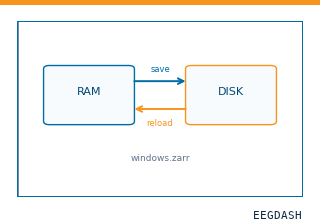 Save and reload prepared dataCache a windowed dataset to disk and reattach it without recompute.
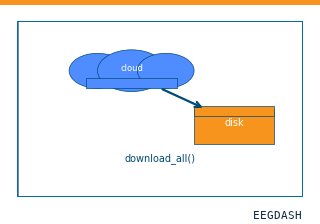 Download a dataset locallyPrefetch BIDS files to a local cache and validate the layout.
Swap any load_dataset(...) call for nm000349 to reproduce the tutorial on this dataset.
Citation
Alireza Chamanzar, Sarah M. Haigh, Pulkit Grover, Marlene Behrmann (2021). Chamanzar2020: Ultra high-density EEG of interictal migraine and controls during visual, auditory stimulation and rest. 10.82901/nemar.nm000349
Provenance
¹Contributed to nemar in BIDS format.
²Curated & ingested by the EEGDash catalog; see CITATION.cff for canonical reference.
³Persistent identifier: 10.82901/nemar.nm000349.
See Also#
eegdash.dataset.EEGDashDataseteegdash.dataset