


NM000368: ieeg dataset, 35 subjects#
Sternberg working memory: human microwire LFP from medial temporal and medial frontal lobe (Daume et al. 2024, DANDI 000673)
Access recordings and metadata through EEGDash.
Citation: Jonathan Daume, Jan Kaminski, Andrea G. P. Schjetnan, Yousef Salimpour, Umais Khan, Michael Kyzar, Chrystal M. Reed, William S. Anderson, Taufik A. Valiante, Adam N. Mamelak, Ueli Rutishauser (2025). Sternberg working memory: human microwire LFP from medial temporal and medial frontal lobe (Daume et al. 2024, DANDI 000673). 10.82901/nemar.nm000368
Modality: ieeg Subjects: 35 Recordings: 43 License: CC-BY-4.0 Source: nemar
Metadata: Complete (100%)
35-participant iEEG dataset — Sternberg working memory: human microwire LFP from medial temporal and medial frontal lobe (Daume et al. 2024, DANDI 000673).
Quickstart#
Install
pip install eegdash
Access the data
from eegdash.dataset import NM000368

dataset = NM000368(cache_dir="./data")
# Get the raw object of the first recording
raw = dataset.datasets[0].raw
print(raw.info)
Filter by subject
dataset = NM000368(cache_dir="./data", subject="01")
Advanced query
dataset = NM000368(
    cache_dir="./data",
    query={"subject": {"$in": ["01", "02"]}},
)
Iterate recordings
for rec in dataset:
    print(rec.subject, rec.raw.info['sfreq'])
If you use this dataset in your research, please cite the original authors.
BibTeX
@dataset{nm000368,
  title = {Sternberg working memory: human microwire LFP from medial temporal and medial frontal lobe (Daume et al. 2024, DANDI 000673)},
  author = {Jonathan Daume and Jan Kaminski and Andrea G. P. Schjetnan and Yousef Salimpour and Umais Khan and Michael Kyzar and Chrystal M. Reed and William S. Anderson and Taufik A. Valiante and Adam N. Mamelak and Ueli Rutishauser},
  doi = {10.82901/nemar.nm000368},
  url = {https://doi.org/10.82901/nemar.nm000368},
}
About This Dataset#
Microwire local field potentials (LFP) from Behnke-Fried hybrid depth electrodes in patients with
drug-resistant epilepsy undergoing invasive seizure monitoring, recorded while they performed a Sternberg working-memory task with pictures (load 1 or load 3, 140 trials per session). Recording sites: hippocampus, amygdala, dorsal anterior cingulate cortex (dACC), pre-supplementary motor area (pre-SMA) and ventromedial prefrontal cortex (vmPFC). The study was part of an NIH BRAIN consortium of Cedars-Sinai Medical Center, Toronto Western Hospital and Johns Hopkins Hospital.
This dataset is an iEEG-BIDS representation of the LFP released by the authors in NWB format on DANDI:
Daume J, Kaminski J, Schjetnan AGP, Salimpour Y, Khan U, Kyzar M, Reed CM, Anderson WS, Valiante TA, Mamelak AN, Rutishauser U (2025). Data for: Control of working memory by phase-amplitude coupling of human hippocampal neurons (Version 0.250122.0110). DANDI Archive. https://doi.org/10.48324/dandi.000673/0.250122.0110 (license CC-BY-4.0) Article: Daume J et al. Control of working memory by phase-amplitude coupling of human hippocampal neurons. Nature 629, 393-401 (2024). https://doi.org/10.1038/s41586-024-07309-z
Sternberg working memory: human microwire LFP (Daume et al. 2024, DANDI 000673)
Overview
Please cite both. Example analysis code: rutishauserlab/SBCAT-release-NWB.
Related release: DANDI 000469 (Kyzar et al., Sternberg task, single-neuron spike times only, no continuous
View full README
Sternberg working memory: human microwire LFP (Daume et al. 2024, DANDI 000673)
Overview
Please cite both. Example analysis code: rutishauserlab/SBCAT-release-NWB.
Related release: DANDI 000469 (Kyzar et al., Sternberg task, single-neuron spike times only, no continuous signal) comes from the same lab and task; its subject labels were not cross-checked here.
Same participants in other releases: the NWB file identifiers carry the lab patient code (e.g. P62CS, P101TWH, P1802JHU; column lab_patient_code of participants.tsv; the suffix appears to name the site: CS Cedars-Sinai, TWH Toronto Western, JHU Johns Hopkins). Where the same code appears in another public release with the same age and sex, participants.tsv names that subject (column same_participant_in): 9 participants were also recorded in the cognitive-boundary task of DANDI 000940 (Zheng et al. 2024; NEMAR nm000367) and 5 (P55CS, P56CS, P58CS, P60CS, P62CS) in the movie-watching study DANDI 000623 (NEMAR nm000357). These are different tasks and recordings, not duplicates. One code (P116TWH here, TWH116 in DANDI 000940) has a different age and sex in the two releases and is not linked.
Ethics
From the article: “Their participation was voluntary, and all of the patients gave their informed consent.
This study was part of an NIH Brain consortium between three institutions (Cedars-Sinai Medical Center, Toronto Western Hospital and Johns Hopkins Hospital) and was approved by the Institutional Review Board of the institution at which the patient was enrolled.” This deposit redistributes the publicly released data under its CC-BY-4.0 license.
Contents
35 participants, 43 recordings (sessions), 1,922 microwire LFP channels (8-71 per recording), 400 Hz, 1221-1899 s per recording, 17.23 h in total; 6,007 trial rows, 42,139 TTL markers, 24,028 picture presentations.
sub-<label>/ses-<label> DANDI subject and session labels (ses-1, ses-2, ses-3). ieeg/*_ieeg.vhdr/.vmrk/.eeg BrainVision, IEEE float32, microvolts, resolution 1.0. ieeg/*_channels.tsv one row per microwire, in the column order of the source series. ieeg/*_electrodes.tsv source coordinates of each microwire (one location per bundle). ieeg/*_events.tsv trials, TTL markers and picture presentations (see Events). *_scans.tsv recording year, source file, SHA-256 and float32 rounding error. sourcedata/sourcedata_provenance.json
the 44 source NWB files with size, SHA-256, DANDI asset id and download URL.
Why the original NWB files are not included: they embed the stimulus pictures (stimulus/templates,
StimulusTemplates, 400 x 300 RGB images). The article states “Due to copyright restrictions, the images
shown here are similar but not identical to those used in the study”, so the pictures have their own
copyright. The NWB files (and the pictures) remain available unchanged from DANDI with the URLs and
checksums in sourcedata/sourcedata_provenance.json, e.g. dandi download DANDI:000673/0.250122.0110.
Signal: what was converted and how
Source: acquisition/LFPs (ElectricalSeries) of each NWB file: float64 values in “microvolts”, conversion 1, offset 0, regular 400 Hz clock (starting_time between 0.0000153 and 0.0025 s in the session clock). NWB description: “These are LFP recordings that have spike potentials removed and is downsampled to 400Hz”.
Values were written to BrainVision as float32 microvolts; this is the only change (float32 rounding, at most 0.00049 µV per file, reported per file in scans.tsv). No filtering, resampling, re-referencing, cropping or channel removal was done by this conversion.
Processing already applied by the authors (Daume et al. 2024, Methods): broadband 0.1-8000 Hz recorded at 32 kHz (Neuralynx ATLAS; Cedars-Sinai and Toronto Western) or 30 kHz (Blackrock; Johns Hopkins); spike waveforms removed by linear interpolation from -1 to 2 ms around each spike onset on all wires of the bundle; zero phase-lag low-pass at 175 Hz; downsampling to 400 Hz. The article then removes 60/120 Hz line noise for its analyses; whether that band-stop was applied to the released series is not stated. Reference: locally within each bundle (one of the eight microwires or a dedicated low-impedance reference wire); the reference wire per channel is not given. Channel type: BIDS has no microwire channel type; SEEG (depth electrode) is used and each channel is described as a microwire in channels.tsv.
Institution: every NWB file states general/institution = “Cedars-Sinai Medical Center”, although the article reports recordings at three institutions; the release gives no explicit per-patient site. The recording_institution column and InstitutionName repeat the NWB value; the lab patient code suffix (CS, TWH, JHU) in participants.tsv suggests the site.
Events
onset = NWB time - LFP starting_time (all NWB times share the session clock). Because the LFP starts up to 2.5 ms after the session-clock zero, the experiment-start TTL can have a small negative onset.
- sternberg_trial one row per trial (intervals/trials; onset = trial start, duration = stop - start),
with all source columns: loads, PicIDs_Encoding1/2/3, PicIDs_Probe, probe_in_out, response_accuracy and the absolute NWB times timestamps_FixationCross, timestamps_Encoding1/2/3(_end), timestamps_Maintenance, timestamps_Probe, timestamps_Response.
- ttl every TTL marker (acquisition/events): 61 start of experiment, 11 fixation cross,
1/2/3 picture 1/2/3 shown, 5 transition between pictures, 6 end of encoding / start of maintenance, 7 probe, 8 response, 60 end of experiment (NWB description).
- stimulus_presentation every picture presentation (stimulus/presentation/StimulusPresentation, IndexSeries);
stimulus_index indexes the source StimulusTemplates (not distributed, see above).
NWB column descriptions are copied into events.json. Times inside source columns are absolute NWB session times (subtract source_lfp_starting_time_s in scans.tsv to get recording time).
Coordinates
electrodes.tsv gives the x, y, z of the NWB electrodes table in mm (one location per bundle). The article plots electrode positions “on the CITI168 Atlas Brain in MNI152 coordinates for the sole purpose of visualization” and notes that template coordinates can fall into white matter; coordsystem.json therefore uses “Other” with that description.
Participants
Cohort (Daume et al. 2024, Methods and Supplementary Table S5): 36 patients (44 sessions; 21 female, 15 male; age 40.47 +/- 13.76 years) with Behnke-Fried hybrid electrodes (AdTech) implanted for intracranial seizure monitoring and evaluation for surgical treatment of drug-resistant epilepsy, at Cedars-Sinai Medical Center, Toronto Western Hospital and Johns Hopkins Hospital. Recording years (NWB, year only): 2018-2022. sub-20 (lab code P088TWH) is not included: its only NWB file has spike-sorted units but no LFP series (acquisition/LFPs absent), so 35 of the 36 DANDI participants are present (Table S5: P88T, male, 26, right mesial temporal onset). participants.tsv columns:
age, sex, species, recording_institution, dandi_subject_id NWB general/subject and general/institution. lab_patient_code, same_participant_in NWB file identifier; links to other releases. seizure_onset_zone Daume et al. 2024 Supplementary Table S5, verbatim. paper_session_labels, n_sessions Table S5 row labels of the participant’s sessions
(first = ses-1, _2 = ses-2, _3 = ses-3).
diagnosis, implant_type cohort-level facts from the article Methods. recording_year year of NWB session_start_time (as scans.tsv). lfp_regions, lfp_hemispheres derived from channels.tsv of this release.
Mapping proof: Table S5 names rows by lab code (P55cs, P101T, P1802jh, …). For all 35 participants the code, age, sex and number of sessions agree, and for every one of the 43 sessions the number of LFP channels per area (hippocampus, amygdala, pre-SMA, dACC, vmPFC) in this release equals Table S5’s number of clean micro-LFP channels per area. Table S5 also gives neuron counts per session and area (not copied here).
Handedness, epilepsy duration/onset age, etiology and medication are not reported by the sources (n/a). Recording year (scans.tsv) is the year of the NWB session_start_time, which the authors set to 1 January of the recording year to avoid disclosure of protected health information.
Not converted (available unchanged in the NWB files on DANDI)
Spike-sorted single units (spike times, waveforms and quality metrics) and the stimulus pictures.
Conversion checks
Every BrainVision file was read back with MNE-Python and compared with the source NWB: channel names and order equal the NWB electrode region, sampling rate and sample count equal, every sample equals the float32 representation of the source value (largest absolute difference to the float64 source 0.00049 µV), no non-finite values.
Every trial row, TTL marker and picture presentation was recomputed from the NWB (onset = time - starting_time); all match events.tsv within 1 µs; only the experiment-start TTL of each file lies before the first sample (by at most 2.5 ms).
scans.tsv SHA-256 values equal the DANDI digests of the source files.
bids-validator 3.0.2: 0 errors; warnings only for recommended fields the source does not document.
Conversion code: b2dandi_rutishauser_bids.py (iEEG-NEMAR campaign, batch 2), using h5py and pybv.
Known caveats
Every NWB file states general/institution = “Cedars-Sinai Medical Center” although the article reports three sites; recording_institution and InstitutionName repeat the NWB value (see Signal).
Whether the article’s 60/120 Hz band-stop was applied to the released series is not stated; the reference wire per channel is not given (see Signal).
The stimulus pictures are not distributed (copyright; see Contents).
One code (P116TWH here, TWH116 in DANDI 000940) has a different age and sex in the two releases and is not linked; DANDI 000940 states 2018 for all its files, including patients whose Sternberg sessions here are dated 2019 or 2020.
How to load
from mne_bids import BIDSPath, read_raw_bids bp = BIDSPath(root=”nm000368”, subject=”1”, session=”1”, task=”sternberg”, datatype=”ieeg”) raw = read_raw_bids(bp) # 400 Hz microwire LFP in microvolts (MNE stores volts) events = raw.annotations # trials, TTL markers, picture presentations from events.tsv
Citation
Daume J, Kaminski J, Schjetnan AGP, Salimpour Y, Khan U, Kyzar M, Reed CM, Anderson WS, Valiante TA, Mamelak AN, Rutishauser U. Control of working memory by phase-amplitude coupling of human hippocampal neurons. Nature 629, 393-401 (2024). doi:10.1038/s41586-024-07309-z ; and the data: doi:10.48324/dandi.000673/0.250122.0110.
Provenance of the 2026-10-07 metadata enrichment
Daume et al. 2024 Methods and Supplementary Information (Supplementary Table S5); the release itself (channels.tsv, scans.tsv).
NEMAR Metadata#
[](https://doi.org/10.82901/nemar.nm000368) Sternberg working memory: human microwire LFP (Daume et al. 2024, DANDI 000673) ================================================================================ Overview ——– Microwire local field potentials (LFP) from Behnke-Fried hybrid depth electrodes in patients with drug-resistant epilepsy undergoing invasive seizure monitoring, recorded while they performed a Sternberg working-memory task with pictures (load 1 or load 3, 140 trials per session). Recording sites: hippocampus, amygdala, dorsal anterior cingulate cortex (dACC), pre-supplementary motor area (pre-SMA) and ventromedial prefrontal cortex (vmPFC). The study was part of an NIH BRAIN consortium of Cedars-Sinai Medical Center, Toronto Western Hospital and Johns Hopkins Hospital. This dataset is an iEEG-BIDS representation of the LFP released by the authors in NWB format on DANDI:
Daume J, Kaminski J, Schjetnan AGP, Salimpour Y, Khan U, Kyzar M, Reed CM, Anderson WS, Valiante TA, Mamelak AN, Rutishauser U (2025). Data for: Control of working memory by phase-amplitude coupling of human hippocampal neurons (Version 0.250122.0110). DANDI Archive. https://doi.org/10.48324/dandi.000673/0.250122.0110 (license CC-BY-4.0) Article: Daume J et al. Control of working memory by phase-amplitude coupling of human hippocampal neurons. Nature 629, 393-401 (2024). https://doi.org/10.1038/s41586-024-07309-z
Please cite both. Example analysis code: rutishauserlab/SBCAT-release-NWB. Related release: DANDI 000469 (Kyzar et al., Sternberg task, single-neuron spike times only, no continuous signal) comes from the same lab and task; its subject labels were not cross-checked here. Same participants in other releases: the NWB file identifiers carry the lab patient code (e.g. P62CS, P101TWH, P1802JHU; column lab_patient_code of participants.tsv; the suffix appears to name the site: CS Cedars-Sinai, TWH Toronto Western, JHU Johns Hopkins). Where the same code appears in another public release with the same age and sex, participants.tsv names that subject (column same_participant_in): 9 participants were also recorded in the cognitive-boundary task of DANDI 000940 (Zheng et al. 2024; NEMAR nm000367) and 5 (P55CS, P56CS, P58CS, P60CS, P62CS) in the movie-watching study DANDI 000623 (NEMAR nm000357). These are different tasks and recordings, not duplicates. One code (P116TWH here, TWH116 in DANDI 000940) has a different age and sex in the two releases and is not linked. Ethics —— From the article: “Their participation was voluntary, and all of the patients gave their informed consent. This study was part of an NIH Brain consortium between three institutions (Cedars-Sinai Medical Center, Toronto Western Hospital and Johns Hopkins Hospital) and was approved by the Institutional Review Board of the institution at which the patient was enrolled.” This deposit redistributes the publicly released data under its CC-BY-4.0 license. Contents ——– 35 participants, 43 recordings (sessions), 1,922 microwire LFP channels (8-71 per recording), 400 Hz, 1221-1899 s per recording, 17.23 h in total; 6,007 trial rows, 42,139 TTL markers, 24,028 picture presentations.
sub-<label>/ses-<label> DANDI subject and session labels (ses-1, ses-2, ses-3). ieeg/*_ieeg.vhdr/.vmrk/.eeg BrainVision, IEEE float32, microvolts, resolution 1.0. ieeg/*_channels.tsv one row per microwire, in the column order of the source series. ieeg/*_electrodes.tsv source coordinates of each microwire (one location per bundle). ieeg/*_events.tsv trials, TTL markers and picture presentations (see Events). *_scans.tsv recording year, source file, SHA-256 and float32 rounding error. sourcedata/sourcedata_provenance.json
the 44 source NWB files with size, SHA-256, DANDI asset id and download URL.
Why the original NWB files are not included: they embed the stimulus pictures (stimulus/templates, StimulusTemplates, 400 x 300 RGB images). The article states “Due to copyright restrictions, the images shown here are similar but not identical to those used in the study”, so the pictures have their own copyright. The NWB files (and the pictures) remain available unchanged from DANDI with the URLs and checksums in sourcedata/sourcedata_provenance.json, e.g. dandi download DANDI:000673/0.250122.0110. Signal: what was converted and how ———————————- Source: acquisition/LFPs (ElectricalSeries) of each NWB file: float64 values in “microvolts”, conversion 1, offset 0, regular 400 Hz clock (starting_time between 0.0000153 and 0.0025 s in the session clock). NWB description: “These are LFP recordings that have spike potentials removed and is downsampled to 400Hz”. Values were written to BrainVision as float32 microvolts; this is the only change (float32 rounding, at most 0.00049 µV per file, reported per file in scans.tsv). No filtering, resampling, re-referencing, cropping or channel removal was done by this conversion. Processing already applied by the authors (Daume et al. 2024, Methods): broadband 0.1-8000 Hz recorded at 32 kHz (Neuralynx ATLAS; Cedars-Sinai and Toronto Western) or 30 kHz (Blackrock; Johns Hopkins); spike waveforms removed by linear interpolation from -1 to 2 ms around each spike onset on all wires of the bundle; zero phase-lag low-pass at 175 Hz; downsampling to 400 Hz. The article then removes 60/120 Hz line noise for its analyses; whether that band-stop was applied to the released series is not stated. Reference: locally within each bundle (one of the eight microwires or a dedicated low-impedance reference wire); the reference wire per channel is not given. Channel type: BIDS has no microwire channel type; SEEG (depth electrode) is used and each channel is described as a microwire in channels.tsv. Institution: every NWB file states general/institution = “Cedars-Sinai Medical Center”, although the article reports recordings at three institutions; the release gives no explicit per-patient site. The recording_institution column and InstitutionName repeat the NWB value; the lab patient code suffix (CS, TWH, JHU) in participants.tsv suggests the site. Events —— onset = NWB time - LFP starting_time (all NWB times share the session clock). Because the LFP starts up to 2.5 ms after the session-clock zero, the experiment-start TTL can have a small negative onset.
- sternberg_trial one row per trial (intervals/trials; onset = trial start, duration = stop - start),
with all source columns: loads, PicIDs_Encoding1/2/3, PicIDs_Probe, probe_in_out, response_accuracy and the absolute NWB times timestamps_FixationCross, timestamps_Encoding1/2/3(_end), timestamps_Maintenance, timestamps_Probe, timestamps_Response.
- ttl every TTL marker (acquisition/events): 61 start of experiment, 11 fixation cross,
1/2/3 picture 1/2/3 shown, 5 transition between pictures, 6 end of encoding / start of maintenance, 7 probe, 8 response, 60 end of experiment (NWB description).
- stimulus_presentation every picture presentation (stimulus/presentation/StimulusPresentation, IndexSeries);
stimulus_index indexes the source StimulusTemplates (not distributed, see above).
NWB column descriptions are copied into events.json. Times inside source columns are absolute NWB session times (subtract source_lfp_starting_time_s in scans.tsv to get recording time). Coordinates ———– electrodes.tsv gives the x, y, z of the NWB electrodes table in mm (one location per bundle). The article plots electrode positions “on the CITI168 Atlas Brain in MNI152 coordinates for the sole purpose of visualization” and notes that template coordinates can fall into white matter; coordsystem.json therefore uses “Other” with that description. Participants ———— Cohort (Daume et al. 2024, Methods and Supplementary Table S5): 36 patients (44 sessions; 21 female, 15 male; age 40.47 +/- 13.76 years) with Behnke-Fried hybrid electrodes (AdTech) implanted for intracranial seizure monitoring and evaluation for surgical treatment of drug-resistant epilepsy, at Cedars-Sinai Medical Center, Toronto Western Hospital and Johns Hopkins Hospital. Recording years (NWB, year only): 2018-2022. sub-20 (lab code P088TWH) is not included: its only NWB file has spike-sorted units but no LFP series (acquisition/LFPs absent), so 35 of the 36 DANDI participants are present (Table S5: P88T, male, 26, right mesial temporal onset). participants.tsv columns:
age, sex, species, recording_institution, dandi_subject_id NWB general/subject and general/institution. lab_patient_code, same_participant_in NWB file identifier; links to other releases. seizure_onset_zone Daume et al. 2024 Supplementary Table S5, verbatim. paper_session_labels, n_sessions Table S5 row labels of the participant’s sessions
(first = ses-1, _2 = ses-2, _3 = ses-3).
diagnosis, implant_type cohort-level facts from the article Methods. recording_year year of NWB session_start_time (as scans.tsv). lfp_regions, lfp_hemispheres derived from channels.tsv of this release.
Mapping proof: Table S5 names rows by lab code (P55cs, P101T, P1802jh, …). For all 35 participants the code, age, sex and number of sessions agree, and for every one of the 43 sessions the number of LFP channels per area (hippocampus, amygdala, pre-SMA, dACC, vmPFC) in this release equals Table S5’s number of clean micro-LFP channels per area. Table S5 also gives neuron counts per session and area (not copied here). Handedness, epilepsy duration/onset age, etiology and medication are not reported by the sources (n/a). Recording year (scans.tsv) is the year of the NWB session_start_time, which the authors set to 1 January of the recording year to avoid disclosure of protected health information. Not converted (available unchanged in the NWB files on DANDI) ————————————————————– Spike-sorted single units (spike times, waveforms and quality metrics) and the stimulus pictures. Conversion checks —————– - Every BrainVision file was read back with MNE-Python and compared with the source NWB: channel names and
order equal the NWB electrode region, sampling rate and sample count equal, every sample equals the float32 representation of the source value (largest absolute difference to the float64 source 0.00049 µV), no non-finite values.
Every trial row, TTL marker and picture presentation was recomputed from the NWB (onset = time - starting_time); all match events.tsv within 1 µs; only the experiment-start TTL of each file lies before the first sample (by at most 2.5 ms).
scans.tsv SHA-256 values equal the DANDI digests of the source files.
bids-validator 3.0.2: 0 errors; warnings only for recommended fields the source does not document.
Conversion code: b2dandi_rutishauser_bids.py (iEEG-NEMAR campaign, batch 2), using h5py and pybv. Known caveats ————- - Every NWB file states general/institution = “Cedars-Sinai Medical Center” although the article reports three
sites; recording_institution and InstitutionName repeat the NWB value (see Signal).
Whether the article’s 60/120 Hz band-stop was applied to the released series is not stated; the reference wire per channel is not given (see Signal).
The stimulus pictures are not distributed (copyright; see Contents).
One code (P116TWH here, TWH116 in DANDI 000940) has a different age and sex in the two releases and is not linked; DANDI 000940 states 2018 for all its files, including patients whose Sternberg sessions here are dated 2019 or 2020.
How to load#
from mne_bids import BIDSPath, read_raw_bids bp = BIDSPath(root=”nm000368”, subject=”1”, session=”1”, task=”sternberg”, datatype=”ieeg”) raw = read_raw_bids(bp) # 400 Hz microwire LFP in microvolts (MNE stores volts) events = raw.annotations # trials, TTL markers, picture presentations from events.tsv
Citation#
Daume J, Kaminski J, Schjetnan AGP, Salimpour Y, Khan U, Kyzar M, Reed CM, Anderson WS, Valiante TA, Mamelak AN, Rutishauser U. Control of working memory by phase-amplitude coupling of human hippocampal neurons. Nature 629, 393-401 (2024). doi:10.1038/s41586-024-07309-z ; and the data: doi:10.48324/dandi.000673/0.250122.0110. Provenance of the 2026-10-07 metadata enrichment ———————————————— Daume et al. 2024 Methods and Supplementary Information (Supplementary Table S5); the release itself (channels.tsv, scans.tsv).
License: CC-BY-4.0
Authors:
Jonathan Daume
Jan Kaminski
Andrea G. P. Schjetnan
Yousef Salimpour
Umais Khan
… and 6 more
Versions:
Version |
DOI |
Released |
|---|---|---|
|
Cohort#
Dataset Statistics#
Age distribution by gender (n=35, range 20–67 yr, mean 40.9 yr)
Sex composition
Channel counts (ch)
Sampling frequencies: 400.0 Hz (n=43 recordings)
Total recording duration: 17 h 13 min
Signal · Electrodes & live trace#
Live trace viewer — sub-28 · ses-1 · task-sternberg
Showing one representative recording out of
35 subjects and 43 recordings in this dataset.
Browse the full set on OpenNeuro;
drop any other _ieeg.{set,edf,bdf,vhdr} file onto the
viewer (or pass ?ieeg=<url>) to inspect it.
Electrode layout — iEEG · 70 sensors — 70 channels
NEMAR Processing Statistics#
The plots below are generated by NEMAR’s automated EEG pipeline. The histogram shows pipeline success for data cleaning and ICA decomposition, the percentage of data frames and EEG channels retained after artefact removal, line noise per channel (RMS, dB), and the age/gender distribution of participants.

HED event descriptors word cloud

Manifest#
File Explorer#
Browse the BIDS file structure of this dataset. Records are fetched on demand from the EEGDash catalog the first time you open the explorer.
Full dataset metadata table
Dataset ID |
|
Title |
Sternberg working memory: human microwire LFP from medial temporal and medial frontal lobe (Daume et al. 2024, DANDI 000673) |
Author (year) |
— |
Canonical |
— |
Importable as |
|
Year |
2025 |
Authors |
Jonathan Daume, Jan Kaminski, Andrea G. P. Schjetnan, Yousef Salimpour, Umais Khan, Michael Kyzar, Chrystal M. Reed, William S. Anderson, Taufik A. Valiante, Adam N. Mamelak, Ueli Rutishauser |
License |
CC-BY-4.0 |
Citation / DOI |
|
Source links |
OpenNeuro | NeMAR | Source URL |
Copy-paste BibTeX
@dataset{nm000368,
  title = {Sternberg working memory: human microwire LFP from medial temporal and medial frontal lobe (Daume et al. 2024, DANDI 000673)},
  author = {Jonathan Daume and Jan Kaminski and Andrea G. P. Schjetnan and Yousef Salimpour and Umais Khan and Michael Kyzar and Chrystal M. Reed and William S. Anderson and Taufik A. Valiante and Adam N. Mamelak and Ueli Rutishauser},
  doi = {10.82901/nemar.nm000368},
  url = {https://doi.org/10.82901/nemar.nm000368},
}
API Reference#
eegdash.datasetEEGDashDataset- class eegdash.dataset.NM000368(cache_dir: str, query: dict | None = None, s3_bucket: str | None = None, **kwargs)[source]#
Sternberg working memory: human microwire LFP from medial temporal and medial frontal lobe (Daume et al. 2024, DANDI 000673)
- Study:
nm000368(NeMAR)- Author (year):
—
- Canonical:
—
Also importable as:
NM000368.Modality:
ieeg; Subject type:Unknown. Subjects: 35; recordings: 43; tasks: 1.- Parameters:
cache_dir (str | Path) – Directory where data are cached locally.
query (dict | None) – Additional MongoDB-style filters to AND with the dataset selection. Must not contain the key
dataset.s3_bucket (str | None) – Base S3 bucket used to locate the data.
**kwargs (dict) – Additional keyword arguments forwarded to
EEGDashDataset.
- data_dir#
Local dataset cache directory (
cache_dir / dataset_id).- Type:
Path
Notes
Each item is a recording; recording-level metadata are available via
dataset.description.querysupports MongoDB-style filters on fields inALLOWED_QUERY_FIELDSand is combined with the dataset filter. Dataset-specific caveats are not provided in the summary metadata.References
OpenNeuro dataset: https://openneuro.org/datasets/nm000368 NeMAR dataset: https://nemar.org/dataexplorer/detail?dataset_id=nm000368 DOI: https://doi.org/10.82901/nemar.nm000368
Examples
>>> from eegdash.dataset import NM000368
>>> dataset = NM000368(cache_dir="./data")
>>> recording = dataset[0]
>>> raw = recording.load()
- __init__(cache_dir: str, query: dict | None = None, s3_bucket: str | None = None, **kwargs)[source]#
- save(path: str, overwrite: bool = False, offset: int = 0)[source]#
Save datasets to files by creating one subdirectory for each dataset:
path/
    0/
        0-raw.fif | 0-epo.fif
        description.json
        raw_preproc_kwargs.json (if raws were preprocessed)
        window_kwargs.json (if this is a windowed dataset)
        window_preproc_kwargs.json  (if windows were preprocessed)
        target_name.json (if target_name is not None and dataset is raw)
    1/
        1-raw.fif | 1-epo.fif
        description.json
        raw_preproc_kwargs.json (if raws were preprocessed)
        window_kwargs.json (if this is a windowed dataset)
        window_preproc_kwargs.json  (if windows were preprocessed)
        target_name.json (if target_name is not None and dataset is raw)
- Parameters:
path (str) –
- Directory in which subdirectories are created to store
-raw.fif | -epo.fif and .json files to.
overwrite (bool) – Whether to delete old subdirectories that will be saved to in this call.
offset (int) – If provided, the integer is added to the id of the dataset in the concat. This is useful in the setting of very large datasets, where one dataset has to be processed and saved at a time to account for its original position.
BaseDataset from braindecode — windowed via create_windows_from_events.braindecodeDataLoader; supports parallel workers and on-the-fly augmentations.pytorch Find datasets with the EEGDash APIQuery the catalogue, filter by task or modality, list candidates.
 Load one EEG recordingResolve a single record to an MNE Raw with channels and events.
 EEG recording to PyTorch DataLoaderWrap braindecode windows in a DataLoader for model training.
 Preprocess EEG and create windowsFilter, resample, epoch — and persist the windowed dataset.
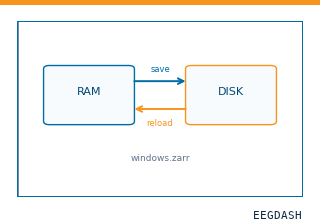 Save and reload prepared dataCache a windowed dataset to disk and reattach it without recompute.
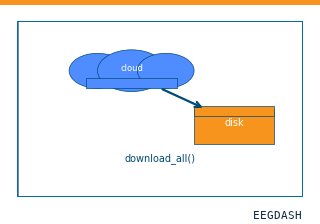 Download a dataset locallyPrefetch BIDS files to a local cache and validate the layout.
Swap any load_dataset(...) call for nm000368 to reproduce the tutorial on this dataset.
Citation
Jonathan Daume, Jan Kaminski, Andrea G. P. Schjetnan, Yousef Salimpour, Umais Khan, … (2025). Sternberg working memory: human microwire LFP from medial temporal and medial frontal lobe (Daume et al. 2024, DANDI 000673). 10.82901/nemar.nm000368
Provenance
¹Contributed to nemar in BIDS format.
²Curated & ingested by the EEGDash catalog; see CITATION.cff for canonical reference.
³Persistent identifier: 10.82901/nemar.nm000368.
See Also#
eegdash.dataset.EEGDashDataseteegdash.dataset