


NM000350: ieeg dataset, 4 subjects#
Human ECoG speaking consonant-vowel syllables
Access recordings and metadata through EEGDash.
Citation: Kristofer E. Bouchard, Edward F Chang, Ben Dichter (2013). Human ECoG speaking consonant-vowel syllables. 10.82901/nemar.nm000350
Modality: ieeg Subjects: 4 Recordings: 31 License: MIT Source: nemar
Metadata: Complete (100%)
4-participant iEEG dataset — Human ECoG speaking consonant-vowel syllables.
Quickstart#
Install
pip install eegdash
Access the data
from eegdash.dataset import NM000350

dataset = NM000350(cache_dir="./data")
# Get the raw object of the first recording
raw = dataset.datasets[0].raw
print(raw.info)
Filter by subject
dataset = NM000350(cache_dir="./data", subject="01")
Advanced query
dataset = NM000350(
    cache_dir="./data",
    query={"subject": {"$in": ["01", "02"]}},
)
Iterate recordings
for rec in dataset:
    print(rec.subject, rec.raw.info['sfreq'])
If you use this dataset in your research, please cite the original authors.
BibTeX
@dataset{nm000350,
  title = {Human ECoG speaking consonant-vowel syllables},
  author = {Kristofer E. Bouchard and Edward F Chang and Ben Dichter},
  doi = {10.82901/nemar.nm000350},
  url = {https://doi.org/10.82901/nemar.nm000350},
}
About This Dataset#
High-density (256-channel) electrocorticography (ECoG) recorded at the University of California, San Francisco from
patients undergoing clinical treatment for epilepsy while they read aloud consonant-vowel (CV) syllables from a list.
Source study: Bouchard KE, Mesgarani N, Johnson K, Chang EF (2013). Functional organization of human sensorimotor
cortex for speech articulation. Nature 495:327-332. doi:10.1038/nature11911.
Human ECoG speaking consonant-vowel syllables
Overview
The source collection describes the content as: voltage traces for each of the 256 recorded channels; detailed hand-marked annotations of which syllable was said and of the start, consonant-vowel transition and end of each syllable; a rest period when the subject was silent (usable as a baseline); and hand-marked anatomical labels for
View full README
Human ECoG speaking consonant-vowel syllables
Overview
The source collection describes the content as: voltage traces for each of the 256 recorded channels; detailed hand-marked annotations of which syllable was said and of the start, consonant-vowel transition and end of each syllable; a rest period when the subject was silent (usable as a baseline); and hand-marked anatomical labels for electrodes in the relevant brain regions.
Cohort
4 subject codes (EC2, EC9, GP31, GP33), 31 recording blocks (one BIDS session per block). Per-participant information, where the sources give it, is in
participants.tsv/participants.json.Clinical population: patients undergoing clinical treatment for epilepsy (source collection description).
The source publication describes three native English-speaking subjects with chronic implantation of a high-density subdural ECoG array over the left hemisphere (two subjects) or right hemisphere (one subject) as part of their clinical treatment of epilepsy; all had self-reported normal hearing and normal neuropsychological language testing (Boston Naming and verbal fluency tests) (Bouchard et al. 2013 (doi:10.1038/nature11911, PMC3606666), Methods). The collection contains four subject codes; the source does not map every code to a paper subject.
Implant type: high-density 256-channel subdural ECoG array (all channels typed ECOG). Source NWB electrode groups:
L256Grid electrodes(sub-EC2, sub-GP31),256Grid electrodesandauto_group(sub-EC9),auto_group(sub-GP33); listed per session iniEEGElectrodeGroups.Recording centre: University of California, San Francisco (Chang Lab, per NWB
general/lab).Acquisition system (source publication): “Cortical local field potentials (LFP) were recorded with ECoG arrays and a multi-channel amplifier optically connected to a digital signal processor (Tucker-Davis Technologies [TDT], Alachua, FL)”; “ECoG signals were acquired at 3052 Hz” (Bouchard et al. 2013 (doi:10.1038/nature11911, PMC3606666), Methods). The amplifier model, electrode manufacturer and the recording reference/ground are not stated by the sources.
Sampling rate as stored: 3051.7578 / 3051.7578125 Hz (see Recordings).
Task
Task
syllables: subjects read aloud consonant-vowel (CV) syllables from a list (source collection description).Source publication: CV syllables composed of 18-19 consonants (19 consonants for two subjects, 18 for one subject) followed by one of three vowels (/a/, /u/, /i/); each CV was produced between 15 and 100 times; microphone recordings were synchronized with the ECoG data (Bouchard et al. 2013 (doi:10.1038/nature11911, PMC3606666), Methods). The microphone signal is not included (removed by the source for HIPAA compliance).
Timing: syllable start, consonant-vowel transition and end are hand-marked annotations in the source (transcribed off-line from the speech recording per the source publication); see Events.
Files
sub-<s>/ses-B<n>/ieeg/*_ieeg.nwb: the source NWB 2.0 file (byte-identical), with the 256-channel ECoG ElectricalSeries in/acquisition/ElectricalSeries.*_ieeg.json: recording metadata (sampling rate, channel counts, duration, power line frequency, task, the NWB signal attributes inNWBSignalMetadata, acquisition system from the source publication).*_channels.tsv: one row per signal column in source order (type ECOG, units as declared by NWB,statusfrom the NWBbadflag).*_electrodes.tsv/*_electrodes.json/*_coordsystem.json: the source NWB electrode table (see Recordings for the coordinate caveat).*_events.tsv/*_events.json: all NWB interval tables (trials, CV transitions, epochs, invalid_times).*_scans.tsv: file list per session (acq_time n/a).sourcedata/figshare-c4617263-v4/: the 31 source files under their upstream names, withsourcedata/sourcedata_provenance.json.
Preprocessing applied by the source
Microphone audio removed and dates replaced by 1900-01-01 (source collection description).
Some files contain derived content (see Recordings, “Derived content inside source files”).
No other processing is documented by the source. The publication’s common-average referencing, high-gamma extraction and 200 Hz downsampling were analysis steps of the paper and are NOT applied to these files.
Known caveats
(Every caveat below is also stated in the sections Source and provenance, Ethics, Recordings, Events and Privacy.) - The Nature paper describes three subjects; this collection contains four subject codes. - NWB scaling: unit ‘volt’ with conversion 0.001, but stored values already have the magnitude of volts; values are
left exactly as published (see Recordings).
Electrode x/y/z have no documented frame or units and are kept only as
nwb_x/y/z(see Recordings).Recording reference, hardware filters and amplifier model are not stated (iEEGReference and SoftwareFilters n/a).
Funding grant numbers are given exactly as published (e.g. DP2-OD00862).
Source and provenance
Source: Bouchard, Kristofer E.; Chang, Edward F (2019). Human ECoG speaking consonant-vowel syllables. figshare. Collection. https://doi.org/10.6084/m9.figshare.c.4617263.v4 (31 Figshare articles, each version 1, each one NWB 2.0 file, each declared MIT).
The same 31 files (identical size and SHA-256) are also published on DANDI as Dandiset 000019, version 0.220126.2148, doi:10.48324/dandi.000019/0.220126.2148 (DANDI lists the licence as CC-BY-4.0). This BIDS release follows the Figshare record’s MIT licence and credits both releases.
Every
*_ieeg.nwbfile in this dataset is a byte-identical copy of the corresponding source file (SHA-256 verified). The original files are also kept under their upstream names insourcedata/figshare-c4617263-v4/withsourcedata/sourcedata_provenance.json(size, MD5, SHA-256, URL, article DOI per file).Each source block (file
<subject>_B<n>.nwb) maps to one BIDS sessionses-B<n>of subjectsub-<subject>(subjects: EC2, EC9, GP31, GP33; 31 sessions).
Ethics
Human Research Protection Program, University of California, San Francisco: “The experimental protocol was approved by the Human Research Protection Program at the University of California, San Francisco.” “Subjects gave their written informed consent before the day of surgery.” (Bouchard et al. 2013, Nature 495:327-332, doi:10.1038/nature11911, Methods; PMC3606666).
The Nature paper describes three subjects; this collection contains four subject codes. The source records do not state the approval for each subject separately; the data were released by the study authors as part of this collection.
Recordings
Sampling rate(s): 3051.7578 and 3051.7578125 Hz (as stored per file); channels per file: 256; channel type ECOG.
Conversion is organisation only: no filtering, resampling, re-referencing, channel removal or rescaling.
Scaling caveat: the NWB ElectricalSeries declares unit ‘volt’ with conversion attribute(s) 0.001. Under the NWB specification physical value = stored value x conversion. The stored float32 values have a median absolute value of about 0.00014-0.00019 (10 s mid-recording window, all channels), which is the typical magnitude of ECoG in volts; multiplying by 0.001 would give sub-microvolt values. The source does not resolve this, so values and attributes are left exactly as published. Users should check the scaling against their analysis.
Reference, hardware filters and amplifier are not stated in the files: iEEGReference and SoftwareFilters are n/a. PowerLineFrequency is 60 Hz (United States mains).
Electrode positions: the source electrode tables of sub-EC2, sub-GP31 contain x/y/z values, but the source does not document their coordinate frame or units. They are kept unchanged in electrodes.tsv columns
nwb_x,nwb_y,nwb_z; BIDS x/y/z are n/a and coordsystem.json declares ‘Other’ with units n/a (no frame is asserted). For sub-EC9, sub-GP33 the source coordinates are NaN. All other source electrode columns, including the anatomicallocationlabels (the source collection describes hand-marked anatomical labels),group_name,filtering,impandbad, are kept asnwb_*columns. Channelstatusreflects the NWBbadflag (“electrode identified as too noisy”).Derived content inside source files: sub-EC2_ses-B1_task-syllables_ieeg.nwb: processing/ecephys (ProcessingModule), processing/ecephys/spectrum (Spectrum). This is part of the published NWB file and is kept byte-identical; it is not raw signal.
Events
*_events.tsv lists every NWB interval table: trials (syllable start/stop, nwb_trials_condition = syllable,
nwb_trials_speak), an additional zero-duration cv_transition event per trial (from cv_transition_time),
epochs (e.g. baseline rest_period) and invalid_times (artifact annotations; the signal is not removed).
Onsets are seconds from the first ElectricalSeries sample; original NWB times are kept in nwb_* columns.
Empty strings in the source (e.g. a few trials with an empty condition) are written as n/a.
- trial_type levels: trials (syllable start to stop), cv_transition (zero-duration CV transition),
epochs(rest_periodbaseline),invalid_times(tag “ECoG artifact”).nwb_trials_speak: true = speaking, false = listening (source column description).
Privacy
The source collection states that microphone audio was removed and that dates were replaced by 1900-01-01. A
byte-level review of all HDF5 string datasets and attributes in every file found no names, contact details, record
numbers or real recording dates (session_start_time is 1900-01-01; file_create_date is the 2019 NWB file creation
time). Files embedding NWB schema/extension specifications (sub-EC2_ses-B1_task-syllables_ieeg.nwb) carry the
public NWB schema text, which names the schema/extension authors with their work contact addresses; this is not
participant information.
No demographics are included. scans.tsv acq_time is n/a because the recording dates are placeholders.
Funding (source record)
R00-NS065120; DP2-OD00862; R01-DC012379 Source publication: “E.F.C. was funded by National Institutes of Health grants R00-NS065120, DP2-OD00862, R01-DC012379, and the Ester A. and Joseph Klingenstein Foundation.” (Bouchard et al. 2013 (doi:10.1038/nature11911, PMC3606666), Acknowledgements).
How to load
from pynwb import NWBHDF5IO
with NWBHDF5IO("sub-EC2/ses-B1/ieeg/sub-EC2_ses-B1_task-syllables_ieeg.nwb", "r", load_namespaces=True) as io:
    nwb = io.read()
    es = nwb.acquisition["ElectricalSeries"]      # samples x 256 channels, rate in es.rate
    trials = nwb.trials.to_dataframe()            # condition (syllable), speak, cv_transition_time

import pandas as pd
events = pd.read_csv("sub-EC2/ses-B1/ieeg/sub-EC2_ses-B1_task-syllables_events.tsv", sep="\t")
Mind the scaling caveat (Recordings) before converting stored values to physical units.
Citations
Bouchard KE, Mesgarani N, Johnson K, Chang EF (2013). Functional organization of human sensorimotor cortex for speech articulation. Nature 495:327-332. doi:10.1038/nature11911.
Bouchard, Kristofer E.; Chang, Edward F (2019). Human ECoG speaking consonant-vowel syllables. figshare. Collection. https://doi.org/10.6084/m9.figshare.c.4617263.v4
DANDI Archive Dandiset 000019, version 0.220126.2148, doi:10.48324/dandi.000019/0.220126.2148.
NEMAR Metadata#
[](https://doi.org/10.82901/nemar.nm000350) # Human ECoG speaking consonant-vowel syllables ## Overview High-density (256-channel) electrocorticography (ECoG) recorded at the University of California, San Francisco from patients undergoing clinical treatment for epilepsy while they read aloud consonant-vowel (CV) syllables from a list. Source study: Bouchard KE, Mesgarani N, Johnson K, Chang EF (2013). Functional organization of human sensorimotor cortex for speech articulation. Nature 495:327-332. doi:10.1038/nature11911. The source collection describes the content as: voltage traces for each of the 256 recorded channels; detailed hand-marked annotations of which syllable was said and of the start, consonant-vowel transition and end of each syllable; a rest period when the subject was silent (usable as a baseline); and hand-marked anatomical labels for electrodes in the relevant brain regions. ## Cohort - 4 subject codes (EC2, EC9, GP31, GP33), 31 recording blocks (one BIDS session per block). Per-participant
information, where the sources give it, is in participants.tsv / participants.json.
Clinical population: patients undergoing clinical treatment for epilepsy (source collection description).
The source publication describes three native English-speaking subjects with chronic implantation of a high-density subdural ECoG array over the left hemisphere (two subjects) or right hemisphere (one subject) as part of their clinical treatment of epilepsy; all had self-reported normal hearing and normal neuropsychological language testing (Boston Naming and verbal fluency tests) (Bouchard et al. 2013 (doi:10.1038/nature11911, PMC3606666), Methods). The collection contains four subject codes; the source does not map every code to a paper subject.
Implant type: high-density 256-channel subdural ECoG array (all channels typed ECOG). Source NWB electrode groups: L256Grid electrodes (sub-EC2, sub-GP31), 256Grid electrodes and auto_group (sub-EC9), auto_group (sub-GP33); listed per session in iEEGElectrodeGroups.
Recording centre: University of California, San Francisco (Chang Lab, per NWB general/lab).
Acquisition system (source publication): “Cortical local field potentials (LFP) were recorded with ECoG arrays and a multi-channel amplifier optically connected to a digital signal processor (Tucker-Davis Technologies [TDT], Alachua, FL)”; “ECoG signals were acquired at 3052 Hz” (Bouchard et al. 2013 (doi:10.1038/nature11911, PMC3606666), Methods). The amplifier model, electrode manufacturer and the recording reference/ground are not stated by the sources.
Sampling rate as stored: 3051.7578 / 3051.7578125 Hz (see Recordings).
## Task - Task syllables: subjects read aloud consonant-vowel (CV) syllables from a list (source collection description). - Source publication: CV syllables composed of 18-19 consonants (19 consonants for two subjects, 18 for one subject)
followed by one of three vowels (/a/, /u/, /i/); each CV was produced between 15 and 100 times; microphone recordings were synchronized with the ECoG data (Bouchard et al. 2013 (doi:10.1038/nature11911, PMC3606666), Methods). The microphone signal is not included (removed by the source for HIPAA compliance).
Timing: syllable start, consonant-vowel transition and end are hand-marked annotations in the source (transcribed off-line from the speech recording per the source publication); see Events.
## Files - sub-<s>/ses-B<n>/ieeg/*_ieeg.nwb: the source NWB 2.0 file (byte-identical), with the 256-channel ECoG
ElectricalSeries in /acquisition/ElectricalSeries.
*_ieeg.json: recording metadata (sampling rate, channel counts, duration, power line frequency, task, the NWB signal attributes in NWBSignalMetadata, acquisition system from the source publication).
*_channels.tsv: one row per signal column in source order (type ECOG, units as declared by NWB, status from the NWB bad flag).
*_electrodes.tsv / *_electrodes.json / *_coordsystem.json: the source NWB electrode table (see Recordings for the coordinate caveat).
*_events.tsv / *_events.json: all NWB interval tables (trials, CV transitions, epochs, invalid_times).
*_scans.tsv: file list per session (acq_time n/a).
sourcedata/figshare-c4617263-v4/: the 31 source files under their upstream names, with sourcedata/sourcedata_provenance.json.
## Preprocessing applied by the source - Microphone audio removed and dates replaced by 1900-01-01 (source collection description). - Some files contain derived content (see Recordings, “Derived content inside source files”). - No other processing is documented by the source. The publication’s common-average referencing, high-gamma
extraction and 200 Hz downsampling were analysis steps of the paper and are NOT applied to these files.
## Known caveats (Every caveat below is also stated in the sections Source and provenance, Ethics, Recordings, Events and Privacy.) - The Nature paper describes three subjects; this collection contains four subject codes. - NWB scaling: unit ‘volt’ with conversion 0.001, but stored values already have the magnitude of volts; values are
left exactly as published (see Recordings).
Electrode x/y/z have no documented frame or units and are kept only as nwb_x/y/z (see Recordings).
Recording reference, hardware filters and amplifier model are not stated (iEEGReference and SoftwareFilters n/a).
Funding grant numbers are given exactly as published (e.g. DP2-OD00862).
## Source and provenance - Source: Bouchard, Kristofer E.; Chang, Edward F (2019). Human ECoG speaking consonant-vowel syllables. figshare. Collection. https://doi.org/10.6084/m9.figshare.c.4617263.v4 (31 Figshare articles, each version 1, each one NWB 2.0 file, each declared MIT). - The same 31 files (identical size and SHA-256) are also published on DANDI as Dandiset 000019, version 0.220126.2148,
doi:10.48324/dandi.000019/0.220126.2148 (DANDI lists the licence as CC-BY-4.0). This BIDS release follows the Figshare record’s MIT licence and credits both releases.
Every *_ieeg.nwb file in this dataset is a byte-identical copy of the corresponding source file (SHA-256 verified). The original files are also kept under their upstream names in sourcedata/figshare-c4617263-v4/ with sourcedata/sourcedata_provenance.json (size, MD5, SHA-256, URL, article DOI per file).
Each source block (file <subject>_B<n>.nwb) maps to one BIDS session ses-B<n> of subject sub-<subject> (subjects: EC2, EC9, GP31, GP33; 31 sessions).
## Ethics Human Research Protection Program, University of California, San Francisco: “The experimental protocol was approved by the Human Research Protection Program at the University of California, San Francisco.” “Subjects gave their written informed consent before the day of surgery.” (Bouchard et al. 2013, Nature 495:327-332, doi:10.1038/nature11911, Methods; PMC3606666). The Nature paper describes three subjects; this collection contains four subject codes. The source records do not state the approval for each subject separately; the data were released by the study authors as part of this collection. ## Recordings - Sampling rate(s): 3051.7578 and 3051.7578125 Hz (as stored per file); channels per file: 256; channel type ECOG. - Conversion is organisation only: no filtering, resampling, re-referencing, channel removal or rescaling. - Scaling caveat: the NWB ElectricalSeries declares unit ‘volt’ with conversion attribute(s) 0.001. Under the
NWB specification physical value = stored value x conversion. The stored float32 values have a median absolute value of about 0.00014-0.00019 (10 s mid-recording window, all channels), which is the typical magnitude of ECoG in volts; multiplying by 0.001 would give sub-microvolt values. The source does not resolve this, so values and attributes are left exactly as published. Users should check the scaling against their analysis.
Reference, hardware filters and amplifier are not stated in the files: iEEGReference and SoftwareFilters are n/a. PowerLineFrequency is 60 Hz (United States mains).
Electrode positions: the source electrode tables of sub-EC2, sub-GP31 contain x/y/z values, but the source does not document their coordinate frame or units. They are kept unchanged in electrodes.tsv columns nwb_x, nwb_y, nwb_z; BIDS x/y/z are n/a and coordsystem.json declares ‘Other’ with units n/a (no frame is asserted). For sub-EC9, sub-GP33 the source coordinates are NaN. All other source electrode columns, including the anatomical location labels (the source collection describes hand-marked anatomical labels), group_name, filtering, imp and bad, are kept as nwb_* columns. Channel status reflects the NWB bad flag (“electrode identified as too noisy”).
Derived content inside source files: sub-EC2_ses-B1_task-syllables_ieeg.nwb: processing/ecephys (ProcessingModule), processing/ecephys/spectrum (Spectrum). This is part of the published NWB file and is kept byte-identical; it is not raw signal.
## Events *_events.tsv lists every NWB interval table: trials (syllable start/stop, nwb_trials_condition = syllable, nwb_trials_speak), an additional zero-duration cv_transition event per trial (from cv_transition_time), epochs (e.g. baseline rest_period) and invalid_times (artifact annotations; the signal is not removed). Onsets are seconds from the first ElectricalSeries sample; original NWB times are kept in nwb_* columns. Empty strings in the source (e.g. a few trials with an empty condition) are written as n/a. - trial_type levels: trials (syllable start to stop), cv_transition (zero-duration CV transition),
epochs (rest_period baseline), invalid_times (tag “ECoG artifact”). nwb_trials_speak: true = speaking, false = listening (source column description).
## Privacy The source collection states that microphone audio was removed and that dates were replaced by 1900-01-01. A byte-level review of all HDF5 string datasets and attributes in every file found no names, contact details, record numbers or real recording dates (session_start_time is 1900-01-01; file_create_date is the 2019 NWB file creation time). Files embedding NWB schema/extension specifications (sub-EC2_ses-B1_task-syllables_ieeg.nwb) carry the public NWB schema text, which names the schema/extension authors with their work contact addresses; this is not participant information. No demographics are included. scans.tsv acq_time is n/a because the recording dates are placeholders. ## Funding (source record) R00-NS065120; DP2-OD00862; R01-DC012379 Source publication: “E.F.C. was funded by National Institutes of Health grants R00-NS065120, DP2-OD00862, R01-DC012379, and the Ester A. and Joseph Klingenstein Foundation.” (Bouchard et al. 2013 (doi:10.1038/nature11911, PMC3606666), Acknowledgements). ## How to load ```python from pynwb import NWBHDF5IO with NWBHDF5IO(“sub-EC2/ses-B1/ieeg/sub-EC2_ses-B1_task-syllables_ieeg.nwb”, “r”, load_namespaces=True) as io:
nwb = io.read() es = nwb.acquisition[“ElectricalSeries”] # samples x 256 channels, rate in es.rate trials = nwb.trials.to_dataframe() # condition (syllable), speak, cv_transition_time
import pandas as pd events = pd.read_csv(“sub-EC2/ses-B1/ieeg/sub-EC2_ses-B1_task-syllables_events.tsv”, sep=”t”) ``` Mind the scaling caveat (Recordings) before converting stored values to physical units. ## Citations - Bouchard KE, Mesgarani N, Johnson K, Chang EF (2013). Functional organization of human sensorimotor cortex for
speech articulation. Nature 495:327-332. doi:10.1038/nature11911.
Bouchard, Kristofer E.; Chang, Edward F (2019). Human ECoG speaking consonant-vowel syllables. figshare. Collection. https://doi.org/10.6084/m9.figshare.c.4617263.v4
DANDI Archive Dandiset 000019, version 0.220126.2148, doi:10.48324/dandi.000019/0.220126.2148.
License: MIT
Authors:
Kristofer E. Bouchard
Edward F Chang
Ben Dichter
Versions:
Version |
DOI |
Released |
|---|---|---|
|
Cohort#
Dataset Statistics#
Channel counts: 256 ch (n=31 recordings)
Sampling frequencies (Hz)
Total recording duration: 5 h 29 min
Signal · Electrodes & live trace#
No scalp electrode layout is currently indexed for this dataset. Once the eegdash montage registry ingests it, the interactive viewer will appear here automatically.
NEMAR Processing Statistics#
The plots below are generated by NEMAR’s automated EEG pipeline. The histogram shows pipeline success for data cleaning and ICA decomposition, the percentage of data frames and EEG channels retained after artefact removal, line noise per channel (RMS, dB), and the age/gender distribution of participants.

HED event descriptors word cloud

Manifest#
File Explorer#
Browse the BIDS file structure of this dataset. Records are fetched on demand from the EEGDash catalog the first time you open the explorer.
Full dataset metadata table
Dataset ID |
|
Title |
Human ECoG speaking consonant-vowel syllables |
Author (year) |
— |
Canonical |
— |
Importable as |
|
Year |
2013 |
Authors |
Kristofer E. Bouchard, Edward F Chang, Ben Dichter |
License |
MIT |
Citation / DOI |
|
Source links |
OpenNeuro | NeMAR | Source URL |
Copy-paste BibTeX
@dataset{nm000350,
  title = {Human ECoG speaking consonant-vowel syllables},
  author = {Kristofer E. Bouchard and Edward F Chang and Ben Dichter},
  doi = {10.82901/nemar.nm000350},
  url = {https://doi.org/10.82901/nemar.nm000350},
}
API Reference#
eegdash.datasetEEGDashDataset- class eegdash.dataset.NM000350(cache_dir: str, query: dict | None = None, s3_bucket: str | None = None, **kwargs)[source]#
Human ECoG speaking consonant-vowel syllables
- Study:
nm000350(NeMAR)- Author (year):
—
- Canonical:
—
Also importable as:
NM000350.Modality:
ieeg; Experiment type:Language; Subject type:Unknown. Subjects: 4; recordings: 31; tasks: 1.- Parameters:
cache_dir (str | Path) – Directory where data are cached locally.
query (dict | None) – Additional MongoDB-style filters to AND with the dataset selection. Must not contain the key
dataset.s3_bucket (str | None) – Base S3 bucket used to locate the data.
**kwargs (dict) – Additional keyword arguments forwarded to
EEGDashDataset.
- data_dir#
Local dataset cache directory (
cache_dir / dataset_id).- Type:
Path
Notes
Each item is a recording; recording-level metadata are available via
dataset.description.querysupports MongoDB-style filters on fields inALLOWED_QUERY_FIELDSand is combined with the dataset filter. Dataset-specific caveats are not provided in the summary metadata.References
OpenNeuro dataset: https://openneuro.org/datasets/nm000350 NeMAR dataset: https://nemar.org/dataexplorer/detail?dataset_id=nm000350 DOI: https://doi.org/10.82901/nemar.nm000350
Examples
>>> from eegdash.dataset import NM000350
>>> dataset = NM000350(cache_dir="./data")
>>> recording = dataset[0]
>>> raw = recording.load()
- __init__(cache_dir: str, query: dict | None = None, s3_bucket: str | None = None, **kwargs)[source]#
- save(path: str, overwrite: bool = False, offset: int = 0)[source]#
Save datasets to files by creating one subdirectory for each dataset:
path/
    0/
        0-raw.fif | 0-epo.fif
        description.json
        raw_preproc_kwargs.json (if raws were preprocessed)
        window_kwargs.json (if this is a windowed dataset)
        window_preproc_kwargs.json  (if windows were preprocessed)
        target_name.json (if target_name is not None and dataset is raw)
    1/
        1-raw.fif | 1-epo.fif
        description.json
        raw_preproc_kwargs.json (if raws were preprocessed)
        window_kwargs.json (if this is a windowed dataset)
        window_preproc_kwargs.json  (if windows were preprocessed)
        target_name.json (if target_name is not None and dataset is raw)
- Parameters:
path (str) –
- Directory in which subdirectories are created to store
-raw.fif | -epo.fif and .json files to.
overwrite (bool) – Whether to delete old subdirectories that will be saved to in this call. If a dataset still reads its data lazily from one of them, a
ValueErroris raised before anything is deleted: load the data into memory first (preload=True) or save to another directory.offset (int) – If provided, the integer is added to the id of the dataset in the concat. This is useful in the setting of very large datasets, where one dataset has to be processed and saved at a time to account for its original position.
BaseDataset from braindecode — windowed via create_windows_from_events.braindecodeDataLoader; supports parallel workers and on-the-fly augmentations.pytorch Find datasets with the EEGDash APIQuery the catalogue, filter by task or modality, list candidates.
 Load one EEG recordingResolve a single record to an MNE Raw with channels and events.
 EEG recording to PyTorch DataLoaderWrap braindecode windows in a DataLoader for model training.
 Preprocess EEG and create windowsFilter, resample, epoch — and persist the windowed dataset.
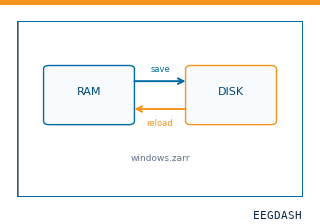 Save and reload prepared dataCache a windowed dataset to disk and reattach it without recompute.
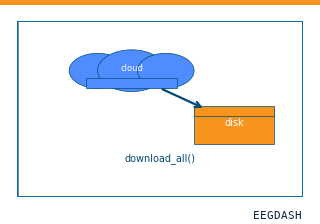 Download a dataset locallyPrefetch BIDS files to a local cache and validate the layout.
Swap any load_dataset(...) call for nm000350 to reproduce the tutorial on this dataset.
Citation
Kristofer E. Bouchard, Edward F Chang, Ben Dichter (2013). Human ECoG speaking consonant-vowel syllables. 10.82901/nemar.nm000350
Provenance
¹Contributed to nemar in BIDS format.
²Curated & ingested by the EEGDash catalog; see CITATION.cff for canonical reference.
³Persistent identifier: 10.82901/nemar.nm000350.
See Also#
eegdash.dataset.EEGDashDataseteegdash.dataset