


NM000455: ieeg dataset, 30 subjects#
The neural activity of auditory conscious perception: intracranial EEG epochs (Christison-Lagay et al. 2025; derivative: authors’ 2-s grey-matter epochs)
Access recordings and metadata through EEGDash.
Citation: Kate L. Christison-Lagay, Aya Khalaf, Noah C. Freedman, Christopher Micek, Sharif I. Kronemer, Mariana M. Gusso, Lauren Kim, Sarit Forman, Julia Ding, Mark Aksen, Ahmad Abdel-Aty, Hunki Kwon, Noah Markowitz, Erin Yeagle, Elizabeth Espinal, Jose Herrero, Stephan Bickel, James Young, Ashesh Mehta, Kun Wu, Jason Gerrard, Eyiyemisi Damisah, Dennis Spencer, Jiayin Qu, Hal Blumenfeld (2025). The neural activity of auditory conscious perception: intracranial EEG epochs (Christison-Lagay et al. 2025; derivative: authors’ 2-s grey-matter epochs). 10.82901/nemar.nm000455
Modality: ieeg Subjects: 30 Recordings: 32 License: CC0-1.0 Source: nemar
Metadata: Complete (100%)
30-participant iEEG dataset — The neural activity of auditory conscious perception: intracranial EEG epochs (Christison-Lagay et al. 2025; derivative: authors' 2-s grey-matter epochs).
Quickstart#
Install
pip install eegdash
Access the data
from eegdash.dataset import NM000455

dataset = NM000455(cache_dir="./data")
# Get the raw object of the first recording
raw = dataset.datasets[0].raw
print(raw.info)
Filter by subject
dataset = NM000455(cache_dir="./data", subject="01")
Advanced query
dataset = NM000455(
    cache_dir="./data",
    query={"subject": {"$in": ["01", "02"]}},
)
Iterate recordings
for rec in dataset:
    print(rec.subject, rec.raw.info['sfreq'])
If you use this dataset in your research, please cite the original authors.
BibTeX
@dataset{nm000455,
  title = {The neural activity of auditory conscious perception: intracranial EEG epochs (Christison-Lagay et al. 2025; derivative: authors' 2-s grey-matter epochs)},
  author = {Kate L. Christison-Lagay and Aya Khalaf and Noah C. Freedman and Christopher Micek and Sharif I. Kronemer and Mariana M. Gusso and Lauren Kim and Sarit Forman and Julia Ding and Mark Aksen and Ahmad Abdel-Aty and Hunki Kwon and Noah Markowitz and Erin Yeagle and Elizabeth Espinal and Jose Herrero and Stephan Bickel and James Young and Ashesh Mehta and Kun Wu and Jason Gerrard and Eyiyemisi Damisah and Dennis Spencer and Jiayin Qu and Hal Blumenfeld},
  doi = {10.82901/nemar.nm000455},
  url = {https://doi.org/10.82901/nemar.nm000455},
}
About This Dataset#
Intracranial EEG from adults with drug-resistant epilepsy (subdural grids, strips and depth electrodes; Yale New Haven Hospital,
Northwell Health, Mount Sinai) performing an auditory perceptual threshold task. A 75 ms target sound (waterdrop, whistle or ‘laser’) was embedded in white noise at each participant’s 50 % detection threshold (14 % blank trials). Each trial asked whether a sound was heard and which one. Perceived = heard and correctly identified; Not Perceived = not heard and wrongly identified.
continuous icEEG recordings and the TTL trigger channels were not released by the authors.
The neural activity of auditory conscious perception (Christison-Lagay et al. 2025): intracranial EEG epochs. DERIVATIVE
Each epoch is 2 s long (“samples contain 2 seconds at the patient’s sampling rate”, Dryad README). The release does not state where the target sound falls within the 2-s epoch. The article describes 4-s epochs centred on the target with the outer 500 ms later pruned for the gamma analysis. Treat the epoch timing relative to the stimulus as unknown unless you verify it.
Grey-matter electrodes only (article: 2,805 of 5,793 contacts), as chosen by the authors from co-registered MRI/CT.
Authors’ processing (article sections 2.3-2.5): trials sorted by behaviour; epochs with clinical or subclinical epileptic events removed
View full README
The neural activity of auditory conscious perception (Christison-Lagay et al. 2025): intracranial EEG epochs. DERIVATIVE
Each epoch is 2 s long (“samples contain 2 seconds at the patient’s sampling rate”, Dryad README). The release does not state where the target sound falls within the 2-s epoch. The article describes 4-s epochs centred on the target with the outer 500 ms later pruned for the gamma analysis. Treat the epoch timing relative to the stimulus as unknown unless you verify it.
Grey-matter electrodes only (article: 2,805 of 5,793 contacts), as chosen by the authors from co-registered MRI/CT.
Authors’ processing (article sections 2.3-2.5): trials sorted by behaviour; epochs with clinical or subclinical epileptic events removed by visual inspection; four-stage artifact rejection (Welch PSD peak > 200 µV/Hz above 30 Hz; mean-square < 200 µV²; MSE to the electrode’s mean trace > 3000 µV², at most 20 % of epochs; any sample > 5 SD). Removed channel-epochs are NaN in the release and stay NaN here (events.tsv
channels_rejected; channels.tsvstatus_description). Several source file names name further processing that is not documented further:sounds_restricted,CPonly,recalibrated,redone,extended_norun6or8,_r_, and for two participants (436, 451) ``no_TTL_artifact_subtract_30Hz_movmean`` (TTL artifact handling with a 30 Hz moving mean). The source file of each recording is listed in its_ieeg.json(SourceFile).Reference: the referential montage of the original acquisition (one reference electrode chosen by the clinical team; not identified).
Contents
30 participants, 32 recordings (
ses-2= second implantation, release folders with suffix_2), 8946 epochs, 4.97 h of epochs. Sampling rates 1024, 2000, 3051, 4096, 16384 Hz (= samples per epoch / 2 s).One file per participant and session:
task-auditorythresholdwith all epochs concatenated in the order Perceived (BC_trials), Not Perceived (WG_trials), blank (blank_TN_trials), each in the order of the MATLAB pages (order of appearance within the category). The file is not a continuous recording: every epoch is oneevents.tsvrow (onset, 2 s, trial_type), and BrainVision ‘New Segment’ markers mark every epoch boundary. The sidecar saysRecordingType: epoched,EpochLength: 2.Single trials cannot be linked to the behaviour files from the release alone (artifact rejection and per-sound exclusions removed trials). The behaviour files are in sourcedata.
Channels
E001… = electrode # of the release (channel i of the arrays = electrode #i of the montage maps). TypeEEGbecause the release does not say which contacts are grid, strip or depth. µV (unit implied by the article’s µV thresholds; not stated in the files).Data format: BrainVision IEEE float32. The float64 source values are stored as float32 (largest relative difference 5.96e-08, i.e. float32 rounding). CAVEAT: some released epochs contain implausibly large values (|value| > 1e6 µV; recording: [number of samples, largest |value|]): sub-MS001_ses-1: [244000, 1.96e+38]. They are kept exactly as released (float32 rounding only); treat them as artifacts. Every file was read back bit-identical to float32 of the source, NaN included, and read with MNE. The float64 originals are in sourcedata/.
Electrodes:
space-Otherwith columns 2-4 of the authors’ L_/R_MontageMap.mat, unchanged. CAVEAT: the README calls them “3d MNI coordinates” and the article says BioImage Suite placed electrodes in “MNI space (Colin 22 brain template)”. But the values are all positive (about 10-200), i.e. image coordinates in the template volume, not MNI millimetres. The transform is not given, so they are not labelled MNI here.hemisphere= which montage file lists the electrode. Recordings whose electrodes are not (all) listed in the montage maps have n/a coordinates for those electrodes: sub-383_ses-1, sub-451_ses-1, sub-528_ses-1, sub-MS001_ses-1.Hardware filters and sites (article 2.4): Yale 4096 Hz, 0.1-1330 Hz (one patient 1024 Hz, 0.1-400 Hz); Northwell (NS*) TDT PZ5M 3 kHz, 0.4-1500 Hz; Mount Sinai (MS*) 2048 Hz, 0.1-670 Hz.
participants.tsv: age and sex n/a (article: 38 enrolled, 16 female, mean age 38.8, range 16-69; 31 analysed).
Conversion notes: - 383: montage electrode numbers [1, 2, 3, 4, 5]..[132, 133, 134] (n=134) do not cover channels 1..136; coordinates kept only for listed numbers - 383: electrodes.tsv has n/a rows for channels missing from the montage maps - Part1of4icEEGandelectrodes/390/sorted_trials_sounds_restricted_all_gray_matter.mat: MAT v5 file (read with scipy.io.loadmat) - 390: samples/2 s = 3051.0 Hz differs from the article’s rate for Yale New Haven Hospital (4096 Hz) - 451: montage electrode numbers [1, 2, 3, 4, 5]..[82, 83, 84] (n=84) do not cover channels 1..85; coordinates kept only for listed numbers - 451: electrodes.tsv has n/a rows for channels missing from the montage maps - 528: montage electrode numbers [1, 2, 3, 4, 5]..[74, 75, 76] (n=76) do not cover channels 1..84; coordinates kept only for listed numbers - 528: electrodes.tsv has n/a rows for channels missing from the montage maps - 532: samples/2 s = 16384.0 Hz differs from the article’s rate for Yale New Haven Hospital (4096 Hz) - Part4of4icEEGandelectrodes/543/L_MontageMap.mat: MAT v5 file, variables [(‘L_MontageMap’, (182, 4))] - Part4of4icEEGandelectrodes/543/R_MontageMap.mat: MAT v5 file, variables [(‘R_MontageMap’, (0, 0))] - MS001: samples/2 s = 2000.0 Hz differs from the article’s rate for Mount Sinai Hospital (2048 Hz) - MS001: montage electrode numbers []..[] (n=0) do not cover channels 1..61; coordinates kept only for listed numbers - MS001: BC_trials page 75 (perceived_75) has 244000 samples with |value| > 1e6 µV (max 1.96e+38); kept as released - MS001: electrodes.tsv has n/a rows for channels missing from the montage maps - NS140: samples/2 s = 3051.0 Hz differs from the article’s rate for Northwell Health (3000 Hz) - NS140_2: samples/2 s = 3051.0 Hz differs from the article’s rate for Northwell Health (3000 Hz) - NS142: samples/2 s = 3051.0 Hz differs from the article’s rate for Northwell Health (3000 Hz)
sourcedata/: all sorted_trials and montage files (MAT header dates set to day 01), behaviour files (renamed and the subject_idnumber field replaced because they contained initials), Dryad README files. Parcellation maps not included.
Source
Dryad: Kate L. Christison-Lagay, Aya Khalaf, Noah C. Freedman, Christopher Micek, Sharif I. Kronemer, Mariana M. Gusso, Lauren Kim, Sarit Forman, Julia Ding, Mark Aksen, Ahmad Abdel-Aty, Hunki Kwon, Noah Markowitz, Erin Yeagle, Elizabeth Espinal, Jose Herrero, Stephan Bickel, James Young, Ashesh Mehta, Kun Wu, Jason Gerrard, Eyiyemisi Damisah, Dennis Spencer, Jiayin Qu, Hal Blumenfeld. “The neural activity of auditory conscious perception”. doi:10.5061/dryad.h44j0zpww (CC0-1.0).
Article: Christison-Lagay KL et al. (2025) NeuroImage 308:121041, doi:10.1016/j.neuroimage.2025.121041. Preprint doi:10.1101/2023.01.12.523829.
Funding: NIH R01 NS134655 (HB); NIH R01 DC007657 (Europe PMC grant list); Mark Loughridge and Michelle Williams Foundation (HB); Betsy and Jonathan Blattmachr Family (HB); CAPES 88887.147295/2017-00 and 88881.186875/2018-01 (MG); Fundação Araucária and CAPES 88887.185226/2018-00 (MG).
Ethics: IRBs of Yale University, The Mount Sinai Hospital and Northwell Health; written informed consent (article 2.1).
Privacy
Subject labels are the authors’ study codes. The MAT files hold no strings in the signal and montage files. The MAT header file-creation dates were set to day 01. The behaviour file names and their subject_idnumber field contained participant initials. They were removed, and the key status is recorded as retained.
NEMAR Metadata#
[](https://doi.org/10.82901/nemar.nm000455) # The neural activity of auditory conscious perception (Christison-Lagay et al. 2025): intracranial EEG epochs. DERIVATIVE Intracranial EEG from adults with drug-resistant epilepsy (subdural grids, strips and depth electrodes; Yale New Haven Hospital, Northwell Health, Mount Sinai) performing an auditory perceptual threshold task. A 75 ms target sound (waterdrop, whistle or ‘laser’) was embedded in white noise at each participant’s 50 % detection threshold (14 % blank trials). Each trial asked whether a sound was heard and which one. Perceived = heard and correctly identified; Not Perceived = not heard and wrongly identified. ## THIS IS A DERIVATIVE DATASET: the continuous recordings were not released - The release holds only the authors’ epoched, artifact-screened trials, sorted by category (sorted_trials_*.mat). The
continuous icEEG recordings and the TTL trigger channels were not released by the authors.
Each epoch is 2 s long (“samples contain 2 seconds at the patient’s sampling rate”, Dryad README). The release does not state where the target sound falls within the 2-s epoch. The article describes 4-s epochs centred on the target with the outer 500 ms later pruned for the gamma analysis. Treat the epoch timing relative to the stimulus as unknown unless you verify it.
Grey-matter electrodes only (article: 2,805 of 5,793 contacts), as chosen by the authors from co-registered MRI/CT.
Authors’ processing (article sections 2.3-2.5): trials sorted by behaviour; epochs with clinical or subclinical epileptic events removed by visual inspection; four-stage artifact rejection (Welch PSD peak > 200 µV/Hz above 30 Hz; mean-square < 200 µV²; MSE to the electrode’s mean trace > 3000 µV², at most 20 % of epochs; any sample > 5 SD). Removed channel-epochs are NaN in the release and stay NaN here (events.tsv channels_rejected; channels.tsv status_description). Several source file names name further processing that is not documented further: sounds_restricted, CPonly, recalibrated, redone, extended_norun6or8, _r_, and for two participants (436, 451) `no_TTL_artifact_subtract_30Hz_movmean` (TTL artifact handling with a 30 Hz moving mean). The source file of each recording is listed in its _ieeg.json (SourceFile).
Reference: the referential montage of the original acquisition (one reference electrode chosen by the clinical team; not identified).
## Contents - 30 participants, 32 recordings (ses-2 = second implantation, release folders with suffix _2),
8946 epochs, 4.97 h of epochs. Sampling rates 1024, 2000, 3051, 4096, 16384 Hz (= samples per epoch / 2 s).
One file per participant and session: task-auditorythreshold with all epochs concatenated in the order Perceived (BC_trials), Not Perceived (WG_trials), blank (blank_TN_trials), each in the order of the MATLAB pages (order of appearance within the category). The file is not a continuous recording: every epoch is one events.tsv row (onset, 2 s, trial_type), and BrainVision ‘New Segment’ markers mark every epoch boundary. The sidecar says RecordingType: epoched, EpochLength: 2.
Single trials cannot be linked to the behaviour files from the release alone (artifact rejection and per-sound exclusions removed trials). The behaviour files are in sourcedata.
Channels E001… = electrode # of the release (channel i of the arrays = electrode #i of the montage maps). Type EEG because the release does not say which contacts are grid, strip or depth. µV (unit implied by the article’s µV thresholds; not stated in the files).
Data format: BrainVision IEEE float32. The float64 source values are stored as float32 (largest relative difference 5.96e-08, i.e. float32 rounding). CAVEAT: some released epochs contain implausibly large values (|value| > 1e6 µV; recording: [number of samples, largest |value|]): sub-MS001_ses-1: [244000, 1.96e+38]. They are kept exactly as released (float32 rounding only); treat them as artifacts. Every file was read back bit-identical to float32 of the source, NaN included, and read with MNE. The float64 originals are in sourcedata/.
Electrodes: space-Other with columns 2-4 of the authors’ L_/R_MontageMap.mat, unchanged. CAVEAT: the README calls them “3d MNI coordinates” and the article says BioImage Suite placed electrodes in “MNI space (Colin 22 brain template)”. But the values are all positive (about 10-200), i.e. image coordinates in the template volume, not MNI millimetres. The transform is not given, so they are not labelled MNI here. hemisphere = which montage file lists the electrode. Recordings whose electrodes are not (all) listed in the montage maps have n/a coordinates for those electrodes: sub-383_ses-1, sub-451_ses-1, sub-528_ses-1, sub-MS001_ses-1.
Hardware filters and sites (article 2.4): Yale 4096 Hz, 0.1-1330 Hz (one patient 1024 Hz, 0.1-400 Hz); Northwell (NS*) TDT PZ5M 3 kHz, 0.4-1500 Hz; Mount Sinai (MS*) 2048 Hz, 0.1-670 Hz.
participants.tsv: age and sex n/a (article: 38 enrolled, 16 female, mean age 38.8, range 16-69; 31 analysed).
Conversion notes: - 383: montage electrode numbers [1, 2, 3, 4, 5]..[132, 133, 134] (n=134) do not cover channels 1..136; coordinates kept only for listed numbers - 383: electrodes.tsv has n/a rows for channels missing from the montage maps - Part1of4icEEGandelectrodes/390/sorted_trials_sounds_restricted_all_gray_matter.mat: MAT v5 file (read with scipy.io.loadmat) - 390: samples/2 s = 3051.0 Hz differs from the article’s rate for Yale New Haven Hospital (4096 Hz) - 451: montage electrode numbers [1, 2, 3, 4, 5]..[82, 83, 84] (n=84) do not cover channels 1..85; coordinates kept only for listed numbers - 451: electrodes.tsv has n/a rows for channels missing from the montage maps - 528: montage electrode numbers [1, 2, 3, 4, 5]..[74, 75, 76] (n=76) do not cover channels 1..84; coordinates kept only for listed numbers - 528: electrodes.tsv has n/a rows for channels missing from the montage maps - 532: samples/2 s = 16384.0 Hz differs from the article’s rate for Yale New Haven Hospital (4096 Hz) - Part4of4icEEGandelectrodes/543/L_MontageMap.mat: MAT v5 file, variables [(‘L_MontageMap’, (182, 4))] - Part4of4icEEGandelectrodes/543/R_MontageMap.mat: MAT v5 file, variables [(‘R_MontageMap’, (0, 0))] - MS001: samples/2 s = 2000.0 Hz differs from the article’s rate for Mount Sinai Hospital (2048 Hz) - MS001: montage electrode numbers []..[] (n=0) do not cover channels 1..61; coordinates kept only for listed numbers - MS001: BC_trials page 75 (perceived_75) has 244000 samples with |value| > 1e6 µV (max 1.96e+38); kept as released - MS001: electrodes.tsv has n/a rows for channels missing from the montage maps - NS140: samples/2 s = 3051.0 Hz differs from the article’s rate for Northwell Health (3000 Hz) - NS140_2: samples/2 s = 3051.0 Hz differs from the article’s rate for Northwell Health (3000 Hz) - NS142: samples/2 s = 3051.0 Hz differs from the article’s rate for Northwell Health (3000 Hz)
sourcedata/: all sorted_trials and montage files (MAT header dates set to day 01), behaviour files (renamed and the subject_idnumber field replaced because they contained initials), Dryad README files. Parcellation maps not included.
## Source - Dryad: Kate L. Christison-Lagay, Aya Khalaf, Noah C. Freedman, Christopher Micek, Sharif I. Kronemer, Mariana M. Gusso, Lauren Kim, Sarit Forman, Julia Ding, Mark Aksen, Ahmad Abdel-Aty, Hunki Kwon, Noah Markowitz, Erin Yeagle, Elizabeth Espinal, Jose Herrero, Stephan Bickel, James Young, Ashesh Mehta, Kun Wu, Jason Gerrard, Eyiyemisi Damisah, Dennis Spencer, Jiayin Qu, Hal Blumenfeld. “The neural activity of auditory conscious perception”. doi:10.5061/dryad.h44j0zpww (CC0-1.0). - Article: Christison-Lagay KL et al. (2025) NeuroImage 308:121041, doi:10.1016/j.neuroimage.2025.121041. Preprint doi:10.1101/2023.01.12.523829. - Funding: NIH R01 NS134655 (HB); NIH R01 DC007657 (Europe PMC grant list); Mark Loughridge and Michelle Williams Foundation (HB); Betsy and Jonathan Blattmachr Family (HB); CAPES 88887.147295/2017-00 and 88881.186875/2018-01 (MG); Fundação Araucária and CAPES 88887.185226/2018-00 (MG). - Ethics: IRBs of Yale University, The Mount Sinai Hospital and Northwell Health; written informed consent (article 2.1). ## Privacy Subject labels are the authors’ study codes. The MAT files hold no strings in the signal and montage files. The MAT header file-creation dates were set to day 01. The behaviour file names and their subject_idnumber field contained participant initials. They were removed, and the key status is recorded as retained.
License: CC0-1.0
Authors:
Kate L. Christison-Lagay
Aya Khalaf
Noah C. Freedman
Christopher Micek
Sharif I. Kronemer
… and 20 more
Versions:
Version |
DOI |
Released |
|---|---|---|
|
Cohort#
Dataset Statistics#
Channel counts (ch)
Sampling frequencies (Hz)
Total recording duration: 4 h 58 min
Signal · Electrodes & live trace#
Live trace viewer — sub-311 · ses-1 · task-auditorythreshold
Showing one representative recording out of
30 subjects and 32 recordings in this dataset.
Browse the full set on OpenNeuro;
drop any other _ieeg.{set,edf,bdf,vhdr} file onto the
viewer (or pass ?ieeg=<url>) to inspect it.
Electrode layout — iEEG · 76 sensors — 76 channels
NEMAR Processing Statistics#
The plots below are generated by NEMAR’s automated EEG pipeline. The histogram shows pipeline success for data cleaning and ICA decomposition, the percentage of data frames and EEG channels retained after artefact removal, line noise per channel (RMS, dB), and the age/gender distribution of participants.

HED event descriptors word cloud

Manifest#
File Explorer#
Browse the BIDS file structure of this dataset. Records are fetched on demand from the EEGDash catalog the first time you open the explorer.
Full dataset metadata table
Dataset ID |
|
Title |
The neural activity of auditory conscious perception: intracranial EEG epochs (Christison-Lagay et al. 2025; derivative: authors’ 2-s grey-matter epochs) |
Author (year) |
— |
Canonical |
— |
Importable as |
|
Year |
2025 |
Authors |
Kate L. Christison-Lagay, Aya Khalaf, Noah C. Freedman, Christopher Micek, Sharif I. Kronemer, Mariana M. Gusso, Lauren Kim, Sarit Forman, Julia Ding, Mark Aksen, Ahmad Abdel-Aty, Hunki Kwon, Noah Markowitz, Erin Yeagle, Elizabeth Espinal, Jose Herrero, Stephan Bickel, James Young, Ashesh Mehta, Kun Wu, Jason Gerrard, Eyiyemisi Damisah, Dennis Spencer, Jiayin Qu, Hal Blumenfeld |
License |
CC0-1.0 |
Citation / DOI |
|
Source links |
OpenNeuro | NeMAR | Source URL |
Copy-paste BibTeX
@dataset{nm000455,
  title = {The neural activity of auditory conscious perception: intracranial EEG epochs (Christison-Lagay et al. 2025; derivative: authors' 2-s grey-matter epochs)},
  author = {Kate L. Christison-Lagay and Aya Khalaf and Noah C. Freedman and Christopher Micek and Sharif I. Kronemer and Mariana M. Gusso and Lauren Kim and Sarit Forman and Julia Ding and Mark Aksen and Ahmad Abdel-Aty and Hunki Kwon and Noah Markowitz and Erin Yeagle and Elizabeth Espinal and Jose Herrero and Stephan Bickel and James Young and Ashesh Mehta and Kun Wu and Jason Gerrard and Eyiyemisi Damisah and Dennis Spencer and Jiayin Qu and Hal Blumenfeld},
  doi = {10.82901/nemar.nm000455},
  url = {https://doi.org/10.82901/nemar.nm000455},
}
API Reference#
eegdash.datasetEEGDashDataset- class eegdash.dataset.NM000455(cache_dir: str, query: dict | None = None, s3_bucket: str | None = None, **kwargs)[source]#
The neural activity of auditory conscious perception: intracranial EEG epochs (Christison-Lagay et al. 2025; derivative: authors’ 2-s grey-matter epochs)
- Study:
nm000455(NeMAR)- Author (year):
—
- Canonical:
—
Also importable as:
NM000455.Modality:
ieeg; Subject type:Unknown. Subjects: 30; recordings: 32; tasks: 1.- Parameters:
cache_dir (str | Path) – Directory where data are cached locally.
query (dict | None) – Additional MongoDB-style filters to AND with the dataset selection. Must not contain the key
dataset.s3_bucket (str | None) – Base S3 bucket used to locate the data.
**kwargs (dict) – Additional keyword arguments forwarded to
EEGDashDataset.
- data_dir#
Local dataset cache directory (
cache_dir / dataset_id).- Type:
Path
Notes
Each item is a recording; recording-level metadata are available via
dataset.description.querysupports MongoDB-style filters on fields inALLOWED_QUERY_FIELDSand is combined with the dataset filter. Dataset-specific caveats are not provided in the summary metadata.References
OpenNeuro dataset: https://openneuro.org/datasets/nm000455 NeMAR dataset: https://nemar.org/dataexplorer/detail?dataset_id=nm000455 DOI: https://doi.org/10.82901/nemar.nm000455
Examples
>>> from eegdash.dataset import NM000455
>>> dataset = NM000455(cache_dir="./data")
>>> recording = dataset[0]
>>> raw = recording.load()
- __init__(cache_dir: str, query: dict | None = None, s3_bucket: str | None = None, **kwargs)[source]#
- save(path: str, overwrite: bool = False, offset: int = 0)[source]#
Save datasets to files by creating one subdirectory for each dataset:
path/
    0/
        0-raw.fif | 0-epo.fif
        description.json
        raw_preproc_kwargs.json (if raws were preprocessed)
        window_kwargs.json (if this is a windowed dataset)
        window_preproc_kwargs.json  (if windows were preprocessed)
        target_name.json (if target_name is not None and dataset is raw)
    1/
        1-raw.fif | 1-epo.fif
        description.json
        raw_preproc_kwargs.json (if raws were preprocessed)
        window_kwargs.json (if this is a windowed dataset)
        window_preproc_kwargs.json  (if windows were preprocessed)
        target_name.json (if target_name is not None and dataset is raw)
- Parameters:
path (str) –
- Directory in which subdirectories are created to store
-raw.fif | -epo.fif and .json files to.
overwrite (bool) – Whether to delete old subdirectories that will be saved to in this call.
offset (int) – If provided, the integer is added to the id of the dataset in the concat. This is useful in the setting of very large datasets, where one dataset has to be processed and saved at a time to account for its original position.
BaseDataset from braindecode — windowed via create_windows_from_events.braindecodeDataLoader; supports parallel workers and on-the-fly augmentations.pytorch Find datasets with the EEGDash APIQuery the catalogue, filter by task or modality, list candidates.
 Load one EEG recordingResolve a single record to an MNE Raw with channels and events.
 EEG recording to PyTorch DataLoaderWrap braindecode windows in a DataLoader for model training.
 Preprocess EEG and create windowsFilter, resample, epoch — and persist the windowed dataset.
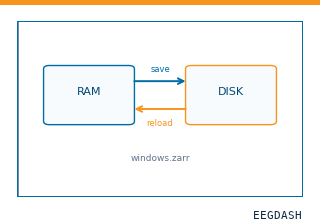 Save and reload prepared dataCache a windowed dataset to disk and reattach it without recompute.
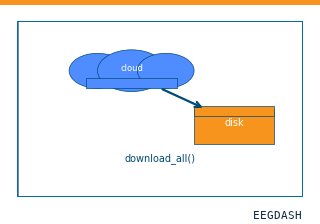 Download a dataset locallyPrefetch BIDS files to a local cache and validate the layout.
Swap any load_dataset(...) call for nm000455 to reproduce the tutorial on this dataset.
Citation
Kate L. Christison-Lagay, Aya Khalaf, Noah C. Freedman, Christopher Micek, Sharif I. Kronemer, … (2025). The neural activity of auditory conscious perception: intracranial EEG epochs (Christison-Lagay et al. 2025; derivative: authors' 2-s grey-matter epochs). 10.82901/nemar.nm000455
Provenance
¹Contributed to nemar in BIDS format.
²Curated & ingested by the EEGDash catalog; see CITATION.cff for canonical reference.
³Persistent identifier: 10.82901/nemar.nm000455.
See Also#
eegdash.dataset.EEGDashDataseteegdash.dataset