


NM000443: ieeg dataset, 7 subjects#
Subthalamic and thalamic local field potentials during DBS in cervical dystonia (Wiest et al. 2022; derivative, DC-removed release at 4096 Hz)
Access recordings and metadata through EEGDash.
Citation: Christoph Wiest, Flavie Torrecillos, Francesca Morgante, Erlick Pereira, Huiling Tan (2023). Subthalamic and thalamic local field potentials during DBS in cervical dystonia (Wiest et al. 2022; derivative, DC-removed release at 4096 Hz). 10.82901/nemar.nm000443
Modality: ieeg Subjects: 7 Recordings: 68 License: CC-BY-SA-4.0 Source: nemar
Metadata: Complete (100%)
7-participant iEEG dataset — Subthalamic and thalamic local field potentials during DBS in cervical dystonia (Wiest et al. 2022; derivative, DC-removed release at 4096 Hz).
Quickstart#
Install
pip install eegdash
Access the data
from eegdash.dataset import NM000443

dataset = NM000443(cache_dir="./data")
# Get the raw object of the first recording
raw = dataset.datasets[0].raw
print(raw.info)
Filter by subject
dataset = NM000443(cache_dir="./data", subject="01")
Advanced query
dataset = NM000443(
    cache_dir="./data",
    query={"subject": {"$in": ["01", "02"]}},
)
Iterate recordings
for rec in dataset:
    print(rec.subject, rec.raw.info['sfreq'])
If you use this dataset in your research, please cite the original authors.
BibTeX
@dataset{nm000443,
  title = {Subthalamic and thalamic local field potentials during DBS in cervical dystonia (Wiest et al. 2022; derivative, DC-removed release at 4096 Hz)},
  author = {Christoph Wiest and Flavie Torrecillos and Francesca Morgante and Erlick Pereira and Huiling Tan},
  doi = {10.82901/nemar.nm000443},
  url = {https://doi.org/10.82901/nemar.nm000443},
}
About This Dataset#
Local field potentials (LFPs) from externalised octopolar deep brain stimulation (DBS) leads in 7 patients with isolated
idiopathic (cranio)cervical dystonia (12 hemispheres; leads span the subthalamic nucleus (STN, inferior contacts), the rostral zona incerta and the ventrolateral thalamus (superior contacts)), recorded 4-7 days after surgery off anti-dystonic medication at St George’s University Hospitals, London, while stimulation was applied through the lead. Scalp EEG, EMG of dystonic neck muscles and accelerometers were recorded in some patients. The data were first analysed in Wiest et al. (2022/2023), which reports broadband power suppression, evoked resonant neural activity (ERNA) and finely tuned gamma under STN stimulation.
with cervical dystonia”. University of Oxford, MRC Brain Network Dynamics Unit data sharing platform (Cambium). doi:10.5287/bodleian:qrnqjnpv7
Subthalamic and thalamic LFPs during DBS in cervical dystonia (Wiest et al. 2022) - DERIVATIVE
Wiest C, Morgante F, Torrecillos F, Pogosyan A, He S, Baig F, Bertaina I, Hart MG, Edwards MJ, Pereira EA, Tan H (2023). Subthalamic Nucleus Stimulation-Induced Local Field Potential Changes in Dystonia. Mov Disord 38(3). doi:10.1002/mds.29302
Funding (release README and paper): Medical Research Council UK (MC_UU_00003/2, MR/P012272/1, MR/V00655X/1), NIHR Oxford Biomedical Research Centre, Rosetrees Trust.
View full README
Subthalamic and thalamic LFPs during DBS in cervical dystonia (Wiest et al. 2022) - DERIVATIVE
Wiest C, Morgante F, Torrecillos F, Pogosyan A, He S, Baig F, Bertaina I, Hart MG, Edwards MJ, Pereira EA, Tan H (2023). Subthalamic Nucleus Stimulation-Induced Local Field Potential Changes in Dystonia. Mov Disord 38(3). doi:10.1002/mds.29302
Funding (release README and paper): Medical Research Council UK (MC_UU_00003/2, MR/P012272/1, MR/V00655X/1), NIHR Oxford Biomedical Research Centre, Rosetrees Trust.
Ethics (paper): Health Research Authority UK and National Research Ethics Service Local Research Ethics Committee (IRAS 46576); written informed consent.
Licence
CC BY-SA 4.0. The Cambium record page, its download form and the README.txt inside each of the three zips all state CC BY-SA 4.0 (no other licence file is in the zips). Copyright 2020-2022, University of Oxford. README.txt is in sourcedata/bndu/.
Recording
TMSi Saga amplifier, 4096 Hz, custom acquisition software (paper); exported via Spike2 to MATLAB (SmrData structs). Boston Scientific Vercise Standard Lead 2201 (non-directional, 8 ring contacts; level 1 most inferior). Contacts adjacent to the stimulated level are recorded bipolar (label e.g. L13 when L2 is stimulated); all other contacts and the EEG are unipolar with common mode rejection (README). The release does not state units, so channels.tsv lists units as n/a; values are unchanged. THIS IS A DERIVATIVE DATASET. The release README and the paper describe no filtering before release (the paper’s 1 Hz high-pass and 50 Hz notch are later analysis steps), but every released channel, including the head accelerometers, is free of DC offset: there is no gravity component on the accelerometers, and 10 s window means are small compared with each channel’s standard deviation, although the TMSi Saga is DC-coupled. The Spike2 files also came from a ‘processed_data/SMR’ folder. An undocumented DC removal / high-pass was therefore applied before release (cutoff not stated), so the dataset is labelled derivative. The sampling rate is the acquisition rate (4096 Hz, no resampling). Channels prefixed F-, S- or f are additional channels that the authors derived (e.g. F-L1 is close to L1); they are kept as MISC.
Contents
68 continuous recordings, 9.65 h in total, 1.9-17.0 min each, all at 4096 Hz. One BIDS run per release .mat file; the release file is listed in each sub-*_scans.tsv (source_file). -
task-dbsramp(62 files; release labels ‘Testing’ and, for participant 2, ‘DBS’): continuous 130 Hzmonopolar DBS of one of the six middle contact levels (2-7;
acq-<L|R><level>) with the intensity increased in 0.5 mA steps up to 4.5 mA or the side-effect threshold. In patient 2 the paper also tested 100/130/150/180 Hz for 2 min each at one contact.task-singlepulse(5 files, participants 5-7;acq-left|right): 25 single pulses applied to each of the 8 contact levels in sequence, the remaining contacts recorded unipolar.task-paired(1 file, participant 7, release label ‘Paired’, left contact level 2): not described in the release or the paper; kept as released.
Channels (types in channels.tsv; release labels kept, repeated release labels such as AUX1 get a suffix _2, _3): DBS = lead contacts L1-L8/R1-R8 and bipolar pairs (e.g. L13); EEG = scalp electrodes; EMG = neck muscles (e.g. SplL, SCML); MISC = accelerometer, stimulation current channels (Cur*/Am*: time stamps and intensity of the applied stimulation, README) and any release channel the README does not describe (e.g. F-\*, S-\*, f*, Rs\*/Res*,*Spc, AUX*), kept unchanged.
events.tsv: Spike2 ‘Mark’ channel time stamps from the release (SmrData.EvData). Stimulation timing and intensity are in the Cur/Am channels.
electrodes.tsv: lead contacts with x, y, z = n/a, hemisphere, contact level and the stated targets; no coordinates are released.
participants.tsv: age, sex, diagnosis, disease duration and days after surgery from Wiest et al. (2022) Table 1. The release numbering is taken to be the paper’s patient numbering: the release README says participants 5-7 received single-pulse stimulation, as Table 1 does, and participant 5 has only a left single-pulse file, matching Table 1 (single pulse: L).
sourcedata/bndu
README.txt and the 68 original .mat files. Changed for privacy only: the MAT header ‘Created on’ day is set to 01; the Spike2 FileName (an internal lab code) and FilePath (lab drive path containing the recording date and hospital/lab codes) strings are overwritten in place with the release file name and ‘[path removed]’. WvData (signals) is byte-identical to the release (checked); SHA-256 of original and edited files in code/conversion_report.json.
Privacy
No names or hospital numbers remain. Recording dates were only in the removed FilePath strings; scans.tsv acq_time is n/a.
NEMAR Metadata#
[](https://doi.org/10.82901/nemar.nm000443) # Subthalamic and thalamic LFPs during DBS in cervical dystonia (Wiest et al. 2022) - DERIVATIVE Local field potentials (LFPs) from externalised octopolar deep brain stimulation (DBS) leads in 7 patients with isolated idiopathic (cranio)cervical dystonia (12 hemispheres; leads span the subthalamic nucleus (STN, inferior contacts), the rostral zona incerta and the ventrolateral thalamus (superior contacts)), recorded 4-7 days after surgery off anti-dystonic medication at St George’s University Hospitals, London, while stimulation was applied through the lead. Scalp EEG, EMG of dystonic neck muscles and accelerometers were recorded in some patients. The data were first analysed in Wiest et al. (2022/2023), which reports broadband power suppression, evoked resonant neural activity (ERNA) and finely tuned gamma under STN stimulation. ## Source - Wiest C, Torrecillos F, Morgante F, Pereira E, Tan H. “Subthalamic and thalamic local field potential recordings from patients
with cervical dystonia”. University of Oxford, MRC Brain Network Dynamics Unit data sharing platform (Cambium). doi:10.5287/bodleian:qrnqjnpv7
Wiest C, Morgante F, Torrecillos F, Pogosyan A, He S, Baig F, Bertaina I, Hart MG, Edwards MJ, Pereira EA, Tan H (2023). Subthalamic Nucleus Stimulation-Induced Local Field Potential Changes in Dystonia. Mov Disord 38(3). doi:10.1002/mds.29302
Funding (release README and paper): Medical Research Council UK (MC_UU_00003/2, MR/P012272/1, MR/V00655X/1), NIHR Oxford Biomedical Research Centre, Rosetrees Trust.
Ethics (paper): Health Research Authority UK and National Research Ethics Service Local Research Ethics Committee (IRAS 46576); written informed consent.
## Licence CC BY-SA 4.0. The Cambium record page, its download form and the README.txt inside each of the three zips all state CC BY-SA 4.0 (no other licence file is in the zips). Copyright 2020-2022, University of Oxford. README.txt is in sourcedata/bndu/. ## Recording TMSi Saga amplifier, 4096 Hz, custom acquisition software (paper); exported via Spike2 to MATLAB (SmrData structs). Boston Scientific Vercise Standard Lead 2201 (non-directional, 8 ring contacts; level 1 most inferior). Contacts adjacent to the stimulated level are recorded bipolar (label e.g. L13 when L2 is stimulated); all other contacts and the EEG are unipolar with common mode rejection (README). The release does not state units, so channels.tsv lists units as n/a; values are unchanged. THIS IS A DERIVATIVE DATASET. The release README and the paper describe no filtering before release (the paper’s 1 Hz high-pass and 50 Hz notch are later analysis steps), but every released channel, including the head accelerometers, is free of DC offset: there is no gravity component on the accelerometers, and 10 s window means are small compared with each channel’s standard deviation, although the TMSi Saga is DC-coupled. The Spike2 files also came from a ‘processed_data/SMR’ folder. An undocumented DC removal / high-pass was therefore applied before release (cutoff not stated), so the dataset is labelled derivative. The sampling rate is the acquisition rate (4096 Hz, no resampling). Channels prefixed F-, S- or f are additional channels that the authors derived (e.g. F-L1 is close to L1); they are kept as MISC. ## Contents - 68 continuous recordings, 9.65 h in total, 1.9-17.0 min each, all at 4096 Hz.
One BIDS run per release .mat file; the release file is listed in each sub-*_scans.tsv (source_file). - task-dbsramp (62 files; release labels ‘Testing’ and, for participant 2, ‘DBS’): continuous 130 Hz
monopolar DBS of one of the six middle contact levels (2-7; acq-<L|R><level>) with the intensity increased in 0.5 mA steps up to 4.5 mA or the side-effect threshold. In patient 2 the paper also tested 100/130/150/180 Hz for 2 min each at one contact.
task-singlepulse (5 files, participants 5-7; acq-left|right): 25 single pulses applied to each of the 8 contact levels in sequence, the remaining contacts recorded unipolar.
task-paired (1 file, participant 7, release label ‘Paired’, left contact level 2): not described in the release or the paper; kept as released.
Channels (types in channels.tsv; release labels kept, repeated release labels such as AUX1 get a suffix _2, _3): DBS = lead contacts L1-L8/R1-R8 and bipolar pairs (e.g. L13); EEG = scalp electrodes; EMG = neck muscles (e.g. SplL, SCML); MISC = accelerometer, stimulation current channels (Cur*/Am*: time stamps and intensity of the applied stimulation, README) and any release channel the README does not describe (e.g. F-, S-, f*, Rs*/Res*, Spc, AUX), kept unchanged.
events.tsv: Spike2 ‘Mark’ channel time stamps from the release (SmrData.EvData). Stimulation timing and intensity are in the Cur/Am channels.
electrodes.tsv: lead contacts with x, y, z = n/a, hemisphere, contact level and the stated targets; no coordinates are released.
participants.tsv: age, sex, diagnosis, disease duration and days after surgery from Wiest et al. (2022) Table 1. The release numbering is taken to be the paper’s patient numbering: the release README says participants 5-7 received single-pulse stimulation, as Table 1 does, and participant 5 has only a left single-pulse file, matching Table 1 (single pulse: L).
## sourcedata/bndu README.txt and the 68 original .mat files. Changed for privacy only: the MAT header ‘Created on’ day is set to 01; the Spike2 FileName (an internal lab code) and FilePath (lab drive path containing the recording date and hospital/lab codes) strings are overwritten in place with the release file name and ‘[path removed]’. WvData (signals) is byte-identical to the release (checked); SHA-256 of original and edited files in code/conversion_report.json. ## Privacy No names or hospital numbers remain. Recording dates were only in the removed FilePath strings; scans.tsv acq_time is n/a.
License: CC-BY-SA-4.0
Authors:
Christoph Wiest
Flavie Torrecillos
Francesca Morgante
Erlick Pereira
Huiling Tan
Versions:
Version |
DOI |
Released |
|---|---|---|
|
Cohort#
Dataset Statistics#
Age distribution by gender (n=7, range 45–68 yr, mean 55.4 yr)
Sex composition
Channel counts (ch)
Sampling frequencies: 4096.0 Hz (n=68 recordings)
Total recording duration: 9 h 38 min
Signal · Electrodes & live trace#
Live trace viewer — sub-01 · task-dbsramp
Showing one representative recording out of
7 subjects and 68 recordings in this dataset.
Browse the full set on OpenNeuro;
drop any other _ieeg.{set,edf,bdf,vhdr} file onto the
viewer (or pass ?ieeg=<url>) to inspect it.
No scalp electrode layout is currently indexed for this dataset. Once the eegdash montage registry ingests it, the interactive viewer will appear here automatically.
NEMAR Processing Statistics#
The plots below are generated by NEMAR’s automated EEG pipeline. The histogram shows pipeline success for data cleaning and ICA decomposition, the percentage of data frames and EEG channels retained after artefact removal, line noise per channel (RMS, dB), and the age/gender distribution of participants.

HED event descriptors word cloud

Manifest#
File Explorer#
Browse the BIDS file structure of this dataset. Records are fetched on demand from the EEGDash catalog the first time you open the explorer.
Full dataset metadata table
Dataset ID |
|
Title |
Subthalamic and thalamic local field potentials during DBS in cervical dystonia (Wiest et al. 2022; derivative, DC-removed release at 4096 Hz) |
Author (year) |
— |
Canonical |
— |
Importable as |
|
Year |
2023 |
Authors |
Christoph Wiest, Flavie Torrecillos, Francesca Morgante, Erlick Pereira, Huiling Tan |
License |
CC-BY-SA-4.0 |
Citation / DOI |
|
Source links |
OpenNeuro | NeMAR | Source URL |
Copy-paste BibTeX
@dataset{nm000443,
  title = {Subthalamic and thalamic local field potentials during DBS in cervical dystonia (Wiest et al. 2022; derivative, DC-removed release at 4096 Hz)},
  author = {Christoph Wiest and Flavie Torrecillos and Francesca Morgante and Erlick Pereira and Huiling Tan},
  doi = {10.82901/nemar.nm000443},
  url = {https://doi.org/10.82901/nemar.nm000443},
}
API Reference#
eegdash.datasetEEGDashDataset- class eegdash.dataset.NM000443(cache_dir: str, query: dict | None = None, s3_bucket: str | None = None, **kwargs)[source]#
Subthalamic and thalamic local field potentials during DBS in cervical dystonia (Wiest et al. 2022; derivative, DC-removed release at 4096 Hz)
- Study:
nm000443(NeMAR)- Author (year):
—
- Canonical:
—
Also importable as:
NM000443.Modality:
ieeg; Subject type:Unknown. Subjects: 7; recordings: 68; tasks: 3.- Parameters:
cache_dir (str | Path) – Directory where data are cached locally.
query (dict | None) – Additional MongoDB-style filters to AND with the dataset selection. Must not contain the key
dataset.s3_bucket (str | None) – Base S3 bucket used to locate the data.
**kwargs (dict) – Additional keyword arguments forwarded to
EEGDashDataset.
- data_dir#
Local dataset cache directory (
cache_dir / dataset_id).- Type:
Path
Notes
Each item is a recording; recording-level metadata are available via
dataset.description.querysupports MongoDB-style filters on fields inALLOWED_QUERY_FIELDSand is combined with the dataset filter. Dataset-specific caveats are not provided in the summary metadata.References
OpenNeuro dataset: https://openneuro.org/datasets/nm000443 NeMAR dataset: https://nemar.org/dataexplorer/detail?dataset_id=nm000443 DOI: https://doi.org/10.82901/nemar.nm000443
Examples
>>> from eegdash.dataset import NM000443
>>> dataset = NM000443(cache_dir="./data")
>>> recording = dataset[0]
>>> raw = recording.load()
- __init__(cache_dir: str, query: dict | None = None, s3_bucket: str | None = None, **kwargs)[source]#
- save(path: str, overwrite: bool = False, offset: int = 0)[source]#
Save datasets to files by creating one subdirectory for each dataset:
path/
    0/
        0-raw.fif | 0-epo.fif
        description.json
        raw_preproc_kwargs.json (if raws were preprocessed)
        window_kwargs.json (if this is a windowed dataset)
        window_preproc_kwargs.json  (if windows were preprocessed)
        target_name.json (if target_name is not None and dataset is raw)
    1/
        1-raw.fif | 1-epo.fif
        description.json
        raw_preproc_kwargs.json (if raws were preprocessed)
        window_kwargs.json (if this is a windowed dataset)
        window_preproc_kwargs.json  (if windows were preprocessed)
        target_name.json (if target_name is not None and dataset is raw)
- Parameters:
path (str) –
- Directory in which subdirectories are created to store
-raw.fif | -epo.fif and .json files to.
overwrite (bool) – Whether to delete old subdirectories that will be saved to in this call.
offset (int) – If provided, the integer is added to the id of the dataset in the concat. This is useful in the setting of very large datasets, where one dataset has to be processed and saved at a time to account for its original position.
BaseDataset from braindecode — windowed via create_windows_from_events.braindecodeDataLoader; supports parallel workers and on-the-fly augmentations.pytorch Find datasets with the EEGDash APIQuery the catalogue, filter by task or modality, list candidates.
 Load one EEG recordingResolve a single record to an MNE Raw with channels and events.
 EEG recording to PyTorch DataLoaderWrap braindecode windows in a DataLoader for model training.
 Preprocess EEG and create windowsFilter, resample, epoch — and persist the windowed dataset.
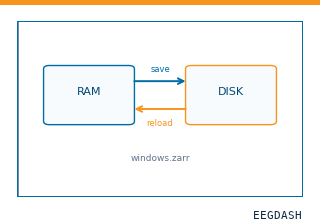 Save and reload prepared dataCache a windowed dataset to disk and reattach it without recompute.
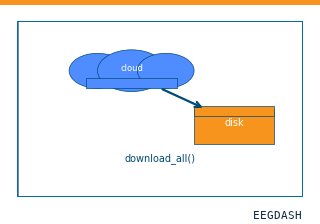 Download a dataset locallyPrefetch BIDS files to a local cache and validate the layout.
Swap any load_dataset(...) call for nm000443 to reproduce the tutorial on this dataset.
Citation
Christoph Wiest, Flavie Torrecillos, Francesca Morgante, Erlick Pereira, Huiling Tan (2023). Subthalamic and thalamic local field potentials during DBS in cervical dystonia (Wiest et al. 2022; derivative, DC-removed release at 4096 Hz). 10.82901/nemar.nm000443
Provenance
¹Contributed to nemar in BIDS format.
²Curated & ingested by the EEGDash catalog; see CITATION.cff for canonical reference.
³Persistent identifier: 10.82901/nemar.nm000443.
See Also#
eegdash.dataset.EEGDashDataseteegdash.dataset