


NM000289: eeg dataset, 607 subjects#
I-CARE: International Cardiac Arrest REsearch consortium EEG Database (BIDS)
Access recordings and metadata through EEGDash.
Citation: Amorim, Edilberto, Zheng, Wei-Long, Ghassemi, Mohammad M., Aghaeeaval, Mahsa, Kandhare, Pravinkumar, Karukonda, Vishnu, Lee, Jong Woo, Herman, Susan, Sivaraju, Adithya, Gaspard, Nicolas, Hofmeijer, Jeannette, van Putten, Michel J.A.M., Sameni, Reza, Reyna, Matthew A., Clifford, Gari D., Westover, M. Brandon (2023). I-CARE: International Cardiac Arrest REsearch consortium EEG Database (BIDS). 10.82901/nemar.nm000289
Modality: eeg Subjects: 607 Recordings: 36123 License: CC-BY-NC-SA-4.0 Source: nemar
Metadata: Complete (100%)
607-participant EEG dataset — I-CARE: International Cardiac Arrest REsearch consortium EEG Database (BIDS).
Quickstart#
Install
pip install eegdash
Access the data
from eegdash.dataset import NM000289

dataset = NM000289(cache_dir="./data")
# Get the raw object of the first recording
raw = dataset.datasets[0].raw
print(raw.info)
Filter by subject
dataset = NM000289(cache_dir="./data", subject="01")
Advanced query
dataset = NM000289(
    cache_dir="./data",
    query={"subject": {"$in": ["01", "02"]}},
)
Iterate recordings
for rec in dataset:
    print(rec.subject, rec.raw.info['sfreq'])
If you use this dataset in your research, please cite the original authors.
BibTeX
@dataset{nm000289,
  title = {I-CARE: International Cardiac Arrest REsearch consortium EEG Database (BIDS)},
  author = {Amorim, Edilberto and Zheng, Wei-Long and Ghassemi, Mohammad M. and Aghaeeaval, Mahsa and Kandhare, Pravinkumar and Karukonda, Vishnu and Lee, Jong Woo and Herman, Susan and Sivaraju, Adithya and Gaspard, Nicolas and Hofmeijer, Jeannette and van Putten, Michel J.A.M. and Sameni, Reza and Reyna, Matthew A. and Clifford, Gari D. and Westover, M. Brandon},
  doi = {10.82901/nemar.nm000289},
  url = {https://doi.org/10.82901/nemar.nm000289},
}
About This Dataset#
The International Cardiac Arrest REsearch consortium (I-CARE) database holds continuous EEG and, where available, ECG recordings with baseline clinical information from comatose adults after cardiac arrest, assembled by seven academic hospitals in the United States, the Netherlands and Belgium. Patients had return of spontaneous circulation (ROSC) but remained comatose (Glasgow Coma Score <= 8). EEG monitoring typically began within hours of the arrest and continued for hours to days as part of neurological prognostication. Ages above 89 are recorded as 90, and all times are relative to ROSC.
Age, sex, hospital, out-of-hospital versus in-hospital arrest, initial rhythm (shockable or not), time to ROSC and targeted temperature management (33 C, 36 C or none). Outcome is the Cerebral Performance Category (CPC), dichotomised as good (CPC 1-2) or poor (CPC 3-5). All of these are columns of participants.tsv, described in participants.json.
I-CARE: International Cardiac Arrest REsearch consortium EEG Database (BIDS)
1. The dataset
Study population and recordings
View full README
I-CARE: International Cardiac Arrest REsearch consortium EEG Database (BIDS)
1. The dataset
Study population and recordings
What this deposit contains
The public release, version 2.1 on PhysioNet (doi:10.13026/m33r-bj81): 607 patients from five of the seven hospitals (de-identified as A, B, D, E and F), 36,123 hourly recordings, 32,712 hours, about 1.5 TB. A further 413 patients are held back by PhysioNet as the hidden test set of the George B. Moody PhysioNet Challenge 2023, for which these data were the training set. Recordings use the standardised 10-20 EEG channels (19-21 per recording, with or without Fpz and F9) plus ECG, reference and other channels where present. Sampling rates vary by site (200, 250, 256, 500, 512, 1024 or 2048 Hz) and are kept at their native value; powerline frequency is 50 or 60 Hz.
Licence and citation
CC BY-NC-SA 4.0, as on PhysioNet. Please cite Amorim et al. (2023), I-CARE: International Cardiac Arrest REsearch consortium Database, version 2.1, PhysioNet, doi:10.13026/m33r-bj81, and Amorim et al., “The International Cardiac Arrest Research Consortium Electroencephalography Database”, Critical Care Medicine, 2023, doi:10.1097/CCM.0000000000006074.
2. This BIDS conversion
Layout
Each I-CARE segment (ending on the hour) is one BIDS run, sub-<NNNN>/eeg/sub-<NNNN>_task-icu_acq-h<HHH>_run-<NNN>_eeg.edf, where acq-h<HHH> is the hour after cardiac arrest at which the segment starts and run-<NNN> the segment index. The EEG, ECG, REF and OTHER WFDB records of a segment are merged into one EDF. Per recording, channels.tsv gives each channel’s type, source record (group) and missing-sample count, and eeg.json its sampling rate, hour after arrest and conversion notes. Per patient, sub-<NNNN>_scans.tsv lists each run’s hour, duration, sampling rate and channel counts. The electrodes files hold template 10-20 positions, not digitised ones.
Signal values and units
The conversion is numerically lossless: EDF stores the source int16 digital values. A few channels whose full range did not fit EDF’s header field are listed under RescaledChannels in the recording sidecar. The WFDB records declare no unit (“nu”). Applying their gain and baseline, as the official Challenge loader does, gives values whose amplitude distribution is consistent with microvolts, so channels are labelled uV. This is an inference, stated in every sidecar’s UnitsNote; compare absolute amplitudes across hospitals with caution. Samples flagged missing in the source (digital code -32768) are filled with the ADC-zero value and counted per channel.
Changes made for this deposit
The participants column sampling_frequency was renamed sampling_frequencies (the BIDS name is reserved for a single number), a root task-icu_channels.json describes the two extra channels.tsv columns, and conversion lock files were removed.
NEMAR Metadata#
[](https://doi.org/10.82901/nemar.nm000289) # I-CARE: International Cardiac Arrest REsearch consortium EEG Database (BIDS) ## 1. The dataset ### Study population and recordings The International Cardiac Arrest REsearch consortium (I-CARE) database holds continuous EEG and, where available, ECG recordings with baseline clinical information from comatose adults after cardiac arrest, assembled by seven academic hospitals in the United States, the Netherlands and Belgium. Patients had return of spontaneous circulation (ROSC) but remained comatose (Glasgow Coma Score <= 8). EEG monitoring typically began within hours of the arrest and continued for hours to days as part of neurological prognostication. Ages above 89 are recorded as 90, and all times are relative to ROSC. ### Clinical variables and outcome Age, sex, hospital, out-of-hospital versus in-hospital arrest, initial rhythm (shockable or not), time to ROSC and targeted temperature management (33 C, 36 C or none). Outcome is the Cerebral Performance Category (CPC), dichotomised as good (CPC 1-2) or poor (CPC 3-5). All of these are columns of participants.tsv, described in participants.json. ### What this deposit contains The public release, version 2.1 on PhysioNet (doi:10.13026/m33r-bj81): 607 patients from five of the seven hospitals (de-identified as A, B, D, E and F), 36,123 hourly recordings, 32,712 hours, about 1.5 TB. A further 413 patients are held back by PhysioNet as the hidden test set of the George B. Moody PhysioNet Challenge 2023, for which these data were the training set. Recordings use the standardised 10-20 EEG channels (19-21 per recording, with or without Fpz and F9) plus ECG, reference and other channels where present. Sampling rates vary by site (200, 250, 256, 500, 512, 1024 or 2048 Hz) and are kept at their native value; powerline frequency is 50 or 60 Hz. ### Licence and citation CC BY-NC-SA 4.0, as on PhysioNet. Please cite Amorim et al. (2023), I-CARE: International Cardiac Arrest REsearch consortium Database, version 2.1, PhysioNet, doi:10.13026/m33r-bj81, and Amorim et al., “The International Cardiac Arrest Research Consortium Electroencephalography Database”, Critical Care Medicine, 2023, doi:10.1097/CCM.0000000000006074. ## 2. This BIDS conversion ### Layout Each I-CARE segment (ending on the hour) is one BIDS run, sub-<NNNN>/eeg/sub-<NNNN>_task-icu_acq-h<HHH>_run-<NNN>_eeg.edf, where acq-h<HHH> is the hour after cardiac arrest at which the segment starts and run-<NNN> the segment index. The EEG, ECG, REF and OTHER WFDB records of a segment are merged into one EDF. Per recording, channels.tsv gives each channel’s type, source record (group) and missing-sample count, and eeg.json its sampling rate, hour after arrest and conversion notes. Per patient, sub-<NNNN>_scans.tsv lists each run’s hour, duration, sampling rate and channel counts. The electrodes files hold template 10-20 positions, not digitised ones. ### Signal values and units The conversion is numerically lossless: EDF stores the source int16 digital values. A few channels whose full range did not fit EDF’s header field are listed under RescaledChannels in the recording sidecar. The WFDB records declare no unit (“nu”). Applying their gain and baseline, as the official Challenge loader does, gives values whose amplitude distribution is consistent with microvolts, so channels are labelled uV. This is an inference, stated in every sidecar’s UnitsNote; compare absolute amplitudes across hospitals with caution. Samples flagged missing in the source (digital code -32768) are filled with the ADC-zero value and counted per channel. ### Changes made for this deposit The participants column sampling_frequency was renamed sampling_frequencies (the BIDS name is reserved for a single number), a root task-icu_channels.json describes the two extra channels.tsv columns, and conversion lock files were removed.
License: CC-BY-NC-SA-4.0
Authors:
Amorim, Edilberto
Zheng, Wei-Long
Ghassemi, Mohammad M
Aghaeeaval, Mahsa
Kandhare, Pravinkumar
… and 11 more
Versions:
Version |
DOI |
Released |
|---|---|---|
|
Cohort#
Dataset Statistics#
Age distribution by gender (n=606, range 16–90 yr, mean 61.2 yr)
Sex composition
Channel counts (ch)
Sampling frequencies (Hz)
Total recording duration: 32712 h
Signal · Electrodes & live trace#
Live trace viewer — sub-0284 · task-icu · run-001
Showing one representative recording out of
607 subjects and 36123 recordings in this dataset.
Browse the full set on OpenNeuro;
drop any other _eeg.{set,edf,bdf,vhdr} file onto the
viewer (or pass ?eeg=<url>) to inspect it.
Electrode layout — EEG · 20 sensors — 20 channels
NEMAR Processing Statistics#
The plots below are generated by NEMAR’s automated EEG pipeline. The histogram shows pipeline success for data cleaning and ICA decomposition, the percentage of data frames and EEG channels retained after artefact removal, line noise per channel (RMS, dB), and the age/gender distribution of participants.

HED event descriptors word cloud

Manifest#
File Explorer#
Browse the BIDS file structure of this dataset. Records are fetched on demand from the EEGDash catalog the first time you open the explorer.
Full dataset metadata table
Dataset ID |
|
Title |
I-CARE: International Cardiac Arrest REsearch consortium EEG Database (BIDS) |
Author (year) |
— |
Canonical |
— |
Importable as |
|
Year |
2023 |
Authors |
Amorim, Edilberto, Zheng, Wei-Long, Ghassemi, Mohammad M., Aghaeeaval, Mahsa, Kandhare, Pravinkumar, Karukonda, Vishnu, Lee, Jong Woo, Herman, Susan, Sivaraju, Adithya, Gaspard, Nicolas, Hofmeijer, Jeannette, van Putten, Michel J.A.M., Sameni, Reza, Reyna, Matthew A., Clifford, Gari D., Westover, M. Brandon |
License |
CC-BY-NC-SA-4.0 |
Citation / DOI |
|
Source links |
OpenNeuro | NeMAR | Source URL |
Copy-paste BibTeX
@dataset{nm000289,
  title = {I-CARE: International Cardiac Arrest REsearch consortium EEG Database (BIDS)},
  author = {Amorim, Edilberto and Zheng, Wei-Long and Ghassemi, Mohammad M. and Aghaeeaval, Mahsa and Kandhare, Pravinkumar and Karukonda, Vishnu and Lee, Jong Woo and Herman, Susan and Sivaraju, Adithya and Gaspard, Nicolas and Hofmeijer, Jeannette and van Putten, Michel J.A.M. and Sameni, Reza and Reyna, Matthew A. and Clifford, Gari D. and Westover, M. Brandon},
  doi = {10.82901/nemar.nm000289},
  url = {https://doi.org/10.82901/nemar.nm000289},
}
API Reference#
eegdash.datasetEEGDashDataset- class eegdash.dataset.NM000289(cache_dir: str, query: dict | None = None, s3_bucket: str | None = None, **kwargs)[source]#
I-CARE: International Cardiac Arrest REsearch consortium EEG Database (BIDS)
- Study:
nm000289(NeMAR)- Author (year):
—
- Canonical:
—
Also importable as:
NM000289.Modality:
eeg; Experiment type:Clinical, Consciousness; Subject type:Disorders of consciousness. Subjects: 607; recordings: 36123; tasks: 1.- Parameters:
cache_dir (str | Path) – Directory where data are cached locally.
query (dict | None) – Additional MongoDB-style filters to AND with the dataset selection. Must not contain the key
dataset.s3_bucket (str | None) – Base S3 bucket used to locate the data.
**kwargs (dict) – Additional keyword arguments forwarded to
EEGDashDataset.
- data_dir#
Local dataset cache directory (
cache_dir / dataset_id).- Type:
Path
Notes
Each item is a recording; recording-level metadata are available via
dataset.description.querysupports MongoDB-style filters on fields inALLOWED_QUERY_FIELDSand is combined with the dataset filter. Dataset-specific caveats are not provided in the summary metadata.References
OpenNeuro dataset: https://openneuro.org/datasets/nm000289 NeMAR dataset: https://nemar.org/dataexplorer/detail?dataset_id=nm000289 DOI: https://doi.org/10.82901/nemar.nm000289
Examples
>>> from eegdash.dataset import NM000289
>>> dataset = NM000289(cache_dir="./data")
>>> recording = dataset[0]
>>> raw = recording.load()
- __init__(cache_dir: str, query: dict | None = None, s3_bucket: str | None = None, **kwargs)[source]#
- save(path: str, overwrite: bool = False, offset: int = 0)[source]#
Save datasets to files by creating one subdirectory for each dataset:
path/
    0/
        0-raw.fif | 0-epo.fif
        description.json
        raw_preproc_kwargs.json (if raws were preprocessed)
        window_kwargs.json (if this is a windowed dataset)
        window_preproc_kwargs.json  (if windows were preprocessed)
        target_name.json (if target_name is not None and dataset is raw)
    1/
        1-raw.fif | 1-epo.fif
        description.json
        raw_preproc_kwargs.json (if raws were preprocessed)
        window_kwargs.json (if this is a windowed dataset)
        window_preproc_kwargs.json  (if windows were preprocessed)
        target_name.json (if target_name is not None and dataset is raw)
- Parameters:
path (str) –
- Directory in which subdirectories are created to store
-raw.fif | -epo.fif and .json files to.
overwrite (bool) – Whether to delete old subdirectories that will be saved to in this call.
offset (int) – If provided, the integer is added to the id of the dataset in the concat. This is useful in the setting of very large datasets, where one dataset has to be processed and saved at a time to account for its original position.
BaseDataset from braindecode — windowed via create_windows_from_events.braindecodeDataLoader; supports parallel workers and on-the-fly augmentations.pytorch Find datasets with the EEGDash APIQuery the catalogue, filter by task or modality, list candidates.
 Load one EEG recordingResolve a single record to an MNE Raw with channels and events.
 EEG recording to PyTorch DataLoaderWrap braindecode windows in a DataLoader for model training.
 Preprocess EEG and create windowsFilter, resample, epoch — and persist the windowed dataset.
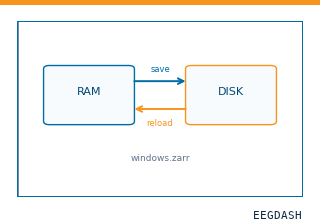 Save and reload prepared dataCache a windowed dataset to disk and reattach it without recompute.
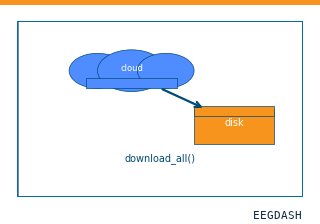 Download a dataset locallyPrefetch BIDS files to a local cache and validate the layout.
Swap any load_dataset(...) call for nm000289 to reproduce the tutorial on this dataset.
Citation
Amorim, Edilberto, Zheng, Wei-Long, Ghassemi, Mohammad M., Aghaeeaval, Mahsa, Kandhare, Pravinkumar, … (2023). I-CARE: International Cardiac Arrest REsearch consortium EEG Database (BIDS). 10.82901/nemar.nm000289
Provenance
¹Contributed to nemar in BIDS format.
²Curated & ingested by the EEGDash catalog; see CITATION.cff for canonical reference.
³Persistent identifier: 10.82901/nemar.nm000289.
See Also#
eegdash.dataset.EEGDashDataseteegdash.dataset