


DS007655: eeg dataset, 32 subjects#
MorseEEG-ATP
Access recordings and metadata through EEGDash.
Citation: HZY, Research Team (—). MorseEEG-ATP. 10.18112/openneuro.ds007655.v1.0.1
Modality: eeg Subjects: 32 Recordings: 64 License: CC0 Source: openneuro
Metadata: Complete (100%)
32-participant EEG dataset — MorseEEG-ATP.
Quickstart#
Install
pip install eegdash
Access the data
from eegdash.dataset import DS007655

dataset = DS007655(cache_dir="./data")
# Get the raw object of the first recording
raw = dataset.datasets[0].raw
print(raw.info)
Filter by subject
dataset = DS007655(cache_dir="./data", subject="01")
Advanced query
dataset = DS007655(
    cache_dir="./data",
    query={"subject": {"$in": ["01", "02"]}},
)
Iterate recordings
for rec in dataset:
    print(rec.subject, rec.raw.info['sfreq'])
If you use this dataset in your research, please cite the original authors.
BibTeX
@dataset{ds007655,
  title = {MorseEEG-ATP},
  author = {HZY and Research Team},
  doi = {10.18112/openneuro.ds007655.v1.0.1},
  url = {https://doi.org/10.18112/openneuro.ds007655.v1.0.1},
}
About This Dataset#
MorseEEG-ATP: a multitask EEG dataset for exploring auditory temporal processing with Morse code
MorseEEG-ATP is a publicly available multitask electroencephalography (EEG) dataset for studying auditory temporal processing and temporal pattern discrimination using Morse code (MC) stimuli. Auditory temporal processing refers to the ability of the auditory system to perceive, encode, and integrate the temporal structure of sounds. The dataset was designed to address the relative lack of open resources targeting the intermediate stage between low-level acoustic encoding and higher-level language or cognitive processing, namely the extraction and discrimination of stable temporal patterns from discrete acoustic elements governed by explicit temporal rules. MC provides a controlled and parameterizable stimulus model for this purpose because it consists of short and long acoustic elements combined according to fixed rules, has a clear and stable temporal structure, and depends relatively little on lexical or semantic knowledge in untrained listeners.
Dataset Content
The dataset contains synchronously recorded EEG and behavioral data from 32 healthy adult participants (14 females). Data were collected with a 62-channel EEG system at a sampling rate of 600 Hz and are organized in an EEG-BIDS compatible structure (BIDS v1.10.1). The release includes:
1. Raw EEG recordings in BrainVision format (.vhdr, .vmrk, .eeg) together with BIDS sidecar files.
2. Minimally preprocessed EEG data under derivatives/preprocessed/ for reproducible downstream analysis.
3. Trial-aligned event annotations, including event onsets, trigger values, block labels, speed conditions, and stimulus file references.
4. Behavioral measures including accuracy and reaction time, together with participant-level summary information.
5. Companion preprocessing and benchmark analysis scripts.
Experimental Design
View full README
Dataset Content
The dataset contains synchronously recorded EEG and behavioral data from 32 healthy adult participants (14 females). Data were collected with a 62-channel EEG system at a sampling rate of 600 Hz and are organized in an EEG-BIDS compatible structure (BIDS v1.10.1). The release includes:
1. Raw EEG recordings in BrainVision format (.vhdr, .vmrk, .eeg) together with BIDS sidecar files.
2. Minimally preprocessed EEG data under derivatives/preprocessed/ for reproducible downstream analysis.
3. Trial-aligned event annotations, including event onsets, trigger values, block labels, speed conditions, and stimulus file references.
4. Behavioral measures including accuracy and reaction time, together with participant-level summary information.
5. Companion preprocessing and benchmark analysis scripts.
Experimental Design
Tasks: The experiment includes two auditory discrimination tasks that share the same stimulus set and trial structure but differ in decision rules. - Dot-count task (``task-dotcount``): Participants report the number of dots contained in the presented Morse code character. - First-last match task (``task-firstlast``): Participants judge whether the first and last elements of the presented Morse code character are identical.
Presentation-rate conditions: Each task includes three presentation-rate conditions defined by Morse character transmission speed: 15, 30, and 40 characters per minute (CPM). These conditions support comparisons across different temporal-rate demands.
Rationale: By jointly manipulating task rules and presentation rate, the dataset supports comparative analyses of auditory temporal processing, temporal pattern discrimination, and listening ability assessment across processing demands and speed conditions.
Trial procedure: Each trial consists of a fixation period, stimulus presentation, a response window, and a jittered inter-trial interval.
Data Acquisition
EEG System: g.tec medical engineering GmbH g.HIamp.
Sampling Rate: 600 Hz.
Online Filtering: 0.1-100 Hz bandpass filter and a 48-52 Hz notch filter.
Effective Channels: 62 scalp electrodes arranged according to the International 10-20 system.
Reference Electrode: right earlobe.
Stimulus and behavior software: Stimuli were presented and behavioral responses were collected using E-Prime 3.0.
Research Value
The value of MorseEEG-ATP lies in three main aspects. First, at the level of experimental paradigm, the dataset is built on the discrete acoustic units and explicit temporal rules of MC, while systematically integrating task demands and presentation-rate manipulations within a unified framework. This provides a reproducible and parameterizable paradigm for studying auditory temporal pattern discrimination based on explicit temporal rules. Second, at the level of assessment methodology, the dataset combines multitask conditions, cross-rate manipulations, trial-aligned EEG recordings, and behavioral measures, supporting comparisons of neural and behavioral performance across different processing demands and speed conditions, as well as the development and validation of methods for listening ability assessment. Third, as a research resource, the dataset provides raw and preprocessed data, event annotations, behavioral measures, and analysis scripts in a standardized format, thereby supporting studies of rhythm perception, related individual differences, EEG analysis methods, neural decoding models, and auditory brain-computer interface approaches under cross-condition generalization settings.
Technical Validation Highlights
According to the accompanying paper, technical validation is provided through behavioral performance, event-related potential responses, and listening-related measures, supporting the quality and usability of the dataset.
Data Quality Notes
Data corruption: - Channel 56 data for participant
sub-13are corrupted. - Channel 56 data for participantsub-14are corrupted. - Channel 43 data for participantsub-15are corrupted.In the minimally preprocessed data, these corrupted channels have been interpolated using neighboring electrodes.
Usage Recommendations
Citation: Please cite the associated Scientific Data article when using this dataset.
Preprocessing: The raw data preserve complete trigger markers. The companion preprocessing pipeline can be used directly or adapted for related studies.
Analysis: The derivative
.matfiles are organized for efficient comparison across blocks and presentation-rate conditions.Applications: The dataset primarily supports studies of auditory temporal processing, temporal pattern discrimination, cross-condition EEG analysis, and listening-related individual differences. It may also be useful for benchmarking EEG analysis and neural decoding methods.
Summary
MorseEEG-ATP provides a standardized and shareable EEG resource for studying auditory temporal processing with controlled Morse code stimuli. It bridges a gap between low-level acoustic encoding datasets and higher-level language datasets by targeting the extraction and discrimination of temporal patterns governed by explicit rules. The resource supports research on temporal pattern discrimination, individual differences, and listening ability assessment, while also providing a useful benchmark for EEG analysis and decoding methods.
Cohort#
Dataset Statistics#
Age distribution by gender (n=32, range 20–26 yr, mean 21.9 yr)
Sex composition
Channel counts: 62 ch (n=64 recordings)
Sampling frequencies: 600.0 Hz (n=64 recordings)
Total recording duration: 20 h 21 min
Signal · Electrodes & live trace#
Live trace viewer — sub-13 · task-dotcount
Showing one representative recording out of
32 subjects and 64 recordings in this dataset.
Browse the full set on OpenNeuro;
drop any other _eeg.{set,edf,bdf,vhdr} file onto the
viewer (or pass ?eeg=<url>) to inspect it.
Electrode layout — EEG · 62 sensors — 62 channels
NEMAR Processing Statistics#
The plots below are generated by NEMAR’s automated EEG pipeline. The histogram shows pipeline success for data cleaning and ICA decomposition, the percentage of data frames and EEG channels retained after artefact removal, line noise per channel (RMS, dB), and the age/gender distribution of participants.

HED event descriptors word cloud

Manifest#
File Explorer#
Browse the BIDS file structure of this dataset. Records are fetched on demand from the EEGDash catalog the first time you open the explorer.
Full dataset metadata table
Dataset ID |
|
Title |
MorseEEG-ATP |
Author (year) |
— |
Canonical |
— |
Importable as |
|
Year |
— |
Authors |
HZY, Research Team |
License |
CC0 |
Citation / DOI |
|
Source links |
OpenNeuro | NeMAR | Source URL |
Copy-paste BibTeX
@dataset{ds007655,
  title = {MorseEEG-ATP},
  author = {HZY and Research Team},
  doi = {10.18112/openneuro.ds007655.v1.0.1},
  url = {https://doi.org/10.18112/openneuro.ds007655.v1.0.1},
}
API Reference#
eegdash.datasetEEGDashDataset- class eegdash.dataset.DS007655(cache_dir: str, query: dict | None = None, s3_bucket: str | None = None, **kwargs)[source]#
MorseEEG-ATP
- Study:
ds007655(OpenNeuro)- Author (year):
—
- Canonical:
—
Also importable as:
DS007655.Modality:
eeg; Experiment type:Perception; Subject type:Healthy. Subjects: 32; recordings: 64; tasks: 2.- Parameters:
cache_dir (str | Path) – Directory where data are cached locally.
query (dict | None) – Additional MongoDB-style filters to AND with the dataset selection. Must not contain the key
dataset.s3_bucket (str | None) – Base S3 bucket used to locate the data.
**kwargs (dict) – Additional keyword arguments forwarded to
EEGDashDataset.
- data_dir#
Local dataset cache directory (
cache_dir / dataset_id).- Type:
Path
Notes
Each item is a recording; recording-level metadata are available via
dataset.description.querysupports MongoDB-style filters on fields inALLOWED_QUERY_FIELDSand is combined with the dataset filter. Dataset-specific caveats are not provided in the summary metadata.References
OpenNeuro dataset: https://openneuro.org/datasets/ds007655 NeMAR dataset: https://nemar.org/dataexplorer/detail?dataset_id=ds007655 DOI: https://doi.org/10.18112/openneuro.ds007655.v1.0.1
Examples
>>> from eegdash.dataset import DS007655
>>> dataset = DS007655(cache_dir="./data")
>>> recording = dataset[0]
>>> raw = recording.load()
- __init__(cache_dir: str, query: dict | None = None, s3_bucket: str | None = None, **kwargs)[source]#
- save(path: str, overwrite: bool = False, offset: int = 0)[source]#
Save datasets to files by creating one subdirectory for each dataset:
path/
    0/
        0-raw.fif | 0-epo.fif
        description.json
        raw_preproc_kwargs.json (if raws were preprocessed)
        window_kwargs.json (if this is a windowed dataset)
        window_preproc_kwargs.json  (if windows were preprocessed)
        target_name.json (if target_name is not None and dataset is raw)
    1/
        1-raw.fif | 1-epo.fif
        description.json
        raw_preproc_kwargs.json (if raws were preprocessed)
        window_kwargs.json (if this is a windowed dataset)
        window_preproc_kwargs.json  (if windows were preprocessed)
        target_name.json (if target_name is not None and dataset is raw)
- Parameters:
path (str) –
- Directory in which subdirectories are created to store
-raw.fif | -epo.fif and .json files to.
overwrite (bool) – Whether to delete old subdirectories that will be saved to in this call.
offset (int) – If provided, the integer is added to the id of the dataset in the concat. This is useful in the setting of very large datasets, where one dataset has to be processed and saved at a time to account for its original position.
BaseDataset from braindecode — windowed via create_windows_from_events.braindecodeDataLoader; supports parallel workers and on-the-fly augmentations.pytorch Find datasets with the EEGDash APIQuery the catalogue, filter by task or modality, list candidates.
 Load one EEG recordingResolve a single record to an MNE Raw with channels and events.
 EEG recording to PyTorch DataLoaderWrap braindecode windows in a DataLoader for model training.
 Preprocess EEG and create windowsFilter, resample, epoch — and persist the windowed dataset.
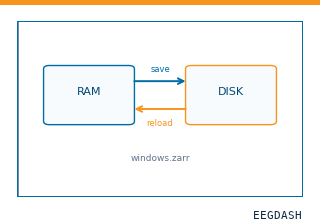 Save and reload prepared dataCache a windowed dataset to disk and reattach it without recompute.
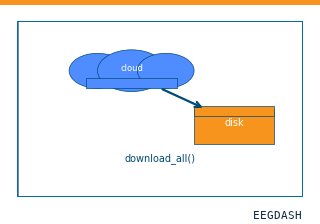 Download a dataset locallyPrefetch BIDS files to a local cache and validate the layout.
Swap any load_dataset(...) call for ds007655 to reproduce the tutorial on this dataset.
Citation
HZY, Research Team (n.d.). MorseEEG-ATP. 10.18112/openneuro.ds007655.v1.0.1
Provenance
¹Contributed to openneuro in BIDS format.
²Curated & ingested by the EEGDash catalog; see CITATION.cff for canonical reference.
³Persistent identifier: 10.18112/openneuro.ds007655.v1.0.1.
See Also#
eegdash.dataset.EEGDashDataseteegdash.dataset