


DS003885: eeg dataset, 24 subjects#
Capacity for movement is an organisational principle in object representations: EEG data from Experiment 1
Access recordings and metadata through EEGDash.
Citation: Shatek, Sophia M., Robinson, Amanda K., Grootswagers, Tijl, Carlson, Thomas A. (—). Capacity for movement is an organisational principle in object representations: EEG data from Experiment 1. 10.18112/openneuro.ds003885.v1.0.7
Modality: eeg Subjects: 24 Recordings: 24 License: CC0 Source: openneuro Citations: 2.0
Metadata: Complete (100%)
24-participant EEG dataset — Capacity for movement is an organisational principle in object representations: EEG data from Experiment 1.
Quickstart#
Install
pip install eegdash
Access the data
from eegdash.dataset import DS003885

dataset = DS003885(cache_dir="./data")
# Get the raw object of the first recording
raw = dataset.datasets[0].raw
print(raw.info)
Filter by subject
dataset = DS003885(cache_dir="./data", subject="01")
Advanced query
dataset = DS003885(
    cache_dir="./data",
    query={"subject": {"$in": ["01", "02"]}},
)
Iterate recordings
for rec in dataset:
    print(rec.subject, rec.raw.info['sfreq'])
If you use this dataset in your research, please cite the original authors.
BibTeX
@dataset{ds003885,
  title = {Capacity for movement is an organisational principle in object representations: EEG data from Experiment 1},
  author = {Shatek, Sophia M. and Robinson, Amanda K. and Grootswagers, Tijl and Carlson, Thomas A.},
  doi = {10.18112/openneuro.ds003885.v1.0.7},
  url = {https://doi.org/10.18112/openneuro.ds003885.v1.0.7},
}
About This Dataset#
This data is from the paper “Capacity for movement is a major organisational principle in object representations”. This is the data of Experiment 1 (EEG: aliveness). The preprint is here: https://doi.org/10.31234/osf.io/3x2qh
Abstract:
The ability to perceive moving objects is crucial for threat identification and survival. Recent neuroimaging evidence has shown that goal-directed movement is an important element of object processing in the brain. However, prior work has primarily used moving stimuli that are also animate, making it difficult to disentangle the effect of movement from aliveness or animacy in representational categorisation. In the current study, we investigated the relationship between how the brain processes movement and aliveness by including stimuli that are alive but still (e.g., plants), and stimuli that are not alive but move (e.g., waves). We examined electroencephalographic (EEG) data recorded while participants viewed static images of moving or non-moving objects that were either natural or artificial. Participants classified the images according to aliveness, or according to capacity for movement. Movement explained significant variance in the neural data over and above that of aliveness, showing that capacity for movement is an important dimension in the representation of visual objects in humans.
Overview
In this experiment, participants completed two tasks - classification and passive viewing. In the classification task, participants classified single images that appeared on the screen as “alive” or “not alive”. This task was time-pressured, and trials timed out after 1 second. In the passive viewing task, participants viewed rapid (RSVP) streams of images, and pressed a button to indicate when the fixation cross changed colour. Contents of the dataset:
Raw EEG data is available in individual subject folders (BrainVision raw formats .eeg, .vmrk, .vhdr). Pre-processed EEG data is available in the derivatives folders in EEGlab (.set, .fdt) and cosmoMVPA dataset (.mat) format. This experiment has 24 subjects.
Scripts for data analysis and running the experiment are available in the code folder. Note that all code runs on both EEG experiments together, so you must download both this and the movement experiment data in order to replicate analyses.
Stimuli are also available (400 CC0 images)
Results of decoding analyses are available in the derivatives folder.
Further notes:
View full README
Overview
In this experiment, participants completed two tasks - classification and passive viewing. In the classification task, participants classified single images that appeared on the screen as “alive” or “not alive”. This task was time-pressured, and trials timed out after 1 second. In the passive viewing task, participants viewed rapid (RSVP) streams of images, and pressed a button to indicate when the fixation cross changed colour. Contents of the dataset:
Raw EEG data is available in individual subject folders (BrainVision raw formats .eeg, .vmrk, .vhdr). Pre-processed EEG data is available in the derivatives folders in EEGlab (.set, .fdt) and cosmoMVPA dataset (.mat) format. This experiment has 24 subjects.
Scripts for data analysis and running the experiment are available in the code folder. Note that all code runs on both EEG experiments together, so you must download both this and the movement experiment data in order to replicate analyses.
Stimuli are also available (400 CC0 images)
Results of decoding analyses are available in the derivatives folder.
Further notes:
Note that the code is designed to run analyses for data and its partner data (experiments 2 and 3 of the paper). Copies in both folders are identical. Scripts need to be run in a particular order (detailed at the top of each script)
Further explanations of the code:
Run pre-processing of EEG (analyse_EEG_preprocessing.m), and behavioural data (analyse_behavioural_EEG.m)
Ensure that the MTurk data has been run (analyse_behavioural_MTurk.m), from the Experiment 1 folder.
Run RSA (analyse_rsa.m; reliant on behavioural data and pre-processed EEG data), and run decoding (analyse_decoding.m; reliant on pre-processed EEG data)
Run GLMs (analyse_glms.m; reliant on RSA, behavioural)
To only look at the results, the results for each of these analyses is saved in the derivatives already, so there is no need to run any of them again.
Each file named plot_X.m will create a graph as in the paper. Each is reliant on saved data from the above analyses, which are saved in the derivatives folder.
Citing this dataset
If using this data, please cite the associated paper: Preprint - https://doi.org/10.31234/osf.io/3x2qh
Contact
Contact Sophia Shatek (sophia.shatek@sydney.edu.au) for additional information. ORCID: 0000-0002-7787-1379
Cohort#
Dataset Statistics#
Age distribution by gender (n=24, range 18–26 yr, mean 19.6 yr)
Sex composition
Channel counts: 128 ch (n=24 recordings)
Sampling frequencies: 1000.0 Hz (n=24 recordings)
Total recording duration: 27 h
Signal · Electrodes & live trace#
Live trace viewer — sub-13 · task-movement
Showing one representative recording out of
24 subjects and 24 recordings in this dataset.
Browse the full set on OpenNeuro;
drop any other _eeg.{set,edf,bdf,vhdr} file onto the
viewer (or pass ?eeg=<url>) to inspect it.
No scalp electrode layout is currently indexed for this dataset. Once the eegdash montage registry ingests it, the interactive viewer will appear here automatically.
NEMAR Processing Statistics#
The plots below are generated by NEMAR’s automated EEG pipeline. The histogram shows pipeline success for data cleaning and ICA decomposition, the percentage of data frames and EEG channels retained after artefact removal, line noise per channel (RMS, dB), and the age/gender distribution of participants.

HED event descriptors word cloud

Manifest#
File Explorer#
Browse the BIDS file structure of this dataset. Records are fetched on demand from the EEGDash catalog the first time you open the explorer.
Full dataset metadata table
Dataset ID |
|
Title |
Capacity for movement is an organisational principle in object representations: EEG data from Experiment 1 |
Author (year) |
|
Canonical |
— |
Importable as |
|
Year |
— |
Authors |
Shatek, Sophia M., Robinson, Amanda K., Grootswagers, Tijl, Carlson, Thomas A. |
License |
CC0 |
Citation / DOI |
|
Source links |
Copy-paste BibTeX
@dataset{ds003885,
  title = {Capacity for movement is an organisational principle in object representations: EEG data from Experiment 1},
  author = {Shatek, Sophia M. and Robinson, Amanda K. and Grootswagers, Tijl and Carlson, Thomas A.},
  doi = {10.18112/openneuro.ds003885.v1.0.7},
  url = {https://doi.org/10.18112/openneuro.ds003885.v1.0.7},
}
API Reference#
eegdash.datasetEEGDashDatasetDS003885 · Shatek2021_E1eegdash/dataset/registry.py · [source ↗]- class eegdash.dataset.DS003885(cache_dir: str, query: dict | None = None, s3_bucket: str | None = None, **kwargs)[source]#
Capacity for movement is an organisational principle in object representations: EEG data from Experiment 1
- Study:
ds003885(OpenNeuro)- Author (year):
Shatek2021_E1- Canonical:
—
Also importable as:
DS003885,Shatek2021_E1.Modality:
eeg; Experiment type:Perception; Subject type:Healthy. Subjects: 24; recordings: 24; tasks: 1.- Parameters:
cache_dir (str | Path) – Directory where data are cached locally.
query (dict | None) – Additional MongoDB-style filters to AND with the dataset selection. Must not contain the key
dataset.s3_bucket (str | None) – Base S3 bucket used to locate the data.
**kwargs (dict) – Additional keyword arguments forwarded to
EEGDashDataset.
- data_dir#
Local dataset cache directory (
cache_dir / dataset_id).- Type:
Path
Notes
Each item is a recording; recording-level metadata are available via
dataset.description.querysupports MongoDB-style filters on fields inALLOWED_QUERY_FIELDSand is combined with the dataset filter. Dataset-specific caveats are not provided in the summary metadata.References
OpenNeuro dataset: https://openneuro.org/datasets/ds003885 NeMAR dataset: https://nemar.org/dataexplorer/detail?dataset_id=ds003885 DOI: https://doi.org/10.18112/openneuro.ds003885.v1.0.7 NEMAR citation count: 2
Examples
>>> from eegdash.dataset import DS003885
>>> dataset = DS003885(cache_dir="./data")
>>> recording = dataset[0]
>>> raw = recording.load()
- __init__(cache_dir: str, query: dict | None = None, s3_bucket: str | None = None, **kwargs)[source]#
- save(path: str, overwrite: bool = False, offset: int = 0)[source]#
Save datasets to files by creating one subdirectory for each dataset:
path/
    0/
        0-raw.fif | 0-epo.fif
        description.json
        raw_preproc_kwargs.json (if raws were preprocessed)
        window_kwargs.json (if this is a windowed dataset)
        window_preproc_kwargs.json  (if windows were preprocessed)
        target_name.json (if target_name is not None and dataset is raw)
    1/
        1-raw.fif | 1-epo.fif
        description.json
        raw_preproc_kwargs.json (if raws were preprocessed)
        window_kwargs.json (if this is a windowed dataset)
        window_preproc_kwargs.json  (if windows were preprocessed)
        target_name.json (if target_name is not None and dataset is raw)
- Parameters:
path (str) –
- Directory in which subdirectories are created to store
-raw.fif | -epo.fif and .json files to.
overwrite (bool) – Whether to delete old subdirectories that will be saved to in this call.
offset (int) – If provided, the integer is added to the id of the dataset in the concat. This is useful in the setting of very large datasets, where one dataset has to be processed and saved at a time to account for its original position.
BaseDataset from braindecode — windowed via create_windows_from_events.braindecodeDataLoader; supports parallel workers and on-the-fly augmentations.pytorchdatasets.load_dataset("EEGDash/ds003885").huggingface Find datasets with the EEGDash APIQuery the catalogue, filter by task or modality, list candidates.
 Load one EEG recordingResolve a single record to an MNE Raw with channels and events.
 EEG recording to PyTorch DataLoaderWrap braindecode windows in a DataLoader for model training.
 Preprocess EEG and create windowsFilter, resample, epoch — and persist the windowed dataset.
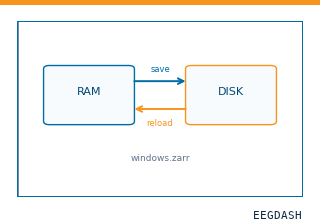 Save and reload prepared dataCache a windowed dataset to disk and reattach it without recompute.
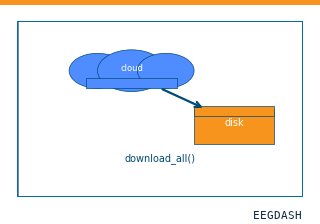 Download a dataset locallyPrefetch BIDS files to a local cache and validate the layout.
Swap any load_dataset(...) call for ds003885 to reproduce the tutorial on this dataset.
Citation
Shatek, Sophia M., Robinson, Amanda K., Grootswagers, Tijl, Carlson, Thomas A. (n.d.). Capacity for movement is an organisational principle in object representations: EEG data from Experiment 1. 10.18112/openneuro.ds003885.v1.0.7
Provenance
¹Contributed to openneuro in BIDS format.
²Curated & ingested by the EEGDash catalog; see CITATION.cff for canonical reference.
³Persistent identifier: 10.18112/openneuro.ds003885.v1.0.7.
See Also#
eegdash.dataset.EEGDashDataseteegdash.dataset