


DS003846: eeg dataset, 19 subjects#
Prediction Error
Access recordings and metadata through EEGDash.
Citation: Lukas Gehrke, Sezen Akman, Albert Chen, Pedro Lopes, Klaus Gramann (19). Prediction Error. 10.18112/openneuro.ds003846.v2.0.2
Modality: eeg Subjects: 19 Recordings: 50 License: CC0 Source: openneuro Citations: 5.0
Metadata: Complete (100%)
19-participant EEG dataset — Prediction Error.
Quickstart#
Install
pip install eegdash
Access the data
from eegdash.dataset import DS003846

dataset = DS003846(cache_dir="./data")
# Get the raw object of the first recording
raw = dataset.datasets[0].raw
print(raw.info)
Filter by subject
dataset = DS003846(cache_dir="./data", subject="01")
Advanced query
dataset = DS003846(
    cache_dir="./data",
    query={"subject": {"$in": ["01", "02"]}},
)
Iterate recordings
for rec in dataset:
    print(rec.subject, rec.raw.info['sfreq'])
If you use this dataset in your research, please cite the original authors.
BibTeX
@dataset{ds003846,
  title = {Prediction Error},
  author = {Lukas Gehrke and Sezen Akman and Albert Chen and Pedro Lopes and Klaus Gramann},
  doi = {10.18112/openneuro.ds003846.v2.0.2},
  url = {https://doi.org/10.18112/openneuro.ds003846.v2.0.2},
}
About This Dataset#
In case of any questions, please contact: Lukas Gehrke, lukas.gehrke@tu-berlin.de, orcid: 0000-0003-3661-1973
Cyber-Physical Systems: Prediction Error
These data were collected at https://www.tu.berlin/bpn. Data collection occurred either between 10:00 and 12:00 or between 14:00 and 18:00.
Readme
To learn about the task, independent-, dependent-, and control variables, please consult the methods sections of the following two publications: https://dl.acm.org/doi/abs/10.1145/3290605.3300657 https://iopscience.iop.org/article/10.1088/1741-2552/ac69bc/meta - Contents of the dataset: Output from BIDS-validator
Summary 324 Files, 9.76GB 19 - Subjects
View full README
Readme
To learn about the task, independent-, dependent-, and control variables, please consult the methods sections of the following two publications: https://dl.acm.org/doi/abs/10.1145/3290605.3300657 https://iopscience.iop.org/article/10.1088/1741-2552/ac69bc/meta - Contents of the dataset: Output from BIDS-validator
Summary 324 Files, 9.76GB 19 - Subjects 5 - Sessions Available Tasks PredictionError Available Modalities EEG - Quality assessment of the data: Link to data paper, once done
Methods
Subjects
The study sample consists of 19 participants (participant_id 1 to 19) with ages ranging from 18 to 34 years and varying cap sizes from 54 to 60. Stimulation is delivered in three blocks: Block_1, Block_2, and Block_3, utilizing different combinations of Visual, Vibro, and EMS.
Participant Information:
Age: Ranges from 18 to 34 years.
Cap Size: Varied, with sizes ranging from 54 to 60. Stimulation Blocks:
Block_1 and Block_2 include Visual, Visual + Vibro, and Visual + Vibro + EMS.
Block_3 primarily involves Visual + Vibro + EMS. Usage of Stimulation Blocks:
Most participants experience Visual stimulation in all blocks.
Visual + Vibro is common in Block_1 and Block_2. Visual + Vibro + EMS is prevalent in Block_3.
Some participants did not experience certain blocks (indicated by “0”). Other Observations:
Cap size variation doesn’t show a clear pattern in relation to stimulation blocks.
Participants exhibit diverse stimulation patterns, showcasing individualized experiences.
Task, Environment and Variables
This set of variables outlines key parameters in a neuroscience experiment involving a haptic task. Here’s a summary: box:
Description: Represents the target object to be touched following its spawn.
Units: String (presumably indicating the characteristics or identity of the object). normal_or_conflict:
Description: Describes the behavior of the target object in the current trial, distinguishing between oddball and non-oddball conditions.
Units: String (presumably indicating the nature of the trial). condition:
Description: Indicates the level of haptic realism in the experiment.
Units: String (presumably representing different levels of realism). cube:
Description: Specifies the position of the target object, whether it is located on the left, right, or center.
Units: String (presumably indicating spatial orientation). trial_nr:
Description: Denotes the number of the current trial in the experiment.
Units: Integer.
Apparatus
Here’s a summary of the recording environment: - EEG Stream Name: BrainVision - EEG Reference and Ground: FCz and AFz, respectively - EEG Channel Locations: 63 channels with specific names (e.g., Fp1, Fz, Pz) and types (EEG) - Additional Channels: 1 EOG (Electrooculogram) - Power Line Frequency: 50 Hz - Manufacturer: Brain Products - Manufacturer’s Model Name: BrainAmp DC - Cap Manufacturer: EasyCap - Cap Model Name: actiCap 64ch CACS-64 - EEG Placement Scheme: Positions chosen from a 10% system - Channel Counts:
EEG Channels: 63
EOG Channels: 1
ECG Channels: 0
EMG Channels: 0
Miscellaneous Channels: 0
Trigger Channels: 0
This configuration indicates a high-density EEG setup with specific electrode placements, utilizing Brain Products’ BrainAmp DC model. The electrode cap is manufactured by EasyCap, with the specific model name actiCap 64ch CACS-64. The EEG data is sampled at an unspecified frequency, and the system is designed to capture electrical brain activity across a comprehensive set of channels. The recording includes an additional channel for recording eye movements (EOG). Overall, the setup appears suitable for detailed EEG investigations in neurophysiological research.
The motion capture recording environment uses two devices: “rigid_head” and “rigid_handr,” which correspond to “HTCViveHead” and “HTCViveRightHand” in the BIDS (Brain Imaging Data Structure) naming convention. The tracked points include “Head” and “handR.” The motion data is captured using quaternions with channels named “quat_X,” “quat_Y,” “quat_Z,” and “quat_W.” Positional data includes channels “_X,” “_Y,” and “_Z.” The system is manufactured by HTC, with the model name “Vive,” and the recording has a sampling frequency of 90 Hz. Additional information such as software versions is not provided.
Cohort#
Dataset Statistics#
Age distribution by gender (n=19, range 18–34 yr, mean 26.7 yr)
Channel counts: 64 ch (n=50 recordings)
Sampling frequencies: 500.0 Hz (n=50 recordings)
Total recording duration: 22 h 43 min
Signal · Electrodes & live trace#
Live trace viewer — sub-13 · ses-EMS · task-PredictionError
Showing one representative recording out of
19 subjects and 50 recordings in this dataset.
Browse the full set on OpenNeuro;
drop any other _eeg.{set,edf,bdf,vhdr} file onto the
viewer (or pass ?eeg=<url>) to inspect it.
Electrode layout — EEG · 63 sensors — 63 channels
NEMAR Processing Statistics#
The plots below are generated by NEMAR’s automated EEG pipeline. The histogram shows pipeline success for data cleaning and ICA decomposition, the percentage of data frames and EEG channels retained after artefact removal, line noise per channel (RMS, dB), and the age/gender distribution of participants.

HED event descriptors word cloud

Manifest#
File Explorer#
Browse the BIDS file structure of this dataset. Records are fetched on demand from the EEGDash catalog the first time you open the explorer.
Full dataset metadata table
Dataset ID |
|
Title |
Prediction Error |
Author (year) |
|
Canonical |
— |
Importable as |
|
Year |
19 |
Authors |
Lukas Gehrke, Sezen Akman, Albert Chen, Pedro Lopes, Klaus Gramann |
License |
CC0 |
Citation / DOI |
|
Source links |
Copy-paste BibTeX
@dataset{ds003846,
  title = {Prediction Error},
  author = {Lukas Gehrke and Sezen Akman and Albert Chen and Pedro Lopes and Klaus Gramann},
  doi = {10.18112/openneuro.ds003846.v2.0.2},
  url = {https://doi.org/10.18112/openneuro.ds003846.v2.0.2},
}
API Reference#
eegdash.datasetEEGDashDatasetDS003846 · Gehrke2021eegdash/dataset/registry.py · [source ↗]- class eegdash.dataset.DS003846(cache_dir: str, query: dict | None = None, s3_bucket: str | None = None, **kwargs)[source]#
Prediction Error
- Study:
ds003846(OpenNeuro)- Author (year):
Gehrke2021- Canonical:
—
Also importable as:
DS003846,Gehrke2021.Modality:
eeg; Experiment type:Decision-making; Subject type:Healthy. Subjects: 19; recordings: 50; tasks: 1.- Parameters:
cache_dir (str | Path) – Directory where data are cached locally.
query (dict | None) – Additional MongoDB-style filters to AND with the dataset selection. Must not contain the key
dataset.s3_bucket (str | None) – Base S3 bucket used to locate the data.
**kwargs (dict) – Additional keyword arguments forwarded to
EEGDashDataset.
- data_dir#
Local dataset cache directory (
cache_dir / dataset_id).- Type:
Path
Notes
Each item is a recording; recording-level metadata are available via
dataset.description.querysupports MongoDB-style filters on fields inALLOWED_QUERY_FIELDSand is combined with the dataset filter. Dataset-specific caveats are not provided in the summary metadata.References
OpenNeuro dataset: https://openneuro.org/datasets/ds003846 NeMAR dataset: https://nemar.org/dataexplorer/detail?dataset_id=ds003846 DOI: https://doi.org/10.18112/openneuro.ds003846.v2.0.2 NEMAR citation count: 5
Examples
>>> from eegdash.dataset import DS003846
>>> dataset = DS003846(cache_dir="./data")
>>> recording = dataset[0]
>>> raw = recording.load()
- __init__(cache_dir: str, query: dict | None = None, s3_bucket: str | None = None, **kwargs)[source]#
- save(path: str, overwrite: bool = False, offset: int = 0)[source]#
Save datasets to files by creating one subdirectory for each dataset:
path/
    0/
        0-raw.fif | 0-epo.fif
        description.json
        raw_preproc_kwargs.json (if raws were preprocessed)
        window_kwargs.json (if this is a windowed dataset)
        window_preproc_kwargs.json  (if windows were preprocessed)
        target_name.json (if target_name is not None and dataset is raw)
    1/
        1-raw.fif | 1-epo.fif
        description.json
        raw_preproc_kwargs.json (if raws were preprocessed)
        window_kwargs.json (if this is a windowed dataset)
        window_preproc_kwargs.json  (if windows were preprocessed)
        target_name.json (if target_name is not None and dataset is raw)
- Parameters:
path (str) –
- Directory in which subdirectories are created to store
-raw.fif | -epo.fif and .json files to.
overwrite (bool) – Whether to delete old subdirectories that will be saved to in this call.
offset (int) – If provided, the integer is added to the id of the dataset in the concat. This is useful in the setting of very large datasets, where one dataset has to be processed and saved at a time to account for its original position.
BaseDataset from braindecode — windowed via create_windows_from_events.braindecodeDataLoader; supports parallel workers and on-the-fly augmentations.pytorchdatasets.load_dataset("EEGDash/ds003846").huggingface Find datasets with the EEGDash APIQuery the catalogue, filter by task or modality, list candidates.
 Load one EEG recordingResolve a single record to an MNE Raw with channels and events.
 EEG recording to PyTorch DataLoaderWrap braindecode windows in a DataLoader for model training.
 Preprocess EEG and create windowsFilter, resample, epoch — and persist the windowed dataset.
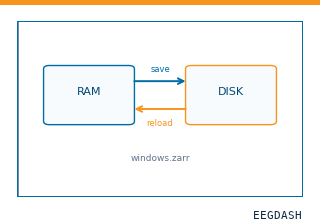 Save and reload prepared dataCache a windowed dataset to disk and reattach it without recompute.
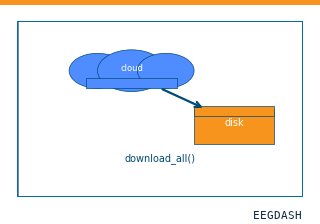 Download a dataset locallyPrefetch BIDS files to a local cache and validate the layout.
Swap any load_dataset(...) call for ds003846 to reproduce the tutorial on this dataset.
Citation
Lukas Gehrke, Sezen Akman, Albert Chen, Pedro Lopes, Klaus Gramann (19). Prediction Error. 10.18112/openneuro.ds003846.v2.0.2
Provenance
¹Contributed to openneuro in BIDS format.
²Curated & ingested by the EEGDash catalog; see CITATION.cff for canonical reference.
³Persistent identifier: 10.18112/openneuro.ds003846.v2.0.2.
See Also#
eegdash.dataset.EEGDashDataseteegdash.dataset