


DS004477: eeg dataset, 9 subjects#
PES - Pandemic Emergency Scenario
Access recordings and metadata through EEGDash.
Citation: Tasos Papastylianou, Rodrigo Ramele, Luca Citi, Caterina Cinel, Riccardo Poli (20). PES - Pandemic Emergency Scenario. 10.18112/openneuro.ds004477.v1.0.2
Modality: eeg Subjects: 9 Recordings: 9 License: CC0 Source: openneuro Citations: 0.0
Metadata: Complete (100%)
9-participant EEG dataset — PES - Pandemic Emergency Scenario.
Quickstart#
Install
pip install eegdash
Access the data
from eegdash.dataset import DS004477

dataset = DS004477(cache_dir="./data")
# Get the raw object of the first recording
raw = dataset.datasets[0].raw
print(raw.info)
Filter by subject
dataset = DS004477(cache_dir="./data", subject="01")
Advanced query
dataset = DS004477(
    cache_dir="./data",
    query={"subject": {"$in": ["01", "02"]}},
)
Iterate recordings
for rec in dataset:
    print(rec.subject, rec.raw.info['sfreq'])
If you use this dataset in your research, please cite the original authors.
BibTeX
@dataset{ds004477,
  title = {PES - Pandemic Emergency Scenario},
  author = {Tasos Papastylianou and Rodrigo Ramele and Luca Citi and Caterina Cinel and Riccardo Poli},
  doi = {10.18112/openneuro.ds004477.v1.0.2},
  url = {https://doi.org/10.18112/openneuro.ds004477.v1.0.2},
}
About This Dataset#
Experiment:
PES is a complex and strategic decision-making “Pandemic” Experiment. In this experiment, users were shown a map that gives a description of the spread of a pandemic emergency situation in various locations within the map. Resources (in terms, medicines, personnels) are allocated to few cities in the beginning. The user must allocate more resources to new cities that are displayed on the map. The user must keep in mind that the resources are limited and handing over all resources could mean that new cities (if displayed) might not get any resources.
In this experiment, 9 participants are paired with an artificial agent and they have to decide resource allocation on this scenario, providing their reported confidences for each decision. The experiment is divided in 64 sequences. Neurophysiological markers and behavioural information is obtained for each participant as they provide the number of allocated resources and their own subjective perception of the accuracy of each response for each trial. There is a span of 10 seconds where the Participant can press the mouse button (the Hold Response event), drag the mouse upwards while keeping the mouse-button pressed, thereby increasing the number of plus symbols that appear around the city icon, or downwards to decrease them, and finally release the mouse button when the decision is made (the Release Response event). Immediately after that, there is an additional span of 5 seconds where the participant reports the confidence in their decision by moving the mouse wheel. After that (the End-of-trial event) a black screen replaces the map, and the responses from the other players are shown for 2 seconds.
Each participant sat comfortably at about 1 meter from an LCD monitor; each participant wore an EEG cap connected to a Biosemi ActiveTwo system. Wet electrodes were used and recordings were performed with 64 electrodes in the International 10-20 System. Eight additional external channels were also included, two measuring the electrocardiogram (ECG), while 4 measured the electrooculogram (EOG) signal. The EEG data was sampled at 2048 Hz. Ethical Statement:
The study complied at all times with the Declaration of Helsinki ethical guidelines for research involving human subjects; formal ethical approval was granted by the Ministry of Defence Research Ethics Committee MoDREC – Application No: 983/MoDREC/19 first approved on 5th September 2019, with revisions (ver. 3) approved on the 3rd of June 2021.
Acknowledgment:
This research was supported by the Defence Science and Technology Laboratory (Dstl) on behalf of the UK Ministry of Defence (MOD) via funding from US/UK DoD Bilateral Academic Research Initiative (BARI).
Code: BCI-NE/PES
Cohort#
Dataset Statistics#
Age distribution by gender (n=9, range 21–38 yr, mean 28.7 yr)
Sex composition
Channel counts: 80 ch (n=9 recordings)
Sampling frequencies: 2048.0 Hz (n=9 recordings)
Total recording duration: 13 h 33 min
Signal · Electrodes & live trace#
Live trace viewer — sub-002 · task-PES
Showing one representative recording out of
9 subjects and 9 recordings in this dataset.
Browse the full set on OpenNeuro;
drop any other _eeg.{set,edf,bdf,vhdr} file onto the
viewer (or pass ?eeg=<url>) to inspect it.
Electrode layout — EEG · 64 sensors — 64 channels
NEMAR Processing Statistics#
The plots below are generated by NEMAR’s automated EEG pipeline. The histogram shows pipeline success for data cleaning and ICA decomposition, the percentage of data frames and EEG channels retained after artefact removal, line noise per channel (RMS, dB), and the age/gender distribution of participants.

HED event descriptors word cloud

Manifest#
File Explorer#
Browse the BIDS file structure of this dataset. Records are fetched on demand from the EEGDash catalog the first time you open the explorer.
Full dataset metadata table
Dataset ID |
|
Title |
PES - Pandemic Emergency Scenario |
Author (year) |
|
Canonical |
— |
Importable as |
|
Year |
20 |
Authors |
Tasos Papastylianou, Rodrigo Ramele, Luca Citi, Caterina Cinel, Riccardo Poli |
License |
CC0 |
Citation / DOI |
|
Source links |
Copy-paste BibTeX
@dataset{ds004477,
  title = {PES - Pandemic Emergency Scenario},
  author = {Tasos Papastylianou and Rodrigo Ramele and Luca Citi and Caterina Cinel and Riccardo Poli},
  doi = {10.18112/openneuro.ds004477.v1.0.2},
  url = {https://doi.org/10.18112/openneuro.ds004477.v1.0.2},
}
API Reference#
eegdash.datasetEEGDashDatasetDS004477 · Papastylianou2023eegdash/dataset/registry.py · [source ↗]- class eegdash.dataset.DS004477(cache_dir: str, query: dict | None = None, s3_bucket: str | None = None, **kwargs)[source]#
PES - Pandemic Emergency Scenario
- Study:
ds004477(OpenNeuro)- Author (year):
Papastylianou2023- Canonical:
—
Also importable as:
DS004477,Papastylianou2023.Modality:
eeg; Experiment type:Decision-making; Subject type:Healthy. Subjects: 9; recordings: 9; tasks: 1.- Parameters:
cache_dir (str | Path) – Directory where data are cached locally.
query (dict | None) – Additional MongoDB-style filters to AND with the dataset selection. Must not contain the key
dataset.s3_bucket (str | None) – Base S3 bucket used to locate the data.
**kwargs (dict) – Additional keyword arguments forwarded to
EEGDashDataset.
- data_dir#
Local dataset cache directory (
cache_dir / dataset_id).- Type:
Path
Notes
Each item is a recording; recording-level metadata are available via
dataset.description.querysupports MongoDB-style filters on fields inALLOWED_QUERY_FIELDSand is combined with the dataset filter. Dataset-specific caveats are not provided in the summary metadata.References
OpenNeuro dataset: https://openneuro.org/datasets/ds004477 NeMAR dataset: https://nemar.org/dataexplorer/detail?dataset_id=ds004477 DOI: https://doi.org/10.18112/openneuro.ds004477.v1.0.2 NEMAR citation count: 0
Examples
>>> from eegdash.dataset import DS004477
>>> dataset = DS004477(cache_dir="./data")
>>> recording = dataset[0]
>>> raw = recording.load()
- __init__(cache_dir: str, query: dict | None = None, s3_bucket: str | None = None, **kwargs)[source]#
- save(path: str, overwrite: bool = False, offset: int = 0)[source]#
Save datasets to files by creating one subdirectory for each dataset:
path/
    0/
        0-raw.fif | 0-epo.fif
        description.json
        raw_preproc_kwargs.json (if raws were preprocessed)
        window_kwargs.json (if this is a windowed dataset)
        window_preproc_kwargs.json  (if windows were preprocessed)
        target_name.json (if target_name is not None and dataset is raw)
    1/
        1-raw.fif | 1-epo.fif
        description.json
        raw_preproc_kwargs.json (if raws were preprocessed)
        window_kwargs.json (if this is a windowed dataset)
        window_preproc_kwargs.json  (if windows were preprocessed)
        target_name.json (if target_name is not None and dataset is raw)
- Parameters:
path (str) –
- Directory in which subdirectories are created to store
-raw.fif | -epo.fif and .json files to.
overwrite (bool) – Whether to delete old subdirectories that will be saved to in this call.
offset (int) – If provided, the integer is added to the id of the dataset in the concat. This is useful in the setting of very large datasets, where one dataset has to be processed and saved at a time to account for its original position.
BaseDataset from braindecode — windowed via create_windows_from_events.braindecodeDataLoader; supports parallel workers and on-the-fly augmentations.pytorchdatasets.load_dataset("EEGDash/ds004477").huggingface Find datasets with the EEGDash APIQuery the catalogue, filter by task or modality, list candidates.
 Load one EEG recordingResolve a single record to an MNE Raw with channels and events.
 EEG recording to PyTorch DataLoaderWrap braindecode windows in a DataLoader for model training.
 Preprocess EEG and create windowsFilter, resample, epoch — and persist the windowed dataset.
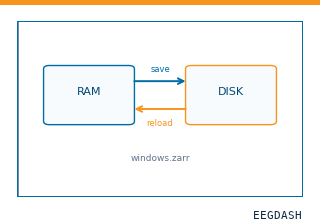 Save and reload prepared dataCache a windowed dataset to disk and reattach it without recompute.
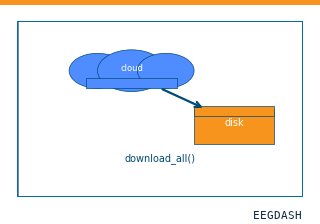 Download a dataset locallyPrefetch BIDS files to a local cache and validate the layout.
Swap any load_dataset(...) call for ds004477 to reproduce the tutorial on this dataset.
Citation
Tasos Papastylianou, Rodrigo Ramele, Luca Citi, Caterina Cinel, Riccardo Poli (20). PES - Pandemic Emergency Scenario. 10.18112/openneuro.ds004477.v1.0.2
Provenance
¹Contributed to openneuro in BIDS format.
²Curated & ingested by the EEGDash catalog; see CITATION.cff for canonical reference.
³Persistent identifier: 10.18112/openneuro.ds004477.v1.0.2.
See Also#
eegdash.dataset.EEGDashDataseteegdash.dataset