


DS003082: meg dataset, 2 subjects#
Auditory Cortex Mapping Dataset
Access recordings and metadata through EEGDash.
Citation: Jonathan Cote, Etienne de Villers-Sidani (20). Auditory Cortex Mapping Dataset. 10.18112/openneuro.ds003082.v1.0.0
Modality: meg Subjects: 2 Recordings: 3 License: CC0 Source: openneuro Citations: 5.0
Metadata: Complete (100%)
2-participant MEG dataset — Auditory Cortex Mapping Dataset.
Quickstart#
Install
pip install eegdash
Access the data
from eegdash.dataset import DS003082

dataset = DS003082(cache_dir="./data")
# Get the raw object of the first recording
raw = dataset.datasets[0].raw
print(raw.info)
Filter by subject
dataset = DS003082(cache_dir="./data", subject="01")
Advanced query
dataset = DS003082(
    cache_dir="./data",
    query={"subject": {"$in": ["01", "02"]}},
)
Iterate recordings
for rec in dataset:
    print(rec.subject, rec.raw.info['sfreq'])
If you use this dataset in your research, please cite the original authors.
BibTeX
@dataset{ds003082,
  title = {Auditory Cortex Mapping Dataset},
  author = {Jonathan Cote and Etienne de Villers-Sidani},
  doi = {10.18112/openneuro.ds003082.v1.0.0},
  url = {https://doi.org/10.18112/openneuro.ds003082.v1.0.0},
}
About This Dataset#
This dataset (MEG and MRI data) was collected by Jonathan Cote of the Neuroplasticity and Sensory Biomarking Lab, Montreal Neurological Institute, McGill University, Canada. Its purpose is to serve as a data example to be used with our MEG-based auditory cortex mapping technique. It is presently released in the Public Domain, and is not subject to copyright in any jurisdiction.
We would appreciate though that you reference this dataset in your publications: please acknowledge its authors (Jonathan Cote and Etienne de Villers-Sidani) and cite the mapping technique publication (under review)
This dataset will first be a single subject, but might be expanded up to the 10 participants in the future.
Brainstorm - Auditory Cortex Mapping Dataset
License
Presentation of the experiment
Experiment
View full README
Brainstorm - Auditory Cortex Mapping Dataset
License
Presentation of the experiment
Experiment
* One subject, one acquisition run of around 12 minutes * Subject stimulated binaurally with intra-aural earphones (air tubes+transducers) * The run contains:
1795 iso-intensity pure tones (IIPT)
The frequency of these ranges between 100 Hz and 21527 Hz, spaced by 1/4 octave.
* Random inter-stimulus interval: randomized but averaging at a presentation rate of 3Hz * The subject passively listened while looking at a fixation cross * Auditory stimuli generated with the Matlab Psychophysics toolbox
MEG acquisition
* Acquisition at **120000Hz**, with a **CTF 275** system, subject in seating position * Recorded at the Montreal Neurological Institute in January 2015 * Anti-aliasing low-pass filter at 3000Hz, files saved with the 3rd order gradient * Recorded channels (340):
1 Trigger channel indicating the presentation times of the audio stimuli: UADC001 (#306)
26 MEG reference sensors (#4-#29)
272 MEG axial gradiometers (#30-#302)
1 ECG bipolar (#303)
2 EOG bipolar (vertical #304, horizontal #305)
3 Unused channels (#1-#3)
- * 3 datasets:
**sub-0001_ses-0001_task-mapping_run-01_meg.ds**: Run #1, 653s, 1795 IIPT, sampled at 12000 Hz
**sub-emptyroom_ses-0001_emptyroom_run-01_meg.ds**: Empty room recording, 120s long, sampled at 12000 Hz
**sub-emptyroom_ses-0001_emptyroom_run-02_meg.ds**: Empty room recording, 120s long, sampled at 2400 Hz
* Use of the .ds, not the AUX (standard at the MNI) because they are easier to manipulate in FieldTrip
Stimulation delays
* **Delay #1**: Transmission of the sound.
Between when the sound card plays the sound and when the subject receives the sound in the ears. This is the time it takes for the transducer to convert the analog audio signal into a sound, plus the time it takes to the sound to travel through the air tubes from the transducer to the subject’s ears. This delay cannot be estimated from the recorded signals: before the acquisition, we placed a sound meter at the extremity of the tubes to record when the sound is delivered. Delay between 4.8ms and 5.0ms**(std = 0.08ms). At a sampling rate of 2400Hz, this delay can be considered ** constant, we will not compensate for it. * **Delay #2**: Recording of the signals.
The CTF MEG systems have a constant delay of **4 samples**between the MEG/EEG channels and the analog channels (such as the audio signal UADC001), because of an anti-aliasing filtered that is applied to the first and not the second. This translate here to a ** constant delay**of **1.7ms**. * **Uncorrected delays**: We will keep the delays. We decide not to compensate for these delays because they do not introduce any jitter in the responses and they are not going to change anything in the interpretation of the data.
Head shape and fiducial points
*3D digitization using a Polhemus Fastrak device driven by Brainstorm (S01_20131218_*.pos) * More information: Digitize EEG electrodes and head shape * The output file is copied to each .ds folder and contains the following entries:
The position of the center of CTF coils
The position of the anatomical references we use in Brainstorm: Nasion and connections tragus/helix, as illustrated here.
* Around 150 head points distributed on the hard parts of the head (no soft tissues)
Subject anatomy
* Subject with 1.5T MRI * Processed with FreeSurfer 5.3
Cohort#
Dataset Statistics#
Age distribution (n=1, range 23–23 yr, mean 23.0 yr · sex per subject not reported)
Sex composition
Channel counts (ch)
Sampling frequencies (Hz)
Total recording duration: 17 min
Signal · Electrodes & live trace#
No scalp electrode layout is currently indexed for this dataset. Once the eegdash montage registry ingests it, the interactive viewer will appear here automatically.
NEMAR Processing Statistics#
The plots below are generated by NEMAR’s automated EEG pipeline. The histogram shows pipeline success for data cleaning and ICA decomposition, the percentage of data frames and EEG channels retained after artefact removal, line noise per channel (RMS, dB), and the age/gender distribution of participants.

HED event descriptors word cloud

Manifest#
File Explorer#
Browse the BIDS file structure of this dataset. Records are fetched on demand from the EEGDash catalog the first time you open the explorer.
Full dataset metadata table
Dataset ID |
|
Title |
Auditory Cortex Mapping Dataset |
Author (year) |
|
Canonical |
— |
Importable as |
|
Year |
20 |
Authors |
Jonathan Cote, Etienne de Villers-Sidani |
License |
CC0 |
Citation / DOI |
|
Source links |
Copy-paste BibTeX
@dataset{ds003082,
  title = {Auditory Cortex Mapping Dataset},
  author = {Jonathan Cote and Etienne de Villers-Sidani},
  doi = {10.18112/openneuro.ds003082.v1.0.0},
  url = {https://doi.org/10.18112/openneuro.ds003082.v1.0.0},
}
API Reference#
eegdash.datasetEEGDashDatasetDS003082 · Cote2020eegdash/dataset/registry.py · [source ↗]- class eegdash.dataset.DS003082(cache_dir: str, query: dict | None = None, s3_bucket: str | None = None, **kwargs)[source]#
Auditory Cortex Mapping Dataset
- Study:
ds003082(OpenNeuro)- Author (year):
Cote2020- Canonical:
—
Also importable as:
DS003082,Cote2020.Modality:
meg; Experiment type:Perception; Subject type:Healthy. Subjects: 2; recordings: 3; tasks: 2.- Parameters:
cache_dir (str | Path) – Directory where data are cached locally.
query (dict | None) – Additional MongoDB-style filters to AND with the dataset selection. Must not contain the key
dataset.s3_bucket (str | None) – Base S3 bucket used to locate the data.
**kwargs (dict) – Additional keyword arguments forwarded to
EEGDashDataset.
- data_dir#
Local dataset cache directory (
cache_dir / dataset_id).- Type:
Path
Notes
Each item is a recording; recording-level metadata are available via
dataset.description.querysupports MongoDB-style filters on fields inALLOWED_QUERY_FIELDSand is combined with the dataset filter. Dataset-specific caveats are not provided in the summary metadata.References
OpenNeuro dataset: https://openneuro.org/datasets/ds003082 NeMAR dataset: https://nemar.org/dataexplorer/detail?dataset_id=ds003082 DOI: https://doi.org/10.18112/openneuro.ds003082.v1.0.0 NEMAR citation count: 5
Examples
>>> from eegdash.dataset import DS003082
>>> dataset = DS003082(cache_dir="./data")
>>> recording = dataset[0]
>>> raw = recording.load()
- __init__(cache_dir: str, query: dict | None = None, s3_bucket: str | None = None, **kwargs)[source]#
- save(path: str, overwrite: bool = False, offset: int = 0)[source]#
Save datasets to files by creating one subdirectory for each dataset:
path/
    0/
        0-raw.fif | 0-epo.fif
        description.json
        raw_preproc_kwargs.json (if raws were preprocessed)
        window_kwargs.json (if this is a windowed dataset)
        window_preproc_kwargs.json  (if windows were preprocessed)
        target_name.json (if target_name is not None and dataset is raw)
    1/
        1-raw.fif | 1-epo.fif
        description.json
        raw_preproc_kwargs.json (if raws were preprocessed)
        window_kwargs.json (if this is a windowed dataset)
        window_preproc_kwargs.json  (if windows were preprocessed)
        target_name.json (if target_name is not None and dataset is raw)
- Parameters:
path (str) –
- Directory in which subdirectories are created to store
-raw.fif | -epo.fif and .json files to.
overwrite (bool) – Whether to delete old subdirectories that will be saved to in this call.
offset (int) – If provided, the integer is added to the id of the dataset in the concat. This is useful in the setting of very large datasets, where one dataset has to be processed and saved at a time to account for its original position.
BaseDataset from braindecode — windowed via create_windows_from_events.braindecodeDataLoader; supports parallel workers and on-the-fly augmentations.pytorchdatasets.load_dataset("EEGDash/ds003082").huggingface Find datasets with the EEGDash APIQuery the catalogue, filter by task or modality, list candidates.
 Load one EEG recordingResolve a single record to an MNE Raw with channels and events.
 EEG recording to PyTorch DataLoaderWrap braindecode windows in a DataLoader for model training.
 Preprocess EEG and create windowsFilter, resample, epoch — and persist the windowed dataset.
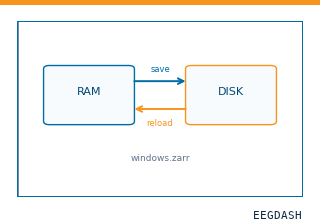 Save and reload prepared dataCache a windowed dataset to disk and reattach it without recompute.
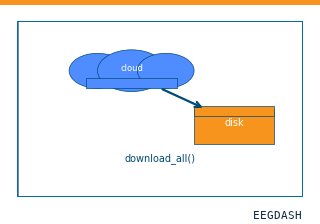 Download a dataset locallyPrefetch BIDS files to a local cache and validate the layout.
Swap any load_dataset(...) call for ds003082 to reproduce the tutorial on this dataset.
Citation
Jonathan Cote, Etienne de Villers-Sidani (20). Auditory Cortex Mapping Dataset. 10.18112/openneuro.ds003082.v1.0.0
Provenance
¹Contributed to openneuro in BIDS format.
²Curated & ingested by the EEGDash catalog; see CITATION.cff for canonical reference.
³Persistent identifier: 10.18112/openneuro.ds003082.v1.0.0.
See Also#
eegdash.dataset.EEGDashDataseteegdash.dataset