


DS004117: eeg dataset, 23 subjects#
Sternberg Working Memory
Access recordings and metadata through EEGDash.
Citation: Julie Onton (data), Scott Makeig (data and curation), Arnaud Delorme (data and curation), Dung Truong (curation), Kay Robbins (curation) (20). Sternberg Working Memory. 10.18112/openneuro.ds004117.v1.0.1
Modality: eeg Subjects: 23 Recordings: 85 License: CC0 Source: openneuro Citations: 2.0
Metadata: Complete (100%)
23-participant EEG dataset — Sternberg Working Memory.
Quickstart#
Install
pip install eegdash
Access the data
from eegdash.dataset import DS004117

dataset = DS004117(cache_dir="./data")
# Get the raw object of the first recording
raw = dataset.datasets[0].raw
print(raw.info)
Filter by subject
dataset = DS004117(cache_dir="./data", subject="01")
Advanced query
dataset = DS004117(
    cache_dir="./data",
    query={"subject": {"$in": ["01", "02"]}},
)
Iterate recordings
for rec in dataset:
    print(rec.subject, rec.raw.info['sfreq'])
If you use this dataset in your research, please cite the original authors.
BibTeX
@dataset{ds004117,
  title = {Sternberg Working Memory},
  author = {Julie Onton (data) and Scott Makeig (data and curation) and Arnaud Delorme (data and curation) and Dung Truong (curation) and Kay Robbins (curation)},
  doi = {10.18112/openneuro.ds004117.v1.0.1},
  url = {https://doi.org/10.18112/openneuro.ds004117.v1.0.1},
}
About This Dataset#
Project name: EEG and working memory
Years the project ran: 2004-05 Brief overview of experiment task: The purpose of this Modified Sternberg task study was to explore source-resolved EEG brain dynamics associated with selectively committing a series of letters to memory, then after a brief maintenance period responding by button press either yes or no to the question of whether a presented query letter had been in the just-presented set of to-be-memorized letters.
The task is a modified version of the classic Sternberg working memory task, with two added features:
(1) interspersing the sequence of presented (black) letters to be memorized with (green) letters to be ignored, and (2) delivering auditory feedback on each trial as to the correctness of the participant response (beep = correct, buzz = incorrect). Data collection: Scalp EEG data were collected from 71 scalp electrode channels, each referred to a right mastoid electrode, at a sampling rate of 250 Hz/channel within an analog passband of 0.1 to 100 Hz. **Contact person: Julie Onton <julieonton@gmail.com>, ORCID#:0000-0002-5602-3557. Access information: Contributed to OpenNeuro.org and NEMAR.org in BIDS format following annotation using HED 8.0.0 in April, 2022. Independent variables: Letter category (to_memorize, to_ignore); numbers of presented letters to_memorize/to_ignore (3/5, 5/3, 7/1); probe letter category (in/not in the presented set). Note, only letters to be memorized appear as in set probe letters. Dependent variables: EEG; button press response latency; participant response (correct/incorrect). Participant pool: The dataset includes data collected from 23 healthy young adult subjects (7 male, 6 female, 11 unidentified) between the ages of 19 and 40 years of age. Apparatus: A Neurobehavioral Systems, Inc. EEG system running under Window98 acquired the data.
Modified Sternberg Working Memory Experiment
The experiment control program was Presentation (Neurobehavioral Systems, Inc.). Initial setup: EEG data were collected from 71 channels (69 scalp and two periocular electrodes, all referred to right mastoid) with an analog pass band of 0.01 to 100 Hz (SA Instrumentation, San Diego).
Input impedances were brought under 5 kOhms by careful scalp preparation. Data for subjects 1-12 was acquired at a sampling rate of 250Hz. The data for subject 14 was acquired at 1000 Hz and the data for subjects 15-24 was a acquired using a 500 Hz sampling rate. Task organization: Data was organized into runs of 25 trials each followed by a rest.
View full README
Modified Sternberg Working Memory Experiment
The experiment control program was Presentation (Neurobehavioral Systems, Inc.). Initial setup: EEG data were collected from 71 channels (69 scalp and two periocular electrodes, all referred to right mastoid) with an analog pass band of 0.01 to 100 Hz (SA Instrumentation, San Diego).
Input impedances were brought under 5 kOhms by careful scalp preparation. Data for subjects 1-12 was acquired at a sampling rate of 250Hz. The data for subject 14 was acquired at 1000 Hz and the data for subjects 15-24 was a acquired using a 500 Hz sampling rate. Task organization: Data was organized into runs of 25 trials each followed by a rest.
Each block was a separate run in the BIDS dataset. Task details: Each trial consisted of the following sequence of events: [Trial initiation]. After a self-selected, variable delay, the subject initiated the next trial by pressing either response button, triggering the reappearance of the fixation cross. [Letter sequence presentation]. In these experiments, following a 5s presentation of a central fixation cross cue, a series of 8 visual letters (~2 deg of visual angle) were presented at screen center for 1.2s followed by a 0.2s ISI: - Either 3, 5, or 7 of these were colored black. - The participant was to memorize as letters in this set. - The other 5, 3, or 1 letters in the sequence were colored green and participants were to ignore these. - The letters were drawn without substitution from the English alphabet (omitting only A, E, I, O, and U). - The presentation order of black and green letters was pseudo-random.
[Memory maintenance]. In place of a ninth letter, a dash appeared on the screen to signal the beginning of a Memory Maintenance period lasting between 2 to 4 s. During this period subjects were to silently rehearse the identities of the memorized letters. [Memory probe]. A (red) probe letter then appeared, prompting the subject to respond by pressing one of two buttons (with the thumb or index finger of their dominant hand) to indicate whether or not the probe letter had been in the trial?s to-be-memorized letter set. [Response feedback]. An auditory feedback signal (a confirmatory beep or cautionary buzz), then presented beginning at 400 ms after the button press, informed the subject whether their response was correct or incorrect. Note: responses in the task were largely correct. [Session time structure]. Each task session comprised of 3 or 4 task blocks of 25 trials each separated into individual run files. Experiment location: Swartz Center for Neural Computation (SCCN), University of California San Diego, La Jolla CA (USA). Note 1: Results presented in Onton, J., Delorme, A. and Makeig, S., 2005. Frontal midline EEG dynamics during working memory. Neuroimage, 27(2), pp.341-356. Note 2: This paradigm is one of 20 event-related EEG task paradigms selected for replication by the EEGManyLabs project. For details, see https://psyarxiv.com/528nr/. Contact: Yuri Pavlov <pavlovug@gmail.com>. Note 3: Participant 5 did not have feedback events in the trials. Note 4: The code subdirectory has several auxilliary files that were produced during the curation process. The curation was done using a series of Jupyter notebooks that are available as run in the code/curation_notebooks subdirectory. During the running of these curation notebooks information about the status was logged using the HEDLogger. The output of the logging process is in code/curation_logs. Updated versions of the curation notebooks can be found at: hed-standard/hed-examples
Cohort#
Dataset Statistics#
Age distribution by gender (n=23, range 19–40 yr, mean 23.4 yr)
Sex composition
Channel counts: 71 ch (n=85 recordings)
Sampling frequencies (Hz)
Total recording duration: 15 h 27 min
Signal · Electrodes & live trace#
Live trace viewer — sub-021 · ses-01 · task-WorkingMemory · run-1
Showing one representative recording out of
23 subjects and 85 recordings in this dataset.
Browse the full set on OpenNeuro;
drop any other _eeg.{set,edf,bdf,vhdr} file onto the
viewer (or pass ?eeg=<url>) to inspect it.
Electrode layout — EEG · 71 sensors — 71 channels
NEMAR Processing Statistics#
The plots below are generated by NEMAR’s automated EEG pipeline. The histogram shows pipeline success for data cleaning and ICA decomposition, the percentage of data frames and EEG channels retained after artefact removal, line noise per channel (RMS, dB), and the age/gender distribution of participants.

HED event descriptors word cloud

Manifest#
File Explorer#
Browse the BIDS file structure of this dataset. Records are fetched on demand from the EEGDash catalog the first time you open the explorer.
Full dataset metadata table
Dataset ID |
|
Title |
Sternberg Working Memory |
Author (year) |
|
Canonical |
— |
Importable as |
|
Year |
20 |
Authors |
Julie Onton (data), Scott Makeig (data and curation), Arnaud Delorme (data and curation), Dung Truong (curation), Kay Robbins (curation) |
License |
CC0 |
Citation / DOI |
|
Source links |
OpenNeuro | NeMAR | Source URL |
Copy-paste BibTeX
@dataset{ds004117,
  title = {Sternberg Working Memory},
  author = {Julie Onton (data) and Scott Makeig (data and curation) and Arnaud Delorme (data and curation) and Dung Truong (curation) and Kay Robbins (curation)},
  doi = {10.18112/openneuro.ds004117.v1.0.1},
  url = {https://doi.org/10.18112/openneuro.ds004117.v1.0.1},
}
API Reference#
eegdash.datasetEEGDashDatasetDS004117 · Onton2022eegdash/dataset/registry.py · [source ↗]- class eegdash.dataset.DS004117(cache_dir: str, query: dict | None = None, s3_bucket: str | None = None, **kwargs)[source]#
Sternberg Working Memory
- Study:
ds004117(OpenNeuro)- Author (year):
Onton2022- Canonical:
—
Also importable as:
DS004117,Onton2022.Modality:
eeg; Experiment type:Memory; Subject type:Healthy. Subjects: 23; recordings: 85; tasks: 1.- Parameters:
cache_dir (str | Path) – Directory where data are cached locally.
query (dict | None) – Additional MongoDB-style filters to AND with the dataset selection. Must not contain the key
dataset.s3_bucket (str | None) – Base S3 bucket used to locate the data.
**kwargs (dict) – Additional keyword arguments forwarded to
EEGDashDataset.
- data_dir#
Local dataset cache directory (
cache_dir / dataset_id).- Type:
Path
Notes
Each item is a recording; recording-level metadata are available via
dataset.description.querysupports MongoDB-style filters on fields inALLOWED_QUERY_FIELDSand is combined with the dataset filter. Dataset-specific caveats are not provided in the summary metadata.References
OpenNeuro dataset: https://openneuro.org/datasets/ds004117 NeMAR dataset: https://nemar.org/dataexplorer/detail?dataset_id=ds004117 DOI: https://doi.org/10.18112/openneuro.ds004117.v1.0.1 NEMAR citation count: 2
Examples
>>> from eegdash.dataset import DS004117
>>> dataset = DS004117(cache_dir="./data")
>>> recording = dataset[0]
>>> raw = recording.load()
- __init__(cache_dir: str, query: dict | None = None, s3_bucket: str | None = None, **kwargs)[source]#
- save(path: str, overwrite: bool = False, offset: int = 0)[source]#
Save datasets to files by creating one subdirectory for each dataset:
path/
    0/
        0-raw.fif | 0-epo.fif
        description.json
        raw_preproc_kwargs.json (if raws were preprocessed)
        window_kwargs.json (if this is a windowed dataset)
        window_preproc_kwargs.json  (if windows were preprocessed)
        target_name.json (if target_name is not None and dataset is raw)
    1/
        1-raw.fif | 1-epo.fif
        description.json
        raw_preproc_kwargs.json (if raws were preprocessed)
        window_kwargs.json (if this is a windowed dataset)
        window_preproc_kwargs.json  (if windows were preprocessed)
        target_name.json (if target_name is not None and dataset is raw)
- Parameters:
path (str) –
- Directory in which subdirectories are created to store
-raw.fif | -epo.fif and .json files to.
overwrite (bool) – Whether to delete old subdirectories that will be saved to in this call.
offset (int) – If provided, the integer is added to the id of the dataset in the concat. This is useful in the setting of very large datasets, where one dataset has to be processed and saved at a time to account for its original position.
BaseDataset from braindecode — windowed via create_windows_from_events.braindecodeDataLoader; supports parallel workers and on-the-fly augmentations.pytorchdatasets.load_dataset("EEGDash/ds004117").huggingface Find datasets with the EEGDash APIQuery the catalogue, filter by task or modality, list candidates.
 Load one EEG recordingResolve a single record to an MNE Raw with channels and events.
 EEG recording to PyTorch DataLoaderWrap braindecode windows in a DataLoader for model training.
 Preprocess EEG and create windowsFilter, resample, epoch — and persist the windowed dataset.
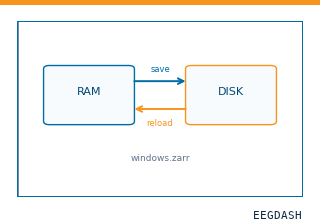 Save and reload prepared dataCache a windowed dataset to disk and reattach it without recompute.
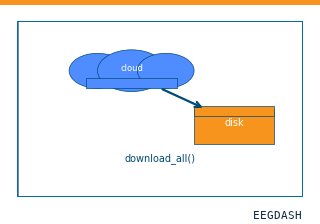 Download a dataset locallyPrefetch BIDS files to a local cache and validate the layout.
Swap any load_dataset(...) call for ds004117 to reproduce the tutorial on this dataset.
Citation
Julie Onton (data), Scott Makeig (data and curation), Arnaud Delorme (data and curation), Dung Truong (curation), Kay Robbins (curation) (20). Sternberg Working Memory. 10.18112/openneuro.ds004117.v1.0.1
Provenance
¹Contributed to openneuro in BIDS format.
²Curated & ingested by the EEGDash catalog; see CITATION.cff for canonical reference.
³Persistent identifier: 10.18112/openneuro.ds004117.v1.0.1.
See Also#
eegdash.dataset.EEGDashDataseteegdash.dataset