


DS004504: eeg dataset, 88 subjects#
A dataset of EEG recordings from: Alzheimer’s disease, Frontotemporal dementia and Healthy subjects
Access recordings and metadata through EEGDash.
Citation: Andreas Miltiadous, Katerina D. Tzimourta, Theodora Afrantou, Panagiotis Ioannidis, Nikolaos Grigoriadis, Dimitrios G. Tsalikakis, Pantelis Angelidis, Markos G. Tsipouras, Evripidis Glavas, Nikolaos Giannakeas, Alexandros T. Tzallas (—). A dataset of EEG recordings from: Alzheimer’s disease, Frontotemporal dementia and Healthy subjects. 10.18112/openneuro.ds004504.v1.0.9
Modality: eeg Subjects: 88 Recordings: 88 License: CC0 Source: openneuro Citations: 55.0
Metadata: Complete (100%)
88-participant EEG dataset — A dataset of EEG recordings from: Alzheimer's disease, Frontotemporal dementia and Healthy subjects.
Quickstart#
Install
pip install eegdash
Access the data
from eegdash.dataset import DS004504

dataset = DS004504(cache_dir="./data")
# Get the raw object of the first recording
raw = dataset.datasets[0].raw
print(raw.info)
Filter by subject
dataset = DS004504(cache_dir="./data", subject="01")
Advanced query
dataset = DS004504(
    cache_dir="./data",
    query={"subject": {"$in": ["01", "02"]}},
)
Iterate recordings
for rec in dataset:
    print(rec.subject, rec.raw.info['sfreq'])
If you use this dataset in your research, please cite the original authors.
BibTeX
@dataset{ds004504,
  title = {A dataset of EEG recordings from: Alzheimer's disease, Frontotemporal dementia and Healthy subjects},
  author = {Andreas Miltiadous and Katerina D. Tzimourta and Theodora Afrantou and Panagiotis Ioannidis and Nikolaos Grigoriadis and Dimitrios G. Tsalikakis and Pantelis Angelidis and Markos G. Tsipouras and Evripidis Glavas and Nikolaos Giannakeas and Alexandros T. Tzallas},
  doi = {10.18112/openneuro.ds004504.v1.0.9},
  url = {https://doi.org/10.18112/openneuro.ds004504.v1.0.9},
}
About This Dataset#
This dataset contains the EEG resting state-closed eyes recordings from 88 subjects in total.
Participants: 36 of them were diagnosed with Alzheimer’s disease (AD group), 23 were diagnosed with Frontotemporal Dementia (FTD group) and 29 were healthy subjects (CN group).
Cognitive and neuropsychological state was evaluated by the international Mini-Mental State Examination (MMSE). MMSE score ranges from 0 to 30, with lower MMSE indicating more severe cognitive decline.
The duration of the disease was measured in months and the median value was 25 with IQR range (Q1-Q3) being 24 - 28.5 months. Concerning the AD groups, no dementia-related comorbidities have been reported. The average MMSE for the AD group was 17.75 (sd=4.5), for the FTD group was 22.17 (sd=8.22) and for the CN group was 30.
The mean age of the AD group was 66.4 (sd=7.9), for the FTD group was 63.6 (sd=8.2), and for the CN group was 67.9 (sd=5.4). Recordings: Recordings were aquired from the 2nd Department of Neurology of AHEPA General Hospital of Thessaloniki by an experienced team of neurologists. For recording, a Nihon Kohden EEG 2100 clinical device was used, with 19 scalp electrodes (Fp1, Fp2, F7, F3, Fz, F4, F8, T3, C3, Cz, C4, T4, T5, P3, Pz, P4, T6, O1, and O2) according to the 10-20 international system and 2 reference electrodes (A1 and A2) placed on the mastoids for impendance check, according to the manual of the device. Each recording was performed according to the clinical protocol with participants being in a sitting position having their eyes closed.
Before the initialization of each recording, the skin impedance value was ensured to be below 5k?. The sampling rate was 500 Hz with 10uV/mm resolution. The recording montages were anterior-posterior bipolar and referential montage using Cz as the common reference. The referential montage was included in this dataset.
The recordings were received under the range of the following parameters of the amplifier: Sensitivity: 10uV/mm, time constant: 0.3s, and high frequency filter at 70 Hz. Each recording lasted approximately 13.5 minutes for AD group (min=5.1, max=21.3), 12 minutes for FTD group (min=7.9, max=16.9) and 13.8 for CN group (min=12.5, max=16.5).
In total, 485.5 minutes of AD, 276.5 minutes of FTD and 402 minutes of CN recordings were collected and are included in the dataset. Preprocessing: The EEG recordings were exported in .eeg format and are transformed to BIDS accepted .set format for the inclusion in the dataset.
Automatic annotations of the Nihon Kohden EEG device marking artifacts (muscle activity, blinking, swallowing) have not been included for language compatibility purposes (If this is an issue, please use the preprocessed dataset in Folder: derivatives).
The unprocessed EEG recordings are included in folders named: sub-0XX. Folders named sub-0XX in the subfolder derivatives contain the preprocessed and denoised EEG recordings. The preprocessing pipeline of the EEG signals is as follows. First, a Butterworth band-pass filter 0.5-45 Hz was applied and the signals were re-referenced to A1-A2.
Then, the Artifact Subspace Reconstruction routine (ASR) which is an EEG artifact correction method included in the EEGLab Matlab software was applied to the signals, removing bad data periods which exceeded the max acceptable 0.5 second window standard deviation of 17, which is considered a conservative window.
Next, the Independent Component Analysis (ICA) method (RunICA algorithm) was performed, transforming the 19 EEG signals to 19 ICA components. ICA components that were classified as “eye artifacts” or “jaw artifacts” by the automatic classification routine “ICLabel” in the EEGLAB platform were automatically rejected.
It should be noted that, even though the recording was performed in a resting state, eyes-closed condition, eye artifacts of eye movement were still found at some EEG recordings. A complete analysis of this dataset can be found in the published Data Descriptor paper “A Dataset of Scalp EEG Recordings of Alzheimer’s Disease, Frontotemporal Dementia and Healthy Subjects from Routine EEG”, https://doi.org/10.3390/data8060095
Cohort#
Dataset Statistics#
Age distribution (n=88, range 44–79 yr, mean 66.2 yr · sex per subject not reported)
Sex composition
Channel counts: 19 ch (n=88 recordings)
Sampling frequencies: 500.0 Hz (n=88 recordings)
Total recording duration: 19 h 36 min
Signal · Electrodes & live trace#
Live trace viewer — sub-021 · task-eyesclosed
Showing one representative recording out of
88 subjects and 88 recordings in this dataset.
Browse the full set on OpenNeuro;
drop any other _eeg.{set,edf,bdf,vhdr} file onto the
viewer (or pass ?eeg=<url>) to inspect it.
Electrode layout — EEG · 19 sensors — 19 channels
NEMAR Processing Statistics#
The plots below are generated by NEMAR’s automated EEG pipeline. The histogram shows pipeline success for data cleaning and ICA decomposition, the percentage of data frames and EEG channels retained after artefact removal, line noise per channel (RMS, dB), and the age/gender distribution of participants.

HED event descriptors word cloud

Manifest#
File Explorer#
Browse the BIDS file structure of this dataset. Records are fetched on demand from the EEGDash catalog the first time you open the explorer.
Full dataset metadata table
Dataset ID |
|
Title |
A dataset of EEG recordings from: Alzheimer’s disease, Frontotemporal dementia and Healthy subjects |
Author (year) |
|
Canonical |
— |
Importable as |
|
Year |
— |
Authors |
Andreas Miltiadous, Katerina D. Tzimourta, Theodora Afrantou, Panagiotis Ioannidis, Nikolaos Grigoriadis, Dimitrios G. Tsalikakis, Pantelis Angelidis, Markos G. Tsipouras, Evripidis Glavas, Nikolaos Giannakeas, Alexandros T. Tzallas |
License |
CC0 |
Citation / DOI |
|
Source links |
Copy-paste BibTeX
@dataset{ds004504,
  title = {A dataset of EEG recordings from: Alzheimer's disease, Frontotemporal dementia and Healthy subjects},
  author = {Andreas Miltiadous and Katerina D. Tzimourta and Theodora Afrantou and Panagiotis Ioannidis and Nikolaos Grigoriadis and Dimitrios G. Tsalikakis and Pantelis Angelidis and Markos G. Tsipouras and Evripidis Glavas and Nikolaos Giannakeas and Alexandros T. Tzallas},
  doi = {10.18112/openneuro.ds004504.v1.0.9},
  url = {https://doi.org/10.18112/openneuro.ds004504.v1.0.9},
}
API Reference#
eegdash.datasetEEGDashDatasetDS004504 · Miltiadous2023eegdash/dataset/registry.py · [source ↗]- class eegdash.dataset.DS004504(cache_dir: str, query: dict | None = None, s3_bucket: str | None = None, **kwargs)[source]#
A dataset of EEG recordings from: Alzheimer’s disease, Frontotemporal dementia and Healthy subjects
- Study:
ds004504(OpenNeuro)- Author (year):
Miltiadous2023- Canonical:
—
Also importable as:
DS004504,Miltiadous2023.Modality:
eeg; Experiment type:Clinical/Intervention; Subject type:Dementia. Subjects: 88; recordings: 88; tasks: 1.- Parameters:
cache_dir (str | Path) – Directory where data are cached locally.
query (dict | None) – Additional MongoDB-style filters to AND with the dataset selection. Must not contain the key
dataset.s3_bucket (str | None) – Base S3 bucket used to locate the data.
**kwargs (dict) – Additional keyword arguments forwarded to
EEGDashDataset.
- data_dir#
Local dataset cache directory (
cache_dir / dataset_id).- Type:
Path
Notes
Each item is a recording; recording-level metadata are available via
dataset.description.querysupports MongoDB-style filters on fields inALLOWED_QUERY_FIELDSand is combined with the dataset filter. Dataset-specific caveats are not provided in the summary metadata.References
OpenNeuro dataset: https://openneuro.org/datasets/ds004504 NeMAR dataset: https://nemar.org/dataexplorer/detail?dataset_id=ds004504 DOI: https://doi.org/10.18112/openneuro.ds004504.v1.0.9 NEMAR citation count: 55
Examples
>>> from eegdash.dataset import DS004504
>>> dataset = DS004504(cache_dir="./data")
>>> recording = dataset[0]
>>> raw = recording.load()
- __init__(cache_dir: str, query: dict | None = None, s3_bucket: str | None = None, **kwargs)[source]#
- save(path: str, overwrite: bool = False, offset: int = 0)[source]#
Save datasets to files by creating one subdirectory for each dataset:
path/
    0/
        0-raw.fif | 0-epo.fif
        description.json
        raw_preproc_kwargs.json (if raws were preprocessed)
        window_kwargs.json (if this is a windowed dataset)
        window_preproc_kwargs.json  (if windows were preprocessed)
        target_name.json (if target_name is not None and dataset is raw)
    1/
        1-raw.fif | 1-epo.fif
        description.json
        raw_preproc_kwargs.json (if raws were preprocessed)
        window_kwargs.json (if this is a windowed dataset)
        window_preproc_kwargs.json  (if windows were preprocessed)
        target_name.json (if target_name is not None and dataset is raw)
- Parameters:
path (str) –
- Directory in which subdirectories are created to store
-raw.fif | -epo.fif and .json files to.
overwrite (bool) – Whether to delete old subdirectories that will be saved to in this call.
offset (int) – If provided, the integer is added to the id of the dataset in the concat. This is useful in the setting of very large datasets, where one dataset has to be processed and saved at a time to account for its original position.
BaseDataset from braindecode — windowed via create_windows_from_events.braindecodeDataLoader; supports parallel workers and on-the-fly augmentations.pytorchdatasets.load_dataset("EEGDash/ds004504").huggingface Find datasets with the EEGDash APIQuery the catalogue, filter by task or modality, list candidates.
 Load one EEG recordingResolve a single record to an MNE Raw with channels and events.
 EEG recording to PyTorch DataLoaderWrap braindecode windows in a DataLoader for model training.
 Preprocess EEG and create windowsFilter, resample, epoch — and persist the windowed dataset.
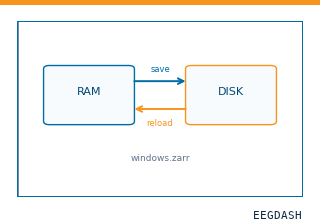 Save and reload prepared dataCache a windowed dataset to disk and reattach it without recompute.
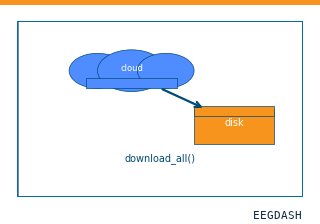 Download a dataset locallyPrefetch BIDS files to a local cache and validate the layout.
Swap any load_dataset(...) call for ds004504 to reproduce the tutorial on this dataset.
Citation
Andreas Miltiadous, Katerina D. Tzimourta, Theodora Afrantou, Panagiotis Ioannidis, Nikolaos Grigoriadis, … (n.d.). A dataset of EEG recordings from: Alzheimer's disease, Frontotemporal dementia and Healthy subjects. 10.18112/openneuro.ds004504.v1.0.9
Provenance
¹Contributed to openneuro in BIDS format.
²Curated & ingested by the EEGDash catalog; see CITATION.cff for canonical reference.
³Persistent identifier: 10.18112/openneuro.ds004504.v1.0.9.
See Also#
eegdash.dataset.EEGDashDataseteegdash.dataset