


DS004796: eeg dataset, 79 subjects#
A Polish Electroencephalography, Alzheimer’s Risk-genes, Lifestyle and Neuroimaging (PEARL-Neuro) Database
Access recordings and metadata through EEGDash.
Citation: Dzianok Patrycja, Kublik Ewa (2024). A Polish Electroencephalography, Alzheimer’s Risk-genes, Lifestyle and Neuroimaging (PEARL-Neuro) Database. 10.18112/openneuro.ds004796.v1.1.0
Modality: eeg Subjects: 79 Recordings: 235 License: CC0 Source: openneuro Citations: 1.0
Metadata: Complete (100%)
79-participant EEG dataset — A Polish Electroencephalography, Alzheimer’s Risk-genes, Lifestyle and Neuroimaging (PEARL-Neuro) Database.
Quickstart#
Install
pip install eegdash
Access the data
from eegdash.dataset import DS004796

dataset = DS004796(cache_dir="./data")
# Get the raw object of the first recording
raw = dataset.datasets[0].raw
print(raw.info)
Filter by subject
dataset = DS004796(cache_dir="./data", subject="01")
Advanced query
dataset = DS004796(
    cache_dir="./data",
    query={"subject": {"$in": ["01", "02"]}},
)
Iterate recordings
for rec in dataset:
    print(rec.subject, rec.raw.info['sfreq'])
If you use this dataset in your research, please cite the original authors.
BibTeX
@dataset{ds004796,
  title = {A Polish Electroencephalography, Alzheimer’s Risk-genes, Lifestyle and Neuroimaging (PEARL-Neuro) Database},
  author = {Dzianok Patrycja and Kublik Ewa},
  doi = {10.18112/openneuro.ds004796.v1.1.0},
  url = {https://doi.org/10.18112/openneuro.ds004796.v1.1.0},
}
About This Dataset#
IMPORTANT NOTE: The dataset contains no errors (BIDS-1). The numerous warnings currently displayed are a result of OpenNeuro updating its validator to BIDS-2. The OpenNeuro team is actively working on refining the validator to display only meaningful warnings (more information on OpenNeuro GitHub page). At this time, as dataset owners, we are unable to take any action to resolve these warnings.
* doi.org/10.1038/s41597-024-03106-5 (https://www.nature.com/articles/s41597-024-03106-5)
A Polish Electroencephalography, Alzheimer’s Risk-genes, Lifestyle and Neuroimaging (PEARL-Neuro) Database
Please cite the following reference if you use these data:
* Dzianok P, Kublik E. PEARL-Neuro Database: EEG, fMRI, health and lifestyle data of middle-aged people at risk of dementia. Sci Data 11, 276 (2024). DOI: https://doi.org/10.1038/s41597-024-03106-5
Publications related to this dataset, reporting & additional data
* PTDZ/PEARL-Neuro — updates, additional study details, and list of research outputs related to this dataset.
View full README
A Polish Electroencephalography, Alzheimer’s Risk-genes, Lifestyle and Neuroimaging (PEARL-Neuro) Database
Please cite the following reference if you use these data:
* Dzianok P, Kublik E. PEARL-Neuro Database: EEG, fMRI, health and lifestyle data of middle-aged people at risk of dementia. Sci Data 11, 276 (2024). DOI: https://doi.org/10.1038/s41597-024-03106-5
Publications related to this dataset, reporting & additional data
* PTDZ/PEARL-Neuro — updates, additional study details, and list of research outputs related to this dataset.
IMPORTANT: Please inform us of any research outputs related to the shared data, including publications, preprints, posters, abstracts, talks, and any commercial usage. This is crucial for ensuring transparency and informing users about the analyses already performed on this dataset. Additionally, such information can foster collaboration.
Description of the database:
Full cohort: 192 healthy middle-aged (50-63) individuals, balanced female and male ratio. * Genetic data (N = 192):
Apolipoprotein E (APOE)
Phosphatidylinositol binding clathrin assembly protein (PICALM)
* Basic demographic and health data * Psychometric data (memory, intelligence, mood, personality, stress coping strategies)
Cohort subgroup: 79 healthy middle-aged (50-63) individuals, balanced female and male ratio. * Neuroimaging data:
Functional data — electroencefalography (EEG) and functional magnetic resonance imaging (fMRI): * Resting-state protocol (with two conditions: eyes open and eyes closed) * Cognitive tasks: multi-source interference task (MSIT) and Sternberg’s memory task
* Blood tests data (blood count, lipid profile, HSV virus)
Release history:
* 10/2023: Initial release * 02/2024: Public release * 06/2025, version: 1.1.0 — marker corrections in .tsv and .vmrk EEG resting-state files
During EEG data acquisition, technical issues led to missing starting markers for the eyes-open and/or eyes-closed conditions in the resting-state protocol for some participants. As described in the Data Note, the S1 marker indicates the end of the instruction phase—when the participant presses “Enter” to begin a condition (either eyes-open or eyes-closed). Consequently, the first S1 marker coincides with the S2 marker (start of the eyes-open condition), and the second S1 marker aligns with the S4 marker (start of the eyes-closed condition).
To ensure consistency with Table 5 in the released Data Note, the missing markers were added to the relevant files (.tsv and .vmrk) for the following participants: 08, 09, 11, 12, 14, 15, 21, 22, 25, 35, 42, 54, 62, 64, 65, 67, 70, 71, 73, 75, and 79. For participants 19 and 30, the S11 marker (indicating the end of the task and accompanying sound effect) was not saved, resulting in a slightly shorter eyes-closed recording duration (by approximately 30–60 seconds).
For participant 34, the S11 marker was also not recorded because he/she forgot to press “Enter” to mark the start of the eyes-closed condition, pressing it only after the condition had ended. However, he/she followed the instructions and kept his/her eyes closed during the condition. Therefore, the relevant markers (S1/S4) were manually adjusted to reflect the correct start time.
Cohort#
Dataset Statistics#
Age distribution by gender (n=79, range 50–63 yr, mean 55.1 yr)
Sex composition
Channel counts: 127 ch (n=235 recordings)
Sampling frequencies: 1000.0 Hz (n=235 recordings)
Total recording duration: 44 h
Signal · Electrodes & live trace#
Live trace viewer — sub-13 · task-msit
Showing one representative recording out of
79 subjects and 235 recordings in this dataset.
Browse the full set on OpenNeuro;
drop any other _eeg.{set,edf,bdf,vhdr} file onto the
viewer (or pass ?eeg=<url>) to inspect it.
No scalp electrode layout is currently indexed for this dataset. Once the eegdash montage registry ingests it, the interactive viewer will appear here automatically.
NEMAR Processing Statistics#
The plots below are generated by NEMAR’s automated EEG pipeline. The histogram shows pipeline success for data cleaning and ICA decomposition, the percentage of data frames and EEG channels retained after artefact removal, line noise per channel (RMS, dB), and the age/gender distribution of participants.

HED event descriptors word cloud

Manifest#
File Explorer#
Browse the BIDS file structure of this dataset. Records are fetched on demand from the EEGDash catalog the first time you open the explorer.
Full dataset metadata table
Dataset ID |
|
Title |
A Polish Electroencephalography, Alzheimer’s Risk-genes, Lifestyle and Neuroimaging (PEARL-Neuro) Database |
Author (year) |
|
Canonical |
— |
Importable as |
|
Year |
2024 |
Authors |
Dzianok Patrycja, Kublik Ewa |
License |
CC0 |
Citation / DOI |
|
Source links |
Copy-paste BibTeX
@dataset{ds004796,
  title = {A Polish Electroencephalography, Alzheimer’s Risk-genes, Lifestyle and Neuroimaging (PEARL-Neuro) Database},
  author = {Dzianok Patrycja and Kublik Ewa},
  doi = {10.18112/openneuro.ds004796.v1.1.0},
  url = {https://doi.org/10.18112/openneuro.ds004796.v1.1.0},
}
API Reference#
eegdash.datasetEEGDashDatasetDS004796 · Patrycja2023_Polisheegdash/dataset/registry.py · [source ↗]- class eegdash.dataset.DS004796(cache_dir: str, query: dict | None = None, s3_bucket: str | None = None, **kwargs)[source]#
A Polish Electroencephalography, Alzheimer’s Risk-genes, Lifestyle and Neuroimaging (PEARL-Neuro) Database
- Study:
ds004796(OpenNeuro)- Author (year):
Patrycja2023_Polish- Canonical:
—
Also importable as:
DS004796,Patrycja2023_Polish.Modality:
eeg; Experiment type:Memory/Resting state; Subject type:Other. Subjects: 79; recordings: 235; tasks: 3.- Parameters:
cache_dir (str | Path) – Directory where data are cached locally.
query (dict | None) – Additional MongoDB-style filters to AND with the dataset selection. Must not contain the key
dataset.s3_bucket (str | None) – Base S3 bucket used to locate the data.
**kwargs (dict) – Additional keyword arguments forwarded to
EEGDashDataset.
- data_dir#
Local dataset cache directory (
cache_dir / dataset_id).- Type:
Path
Notes
Each item is a recording; recording-level metadata are available via
dataset.description.querysupports MongoDB-style filters on fields inALLOWED_QUERY_FIELDSand is combined with the dataset filter. Dataset-specific caveats are not provided in the summary metadata.References
OpenNeuro dataset: https://openneuro.org/datasets/ds004796 NeMAR dataset: https://nemar.org/dataexplorer/detail?dataset_id=ds004796 DOI: https://doi.org/10.18112/openneuro.ds004796.v1.1.0 NEMAR citation count: 1
Examples
>>> from eegdash.dataset import DS004796
>>> dataset = DS004796(cache_dir="./data")
>>> recording = dataset[0]
>>> raw = recording.load()
- __init__(cache_dir: str, query: dict | None = None, s3_bucket: str | None = None, **kwargs)[source]#
- save(path: str, overwrite: bool = False, offset: int = 0)[source]#
Save datasets to files by creating one subdirectory for each dataset:
path/
    0/
        0-raw.fif | 0-epo.fif
        description.json
        raw_preproc_kwargs.json (if raws were preprocessed)
        window_kwargs.json (if this is a windowed dataset)
        window_preproc_kwargs.json  (if windows were preprocessed)
        target_name.json (if target_name is not None and dataset is raw)
    1/
        1-raw.fif | 1-epo.fif
        description.json
        raw_preproc_kwargs.json (if raws were preprocessed)
        window_kwargs.json (if this is a windowed dataset)
        window_preproc_kwargs.json  (if windows were preprocessed)
        target_name.json (if target_name is not None and dataset is raw)
- Parameters:
path (str) –
- Directory in which subdirectories are created to store
-raw.fif | -epo.fif and .json files to.
overwrite (bool) – Whether to delete old subdirectories that will be saved to in this call.
offset (int) – If provided, the integer is added to the id of the dataset in the concat. This is useful in the setting of very large datasets, where one dataset has to be processed and saved at a time to account for its original position.
BaseDataset from braindecode — windowed via create_windows_from_events.braindecodeDataLoader; supports parallel workers and on-the-fly augmentations.pytorchdatasets.load_dataset("EEGDash/ds004796").huggingface Find datasets with the EEGDash APIQuery the catalogue, filter by task or modality, list candidates.
 Load one EEG recordingResolve a single record to an MNE Raw with channels and events.
 EEG recording to PyTorch DataLoaderWrap braindecode windows in a DataLoader for model training.
 Preprocess EEG and create windowsFilter, resample, epoch — and persist the windowed dataset.
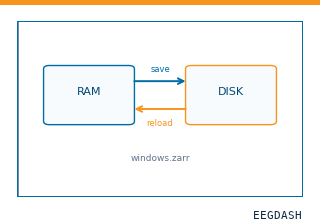 Save and reload prepared dataCache a windowed dataset to disk and reattach it without recompute.
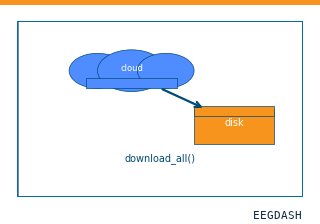 Download a dataset locallyPrefetch BIDS files to a local cache and validate the layout.
Swap any load_dataset(...) call for ds004796 to reproduce the tutorial on this dataset.
Citation
Dzianok Patrycja, Kublik Ewa (2024). A Polish Electroencephalography, Alzheimer’s Risk-genes, Lifestyle and Neuroimaging (PEARL-Neuro) Database. 10.18112/openneuro.ds004796.v1.1.0
Provenance
¹Contributed to openneuro in BIDS format.
²Curated & ingested by the EEGDash catalog; see CITATION.cff for canonical reference.
³Persistent identifier: 10.18112/openneuro.ds004796.v1.1.0.
See Also#
eegdash.dataset.EEGDashDataseteegdash.dataset